



Copyright © 2026 NOVABEYOND LIMITED (company number 2833487). All rights reserved.
Address: UNIT 616 6/F KAM TEEM INDUSTRIAL BUILDING 135 CONNAUGHT ROAD WEST SAI WAN HONGKONG.
Most media planning conversations in 2025 follow a familiar script. You open with Meta for reach and retargeting, layer in Google for intent capture, maybe test TikTok if the demographic fits. The logic is sound. The measurement is clean.
But there's a structural problem hiding inside this playbook: everyone is running it.
When the same three platforms capture the same share of every brand's budget, the result is predictable. CPMs rise, auctions get competitive, and marginal ROAS deteriorates. You're not underperforming. You're just fighting in the most crowded rooms on the internet.
The question worth asking is: where aren't you?
What Native Traffic Actually Means
Native advertising places your message inside the natural flow of content consumption, not interrupting it. Instead of forcing an ad between pieces of content a user is actively trying to get through, native formats appear where attention already exists: after an article has been read, within a content feed, alongside editorial a user chose to engage with.
This is a fundamentally different quality of attention than banner display or interruptive video. The user is not in avoidance mode. They have just finished consuming something, and they are open to what comes next. That receptivity is what native traffic is built on.
The open web is where most of this happens. Roughly two-thirds of time spent online occurs outside of Google, Meta, and TikTok. Users are reading news, browsing editorial content, following interest-based publications, and consuming long-form articles across thousands of publisher properties that never appear in a standard media plan. Native advertising is the most efficient methodology for reaching those users in context, at scale.
What Taboola Is
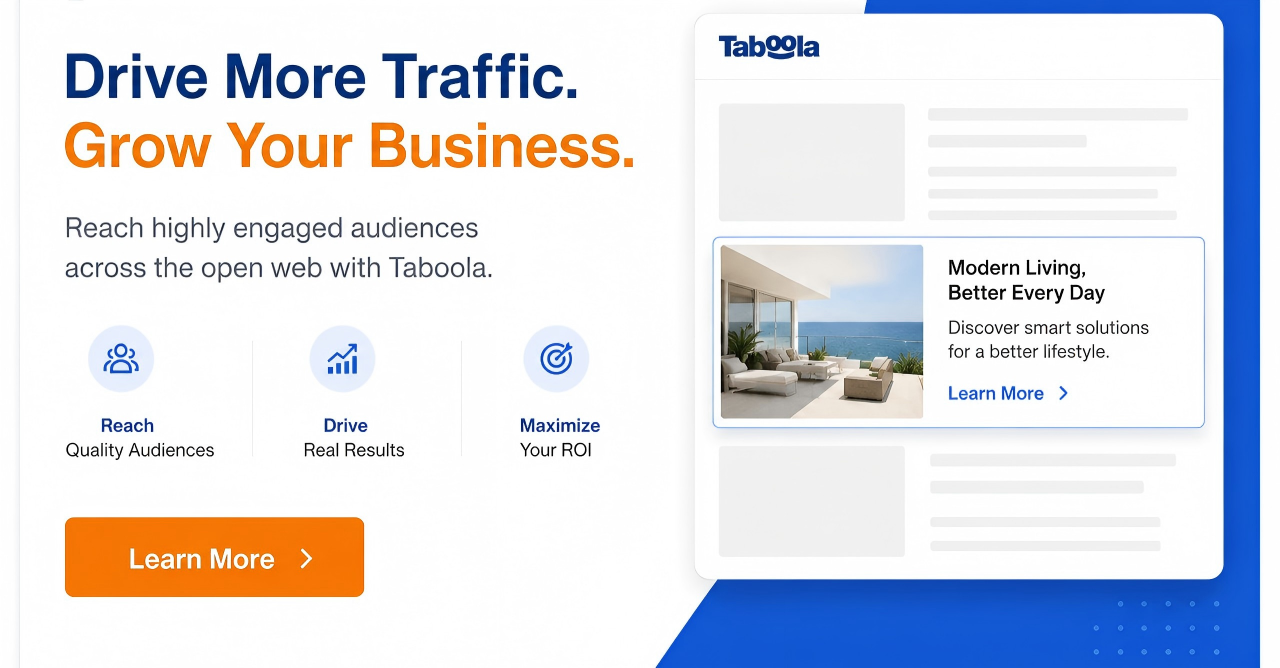
Taboola is the world's largest native advertising platform, and the infrastructure layer that powers content recommendation modules across thousands of publisher sites globally. If you've ever finished reading an article on NBC News, USA Today, Business Insider, or the BBC and seen a row of "Recommended For You" content cards below it, you've encountered Taboola's network.
What makes its position in the ecosystem genuinely interesting is that it doesn't sit exclusively in the long tail, and it doesn't sit exclusively at the premium tier. It spans both. Taboola has direct partnerships with tier-one publishers across English-language and European media, while its network extends across thousands of mid-tier and long-tail properties that would otherwise be inaccessible at scale.
For advertisers, this means unified access to the open web across the full publisher spectrum, with one campaign interface, one set of brand safety controls, and one performance dashboard. You're not choosing between premium editorial reach and long-tail scale. You're accessing both, with controls that let you manage the tradeoffs.
By the numbers, Taboola's network includes:
• 9,000+ publisher partners across global markets
• 600 million+ daily active users
• 30 billion+ content recommendations served each day
That is not a niche channel. That is open-web-scale infrastructure.
How the Platform Works
Taboola ads appear as native content recommendation cards: a thumbnail image, a headline, and a brand name, embedded within or below editorial content in a module that matches the publisher's page design.
The format is non-interruptive by design. Users encounter Taboola units after engaging with content, not forced between pieces of it. That changes the quality of the attention you're buying.
Performance on the platform is acutely sensitive to headline copy, which makes creative testing logic closer to search ad writing than to social production. Destination flexibility is also broad: Taboola can drive users to landing pages, editorial articles, lead forms, or product pages, accommodating a wide range of conversion objectives.
On the targeting side, the platform layers contextual signals (matching ads to the content being consumed), behavioral and interest-based audience segments, first-party data integration, and SmartBid machine learning optimization that shifts spend toward what converts across the full network.
Why This Matters Now
Three converging dynamics make the native traffic argument stronger in 2025 than it was even two years ago.
Walled garden saturation is real and measurable. Meta CPMs in Western markets have climbed steadily. Google search inventory is increasingly competitive. The incremental cost of reaching new users through existing channels keeps rising. Taboola's CPCs remain structurally lower, because the inventory pool is larger and advertiser competition is comparatively thin.
Contextual targeting is having a renaissance. As third-party cookies deprecate and signal loss compounds across social platforms, contextual relevance is re-emerging as a durable methodology. Taboola's publisher-first infrastructure is natively built for this. Context is the product, not a workaround.
User attention is fragmenting further, not consolidating. Independent media, newsletters, niche content sites: the breadth of content consumption is growing. Native advertising is the most efficient infrastructure for following that attention wherever it goes.
Where Taboola Fits in Your Funnel
Taboola performs across funnel stages, but the mechanics look different at each level:
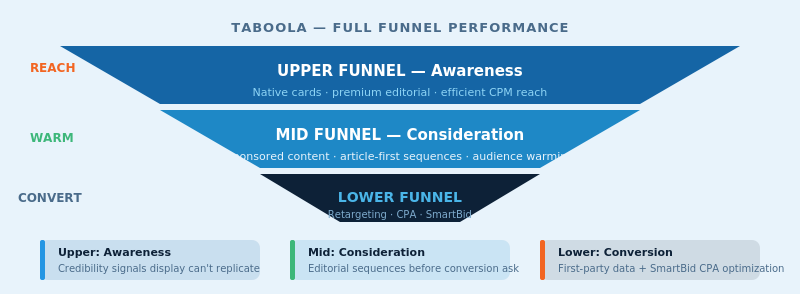
• Upper funnel / awareness: Native card formats at scale, placed within premium editorial contexts, drive efficient reach with credibility signals that display inventory can't replicate.
• Mid funnel / consideration: Sponsored content and article-first creative sequences work well here, driving users to editorial landing pages before conversion asks, warming audiences who aren't yet in a purchasing mindset.
• Lower funnel / retargeting and conversion: With first-party audience integration and SmartBid optimization, Taboola can run performance-oriented campaigns with measurable CPA outcomes, though this works best when brand familiarity is already established upstream.
The strongest Taboola programs tend to treat the platform as a full-funnel complement to social and search, not a like-for-like replacement. It reaches different users, in different contexts, at different moments and that differentiation is the point.
Where Novabeyond Fits
Novabeyond works with brands entering or scaling on Taboola, covering end-to-end strategy and execution: account structure, creative frameworks, publisher targeting strategy, and ongoing performance optimization.
If your media mix is concentrated on Meta and Google and you are looking for a channel that extends your reach into native and open-web inventory, this is where the conversation starts.
Get in touch with the Novabeyond team to explore what a Taboola program could look like for your brand.
more posts
The Emerging Media Ecosystem: The Next Best Engine for UA Incremental Growth
September. 16 2026
LEARN MORE

MediaGo, Taboola, and Outbrain: How Native Ad Platforms Differ for E-commerce Brands
June. 22 2026
LEARN MORE
BIGO Ads vs Kwai Ads: How Geography and Category Shape Performance in Short-Video Ecosystems
June. 16 2026
LEARN MORE
BIGO Ads Keywords & Targeting Strategy (2026 Guide for High ROI Campaigns)
May. 15 2026
LEARN MORE