





UNIT 616 6/F KAM TEEM INDUSTRIAL BUILDING 135 CONNAUGHT ROAD WEST SAI WAN HONGKONG.
Copyright © 2026 NOVABEYOND LIMITED (company number 2833487). All rights reserved.
For many performance marketers, Connected TV (CTV) still sits in the "brand awareness" bucket.
It's often viewed as a channel reserved for large enterprises with massive budgets, difficult attribution models, and long-term branding objectives. As a result, many growth teams continue allocating the majority of their spend to Meta, Google, TikTok, and Apple Search Ads while overlooking CTV entirely.
The problem is that today's CTV ecosystem looks nothing like traditional television advertising.
Programmatic buying, household-level targeting, cross-device measurement, and performance-focused optimization have transformed CTV into one of the fastest-growing channels in digital advertising. Yet many advertisers continue to evaluate it based on outdated assumptions.
Here are five misconceptions that prevent growth teams from fully leveraging CTV as part of a scalable acquisition strategy.
Misconception #1: CTV Is Only for Brand Awareness
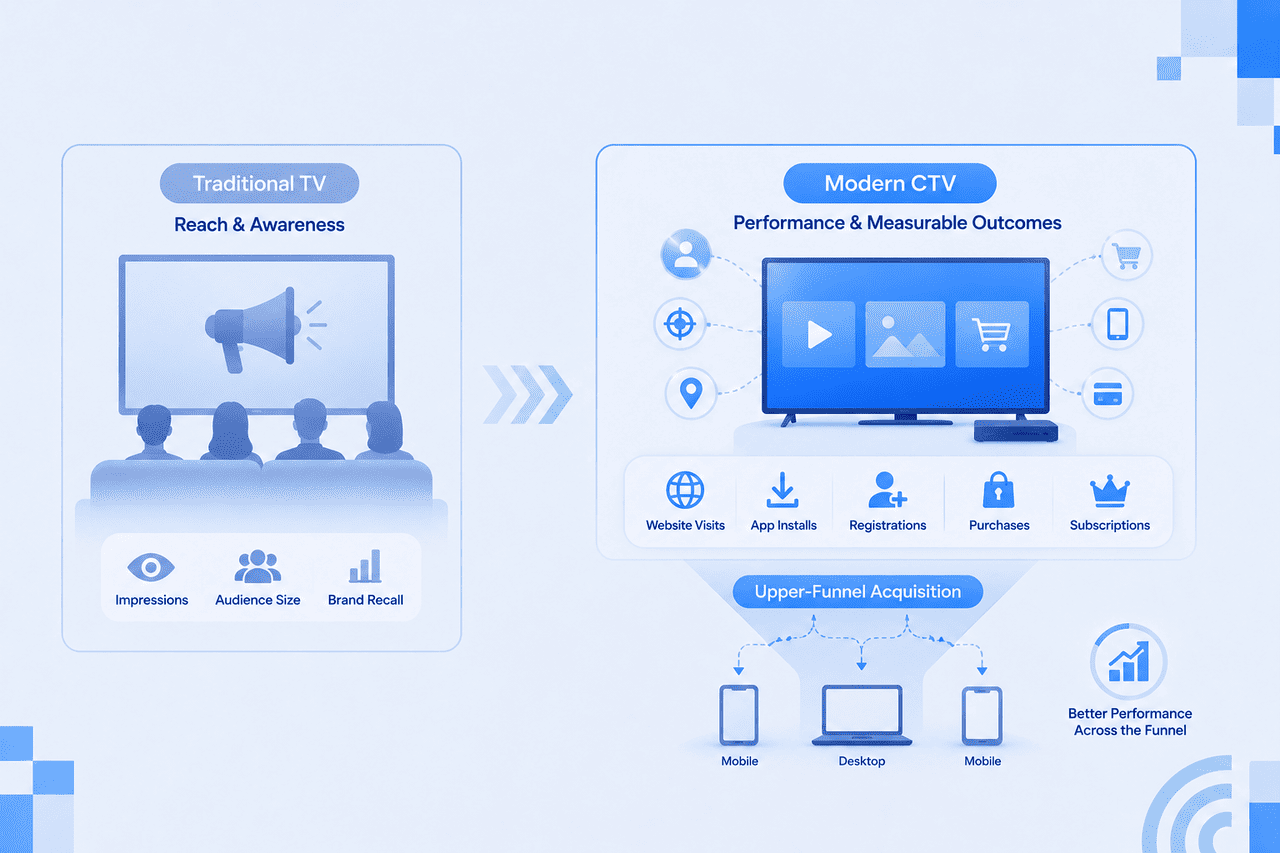
This is perhaps the most common misconception.
Traditional television advertising was largely designed to maximize reach and awareness. Success was measured through impressions, audience size, and brand recall studies.
Modern CTV operates differently.
Today, advertisers can target audiences based on demographics, interests, behavioral signals, geographic locations, and even purchase intent. More importantly, CTV campaigns can be connected to downstream actions such as website visits, app installs, registrations, purchases, and subscription events.
Many mobile app advertisers now use CTV as an upper-funnel acquisition channel that feeds performance campaigns across mobile and desktop environments. Rather than replacing performance marketing, CTV often improves it by introducing new users into the conversion journey.
The question is no longer whether CTV drives performance. The question is how effectively advertisers integrate it into their broader growth architecture.
Misconception #2: CTV Is Too Expensive for Performance Marketers
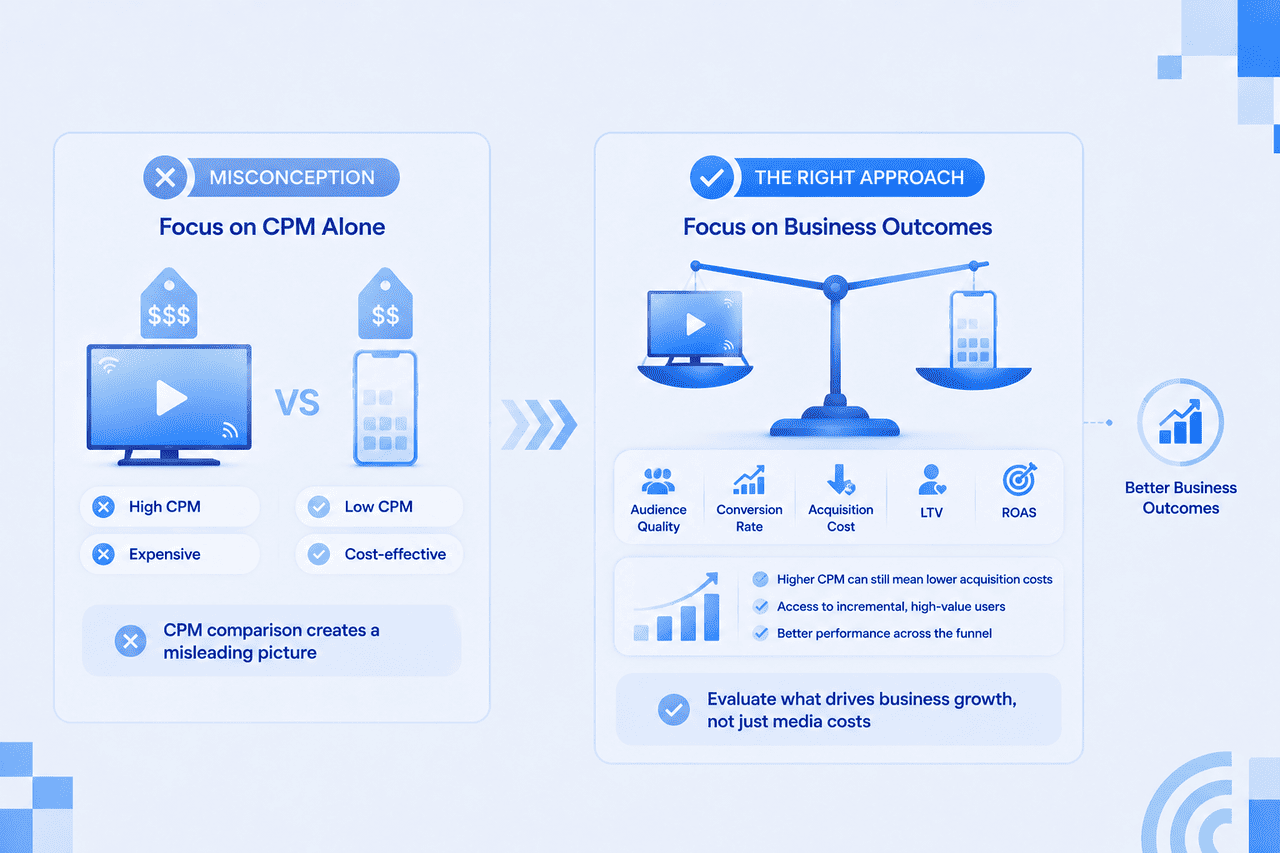
CTV inventory is frequently associated with premium streaming environments and large consumer brands.
While premium inventory can command higher CPMs, evaluating CTV solely through CPM comparisons creates a misleading picture.
Growth teams rarely compare channels based on media costs alone. What matters is the efficiency of acquiring valuable users.
A higher CPM may still produce lower acquisition costs if the audience quality is stronger and conversion rates are higher.
In many markets, increasing competition across Meta and Google has pushed acquisition costs to levels where alternative channels become economically attractive despite higher media pricing. As audience saturation intensifies across mainstream platforms, CTV often provides access to incremental users that are becoming increasingly difficult to reach elsewhere.
The relevant comparison is not CPM versus CPM. It is business outcomes versus business outcomes.
Misconception #3: CTV Cannot Be Measured Properly
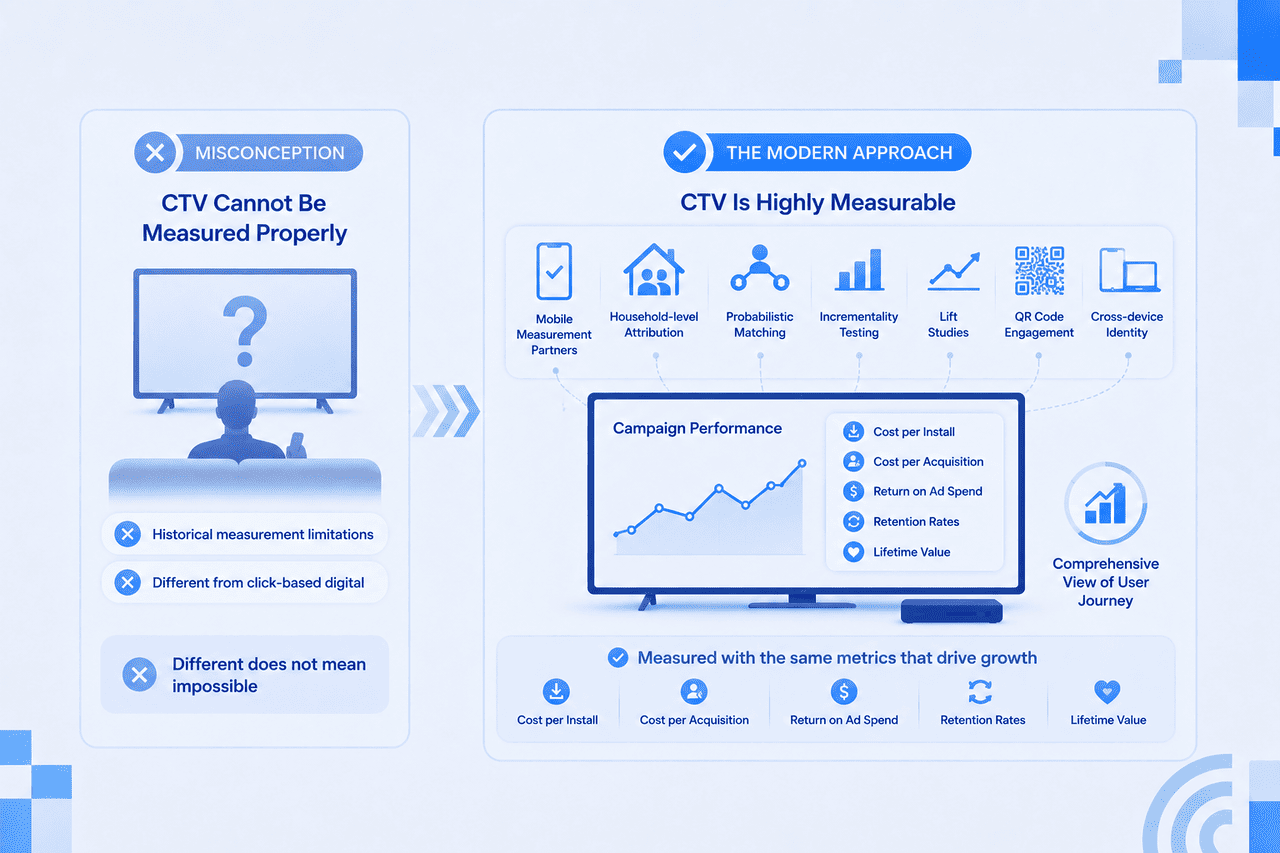
This belief stems from television's historical measurement limitations.
Modern CTV is significantly more measurable than traditional broadcast television.
Advertisers can leverage mobile measurement partners, household-level attribution, probabilistic matching, incrementality testing, lift studies, QR code engagement, and cross-device identity frameworks to understand campaign performance.
Measurement is certainly different from click-based digital advertising, but different does not mean impossible.
In fact, many growth teams now evaluate CTV using the same metrics applied to other acquisition channels, including cost per install, cost per acquisition, return on ad spend, retention rates, and lifetime value.
The organizations gaining the most from CTV are often those willing to move beyond last-click attribution and adopt a more comprehensive view of how users convert across multiple touchpoints.
Misconception #4: CTV Is Only Suitable for Large Brands
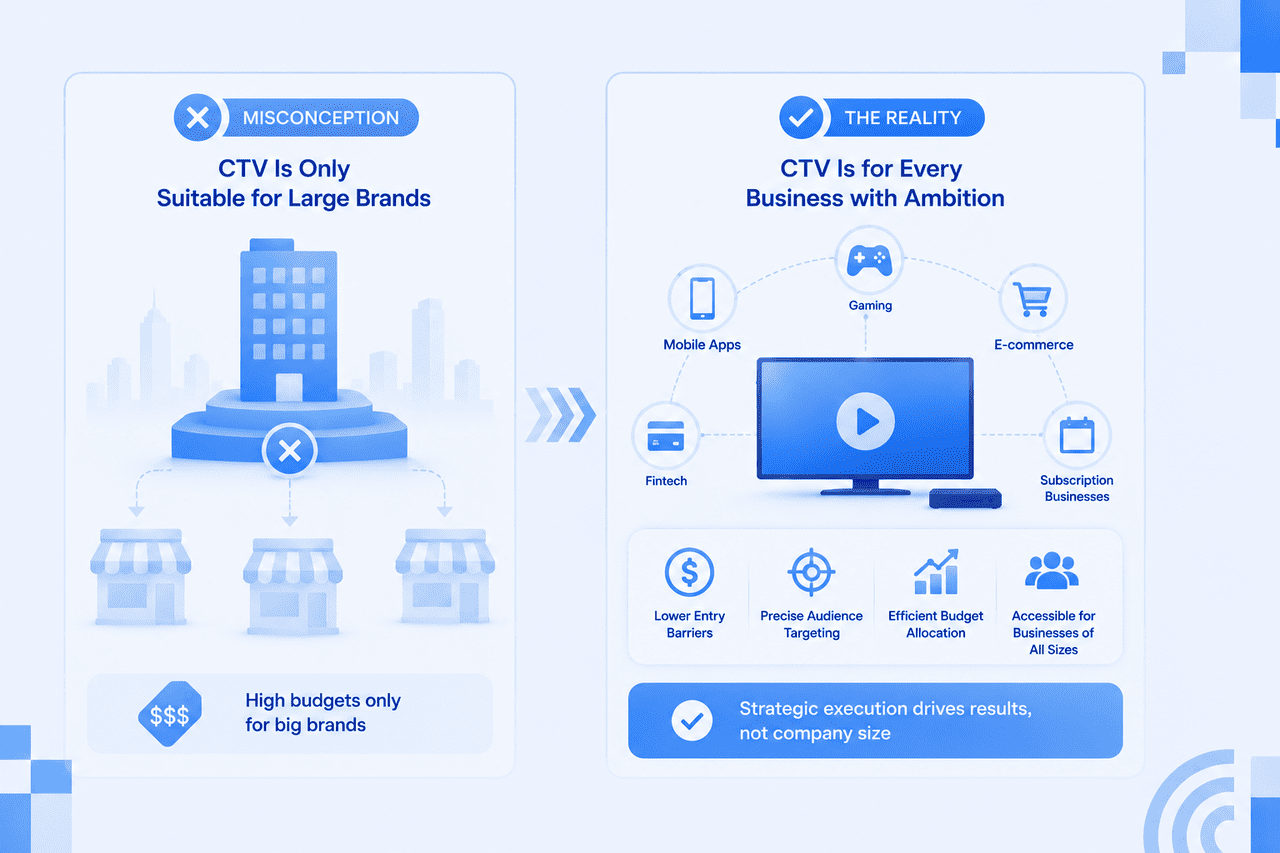
A few years ago, this perception may have been justified.
Today, self-serve buying platforms, programmatic marketplaces, and performance-oriented CTV networks have significantly lowered entry barriers.
Growth-stage companies, mobile apps, fintech platforms, gaming publishers, subscription businesses, and e-commerce brands are increasingly experimenting with CTV campaigns without enterprise-level budgets.
The rise of programmatic buying has made inventory more accessible, while audience targeting capabilities allow advertisers to focus spending on highly relevant user segments rather than broad mass-market exposure.
The reality is that CTV is becoming increasingly democratized.
Success depends less on company size and more on strategic execution.
Misconception #5: CTV Competes With Existing Growth Channels
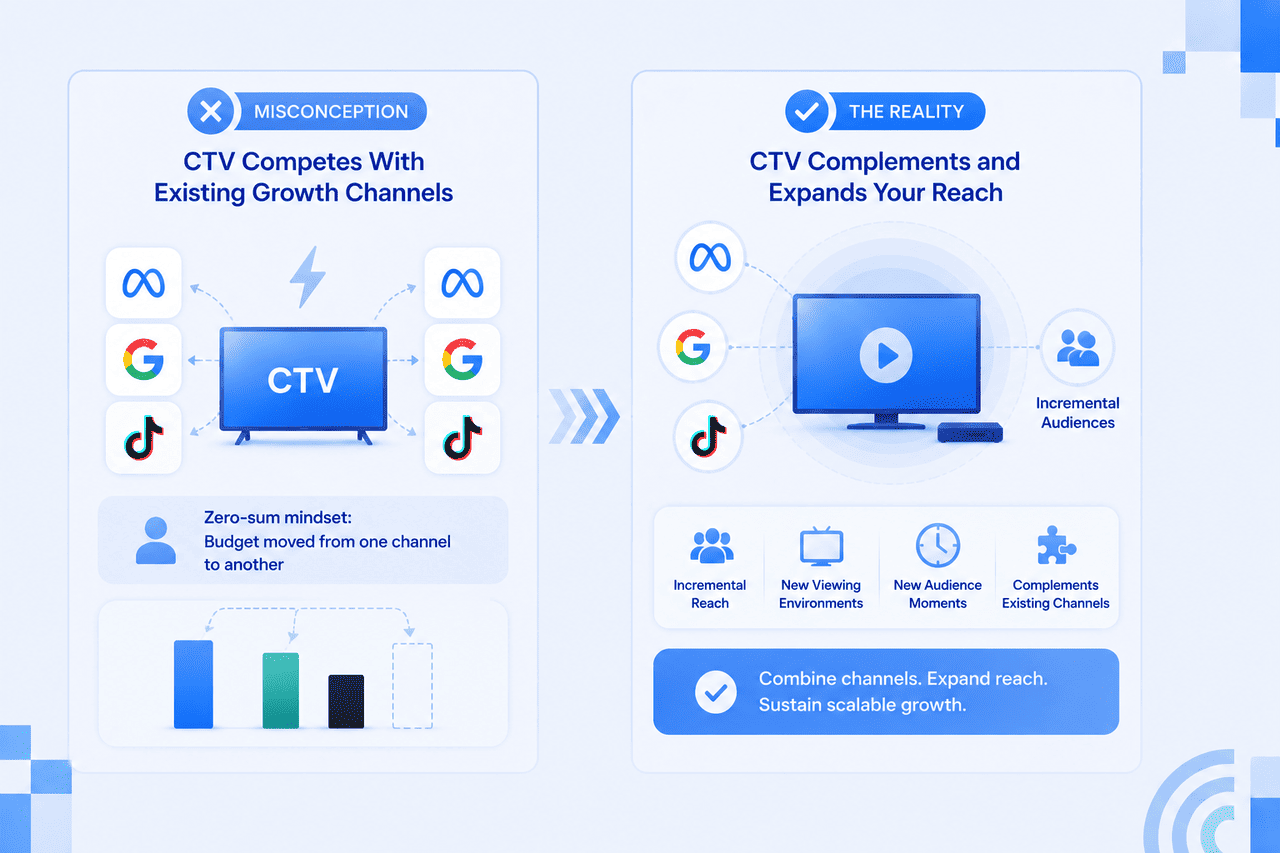
Many advertisers approach channel planning as a zero-sum exercise.
If budget moves into CTV, they assume budget must be removed from Meta, Google, or TikTok.
This mindset overlooks one of CTV's greatest strengths: incrementality.
The purpose of adding CTV is not necessarily to replace existing channels. It is to reach users who may never engage with those channels in the first place.
As audience overlap increases across mainstream advertising ecosystems, incremental reach becomes one of the most valuable assets available to growth teams.
CTV introduces new inventory, new viewing environments, and new audience moments that complement rather than compete with existing acquisition efforts.
The strongest growth strategies increasingly combine mainstream performance channels with emerging media ecosystems, creating a diversified acquisition framework capable of sustaining scale over time.
Looking Beyond Outdated Assumptions
CTV is no longer an experimental channel reserved for branding teams.
It has evolved into a measurable, targetable, and increasingly performance-driven component of modern media strategies.
For growth teams facing rising acquisition costs, audience saturation, and diminishing returns across mainstream platforms, the bigger risk may not be testing CTV. It may be continuing to ignore it.
As the advertising landscape becomes more fragmented, sustainable growth will depend on an organization's ability to diversify beyond traditional acquisition channels. CTV is rapidly becoming one of the most important pieces of that strategy.
more posts
OEM & CTV Advertising: A Cross-Screen Strategy for Brand Growth
October. 29 2026
LEARN MORE


How OEM Advertising Unlocks App Scale in Emerging Markets
October. 09 2026
LEARN MORE
How to Measure CTV ROI in 2026: From Multi-Touch Attribution to Geo-Lift & iROAS
September. 30 2026
LEARN MORE
Why Most Brands Miss the Full Potential of OEM Advertising — How to Drive Smarter App Growth
August. 24 2026
LEARN MORE