





UNIT 616 6/F KAM TEEM INDUSTRIAL BUILDING 135 CONNAUGHT ROAD WEST SAI WAN HONGKONG.
Copyright © 2026 NOVABEYOND LIMITED (company number 2833487). All rights reserved.
Most growth teams build their UA strategy around efficiency. They identify the channels that perform best, allocate budget aggressively, and focus on optimization. This approach is logical. However, it is also how businesses become dangerously exposed to a policy change, algorithm update, or platform decision that arrives without warning and entirely outside their control.
Platform dependency is one of the most underestimated structural risks in mobile user acquisition today. During stable periods, the risk is easy to overlook. When disruption occurs, the consequences can be severe.
What Platform Dependency Actually Costs
The cost of channel concentration is not theoretical. The industry has repeatedly seen examples of businesses facing significant setbacks after major platform changes.
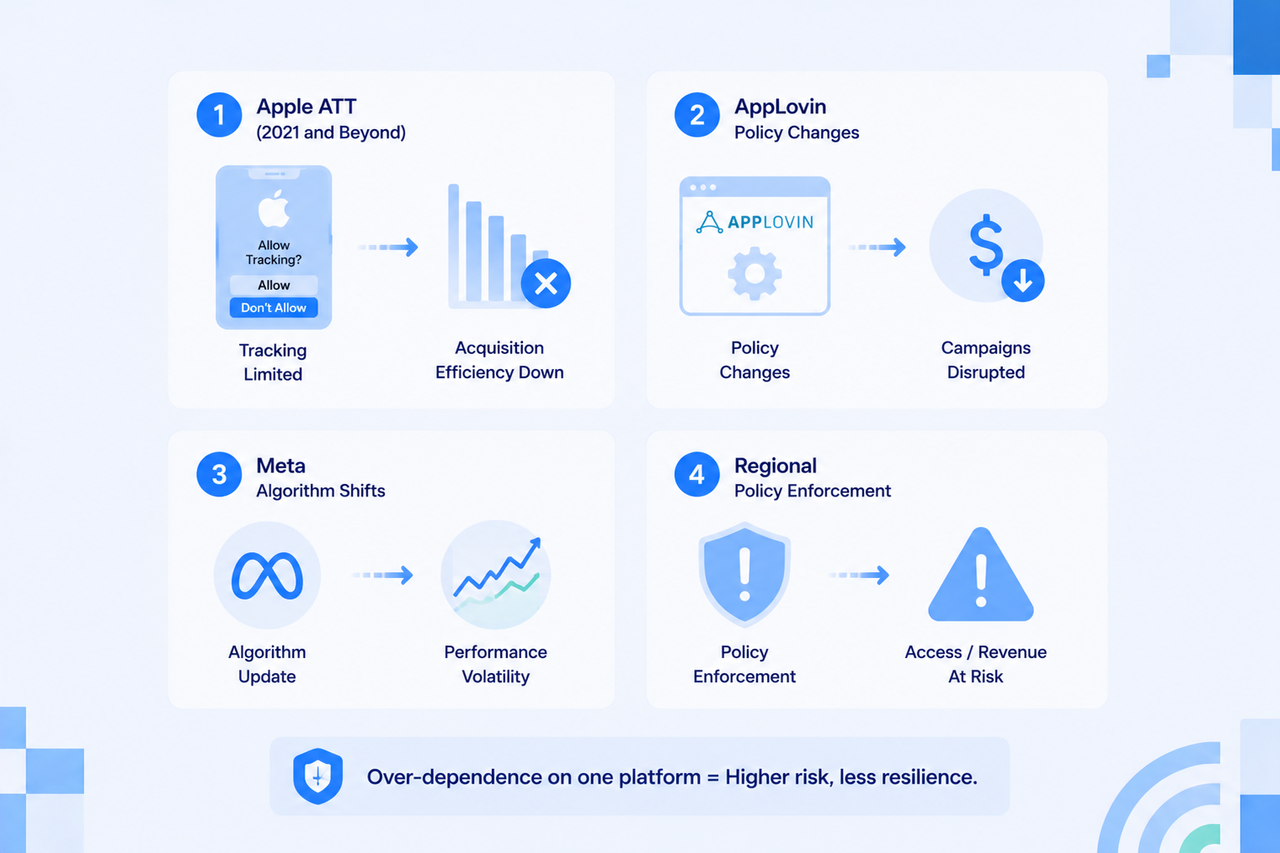
1. Apple ATT (2021 and Beyond)
When Apple introduced App Tracking Transparency, opt-in rates stabilized at roughly 25–30% across many markets. The user-level data that had powered Meta's targeting capabilities was significantly reduced almost overnight.
Apps that relied heavily on iOS social acquisition suddenly saw efficiency decline on their primary growth channel, often without alternative acquisition infrastructure in place. Companies that recovered fastest were typically those that had already established Android-focused OEM campaigns, programmatic alternatives, and strong ASO-driven organic growth channels.
Meanwhile, businesses heavily concentrated on Meta's iOS ecosystem found themselves rebuilding acquisition strategies during an active revenue crisis.
2. Meta Algorithm Shifts
Meta's Andromeda update in late 2025 significantly changed delivery mechanics. Creative performance signals became more influential, while audience targeting behavior evolved in meaningful ways.
Advertisers with limited channel diversification and narrow creative capabilities faced a difficult adjustment period. Without alternative acquisition channels, they had little room to absorb performance volatility while adapting to the new system.
3. Regional Policy Enforcement
Google regularly enforces policy updates across specific app categories. Dating, gaming, and finance publishers have all experienced app listing removals, advertising restrictions, or compliance reviews that created immediate revenue disruption.
Appeal processes can take weeks, leaving businesses heavily dependent on Google with limited short-term recovery options.
4. AppLovin Policy Changes
Over time, AppLovin has introduced adjustments to its ROAS goal policies that altered campaign structures for advertisers with significant budget concentration on the platform.
The disruption was not caused by technical failure. It resulted from platform-level business decisions that directly affected advertiser performance. Companies that had built their growth operations around specific AppLovin campaign mechanics often had to redesign their strategies while campaigns were still running, creating substantial operational and financial costs.
The Five Categories of Platform Risk
Understanding these risk categories helps teams assess their actual level of exposure.
1. Algorithm Risk
Platforms continuously update their delivery systems. Major algorithm changes can alter which creatives perform best, which audiences remain accessible, and which bidding structures generate results.
Teams concentrated on a single platform have little protection when these changes negatively affect performance.
2. Policy Risk
Advertising policies evolve in response to regulation, public scrutiny, competitive pressures, and changing business priorities.
Gaming, finance, health, and dating apps often face the greatest exposure because these verticals experience frequent restrictions related to targeting, creative content, and geographic availability.
3. Attribution Risk
Measurement frameworks continue to evolve through developments such as SKAN updates, Privacy Sandbox initiatives, and broader privacy regulations.
When attribution methodologies change, channel rankings often change as well. Budgets built around previous measurement assumptions can quickly become misaligned.
Without channel diversification, advertisers have fewer ways to validate performance and identify attribution distortions.
4. Market Concentration Risk
As platforms become more dominant, their pricing power grows.
Rising CPMs across mature mainstream channels are a direct reflection of increasing competition and limited alternatives. Advertisers without credible substitute channels have little flexibility when acquisition costs increase.
5. Operational Risk
Even the largest platforms experience outages, delivery interruptions, account suspensions, payment issues, and compliance reviews.
When a majority of installs depend on one or two channels, any operational disruption can have an immediate impact on acquisition volume.
How to Audit Your Exposure
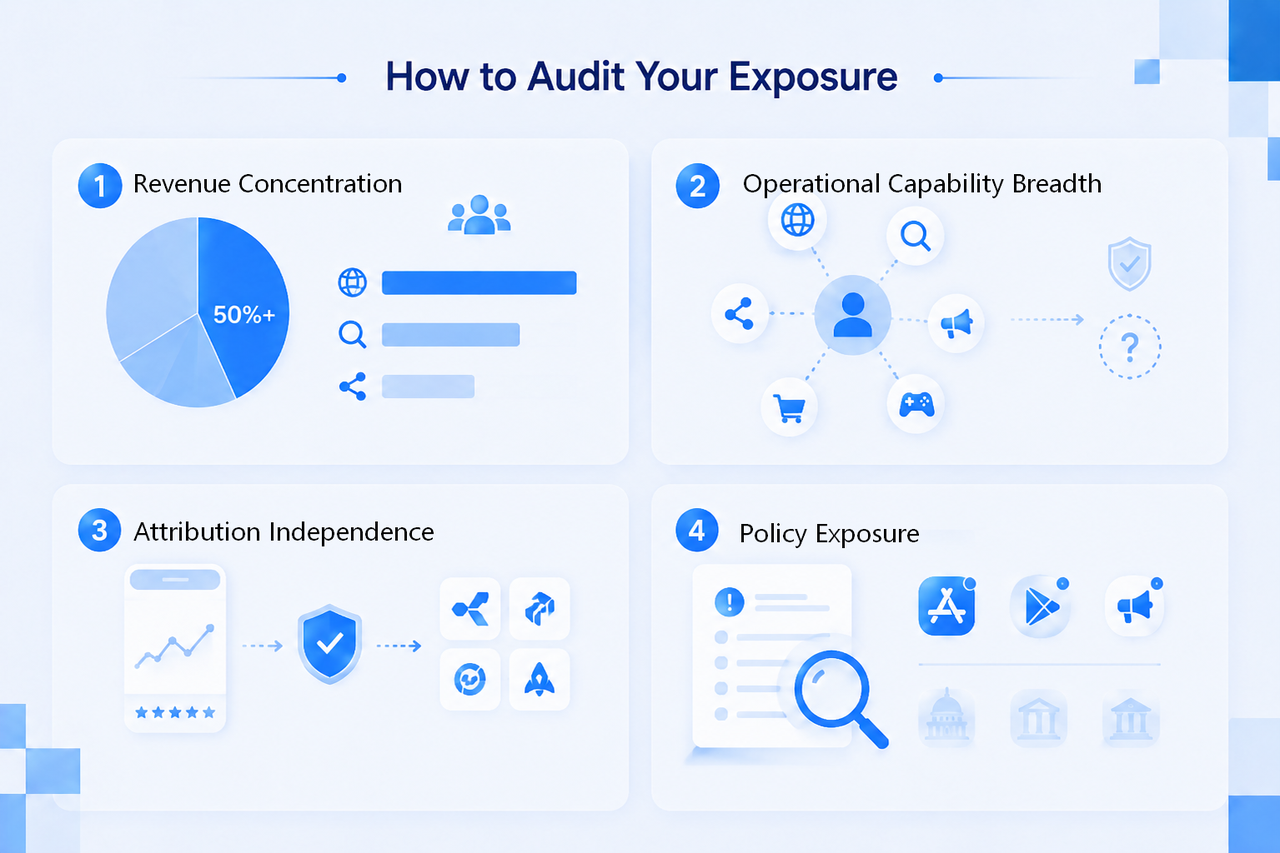
1. Revenue Concentration
What percentage of paid installs comes from your top one, two, or three channels?
If a single channel drives more than 50% of paid acquisition, concentration risk is likely much higher than financial reports currently suggest.
2. Operational Capability Breadth
How many channels does your team actively operate today?
Channels that have never been tested are not realistic contingency plans. Building operational expertise after disruption occurs is often too late.
3. Attribution Independence
Do you use independent MMP solutions such as AppsFlyer, Adjust, or Singular alongside platform reporting?
Teams that rely exclusively on platform-reported data have limited visibility into actual performance and may struggle to detect attribution distortions.
4. Policy Exposure
How frequently do your primary platforms update policies affecting your category?
Businesses operating in regulated or restricted verticals should actively monitor policy developments across all major acquisition channels
Building a Resilient Growth Architecture
Resilience does not require equal investment across every channel. What matters is maintaining enough operational capability across multiple acquisition sources so that no single disruption can severely damage growth.
A practical framework includes three layers:
• Foundational Channels (40–60% of Budget)
Maintain two to three proven platforms with stable infrastructure and scalable performance. These channels remain the primary growth engine, while their concentration risk is balanced by the layers below.
• Emerging & Programmatic Channels (25–35% of Budget)
This layer focuses on scalable, validated alternative media and high-liquidity programmatic buying to drive incremental reach alongside core channels.
Core Inventory: Fast-growing social/content platforms, regional media ecosystems, and multi-exchange programmatic DSPs (display, native, and in-app video).
Objective: Deliver consistent incremental scale, mitigate over-reliance on primary walled gardens, and maintain stable conversion efficiency.
• Experimental & Hardware/Emerging Channels (10–15% of Budget)
This layer serves as an innovation sandbox, capturing non-standard device environments and emerging ad mechanics.
Core Inventory: OEM app stores and pre-installs, Connected TV (CTV/OTT), programmatic audio, and early-stage experimental ad formats.
Objective: Test cross-device incrementality, build agile operational playbooks, and secure rapid budget reallocation capabilities before major market shifts occur.
The Business Case for Proactive Diversification
Diversification is not free. Managing additional channels creates operational complexity, and alternative channels may not match the efficiency of a top-performing primary platform during ideal conditions.
However, the correct comparison is not diversification versus efficiency.
The real comparison is the cost of diversification versus the expected cost of disruption risk.
That calculation should consider both the likelihood of disruption and the financial consequences if it occurs.
For businesses that would suffer significant financial damage from a 60-day disruption in their primary acquisition channels, investing in alternative channel infrastructure is not optional. It is a form of risk management with a measurable business rationale.
The companies that navigated ATT, AppLovin policy changes, and major Meta algorithm shifts most effectively had already established diversified acquisition infrastructure. They were not predicting specific events. They simply understood that dependency on any single platform creates exposure to risks that cannot be predicted in advance.
Reducing platform dependency is more than a growth strategy. It is a business continuity strategy.
more posts
Beyond the Duopoly: The 2027 Guide to Alternative Traffic Sources and Emerging Media Solutions
October. 26 2026
LEARN MORE

2027 Mobile Marketing Trends: 4-Pillar Strategy for Global App Growth
October. 22 2026
LEARN MORE
Diversified Acquisition Strategies for Global Advertisers: A Framework for Evaluating New Channels
September. 11 2026
LEARN MORE
How Incremental Growth Is Changing Performance Marketing
August. 25 2026
LEARN MORE