





Copyright © 2026 NOVABEYOND LIMITED (company number 2833487). All rights reserved.
Address: UNIT 616 6/F KAM TEEM INDUSTRIAL BUILDING 135 CONNAUGHT ROAD WEST SAI WAN HONGKONG.
Introduction
For years, advertising has treated programmatic and direct inventory as opposing forces. Programmatic offered scale and efficiency, while direct buying offered premium placements and greater control. But this binary view is becoming increasingly limiting for advertisers that need both scalable acquisition and stronger customer economics.
Programmatic can reach massive audiences, test inventory quickly, and optimize campaigns in real time. Yet many brands eventually encounter the same problem: acquisition volume continues to grow while customer quality starts to flatten. CPA may remain within target and conversion rates may look healthy, but retention, repeat purchases, subscription renewals, and downstream revenue fail to improve at the same pace.
The problem is often not audience targeting alone. It is the quality and economics of the inventory behind the acquisition strategy.
Direct inventory partnerships address a different part of the equation. They give advertisers greater control over premium environments, publisher relationships, audience context, and supply quality. Instead of treating every impression as interchangeable, brands can build stronger connections with the environments that consistently produce valuable customers.
The answer is not to replace programmatic with direct buying. The opportunity is to make them work together. Programmatic can identify where high-value audiences and inventory patterns emerge, while direct partnerships can provide more controlled access to the environments that produce stronger customer outcomes.
This creates a continuous growth loop: programmatic scale → performance signals → LTV analysis → direct inventory → higher-quality acquisition → stronger LTV → smarter programmatic optimization.
Quick Answer
Programmatic and direct inventory should not be treated as competing buying models. Programmatic provides scale, audience discovery, rapid testing, and real-time optimization. Direct inventory partnerships provide greater control over premium placements, publisher environments, audience context, and supply quality. By using programmatic data to identify high-value audiences and inventory, then securing selected environments through direct partnerships, advertisers can improve customer quality instead of optimizing only for cheap conversions. The result is a more balanced media strategy that connects inventory quality with retention, revenue, and lifetime customer value.
Why Programmatic Scale Alone Can Hit an LTV Ceiling?
Programmatic advertising has transformed media buying by making inventory accessible at scale. A buyer can reach multiple publishers, devices, markets, and audience segments through a single buying workflow. Campaigns can launch quickly, budgets can move between opportunities in real time, and performance signals can continuously inform optimization.
That flexibility makes programmatic an essential growth engine. However, scale also creates a measurement challenge. When campaigns optimize primarily around immediate outcomes such as CPM, CTR, or CPA, algorithms can favor impressions that generate inexpensive conversions without necessarily generating valuable customers.
This creates a gap between conversion efficiency and customer economics.
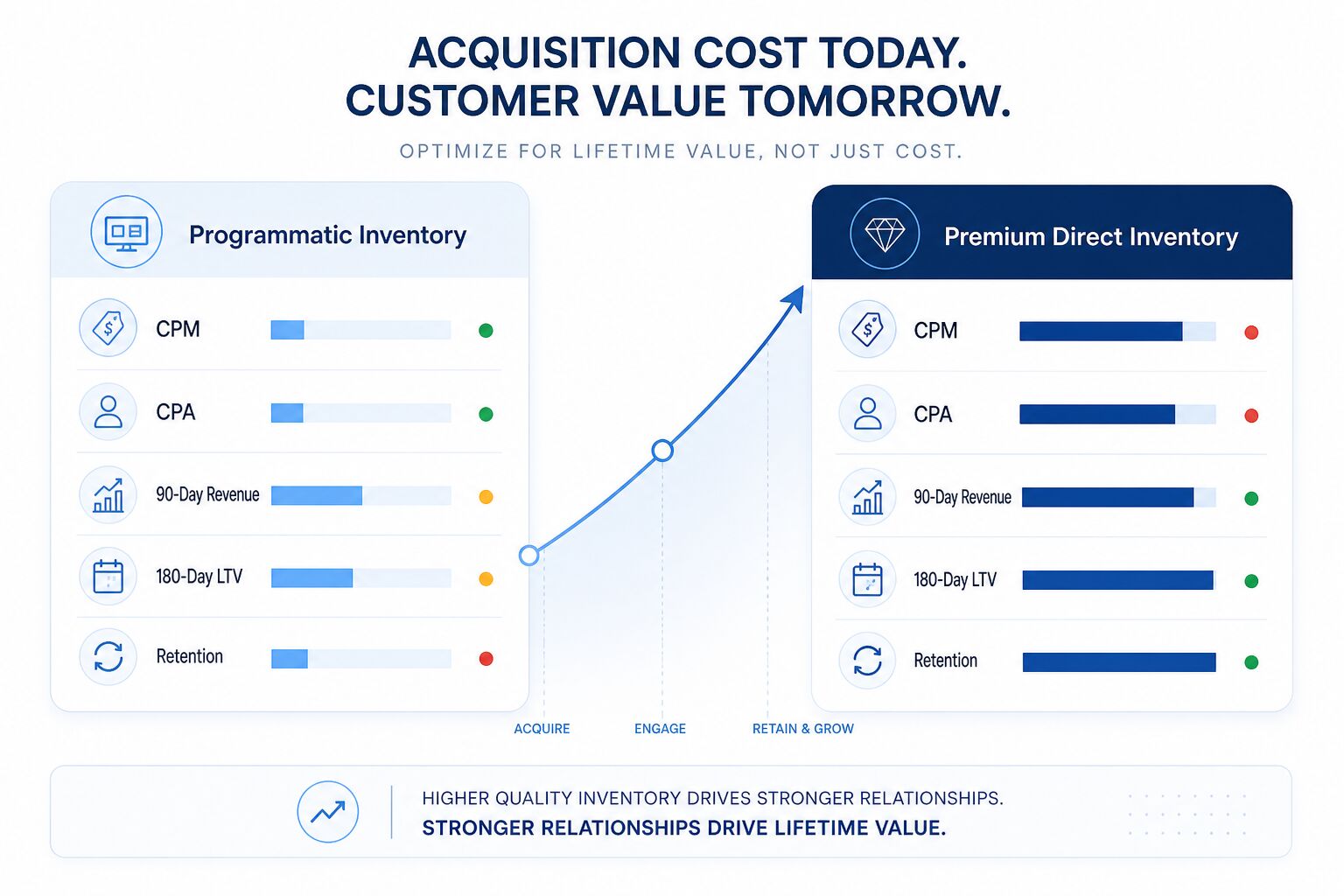
A $10 CPA is not automatically better than a $20 CPA. If the first cohort generates $25 in long-term revenue while the second generates $80, the more expensive acquisition may be dramatically more profitable. For growth teams, inventory should ultimately be evaluated according to the value of the customers it produces, not simply the cost of the first conversion.
For a broader explanation of how programmatic buying works, including RTB, PMP, Preferred Deals, and Programmatic Guaranteed, see Novabeyond's Programmatic Advertising: A Practical Guide for Marketers.
The Math of Wastage
The economics become even more important when advertisers look beyond the media price itself. Industry studies have highlighted substantial supply-chain and quality differences across programmatic buying paths. Some industry estimates place intermediary-related costs in the 30% to 50% range in certain programmatic supply chains, while the reference material also cites an approximately 18% IVT rate for open CTV and display environments. These figures should be treated as directional benchmarks rather than universal rates for every programmatic campaign.
More recent ANA research provides another useful way to view the problem. Its Q1 2026 Programmatic Transparency Benchmark found that higher-performing advertisers converted 54.0% of programmatic spend into qualified impressions, compared with 32.1% among lower-performing advertisers. ANA attributes the widening gap to factors including measurement quality, viewability, and more concentrated supply management.
The lesson is more important than any single percentage: quality management can materially change the value of programmatic spend.
If part of the media budget goes toward intermediary costs, low-quality supply, or non-human traffic, advertisers are not simply paying a higher CPM. They are reducing the amount of spend that can contribute to real customer acquisition.
This is why supply quality belongs in the LTV conversation.
How Buying Models Change the Risk Profile
Different buying paths create different levels of control, transparency, and potential supply-chain friction.
| Buying Model | Fraud / IVT Risk | Potential Ad Tech Tax | Primary Value |
| Open RTB | Higher | Highest potential friction | Maximum scale and instant reach |
| PMP | Moderate | Medium potential friction | Curated publisher access |
| Programmatic Guaranteed | Lower | Reduced intermediary exposure | Reserved premium inventory with automation |
| Direct Partnership | Lower potential risk | Lowest intermediary exposure | Premium access and greater control |
These categories should not be interpreted as fixed industry-wide risk scores. The actual economics depend on the supply path, verification, publisher quality, technology stack, and commercial structure.
The goal is not to eliminate programmatic. Open programmatic remains valuable for discovery, audience expansion, testing, and retargeting. The objective is to use the right buying path for the right inventory and the right stage of the customer journey.
Look Beyond CPA: Compare Customer Value
Consider two inventory sources:
| Metric | Inventory A | Inventory B |
| CPM | $4.00 | $7.00 |
| CTR | 1.20% | 0.90% |
| Conversion Rate | 4.00% | 3.50% |
| Initial CPA | $8.33 | $22.22 |
| 90-Day Revenue/User | $35 | $75 |
| 180-Day LTV | $48 | $105 |
Inventory A looks better if the campaign ends at the first conversion. Inventory B becomes significantly more attractive when the business measures what happens after conversion.
This is the central reason direct inventory can matter to growth teams. A premium placement with a higher CPM may create better economics if it consistently produces customers with stronger retention, purchase frequency, subscription renewal, or average revenue.
The right question is therefore not simply, “Where can we acquire customers most cheaply?” It is “Which inventory environments produce customers worth acquiring at scale?”
From Programmatic Discovery to Direct Inventory Advantage
Programmatic Is the Discovery Engine
Programmatic should not be viewed simply as an execution channel. It can also function as an intelligence layer for the broader media strategy.
As campaigns scale, advertisers accumulate signals across audience segments, publishers and apps, content environments, device types, geographic markets, creative formats, conversion behavior, and post-conversion revenue. When these signals are connected with retention and LTV data, they can reveal which environments are associated with high-value customers.
That insight creates an opportunity to move upstream. Instead of repeatedly competing for the same impressions through open auctions, advertisers can identify publishers or inventory owners that align with their strongest customer segments and explore direct relationships.
This matters because premium inventory is often scarce. BCG's research into live CTV found that publishers sell only around 35% of live-event CTV inventory programmatically, showing that direct buying remains an important route for premium live environments. At the same time, BCG found that 82% of buyers expected to increase their programmatic live CTV investment over the following 12 months.
The market is therefore moving toward coexistence, not replacement.
Premium environments can remain important direct opportunities while programmatic continues to expand its role in CTV and other digital channels.
What Direct Inventory Adds
Direct relationships can provide clearer control over where an ad appears and how the placement fits within the user experience. For brands where context matters, that control can influence attention, trust, and conversion quality.
They can also provide stronger access to publisher-level audience context. Publishers and platforms may possess valuable first-party signals based on content engagement, subscriptions, purchase behavior, or other authenticated interactions. When those signals can be activated in privacy-compliant ways, advertisers gain a stronger understanding of audience intent.
Premium and differentiated supply is another important factor. Homepage sponsorships, premium video placements, high-impact formats, exclusive content environments, and other differentiated inventory may require a closer relationship with the inventory owner. Direct partnerships can make these opportunities more accessible while creating greater visibility into the supply path.
This is particularly relevant in CTV. IAB's 2025 Digital Video Ad Spend & Strategy Report found that buyers expected 47% of CTV inventory to be biddable in 2025, up from 34% in 2024. The growth of biddable CTV does not eliminate premium direct opportunities. Instead, it shows how advertisers are increasingly using both automated and negotiated buying methods to access different types of video inventory.
For brands, the implication is practical: do not ask whether CTV should be bought programmatically or directly. Ask which inventory, audience, and objective belongs in each buying path.
For more context on how CTV is becoming a scalable programmatic growth channel, see Novabeyond's Programmatic CTV Advertising: The Next Breakout Moment in Digital Media Buying.
Programmatic Direct: The Bridge Between the Two
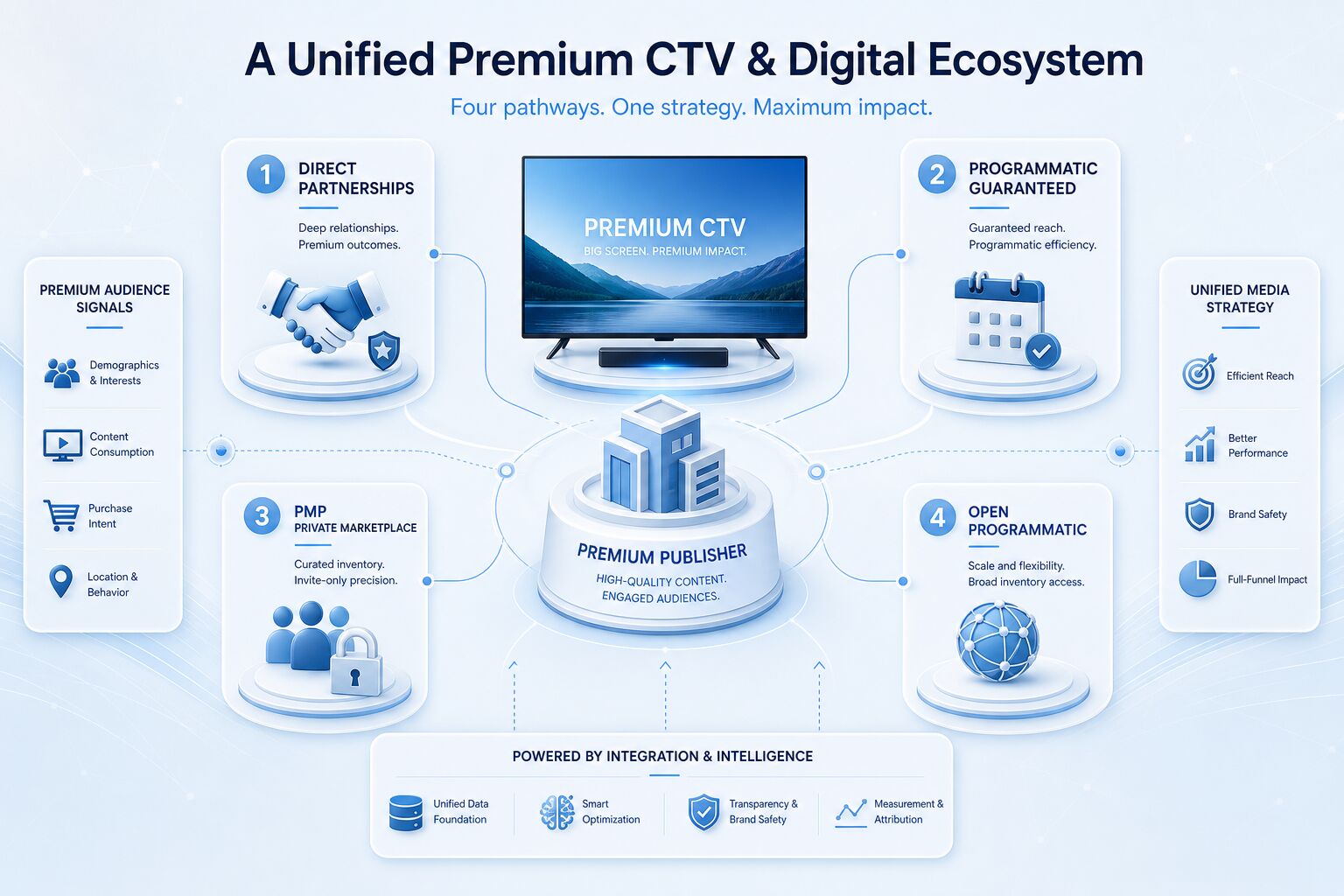
There is also a middle ground between traditional direct buying and open auction buying. Programmatic Guaranteed and Preferred Deals can combine negotiated access with automated execution.
For advertisers, this can provide more predictable access to premium inventory while retaining automated campaign execution, audience targeting, reporting, and optimization. This makes programmatic direct particularly useful when brands want premium access without returning to a fully manual media-buying process.
The broader CTV market reinforces this direction. IAB reports that buyers increasingly expect biddable inventory while also demanding greater control over inventory and business outcomes. In other words, automation and premium access are not mutually exclusive.
Building the LTV Flywheel
Step 1: Optimize Programmatic for Downstream Value
Start by connecting media performance to business outcomes. Do not stop measurement at the first conversion. Depending on the business model, advertisers should connect media exposure with 30-, 90-, and 180-day revenue, retention, repeat purchase rate, subscription renewal, average revenue per customer, customer payback period, contribution margin, and LTV.
This allows media teams to distinguish between inventory that produces cheap conversions and inventory that produces valuable customers. It also creates a more useful benchmark for deciding whether a premium direct placement is genuinely incremental or simply more expensive.
For app-focused advertisers, this principle also applies to re-engagement. Novabeyond's App Retargeting Strategy explains how behavior-based programmatic retargeting can support reactivation, repeat purchase, subscription recovery, and longer user lifecycles.
Step 2: Build an Inventory Quality Profile
Once downstream data is available, compare LTV by inventory source and look for recurring patterns. A particular content category may produce stronger retention. A specific app environment may generate higher-value customers. A publisher's video placements may consistently generate stronger post-conversion engagement.
These patterns form an inventory quality profile. The profile gives growth teams a practical way to decide which environments deserve deeper investigation and which sources should remain primarily in the scalable programmatic layer.
The objective is not to create a perfect score for every impression. It is to identify repeatable signals that can guide better media allocation.
Step 3: Turn High-Value Signals Into Direct Opportunities
The next step is to identify publishers, platforms, or inventory owners that match the highest-value signals. The evaluation should focus on audience quality, contextual alignment, historical performance, available scale, inventory differentiation, and measurement capabilities.
This prevents direct buying from becoming a simple premium-media exercise. The objective is to find premium inventory with a measurable business reason to exist in the media plan.
First-party data can strengthen this process. As third-party identifiers become less reliable, advertisers and media owners increasingly need privacy-safe signals that provide meaningful context without compromising user trust. Novabeyond's 2026 mobile marketing analysis also highlights the growing role of first-party data in performance marketing and its connection to stronger audience relevance.
Step 4: Use Direct Inventory as a Quality Layer
Once a partnership is established, direct inventory should complement rather than replace programmatic. Direct inventory can focus on premium acquisition environments, high-impact placements, high-attention formats, and strategically important audiences. Programmatic can continue to handle scalable audience expansion, testing, retargeting, and broader funnel coverage.
The two sides should share performance and LTV signals. This creates a feedback loop in which programmatic identifies opportunities, LTV analysis determines their value, direct partnerships secure stronger environments, and the resulting performance data improves future optimization.
Beyond clicks and CPAs, attention is becoming an increasingly useful layer of advertising measurement. IAB and MRC's attention measurement guidelines outline how factors such as placement, environment, time-in-view, scroll depth, media plays, and interactions can contribute to attention measurement. Importantly, the guidelines also make clear that attention should complement, rather than replace, business outcome measurement.
That distinction matters for LTV-focused advertisers. Direct partnerships can help secure environments where attention is more intentional and measurable, but attention should ultimately be connected with engagement, conversion quality, retention, and revenue.
The resulting logic is straightforward:
More meaningful exposure → stronger engagement → better conversion quality → stronger retention → higher LTV.
Step 5: Measure Incremental Customer Value
Finally, evaluate direct partnerships against the existing programmatic baseline. The objective is not to make direct inventory cheaper. It is to make the total customer economics better.
| KPI | Programmatic Baseline | Direct Partnership Objective |
| CPM | Baseline | Higher if justified by quality |
| CPA | Baseline | Within profitable range |
| 90-Day LTV | Baseline | Higher |
| 180-Day LTV | Baseline | Material improvement |
| Retention | Baseline | Higher |
| LTV | Baseline | Higher |
| Incremental Revenue | Baseline | Positive |
| Supply Transparency | Varies | Stronger visibility |
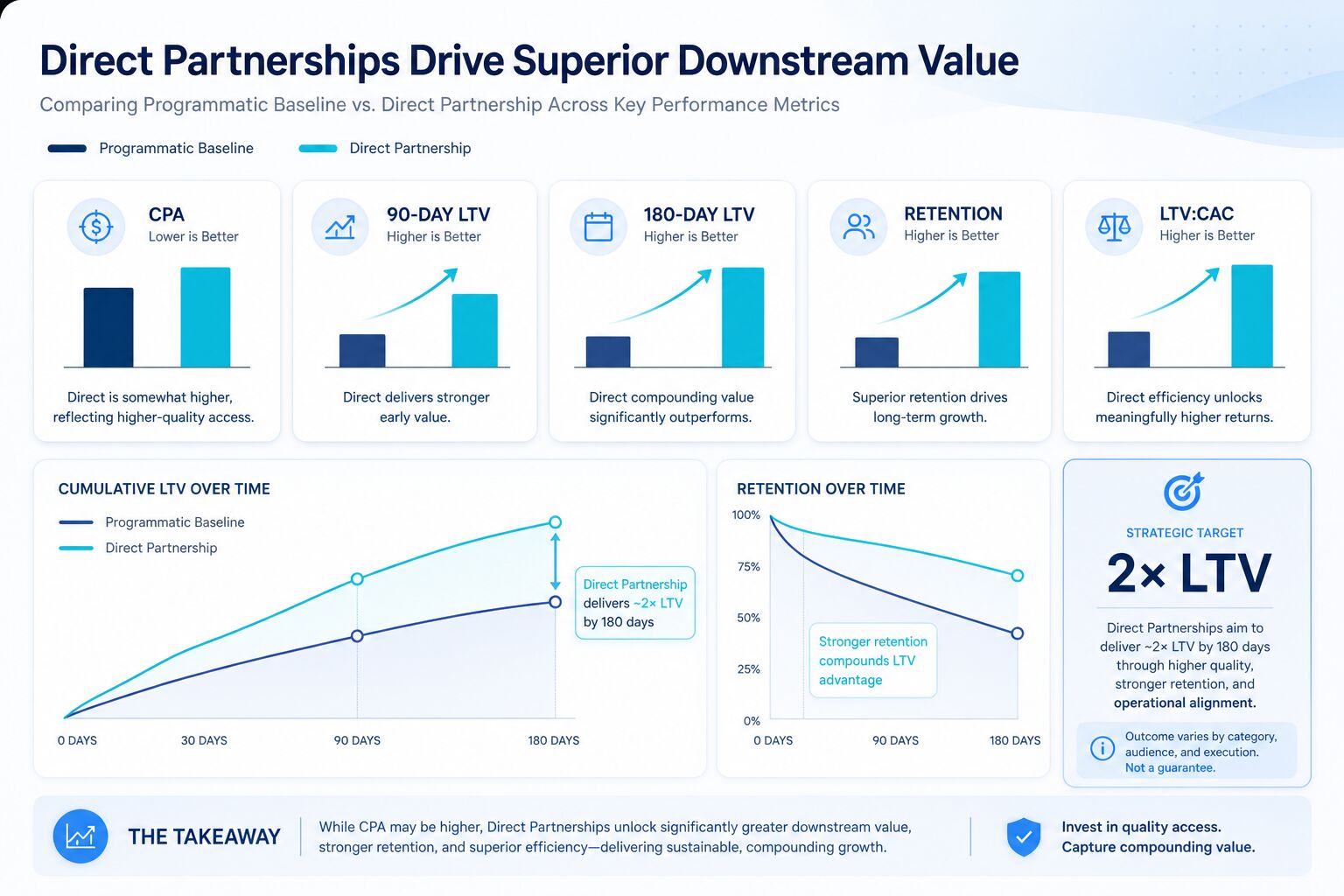
If a premium environment produces customers with materially higher LTV, a higher acquisition cost can still result in stronger profitability. That is where the potential for a 2x LTV outcome comes from: not from one buying tactic, but from multiple improvements working together across inventory quality, customer selection, attention, and downstream optimization.
The 2x figure in this guide should therefore be treated as a strategic performance target, not a guaranteed industry benchmark. Actual LTV improvement will depend on vertical, customer economics, offer structure, audience quality, inventory mix, measurement, and execution.
Connect with our team to evaluate your highest-value inventory opportunities.
FAQs
1. What is direct inventory in digital advertising?
Direct inventory is advertising supply accessed through a direct relationship with a publisher, app, platform, or inventory owner. It can provide greater control over placement, context, pricing, delivery, and supply visibility compared with broad open-auction buying.
2. Is direct inventory better than programmatic?
Neither approach is universally better. Programmatic is highly effective for scale, audience discovery, testing, and retargeting. Direct inventory can provide stronger control, premium access, and differentiated environments. The strongest strategy often combines both.
3. How can direct inventory improve LTV?
Direct inventory can improve LTV when it gives advertisers access to environments or audiences that consistently produce higher-quality customers. The impact should be measured through downstream metrics such as retention, repeat purchases, subscription renewal, and 90- or 180-day revenue.
4. Does direct inventory always have a higher CPM?
Not necessarily, but premium direct inventory often carries a higher price because it can provide greater scarcity, placement control, audience quality, or brand value. The correct comparison is not CPM alone. Advertisers should compare the resulting customer economics.
5. Should brands stop using open programmatic?
No. Open programmatic remains valuable for discovery, audience expansion, testing, and scalable acquisition. The opportunity is to use programmatic performance data to identify which inventory and audience opportunities deserve deeper investment through curated or direct relationships.
6. What is programmatic direct?
Programmatic direct refers to negotiated inventory that is executed through automated buying technology. Programmatic Guaranteed provides reserved inventory at agreed terms, while Preferred Deals can provide buyers with priority access without necessarily guaranteeing every impression.
7. What metrics should advertisers use to evaluate direct inventory?
Start with CPA and conversion rate, but do not stop there. Evaluate 90- and 180-day LTV, retention, repeat purchase rate, subscription renewal, LTV, contribution margin, incremental revenue, and attention-related engagement signals where available.
8. How can Novabeyond help with Direct Inventory Partnerships?
Novabeyond helps advertisers identify and activate direct inventory opportunities that complement their programmatic strategy. The focus is on connecting brands with quality inventory, stronger audience environments, and scalable partnership opportunities that support long-term growth and customer value.
Conclusion
The old debate between programmatic and direct buying is becoming less useful. Programmatic is not the enemy of premium inventory, and direct inventory is not the enemy of scalable automation. Each solves a different problem.
Programmatic gives growth teams reach, speed, testing capability, and real-time optimization. Direct Inventory Partnerships give advertisers greater access to premium environments, stronger supply relationships, and more control over the quality of the media they buy.
The real opportunity comes from connecting the two.
Discover with programmatic. Measure customer value. Identify high-quality inventory. Build direct partnerships. Scale through the right buying path. Feed the results back into your optimization strategy.
That is the LTV flywheel.
A 2x LTV outcome should never be treated as a guaranteed result from changing the buying model. It is the potential result of combining better inventory, stronger signals, reduced waste, higher attention, and more intelligent customer-level optimization.
For brands focused on profitable growth, that distinction matters.
Novabeyond's Direct Inventory Partnerships help advertisers bridge the gap between programmatic scale and premium inventory access, creating a more deliberate media strategy built around quality, transparency, and long-term customer value.