





Copyright © 2026 NOVABEYOND LIMITED (company number 2833487). All rights reserved.
Address: UNIT 616 6/F KAM TEEM INDUSTRIAL BUILDING 135 CONNAUGHT ROAD WEST SAI WAN HONGKONG.
In an era where performance marketing budgets face unprecedented scrutiny, ad buyers are asking a critical question: Where is every ad dollar actually going?
For years, the digital advertising ecosystem expanded by adding layers. Ad networks, reseller platforms, demand-side platforms (DSPs), and programmatic re-brokers stacked tech fees and supply-chain markups between advertisers and publishers. While this multi-tiered waterfall provided scale, it quietly eroded performance margins, obscured supply paths, and introduced hidden tech taxes.
Today, top-tier performance marketers are pivoting back to fundamental efficiency through Direct App and Web Inventory. By establishing direct relationships with publishers and direct inventory supply paths, advertisers bypass intermediaries, unlock transparent cost structures, and gain granular control over creative optimization and attribution.
The Hidden Costs of Intermediary-Heavy Supply Chains
To understand the value of direct inventory, we must first look at the traditional programmatic supply chain. In a typical programmatic transaction involving multiple resellers, an advertiser’s working media budget passes through several hands before reaching the publisher:
• Demand-Side Platform (DSP) Tech Fees: 10%–15%
• Data & Measurement Vendors: $0.05–$0.20 CPM
• Supply-Side Platform (SSP) / Reseller Margins: 15%–30%
• Ad Verification & Fraud Layers: Variable CPM surcharges
By the time an ad impression displays inside an app or on a mobile website, only 40% to 60% of the original budget goes toward actual media delivery. The remaining balance pays for the pipeline, a setup known across the industry as the "supply chain tax."
Beyond reduced working media budget, intermediary-heavy paths introduce systemic friction:
1. Latency: Multiple API hops slow ad rendering, leading to dropped impressions and poor user experience.
2. Data Distortion: Aggregated reporting from intermediaries strips out critical publisher-level signals (e.g., exact placement IDs, contextual triggers, or real-time user session depth).
3. Fraud & Arbitrage: Re-brokered inventory risks domain spoofing, hidden placement nesting, and artificial impression inflation.
3 Strategic Pillars of Direct Inventory Value
3.1 Eliminating the Middleman Fee (Higher Working Media Ratio)
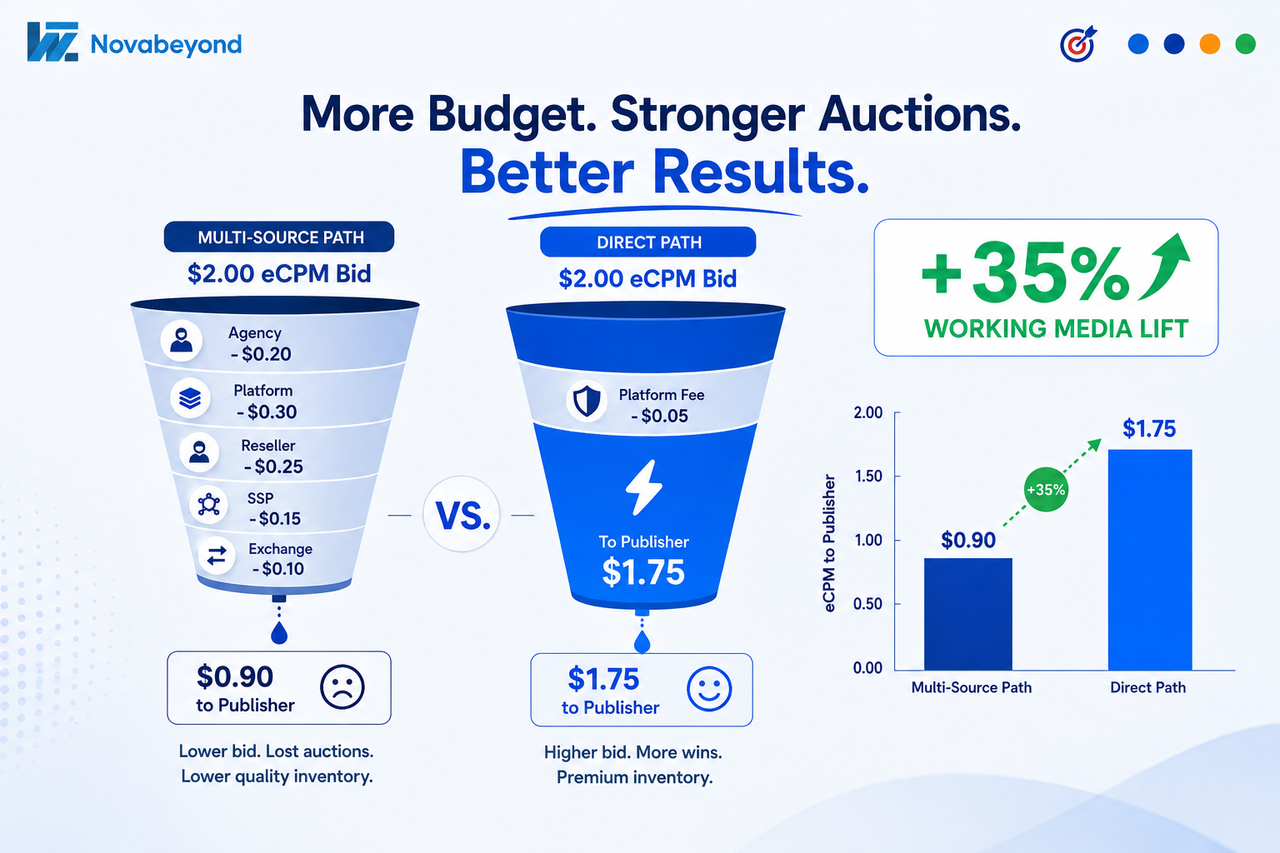
The most immediate impact of going direct is economic efficiency. By cutting out intermediary markups, advertisers transition from paying inflated eCPMs to paying pure media cost.
• Higher Effective Bids: Without margin loss, a $2.00 eCPM bid goes directly to the publisher, making your bid far more competitive in the publisher's internal waterfall or direct ad server compared to a $2.00 bid routed through three resellers.
• Capital Efficiency: For performance campaigns spending six figures monthly, shifting to direct inventory can instantly recover 20% to 35% of wasted budget, funneling those funds directly into user acquisition scale.
3.2 Transparent Cost Structures & Supply Path Optimization (SPO)
Direct inventory provides complete Supply Path Optimization (SPO). Instead of buying through opaque ad bundles or anonymized network IDs, growth teams gain line-of-sight into the exact economics of every campaign:
• True Cost Visibility: Clear distinction between inventory cost and tech service fees.
• Publisher-Level Transparency: Full visibility into publisher app IDs, bundle names, placements (e.g., app open, interstitial, lockscreen, native feed), and real-time user flow.
• Clean Data Signals: Unadulterated device, contextual, and session data pass cleanly to your Mobile Measurement Partner (MMP) or internal analytics warehouse, eliminating discrepancies caused by multi-hop transformation.
3.3 Granular Optimization & Control for High-LTV Acquisition
Performance marketing has evolved beyond broad-brush targeting. High-growth app categories—such as FinTech, iGaming, E-Commerce, and Casual Gaming, require surgical precision to hit Return on Ad Spend (ROAS) targets. Direct inventory provides the granular levers necessary for advanced optimization:
| Optimization Vector | Traditional Intermediary Path | Direct App & Web Inventory |
| Placement Control | Aggregated category/network level | Exact placement & ad format mapping |
| Bid Adjustment | Coarse bid adjustments across network IDs | Granular sub-publisher & placement-level bidding |
| A/B Creative Testing | Delayed reporting, aggregated creative stats | Instant creative render signals & placement testing |
| Fraud Suppression | Post-bid refund disputes | Pre-bid SDK-level integration & direct verification |
Who Benefits Most from Direct Inventory?
While direct supply paths deliver universal advantages, three advertiser profiles benefit most significantly:
• High-Scale Performance Growth Teams
Advertisers running monthly budgets exceeding $50,000 across performance channels cannot afford 30% margin leakages. For these teams, direct inventory provides the efficiency required to maintain positive Return on Ad Spend (ROAS) at scale.
• FinTech, Utility, and Subscription Apps
Categories with strict Customer Acquisition Cost (CAC) thresholds and target Payback Periods rely on clean, deterministic conversion data. Direct inventory ensures full attribution integrity without intermediary data loss.
• Advanced Data-Driven Marketers
Growth teams utilizing proprietary bidding algorithms, custom predictive LTV models, and internal data science pipelines require raw, uncompressed impression and click data, capabilities only direct publisher integrations provide.
Best Practices for Integrating Direct Inventory into Your Growth Mix
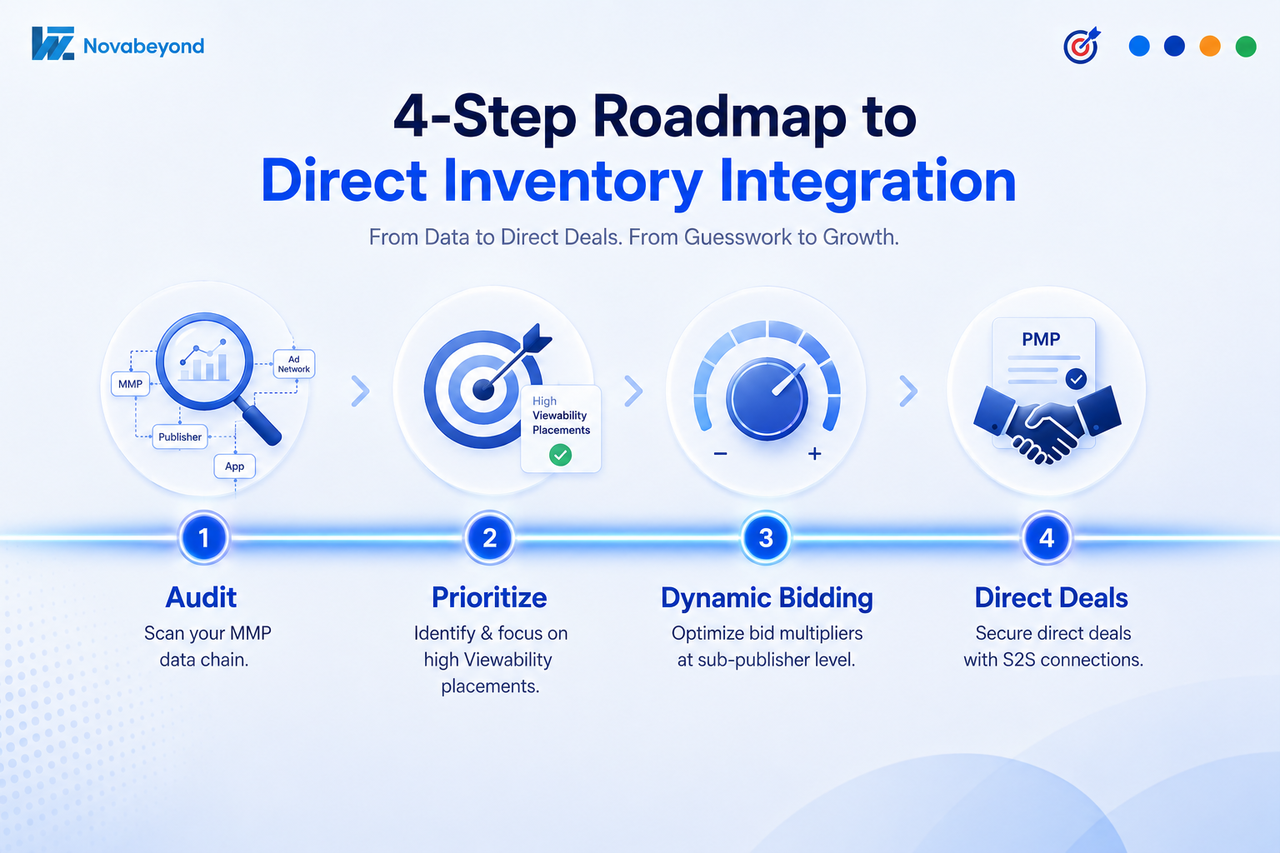
1. Audit Your Current Supply Paths: Work with your MMP to audit traffic sources. Identify which publishers or ad networks re-broker inventory versus those with direct SDK or direct server-to-server (S2S) supply integrations.
2. Prioritize Value Over Raw Reach: Avoid chasing cheap, unverified volume. Focus on direct app placements that offer high viewability, clean user engagement, and transparent reporting.
3. Implement Sub-Publisher Level Bidding: Leverage direct placement transparency by applying dynamic bid multipliers based on down-funnel performance metrics (e.g., Day-7 ROAS, In-App Purchase event rates, or Subscription Trial activations).
4. Negotiate Direct PMP or Direct S2S Deals: Where volume warrants, establish Private Marketplace (PMP) deals or direct ad server agreements to lock in guaranteed placement priority and fixed eCPMs.
Conclusion
As digital acquisition channels become more competitive, the winner won't necessarily be the marketer with the largest budget, but the one with the most efficient supply chain.
Direct App and Web Inventory removes the friction, noise, and hidden costs of the traditional programmatic reseller chain. By demanding full cost transparency, direct access, and granular control, performance marketers can convert wasted tech fees back into working media, driving sustainable, high-ROI growth.
Navigating the complexities of direct integrations, global supply paths, and placement-level optimization requires the right infrastructure partner. Novabeyond empowers global advertisers to unlock true performance growth through our deeply integrated Direct Media Ecosystem.
Ready to take full control of your acquisition supply chain? Partner with Novabeyond today and turn direct inventory into your competitive advantage.