





UNIT 616 6/F KAM TEEM INDUSTRIAL BUILDING 135 CONNAUGHT ROAD WEST SAI WAN HONGKONG.
Copyright © 2026 NOVABEYOND LIMITED (company number 2833487). All rights reserved.
Introduction
Kwai Ads can reach valuable mobile-first audiences, but access does not automatically produce efficient acquisition. The central question is whether your campaign gives delivery enough room to learn while preserving a clear link between audience, creative, and conversion quality.
That balance matters in Brazil, a major international market for Kwai, and in other markets where the platform supports performance and brand activity. In May 2025, a Kuaishou executive said Kwai had surpassed 60 million monthly active users in Brazil. That confirms meaningful reach, but it does not identify which audience will convert. That requires a disciplined Kwai Ads targeting strategy.
This guide explains how to turn market evidence into audience hypotheses, structure prospecting and retargeting, test without fragmenting delivery, and decide when an audience is ready to scale. It also separates paid advertising from creator follower growth and monetization, two topics that often appear in searches for Kwai.
Need a market-specific audience plan rather than a generic platform setup?
Plan a Kwai audience test with Novabeyond →
Quick Answer
How Should You Target Audiences on Kwai Ads?
Start with the campaign objective and conversion event, then build the broadest audience that still represents a credible customer hypothesis. Separate major markets, languages, funnel stages, and materially different customer groups into distinct ad groups. Keep creative localized to each audience, and change one major variable at a time during testing. Evaluate reach, spend, click-through rate, conversion rate, CPA, and downstream quality together. If delivery is weak, remove unnecessary restrictions before raising the budget. If performance is stable across several days and conversion quality holds, expand one dimension at a time, such as geography, audience breadth, or creative coverage.
1. Build the Targeting Strategy Around a Business Hypothesis
A useful audience is not a collection of available settings. It is a testable statement about who is likely to respond, why the offer is relevant, and what signal will prove the hypothesis.
For example, a mobile game advertiser might begin with this hypothesis: Portuguese-speaking Android users in Brazil who engage with casual entertainment content will install after seeing a localized gameplay demonstration. An e-commerce advertiser may instead test whether shoppers outside the largest metropolitan areas respond to a product demonstration that emphasizes delivery confidence and local payment expectations.
The official Kwai for Business page describes a four-step flow: set the objective, select the target audience, set the budget, and build the ads. It also describes in-feed ads as supporting flexible buying and targeting. Exact controls differ by account, market, objective, and product availability, so verify the live options inside Kwai Ads Manager.
Start with objective and signal quality
Audience design should follow the optimization event. A campaign optimized for qualified purchases needs a different evidence threshold from one optimized for video views. If the conversion event is rare or poorly instrumented, a narrow audience can leave the system without enough observations to distinguish real intent from noise.
Before launch, confirm four inputs:
Business outcome: purchase, qualified lead, install, registration, or measured brand action.
Conversion signal: the event is implemented, deduplicated, and visible in reporting.
Market logic: the product, landing page, price, language, and fulfillment model fit the selected location.
Creative promise: the ad communicates a reason to act that is specific to the audience.
Treat Brazil as multiple audience contexts
Kwai app popularity in Brazil makes the country a logical starting point for many advertisers, but Brazil should not be treated as one homogeneous audience. Language may be shared, while purchasing power, delivery expectations, cultural references, device conditions, and urban context vary.
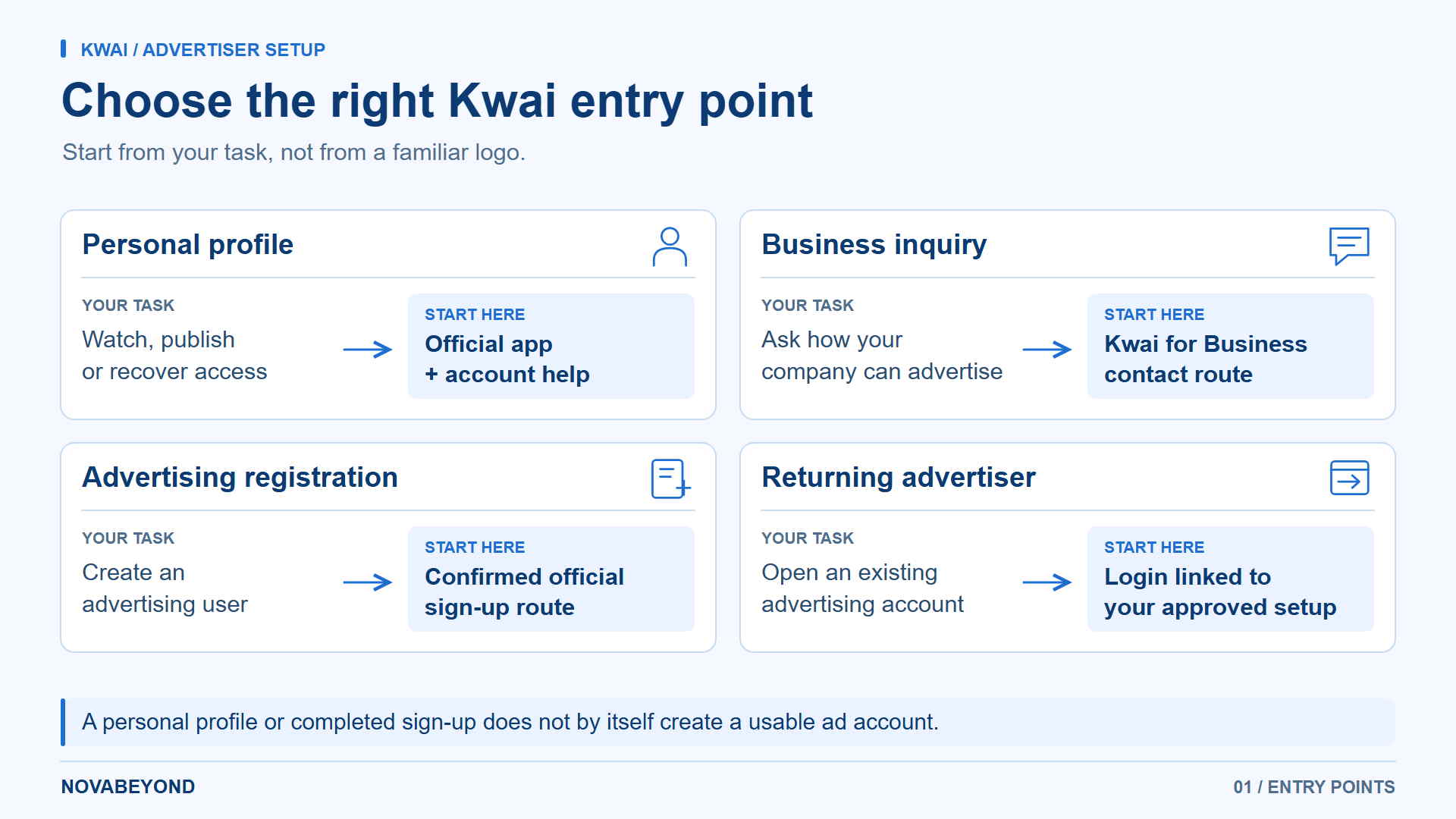
Create separate tests only when those differences lead to a different bid, creative, offer, landing page, or operational decision. Splitting every state or city without a clear decision rule creates small samples and makes results harder to interpret. Keep account access outside the audience test so onboarding changes do not obscure targeting results. The Kwai Brazil ad account setup guide covers Brazil-specific preparation.
2. Structure Audiences by Funnel Stage
The clearest audience plan separates people who have not interacted with the brand from people who already have a measurable relationship with it. The framework below describes media-planning roles, not a guaranteed list of Kwai Ads Manager controls. Confirm first-party audience, retargeting, lookalike, and exclusion availability in the live account before implementation.
Audience layer | Primary job | Starting approach | Main diagnostic |
Broad prospecting | Discover demand | Use only necessary market and eligibility controls | Can the campaign spend and generate qualified actions? |
Hypothesis prospecting | Test a customer theory | Add one meaningful demographic, interest, behavior, or device condition when available | Does the added condition improve conversion quality? |
Seed-based expansion | Find users similar to known customers | Use a high-quality first-party seed when the feature is available | Does incremental reach maintain CPA and value? |
Retargeting | Convert known visitors or engagers | Segment by recency and action depth | Does the audience add conversions rather than claim existing demand? |
Exclusions | Prevent waste and overlap | Exclude converted users or conflicting funnel stages where supported | Are campaigns competing for the same people? |
Keep broad prospecting genuinely broad
Broad does not mean careless. Market, legal eligibility, language, product availability, and operational constraints still matter. Avoid conditions that feel precise but do not represent a proven difference in purchase probability.
If an ad group cannot spend, inspect audience size, bid competitiveness, conversion signal, creative eligibility, and account restrictions before raising the budget. More budget does not repair a restricted audience or a weak signal.
Use retargeting as a separate decision layer
Retargeting audiences often have higher intent because users already know the brand. Mixing them with cold prospecting can make the campaign appear efficient while hiding weak acquisition. Separate reporting shows whether Kwai advertising is finding new demand or converting users created elsewhere.
Match recency windows to the buying cycle, and exclude completed converters when repeat purchase is not the objective. Where custom or exclusion controls are unavailable, use campaign structure and reporting to approximate the distinction without claiming unsupported precision.
Match ad format to the audience task
Kwai for Business lists in-feed ads, Eyemax opening-screen placements, hashtag challenges, Magic Face interactive formats, and creator collaboration. The most popular ad formats in Southeast Asia or Latin America should not be selected by popularity alone.
Use in-feed ads for performance discovery and conversion testing, opening placements for planned reach, and interactive or creator-led formats for participation and local credibility. The official site reports that an AliExpress campaign using precise targeting increased CTR by 7.3% and reached 300 million impressions. Treat this as a first-party case, not a guaranteed benchmark.
3. Run a Test That Produces a Clear Decision
Targeting tests fail when too many variables change at once. If audience, creative, bid, budget, placement, and landing page all differ, the result cannot explain performance.
Give each comparison one primary question, such as broad versus one interest hypothesis, one market cluster versus another, localized creative versus direct translation, or prospecting versus seed-based expansion. Keep the optimization event and measurement logic consistent.
Use a controlled testing sequence
Validate delivery: confirm the ad group can enter auctions, spend, and produce the expected events.
Validate message fit: compare localized creative angles inside the same audience.
Validate audience lift: add or change one audience condition while holding the creative concept stable.
Validate conversion quality: compare purchases, qualified leads, retention, revenue, or another downstream measure.
Validate repeatability: confirm the result across enough time and inventory to avoid promoting a short-lived fluctuation.
Do not declare a winner from CTR alone. A higher CTR can indicate stronger relevance, broader curiosity, or a misleading hook. The audience is useful only when it improves the business outcome or creates efficient incremental reach.
Diagnose audience problems with multiple signals
Use combinations of metrics rather than one threshold:
Low spend and low reach: the audience may be too restricted, the bid may be uncompetitive, the creative may be ineligible, or the account may have a delivery constraint.
High reach and low CTR: the message may not fit the audience, even if targeting is broad enough.
Strong CTR and weak conversion rate: the creative promise, landing page, offer, or traffic quality may be misaligned.
Acceptable CPA and weak downstream value: the campaign may be optimizing toward low-quality actions.
Good performance followed by rapid decay: the audience may be small, creative fatigue may be rising, or the early result may not have been repeatable.
This diagnostic approach is more reliable than importing fixed CTR, CPM, or CPA targets from third-party articles. Costs depend on market, category, objective, season, account history, creative quality, and conversion definition.
Protect localization while testing targeting
Localization is part of audience strategy, not a cosmetic translation step. In Brazil, test Brazilian Portuguese copy, local usage contexts, currency and payment expectations, and culturally credible talent or product demonstrations. Keep the value proposition constant when testing localization so the result measures presentation rather than a different offer.
Teams updating a Kwai for Business publicidade Brasil plan first built in 2025 should not carry old audience assumptions into 2026. A current Kwai Brazil strategy connects audience selection with local creative and conversion operations. A targeting menu alone cannot provide that fit.
4. Scale Without Losing the Audience Signal
Scale after the campaign demonstrates stable delivery, conversion quality, and operational readiness. Increase one dimension at a time so the team can identify where efficiency changes.
A typical sequence is:
Add new localized creative to protect delivery from fatigue.
Broaden one audience condition or remove an unproven restriction.
Expand to an adjacent location with compatible product and operational conditions.
Increase budget gradually within a structure that is still generating reliable conversion signals.
Separate proven audience groups when they need different creative, bids, or business treatment.
Use the Kwai budget scaling guide for spend-limit and pacing decisions. For a wider view of campaign setup, formats, and operational planning, use the complete Kwai Ads strategy guide. Keeping these topics separate protects the targeting page's role as an audience decision framework.
Know when agency support changes the outcome
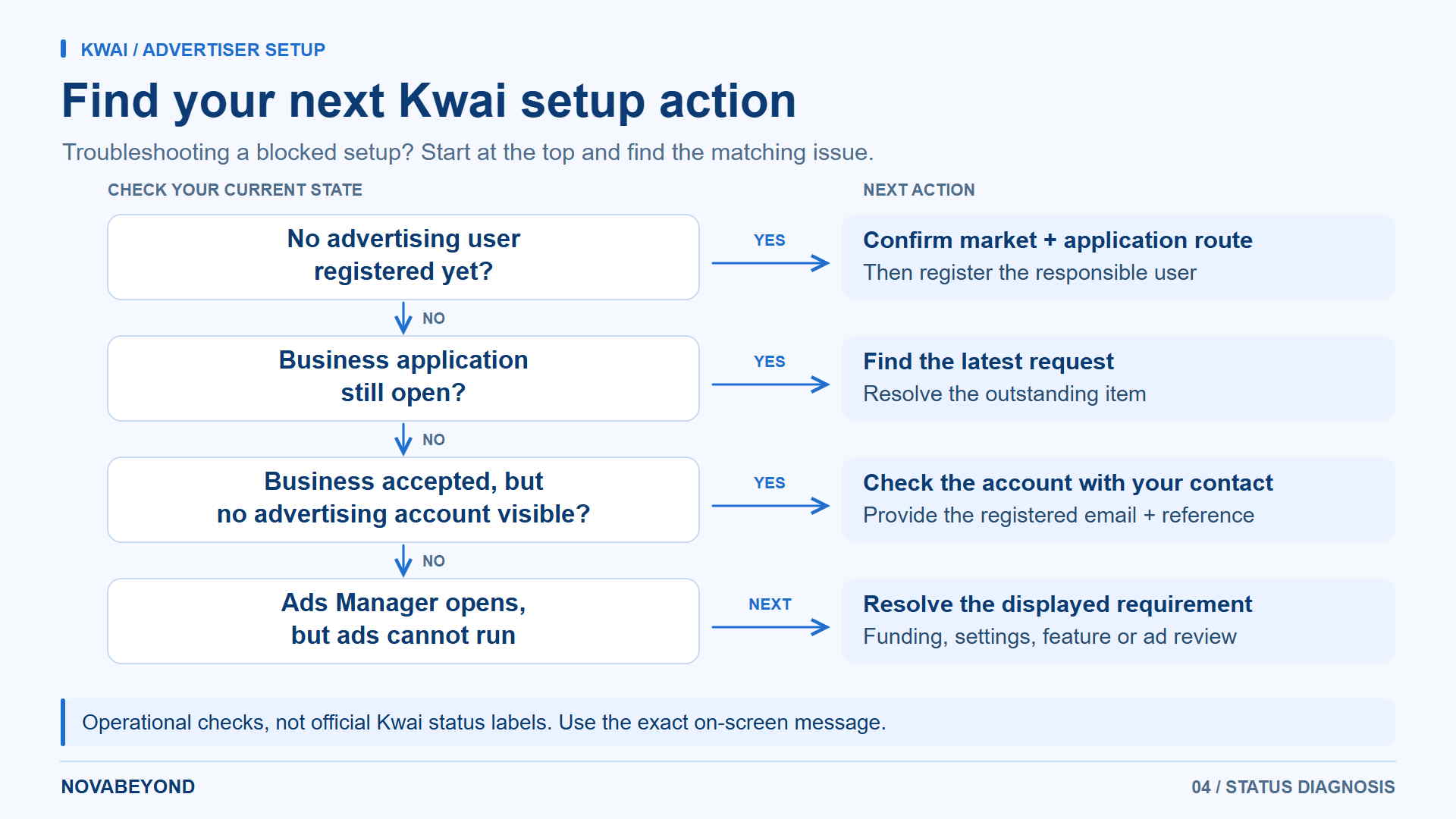
International Kwai campaigns involve account access, market eligibility, creative localization, tracking, and optimization. An agency ad account guide for Kwai can clarify responsibilities before media teams plan around unavailable controls.
Agency support is most valuable when it closes an execution gap, such as confirming account features, separating markets, coordinating local creative, or resolving tracking inconsistencies. The advertiser still defines customer value and conversion quality.
Frequently Asked Questions
1. What targeting options are available in Kwai Ads Manager?
Kwai for Business confirms audience selection and flexible targeting for in-feed advertising, but its public page does not document every control. Use location, language, demographic, device, interest or behavior, first-party audience, retargeting, lookalike, and exclusion as planning concepts only where the live account supports them. Verify current controls before publishing a media plan. For campaigns that may reach younger users, review Kwai's official minor-protection and community guidance.
2. Can Kwai Ads help a brand get more followers, likes, or comments?
Paid delivery can increase qualified exposure, but “how to get more followers on Kwai,” “how to get more likes on Kwai,” “how to get more comments on Kwai,” and French queries such as “augmenter followers Kwai stratégies” are creator-growth questions as well as media questions. Use an engagement objective only when interaction growth has a defined business role. Avoid purchased followers or artificial engagement because they do not measure qualified demand.
3. What is the best time to post on Kwai in Brazil?
The best time to post on Kwai in Brazil depends on the account's audience data, content category, location, and day. Organic publishing time and paid ad delivery are different systems. For paid campaigns, use hourly and day-level reporting only after sufficient volume, and do not restrict delivery to a narrow schedule unless the pattern is repeatable or operations require it.
4. Is Kwai Ads the same as Kwai monetization in Brazil?
No. Kwai Ads is the advertiser-side system for buying media and measuring campaign outcomes. Kwai monetization refers to creator-side programs, eligibility, rewards, commerce, or collaboration. Questions about Kwai monetization requirements in 2026 and supported countries belong to a separate decision path. See the Kwai monetization countries and requirements guide for that topic.
5. Is there an official Kwai Ads library or Kwai creative center?
Kwai provides official business pages, success stories, creator collaboration resources, and account-level tools. At the time of this update, we did not verify a public official ad transparency library equivalent to the best-known cross-platform ad libraries. Third-party pages labeled “Kwai Ads library” may be useful for inspiration, but they should not be treated as official evidence of spend, ROAS, or winning performance.
6. Is Kwai the international version of Kuaishou, and do the user numbers match?
Kwai is part of Kuaishou's international product ecosystem, but Kuaishou App metrics are not Kwai international audience counts. Kuaishou reported 412.3 million average daily active users and 797.3 million average monthly active users for the Kuaishou App in Q2 2026. For Brazil planning, use market-specific Kwai evidence and confirm current reach inside the advertising account.
Conclusion
Effective Kwai Ads targeting is a sequence of business decisions. Define the outcome, protect signal quality, build a broad but credible customer hypothesis, separate funnel stages, and test one major variable at a time. Read reach, spend, engagement, conversion, and downstream value together. Then scale through controlled changes rather than simultaneous expansion across audience, geography, budget, and creative.
This approach preserves Kwai's value in markets such as Brazil while avoiding false precision. It also keeps paid advertising separate from creator growth, monetization, account setup, and budget expansion, each of which has its own operating logic.
Turn Kwai audience insight into a measurable launch and scaling plan.
more posts
TikTok Ads Rejected? 7 Common Policy Violations and How to Fix Them
November. 05 2026
LEARN MORE


Google Ads Suspended in 2026? How to Appeal and Unblock Your Manager Account
September. 20 2026
LEARN MORE
Swiftproxy Review 2026: Exploring Its Residential Proxy Features and Performance
July. 17 2026
LEARN MORE
Verified Agency Ad Account Provider | Stable Ad Accounts 2026
May. 25 2026
LEARN MORE