




Copyright © 2026 NOVABEYOND LIMITED (company number 2833487). All rights reserved.
Address: UNIT 616 6/F KAM TEEM INDUSTRIAL BUILDING 135 CONNAUGHT ROAD WEST SAI WAN HONGKONG.
There is a question that more growth teams are beginning to ask as user acquisition becomes increasingly difficult. If you doubled your budget on the same acquisition channels tomorrow, would your business actually double its growth?
For many advertisers, the answer is no.
Over the past decade, performance marketing has been driven by a relatively straightforward playbook. Brands invested more heavily in the channels that delivered the strongest performance, optimized campaigns continuously, and relied on attribution metrics to guide budget allocation. As long as platforms continued to provide access to new users, this approach worked remarkably well.
Today, however, the landscape has changed.
Competition across mainstream media platforms has intensified, acquisition costs continue to rise, and advertisers are increasingly competing for the same audiences. Additional investment often generates more impressions, but not necessarily more new users. As channels mature, growth becomes harder to sustain because the available audience within those ecosystems is gradually reaching saturation.
For many advertisers, the challenge is no longer improving efficiency. It is finding where the next stage of growth will come from.
That is why incremental growth has become one of the most important strategic priorities in modern performance marketing.
What Incremental Growth Actually Means
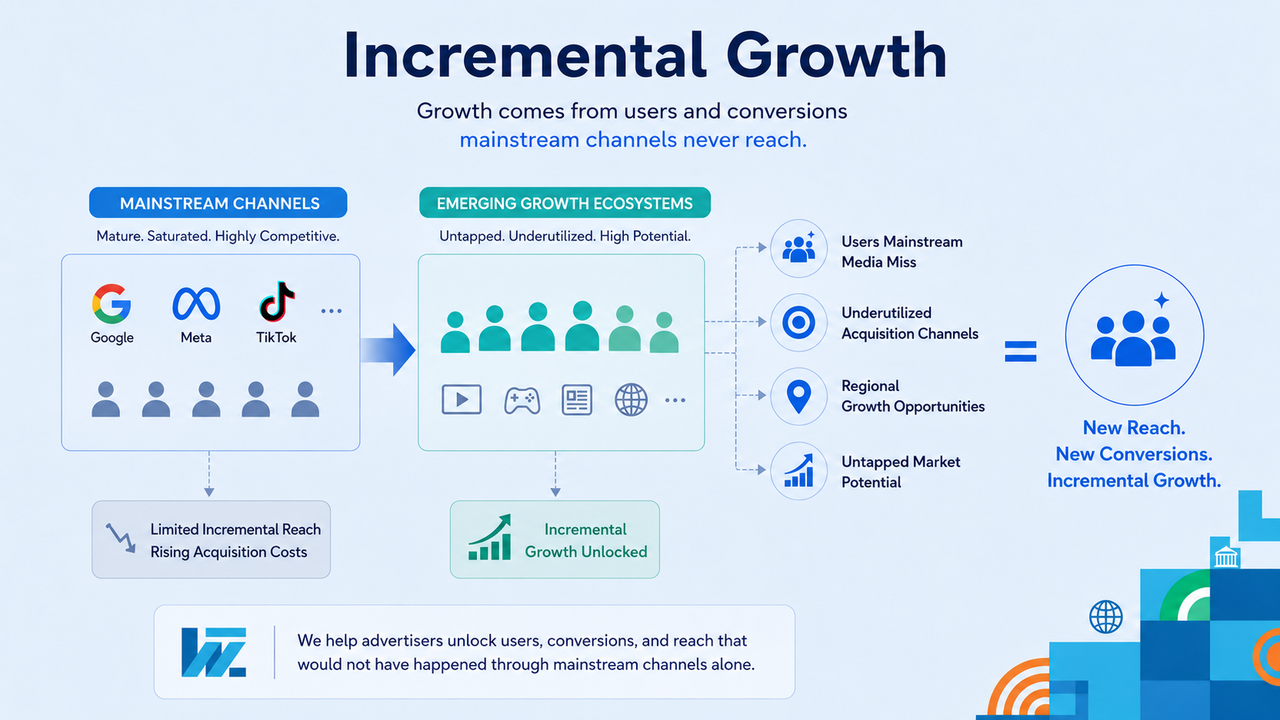
Incremental growth is often misunderstood as buying more traffic or improving campaign efficiency. In reality, it is about unlocking growth that existing acquisition channels cannot efficiently deliver.
As mainstream media ecosystems become increasingly competitive and saturated, advertisers face rising acquisition costs, growing audience overlap and diminishing returns from additional budget. Simply investing more in the same channels rarely creates meaningful new growth because those platforms are increasingly reaching the same users.
True incremental growth comes from expanding beyond those limitations. It means reaching untapped audiences, engaging users in media environments that traditional platforms cannot effectively cover, and activating new sources of scalable inventory. Instead of competing harder for existing demand, advertisers create new opportunities by expanding the overall addressable audience.
This represents an important shift in mindset. Rather than asking which platform delivers the highest ROAS, advertisers should ask which channels help them acquire users they would not otherwise reach. Sustainable growth is no longer driven solely by optimizing existing channels. It comes from continuously discovering new audiences and unlocking new sources of demand.
Why Mainstream Channels Alone Are No Longer Enough
Mainstream platforms remain the foundation of digital advertising, but relying on them alone is becoming increasingly challenging.
As more advertisers compete within the same ecosystems, audience overlap continues to increase. Higher demand for limited inventory drives acquisition costs upward while reducing the incremental value of additional spend. Even with better creatives, smarter automation and more sophisticated bidding strategies, many advertisers eventually reach a point where growth begins to plateau.
This does not mean mainstream platforms are becoming less valuable. They remain an essential part of every performance marketing strategy. However, they are no longer sufficient on their own to support continuous, scalable growth.
The next stage of growth requires expanding beyond existing media environments rather than simply increasing investment within them.
Where Incremental Growth Comes From
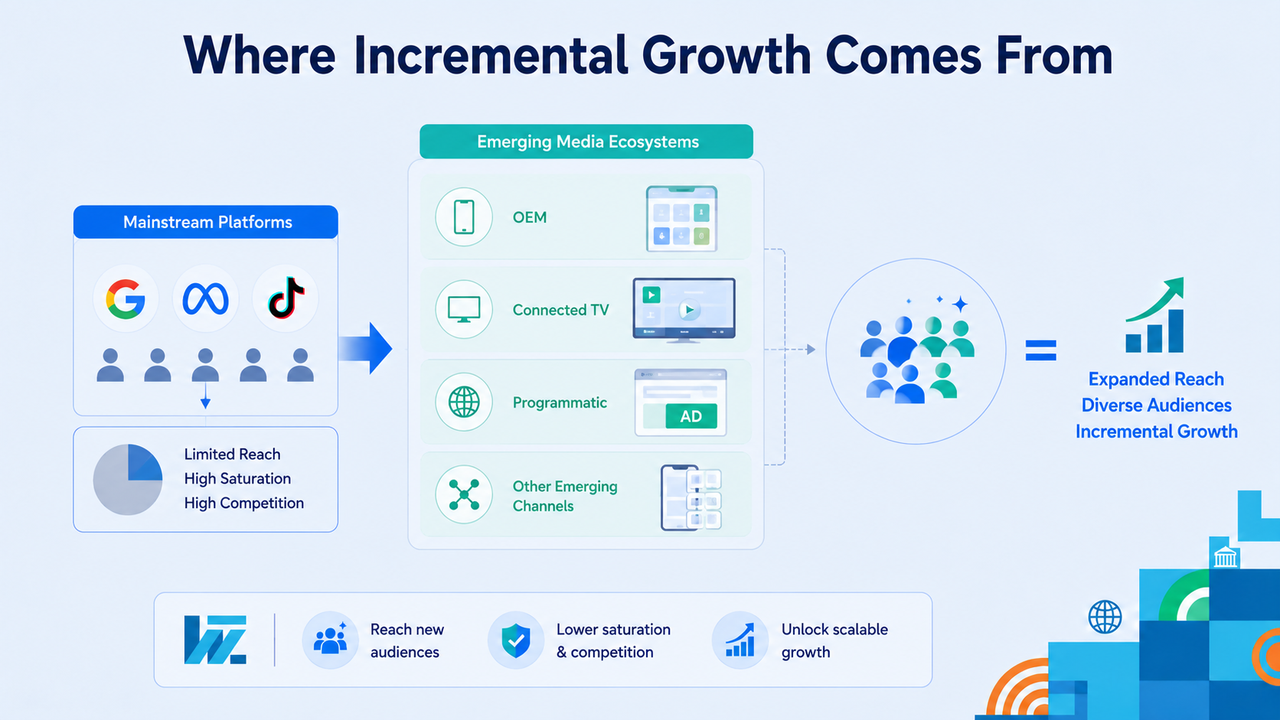
Incremental growth comes from reaching audiences that mainstream platforms cannot efficiently access.
Emerging media ecosystems create opportunities to engage users through different devices, different consumer journeys and different moments of interaction, allowing advertisers to expand their reach beyond traditional acquisition channels.
OEM advertising introduces brands through native placements on mobile devices before users actively begin searching for products or services. Connected TV extends audience reach into premium streaming environments, creating meaningful exposure beyond personal mobile devices. Programmatic advertising provides access to premium publisher inventory and open web audiences that complement social and search platforms while expanding overall market coverage. Other emerging media ecosystems, including social networks, native placements, and push/pop notification traffic, continue to provide additional sources of scalable inventory.
These channels are not designed to replace mainstream platforms. They complement existing acquisition strategies by introducing brands to audiences that are less saturated, less competitive and often unavailable through conventional platform buying. Together, they expand overall audience reach, diversify traffic sources and unlock growth opportunities that cannot be achieved by relying on mainstream channels alone.
Measuring Incremental Value
As advertisers diversify their media mix, understanding which investments genuinely contribute to business growth becomes increasingly important.
Traditional attribution models remain valuable for measuring campaign performance, but they cannot always distinguish between conversions generated by advertising and conversions that would have happened anyway. Incrementality testing, including holdout experiments and other causal measurement approaches, helps advertisers understand the additional business impact created by different media channels.
Measurement, however, should not be confused with strategy.
Incrementality testing helps validate whether growth is truly incremental. Incremental growth strategy focuses on identifying where that growth can be created in the first place. The two are complementary, but sustainable growth begins with expanding into new audiences and new media ecosystems.
Building a More Resilient Growth Strategy
As customer acquisition becomes increasingly competitive, depending on a small number of dominant platforms also creates long-term business risk.
Changes in auction dynamics, privacy regulations, platform policies or advertising costs can quickly affect campaign performance. Diversifying acquisition channels reduces platform dependency while creating a stronger and more resilient growth infrastructure capable of adapting to changing market conditions.
Advertisers that embrace emerging media ecosystems gain more than additional inventory. They build access to incremental global audiences, reduce concentration risk and create greater flexibility in how future growth is achieved. Instead of searching for a single best-performing channel, they develop a diversified acquisition strategy capable of delivering sustainable growth over time.
The Future of Performance Marketing
The future of performance marketing will not be defined by who spends the most on mainstream platforms. It will be defined by who discovers new opportunities for growth before everyone else.
As media ecosystems continue to evolve, sustainable growth will increasingly depend on expanding beyond traditional advertising environments. Brands that rely exclusively on mature platforms will face rising acquisition costs, greater audience overlap and increasingly limited room for scale. Those that diversify across emerging media ecosystems will be better positioned to unlock new demand, reduce platform dependency and build a stronger foundation for long-term growth.
Incremental growth is not about buying more traffic from the same channels. It is about unlocking growth that existing platforms cannot efficiently deliver.
At Novabeyond, we help brands discover and activate these incremental growth opportunities through global emerging media ecosystems that extend beyond the boundaries of mainstream advertising platforms, enabling advertisers to reach incremental audiences, unlock scalable inventory and build sustainable growth beyond traditional channels.
more posts
Diversified Acquisition Strategies for Global Advertisers: A Framework for Evaluating New Channels
September. 11 2026
LEARN MORE

The Hidden Cost of Platform Dependency: What One Policy Change Can Destroy
August. 27 2026
LEARN MORE
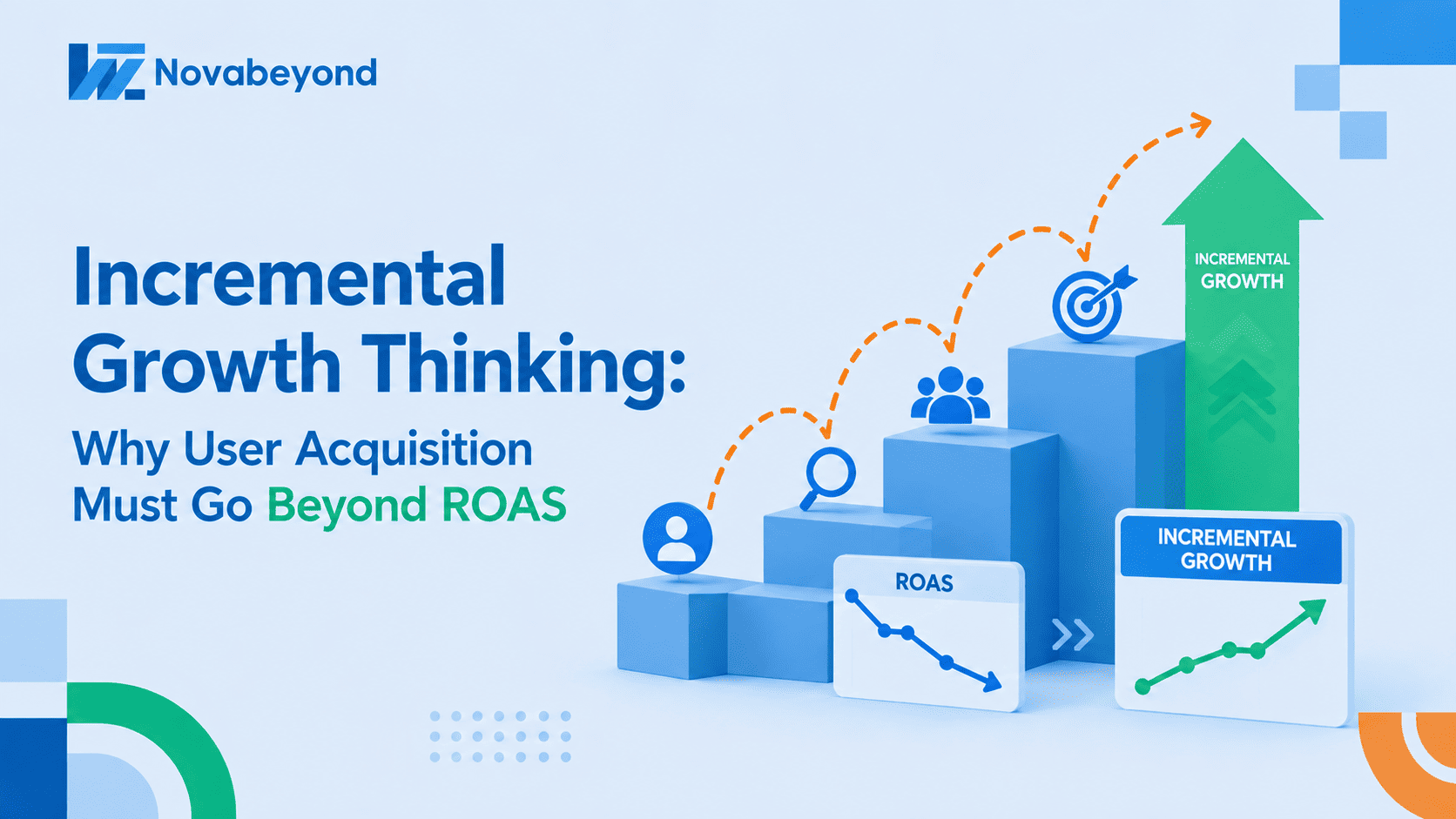
Incremental Growth Thinking: Why User Acquisition Must Go Beyond ROAS
August. 24 2026
LEARN MORE
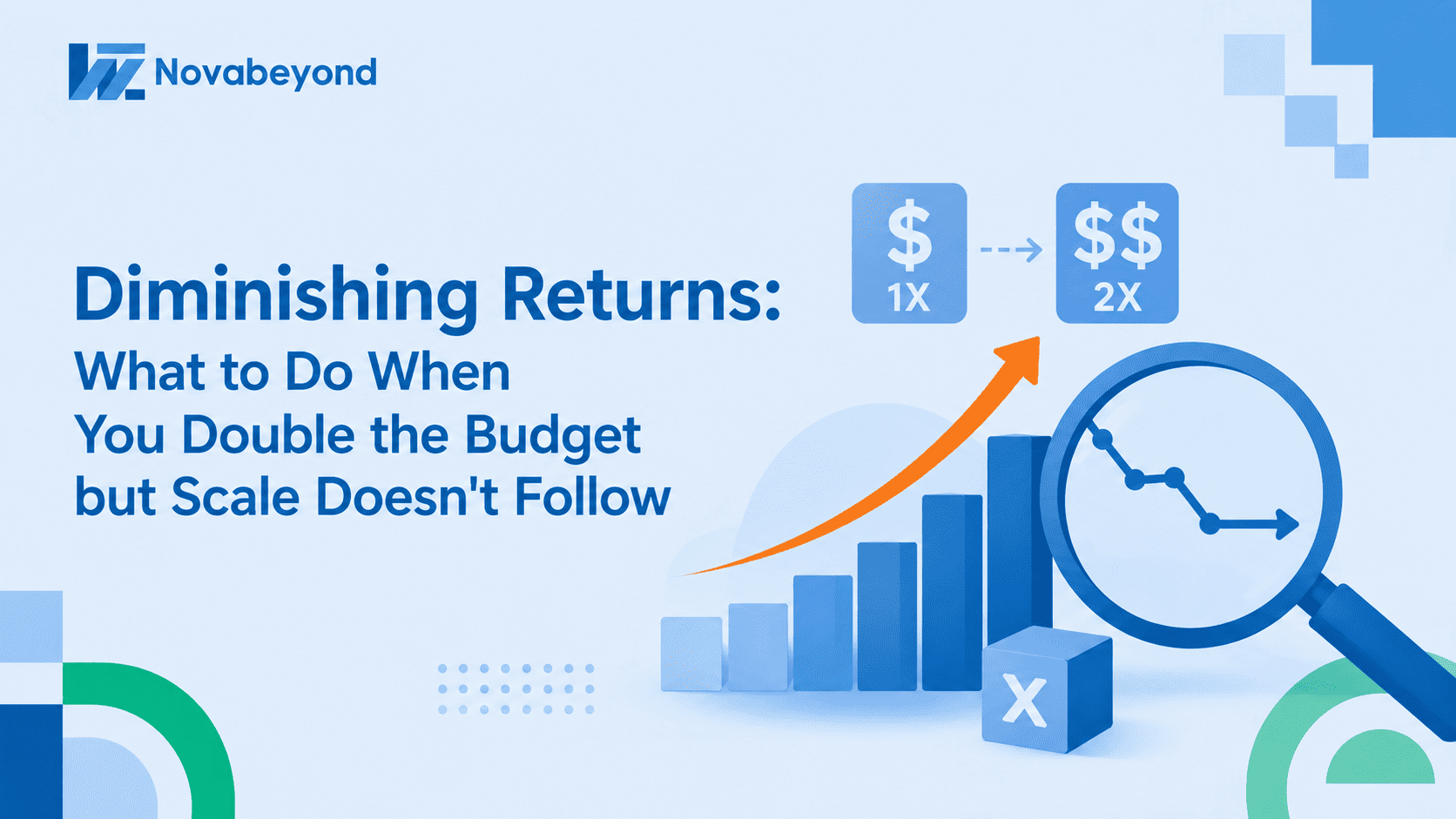
Diminishing Returns: What to Do When You Double the Budget but Scale Doesn't Follow
August. 20 2026
LEARN MORE