




Copyright © 2026 NOVABEYOND LIMITED (company number 2833487). All rights reserved.
Address: UNIT 616 6/F KAM TEEM INDUSTRIAL BUILDING 135 CONNAUGHT ROAD WEST SAI WAN HONGKONG.
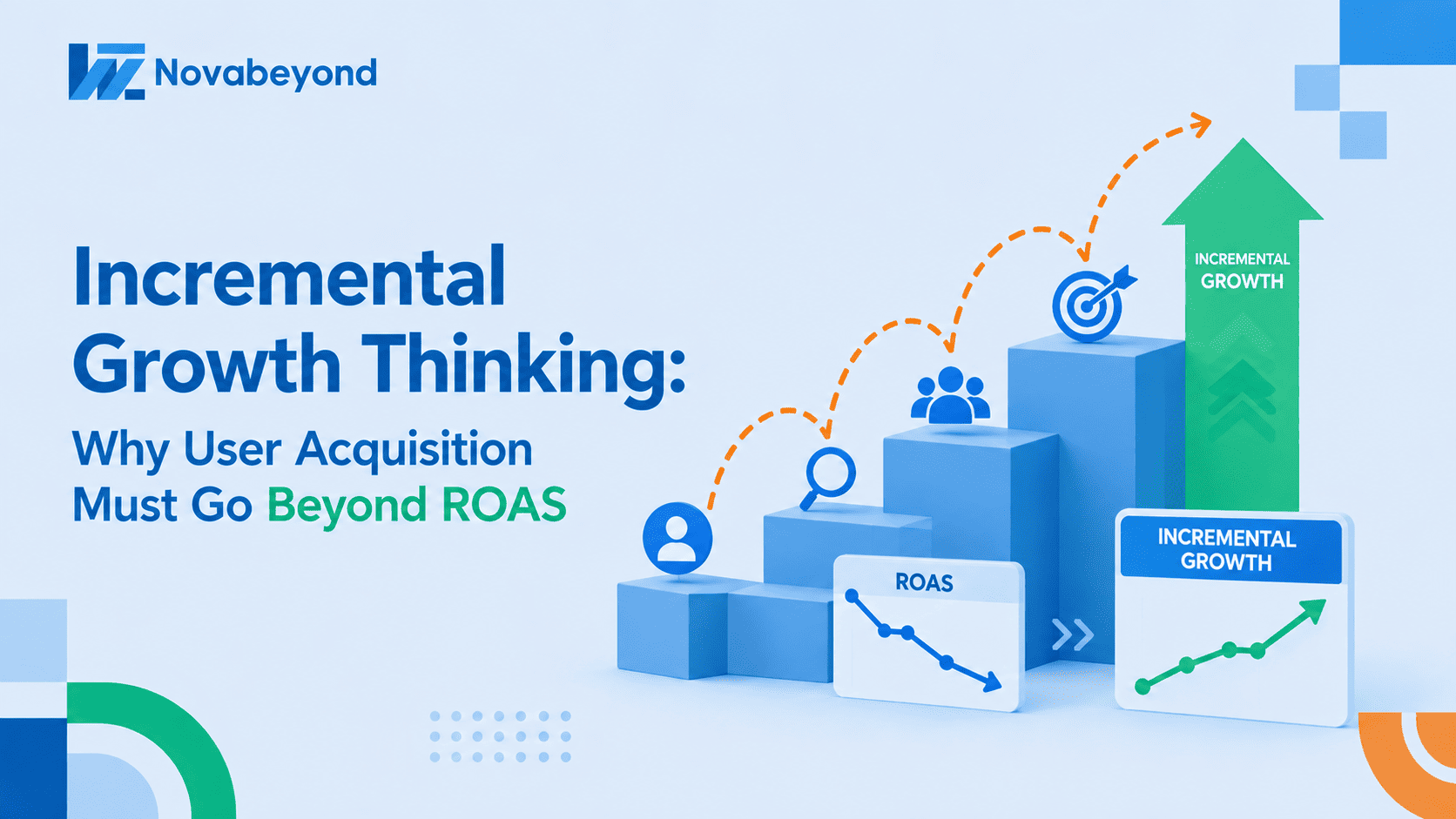
Every growth team encounters it eventually. The budget doubles. Installs go up, but not by 2x. Maybe 1.3x. CPIs climb. ROAS softens. The channel that delivered reliably at $100K/month starts to feel inefficient at $300K/month, and the logic behind the budget increase quietly collapses.
This isn't bad campaign management. It's a structural property of how paid UA channels work. Understanding it is essential, not just to diagnose what's happening, but to know what to do next.
Why More Budget Produces Less Than Proportional Scale
Paid UA on platforms like Meta, Google, and TikTok operates through real-time auctions. When you increase your daily budget, the platform's algorithm doesn't find more of the same users at the same price, it exhausts the most efficient inventory first, then moves into progressively less efficient segments.
The best-matched users , highest purchase intent, lowest CPI, strongest LTV , are a finite pool. Once your campaigns have reached most of them, each additional dollar buys lower-quality audiences at higher cost. The relationship between spend and installs is not linear. It is logarithmic, and the compression accelerates with scale.
Three mechanics drive this:
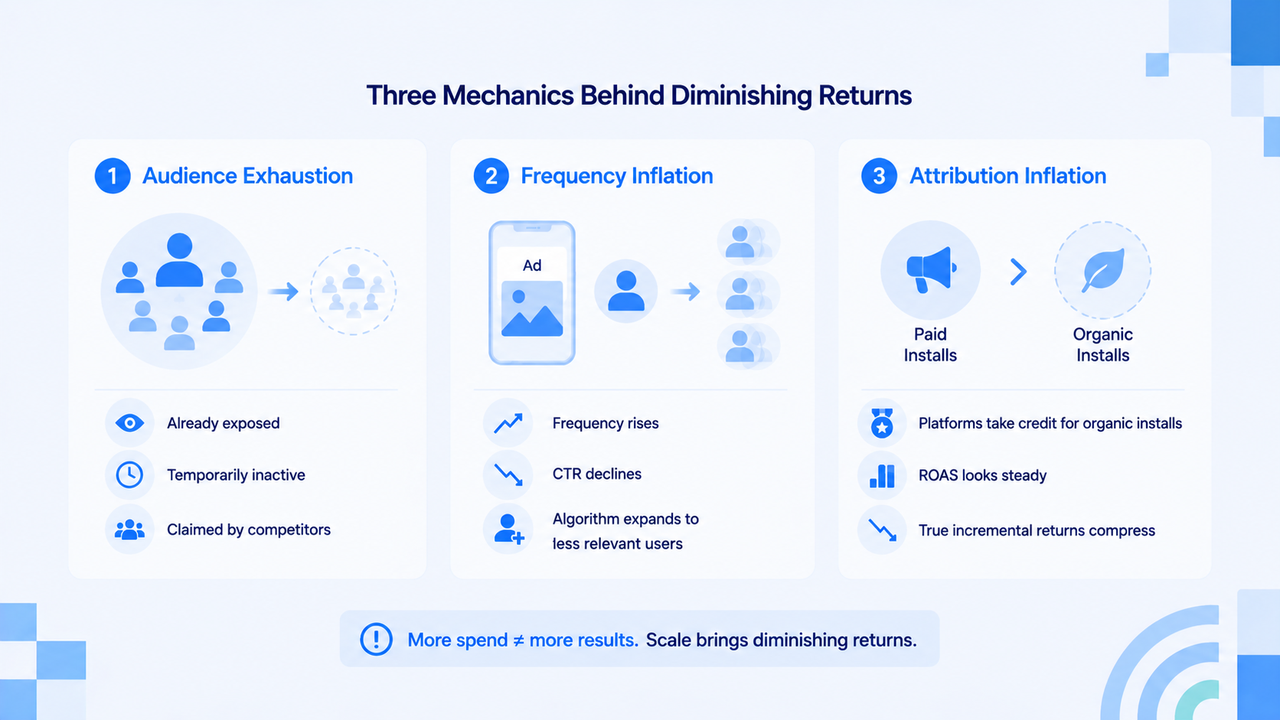
Audience exhaustion
Your target demographic on any given platform is not unlimited. In a specific market and campaign window, many users in your ICP have already been exposed to your ads, are temporarily inactive on the platform, or have been claimed by competitors bidding on identical audience signals.
Frequency inflation.
As budgets scale, average frequency per user rises. The same users see your creative more often. Ad fatigue accelerates. Click-through rates decline. The algorithm compensates by expanding reach to less well-matched users to fulfill budget and efficiency deteriorates further.
Attribution inflation.
At large budget scales, when your ads reach a significant portion of your target market, a meaningful fraction of attributed conversions are users who would have converted organically. Platforms claim credit for organic installs, and your reported ROAS holds steady even as true incremental returns compress. This is not fraud. It is an inherent bias in last-touch attribution models that becomes more pronounced with scale.
The Diagnostic Signals
Before deciding what to do, accurately diagnose where you are in the saturation curve.
1. Rising blended CPI with stable budget.
If cost per install on a channel has been rising quarter over quarter despite consistent creative refresh, you have likely saturated the most efficient audiences. The platform is expanding reach to compensate.
2. Declining ROAS at higher spend cohorts.
Compare ROAS by monthly spend level, controlling for seasonality. If months with higher spend consistently underperform lower-spend months, saturation is the most likely explanation.
3. High frequency with declining CTR.
Platform dashboards surface this directly. Average frequency above 4-5x per week combined with declining CTR is a clear signal of creative fatigue amplified by audience exhaustion.
4. Holdout test showing attribution inflation.
Run a geo-based holdout , pause spend in a comparable market, measure organic install rate. If organic installs in the test market don't drop proportionally to the spend reduction, a portion of your attributed installs were not incrementally driven by paid activity. The gap is the inflation.
What to Do When You're Hitting the Ceiling
1. Unlock New Audiences Through Channel Expansion
This is the most durable response , and the one most teams delay too long. When a channel saturates, the right move is to access genuinely new audiences through channels those platforms don't reach, not to pour more money into audiences they've already exhausted.
Independent apps have over 2 billion global daily active users and offer 82 billion hours of engagement in the US alone, comparable to YouTube and significantly more than Facebook. This is inventory that mainstream channels do not efficiently surface. OEM ecosystems reach users at the moment of device activation, before competitive apps are established. Regional platforms in Southeast Asia, CIS, and Latin America maintain hundreds of millions of daily active users outside the mainstream competitive set.
The teams who avoid the diminishing returns trap are the ones who have built real operational presence on alternative channels before they need them so that when mainstream channels saturate, incremental budget has somewhere genuinely productive to go.
2. Creative Refresh at Scale
The most underestimated lever on mature channels. Platform algorithms increasingly use creative signals as the primary variable for delivery. This is especially true on Meta following the Andromeda update, where UGC-style short-form creatives consistently outperform polished production. Strong creative can meaningfully lower CPI even in saturated audiences by unlocking delivery to users the algorithm couldn't previously identify as relevant. Rotating 15-20+ new concepts per month is not excessive at significant budget levels, it's necessary.
3. Geographic Expansion
Many apps saturate Tier 1 markets well before they've explored adjacent ones. Canada and Australia provide US-similar user profiles at CPIs 20-30% lower. Taiwan mirrors Japan for gaming verticals. Markets in Southeast Asia, MENA, and LATAM offer lower CPIs alongside high growth rates. Indonesia and Saudi Arabia both maintained download growth while most markets declined in 2026. These aren't permanent substitutes, they're validation environments and genuine growth opportunities.
4. Rebalance Toward Retention
When marginal acquisition returns are compressed, the effective cost per incremental engaged user becomes very high. At that point, reactivating existing users through retargeting and owned channels often delivers better marginal ROAS. Global remarketing spend reached $31.3 billion in 2025 — up 37% year over year — as budgets shifted toward reengaging existing users. This reflects a rational reallocation: when acquisition is expensive, retention is frequently the more efficient dollar.
A Budget Allocation Framework Under Saturation
Rather than treating all budget as interchangeable, structured teams apply a tiered approach.
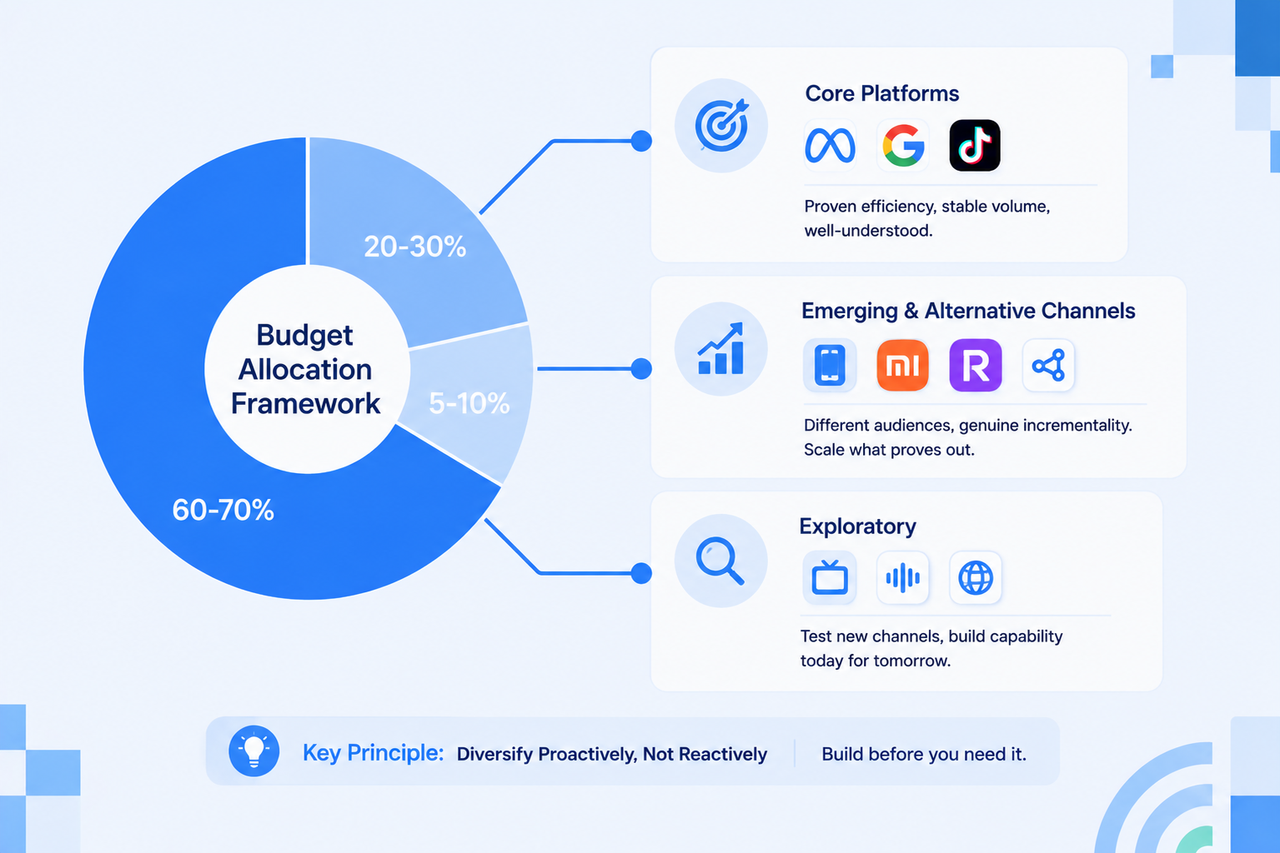
• Core platforms (60-70% of budget)
Proven efficiency, stable volume, well-understood. Accept that marginal returns here have ceilings. Optimize within those limits rather than chasing scale beyond them.
• Emerging and alternative channels (20-30% of budget)
OEM advertising, emerging regional media platforms, rewarded UA networks, programmatic DSP. These channels access different audiences and provide genuine incrementality. Scale what proves out through consistent incrementality testing.
• Exploratory (5-10% of budget)
CTV, programmatic audio, new regional platforms. Maintain active testing. The point is to build operational capability before you urgently need it, so that when core platform efficiency declines further, you have credible alternatives ready.
The key principle: diversification channels should be built proactively. Teams that try to launch new channels in response to a performance crisis face both the efficiency hit and the operational learning curve simultaneously. Building channel infrastructure while core platforms are still performing is the correct order of operations.
The Broader Framing
Diminishing returns on mainstream channels is not a problem that resolves itself with better optimization or more creative testing. Those tactics extend the timeline to saturation, they don't change the underlying dynamic.
The brands building durable growth infrastructure are the ones treating mainstream channel saturation as a structural signal: the time to invest in emerging media ecosystems, OEM channels, programmatic diversity, and direct inventory partnerships is before the mainstream ceiling becomes an emergency. Not after.
Unlocking incremental growth across emerging media ecosystems is not a tactical adjustment to current UA strategy. It is the architecture of growth that is actually available to brands willing to go beyond the platforms everyone is already competing on.
more posts

Diversified Acquisition Strategies for Global Advertisers: A Framework for Evaluating New Channels
September. 11 2026
LEARN MORE

The Hidden Cost of Platform Dependency: What One Policy Change Can Destroy
August. 27 2026
LEARN MORE
How Incremental Growth Is Changing Performance Marketing
August. 25 2026
LEARN MORE
Incremental Growth Thinking: Why User Acquisition Must Go Beyond ROAS
August. 24 2026
LEARN MORE