




Copyright © 2026 NOVABEYOND LIMITED (company number 2833487). All rights reserved.
Address: UNIT 616 6/F KAM TEEM INDUSTRIAL BUILDING 135 CONNAUGHT ROAD WEST SAI WAN HONGKONG.
Introduction
You have a DSP campaign with enough budget, competitive bids, carefully selected audiences and plenty of available inventory. Yet ROAS keeps declining. CPA is rising, conversion volume is becoming less predictable, and increasing spend only seems to make the problem more expensive.
If this sounds familiar, the issue may not be your audience or creative. In programmatic advertising, every impression passes through an auction and a supply chain before it becomes a measurable conversion. A campaign can therefore lose efficiency because it is bidding on low-quality inventory, paying too much to win valuable impressions, buying the same inventory through inefficient supply paths, reaching users too frequently, or giving the DSP weak signals about what a valuable customer actually looks like.
This complexity is becoming increasingly important as programmatic buying becomes more automated. IAB Tech Lab finalized its Programmatic Auction Definitions in June 2026 to provide the industry with a common understanding of auction processes, bid requests, bid responses and the roles involved in the programmatic supply chain.
The right response is not automatically to increase bids, broaden targeting or launch another creative test. Before making those changes, look at the economics of the programmatic transaction itself.
Is your DSP spending efficiently, or simply spending faster?
Novabeyond can analyze your programmatic setup, supply paths and auction-level performance to identify where ROAS is leaking.
Request a Programmatic Account Audit→
Quick Answer
When a programmatic campaign underperforms, start by identifying where value is leaking between the bid request and the final conversion. First, filter IVT, SIVT and poor-quality inventory before the bid enters the auction. Next, compare bid prices with clearing prices to determine whether your DSP is overpaying. Then audit supply paths using ads.txt, sellers.json and the SupplyChain Object to remove redundant routes. After that, control cumulative frequency across CTV, mobile and web. Finally, strengthen S2S, MMP and first-party conversion signals so bidding models can optimize toward high-value users rather than shallow conversions.
Fix #1: Enforce Pre-Bid IVT Filtering and MFA Exclusions
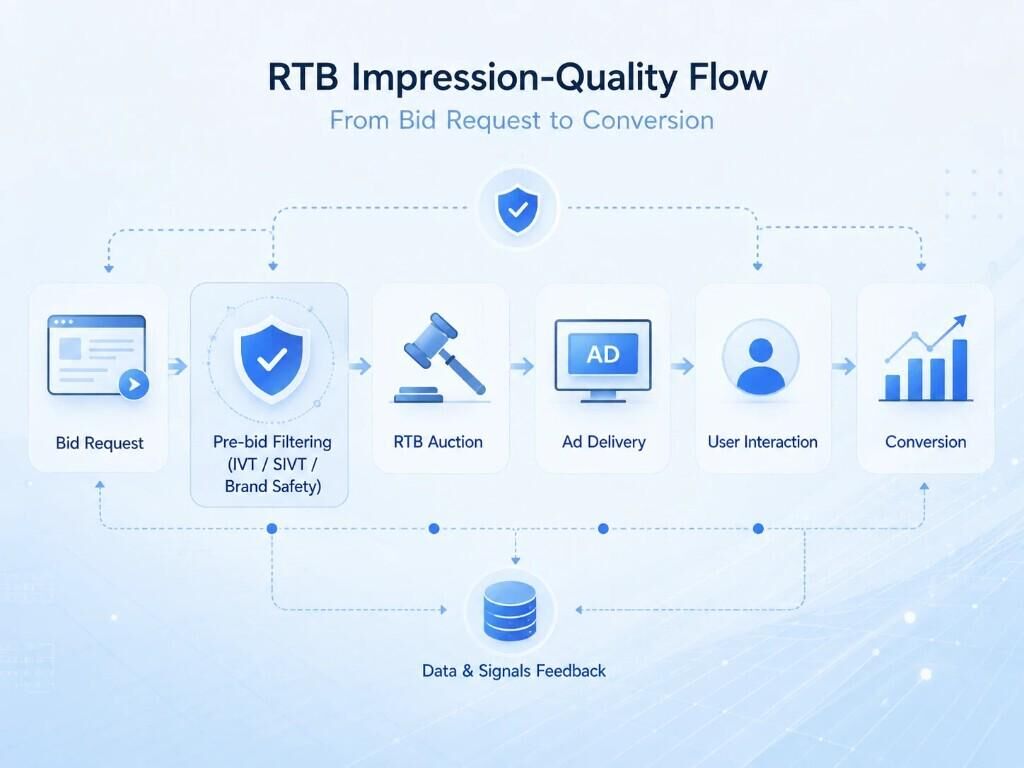
The first question in a programmatic audit should be simple: Is the impression worth bidding on?
Programmatic platforms can access enormous amounts of inventory, but scale does not make every bid request valuable. Invalid traffic, sophisticated invalid traffic, automated browsing, suspicious refresh behavior and Made-for-Advertising environments can consume media budget without producing equivalent business value.
This is why impression quality needs to be addressed before auction optimization. Fraudlogix's 2026 annual analysis examined 105.7 billion impressions collected during 2025 and reported a 20.64% global IVT rate within its dataset. Its Q1 2026 report recorded an 18.12% rate across 26.3 billion impressions. These figures come from Fraudlogix's own measurement methodology rather than representing a universal rate for every programmatic campaign, but they demonstrate why traffic quality remains a material buying issue.
The problem becomes particularly costly when advertisers optimize around surface-level metrics. A placement with a low CPM and high CTR may initially look attractive, but if it produces weak post-click engagement, poor retention or almost no revenue, the cheap impression is not actually cheap.
A stronger audit connects inventory-level signals with business outcomes. Look at domains, apps, publisher IDs and SSPs alongside conversion rate, revenue per user and downstream customer quality. If a supply source consistently produces unusually high engagement but weak post-conversion performance, it deserves closer scrutiny.
Pre-bid filtering is important because post-campaign verification only tells you where waste occurred after the auction has already happened. For buyers, the more valuable decision is whether that impression should have entered the bidding process at all.
IAB Tech Lab's ads.txt standard allows publishers and distributors to publicly declare which companies are authorized to sell their inventory. This helps buyers identify authorized supply and reduce the risk of purchasing misrepresented inventory.
For app campaigns, app-ads.txt provides the equivalent mechanism. For CTV and other fragmented environments, supply-chain transparency becomes even more important because buyers may have limited visibility into the parties involved in selling a bid request.
The practical objective is not to build the biggest possible blacklist. It is to make the DSP more selective about impressions with weak expected value, while protecting the inventory sources that consistently produce legitimate traffic and meaningful conversions.
Fix #2: Calibrate Bid Shading and Optimize for Marginal ROAS
Once low-quality supply has been removed, the next question is whether you are paying the right price for the impressions you win.
This is where programmatic auction mechanics become critical.
In first-price auction environments, the winning buyer generally pays its submitted bid. That makes overbidding a direct margin problem. Bid shading attempts to estimate a lower bid that can still win the impression, rather than automatically submitting the advertiser's maximum bid.
If your bid shading strategy is too conservative or poorly calibrated, you can win inventory while paying more than necessary.
Start by comparing your maximum bid, actual bid, clearing price and publisher floor across SSPs, publishers, placements and audience segments. If your clearing price repeatedly sits close to the maximum bid, investigate whether the bidding strategy is unnecessarily aggressive.
The important point is that win rate should not be treated as the primary success metric. Winning 80% of auctions is not necessarily better than winning 50% if the additional auctions produce weak incremental value.
This is where mROAS, or marginal ROAS, becomes more useful than average ROAS when evaluating scale.
Imagine a campaign has generated $3 million in revenue from $1 million of spend. Its average ROAS is 3.0x. The campaign then receives another $200,000 in budget and generates $360,000 in incremental revenue. The average ROAS still looks healthy, but the marginal ROAS on the additional spend is only 1.8x.
That difference matters because programmatic campaigns often encounter diminishing returns as they scale. The next available impression can be more expensive, less relevant or less likely to convert than the impressions purchased earlier.
A value-based bidding strategy should therefore consider expected conversion value rather than simply maximizing delivery. Where sufficient data is available, downstream revenue, retention or LTV can help distinguish an impression that generates a cheap conversion from one that generates a profitable customer.
The objective is not to win more auctions at any cost. It is to win the auctions that justify their price.
Fix #3: Execute Supply Path Optimization to Cut Hidden Programmatic Waste
A publisher's inventory can reach your DSP through multiple routes.
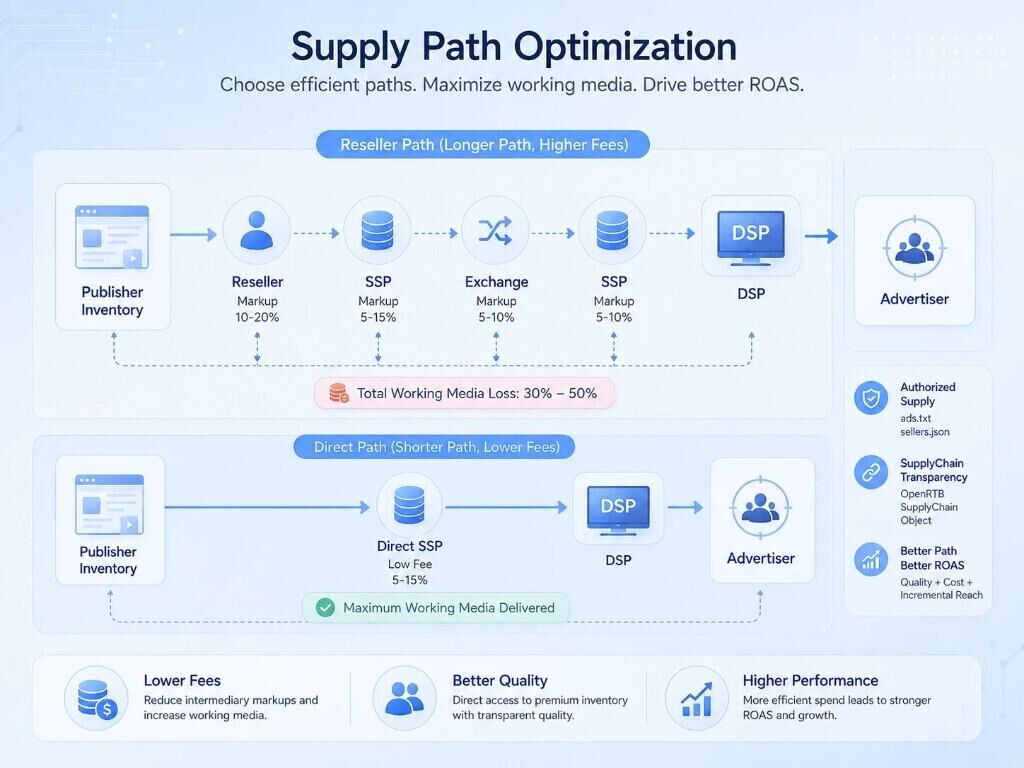
You might access the same publisher through a direct SSP relationship, a reseller, an exchange or another intermediary. Each path may appear as a legitimate supply source inside the DSP, even when several paths ultimately lead to the same inventory.
That creates one of the most important questions in programmatic optimization:
Does every supply path provide incremental value?
Supply Path Optimization, or SPO, is designed to answer that question.
IAB Tech Lab's sellers.json enables buyers to identify entities that are direct sellers or intermediaries in a digital advertising transaction. The OpenRTB SupplyChain Object provides visibility into the parties involved in selling or reselling a bid request. Used together with ads.txt and app-ads.txt, these standards give buyers a much clearer view of how inventory reaches the auction.
The goal is not simply to choose the shortest path. A longer path can sometimes provide incremental inventory or reach. The goal is to determine whether the additional intermediary actually creates enough value to justify its cost.
For example, if two SSPs provide access to the same publisher and one path has a higher clearing CPM, more intermediaries and no incremental conversions, that path becomes a logical candidate for budget reduction. If another path provides unique inventory and stronger downstream performance, its additional cost may be justified.
| Supply Path Signal | What to Compare | Why It Matters |
| Seller / SSP | Spend, CPM and conversion value | Identifies efficient supply partners |
| SupplyChain length | Number of participating nodes | Reveals intermediary complexity |
| ads.txt / app-ads.txt | Authorized seller status | Helps validate inventory |
| Clearing price | Price by supply path | Reveals auction differences |
| Incremental reach | Unique users and inventory | Shows whether a path adds value |
| Revenue / LTV | Downstream customer value | Prevents CPM-only optimization |
IAB Tech Lab explicitly notes that sellers.json and the SupplyChain Object help buyers understand who participates in selling a bid request and support buying inventory as directly as possible.
This is also where Novabeyond's existing educational content can be integrated naturally. When explaining the differences between open auctions, PMPs and more controlled programmatic buying environments, Programmatic Advertising: A Practical Guide for Marketers provides useful supporting context without interrupting the main optimization argument.
The best SPO strategy therefore does not ask, "How many SSPs can we remove?" It asks, "Which supply paths produce the best combination of transparency, incremental reach, auction efficiency and conversion value?"
If your DSP reports show multiple SSPs buying the same publisher inventory, talk to Novabeyond about a supply-path audit.
The objective is not to remove supply blindly. It is to identify which paths actually create incremental value.
Fix #4: Reset Frequency Across CTV, Mobile and Web
Frequency becomes a serious programmatic problem when different buying environments compete for the same user.
A CTV campaign may have its own frequency cap. A mobile campaign may have another. Display retargeting may use a third. When these campaigns operate in separate buying environments, the advertiser may not have a reliable view of total exposure.
Consider a user who receives three CTV impressions, three mobile impressions and five display impressions. Each individual campaign may remain within its own frequency limit, but the user's total exposure has already reached 11 impressions.
At that point, additional impressions may generate very little incremental value.
This is especially relevant for retargeting. A high-intent user can be valuable, but repeatedly bidding for that same user does not necessarily make the user more likely to convert. The advertiser can end up paying for frequency rather than incremental performance.
The solution is to measure response by exposure level. Instead of assuming that a fixed frequency cap works for every campaign, compare conversion probability and revenue after the first, second, third and subsequent exposures. If incremental response declines sharply after a certain point, the buying strategy should reduce bids or suppress that user.
Creative sequencing can also make each exposure more useful. Rather than showing the same performance banner repeatedly, a programmatic journey could move from a CTV awareness message to a mobile product-benefit creative and then to a stronger conversion-oriented offer.
This turns frequency from a simple exposure limit into a sequencing strategy.
Learn Programmatic CTV Advertising insights because CTV works most effectively when exposure is considered alongside broader programmatic activity rather than managed as an isolated buying channel.

Fix #5: Recalibrate Attribution and First-Party Data Integration
The final problem is often hidden inside the conversion signal.
Your DSP may be bidding exactly as designed, but the algorithm can only optimize toward the information it receives.
Suppose an app advertiser's real business objective is 90-day revenue. If the DSP receives reliable install data but incomplete purchase and retention signals, the system has limited information about which impressions generate valuable customers.
It may therefore optimize toward users who install cheaply instead of users who generate strong LTV.
That is not necessarily a bidding problem. It is a conversion-signal problem.
A stronger programmatic measurement architecture connects the impression to progressively deeper events:
Impression → Click → Install → Registration → First Purchase → Retention → Revenue → LTV
For ecommerce, the sequence may look different:
Impression → Product View → Add to Cart → Purchase → Repeat Purchase → Customer Value
The important point is that the DSP should receive the signals that actually distinguish a valuable customer from a shallow conversion.
S2S postbacks and MMP integrations can strengthen this feedback loop, particularly for app campaigns where downstream events such as purchase, subscription, deposit or retention are more meaningful than the install itself.
First-party data can then add another layer of quality.
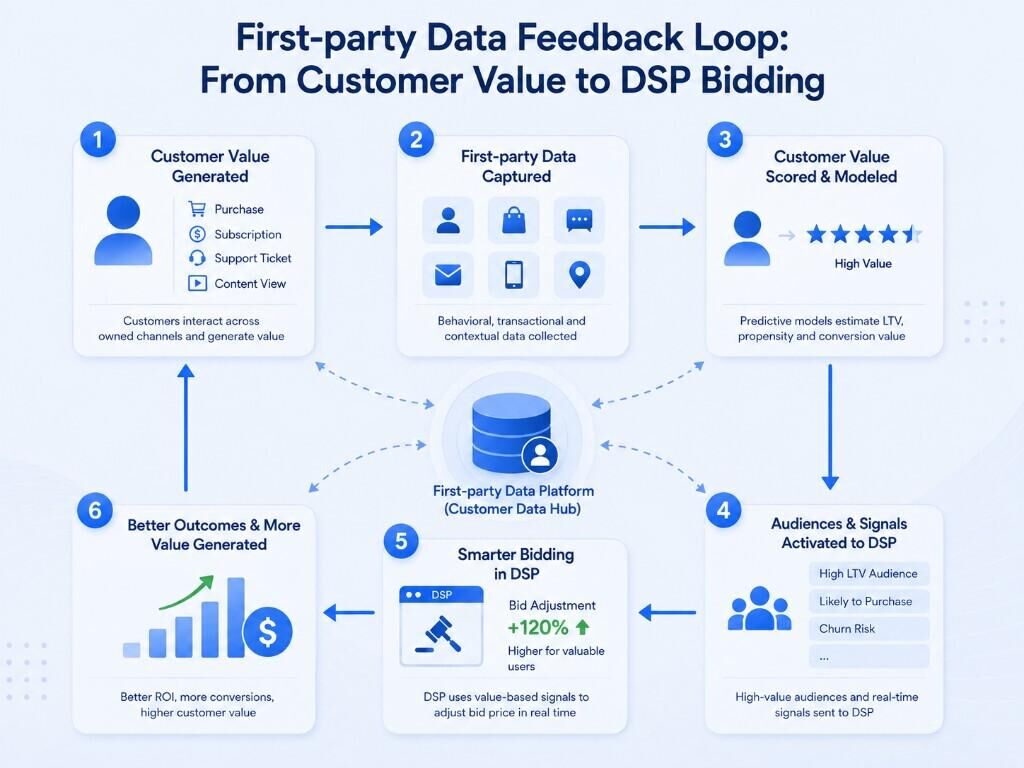
Instead of creating one broad audience containing every converter, advertisers can build a high-LTV customer seed based on actual revenue or retention behavior. A privacy-compliant audience strategy can then use that seed to help identify prospects with characteristics closer to the advertiser's most valuable customers.
The value of first-party data is therefore not simply that it is "first-party." Its value comes from giving the bidding model a better definition of what success looks like.
For advertisers working with limited conversion volume, Novabeyond's Programmatic Advertising strategies for smaller budgets provides relevant context on protecting efficiency when the available data pool is smaller.
For re-engagement campaigns, App Retargeting: Re-Engaging Dormant Users Through Programmatic Advertising can also support the discussion around behavioral events, dormant users and intent-based programmatic retargeting.
2026 Programmatic ROAS Recovery Roadmap
These five fixes should not be treated as isolated campaign changes. They work as a sequence because each stage influences the quality of the data used in the next stage.
Start with inventory quality. If the DSP is bidding on invalid or low-value impressions, improving bid strategy will not solve the underlying problem. Once supply quality is under control, compare bid and clearing prices to understand whether the remaining inventory is being purchased efficiently.
Next, examine the supply path. Use ads.txt, sellers.json, SupplyChain data and DSP log-level performance to determine whether multiple routes are competing to sell the same inventory without creating incremental value.
After that, evaluate cumulative frequency across programmatic environments. Finally, strengthen the conversion feedback loop so the bidding system can optimize toward users who generate actual revenue rather than shallow platform conversions.
| Priority | Fix | Timing | Primary Objective |
| Critical | Pre-Bid IVT & MFA Filtering | Day 1 | Remove low-quality impressions |
| Critical | Bid Shading & mROAS Audit | Day 1–3 | Improve auction economics |
| High | Supply Path Optimization | Week 1–2 | Reduce redundant supply costs |
| High | Cross-Channel Frequency | Week 2 | Reduce saturation and wasted exposure |
| Strategic | Attribution & First-Party Data | Week 2–4 | Improve conversion intelligence |
The sequence can be summarized as:
Clean Traffic → Efficient Auction → Efficient Supply Path → Controlled Exposure → High-Fidelity Conversion Data → Better Marginal ROAS
[Image Idea: Five-stage programmatic ROAS recovery framework | Alt Text: Five data-driven stages to recover programmatic ROAS from inventory quality and auction efficiency to conversion data]
This approach is more useful than simply changing targeting every time ROAS moves down. Programmatic campaigns are dynamic systems. The advertiser needs to understand not only who receives an impression, but which impression was purchased, through which path, at what price, how often, and what value it eventually produced.
FAQ
1. Why can a programmatic campaign have a high win rate but poor ROAS?
A high win rate only shows that the DSP is winning a large proportion of eligible auctions. It does not show whether those impressions are profitable. Check clearing price, inventory quality, supply path, frequency and downstream conversion value before treating win rate as a positive KPI.
2. How can I tell if bid shading is causing me to overpay?
Compare your maximum bid, actual bid and clearing price across SSPs, publishers and placements. If clearing prices consistently approach the maximum bid without generating additional conversion value, review the bidding strategy and auction-level economics.
3. What is the difference between SPO and simply reducing SSPs?
SPO is not about having fewer SSPs for its own sake. It evaluates whether each supply path provides incremental reach, inventory quality or performance relative to its cost. A longer path can still be valuable when it provides unique inventory or stronger results.
4. How do ads.txt, sellers.json and the SupplyChain Object work together?
ads.txt and app-ads.txt identify authorized sellers for publisher or app inventory. sellers.json helps buyers identify the entities behind seller IDs, while the SupplyChain Object shows the parties involved in selling or reselling a bid request. Together, they provide greater transparency into programmatic supply paths.
5. Should I use the same frequency cap for CTV, mobile and web?
Not necessarily. The right level depends on the campaign objective, identity resolution, audience behavior and incremental response. What matters most is understanding cumulative exposure when multiple programmatic channels reach the same users.
6. Is a lower CPM always better in programmatic advertising?
No. CPM measures the price of the impression, not the value created by the impression. A higher CPM can produce better ROAS when it delivers stronger conversion rates, higher LTV, better inventory quality or more incremental reach.
7. What conversion signal should a DSP optimize toward?
The strongest signal is the one that reliably represents business value and can be transmitted with sufficient accuracy and volume. For an app, that could be purchase, subscription, deposit or revenue rather than install. For ecommerce, purchase value and repeat purchase can be more meaningful than clicks.
8. When should I use marginal ROAS instead of average ROAS?
mROAS becomes particularly useful when evaluating additional spend. Average ROAS tells you how the campaign has performed overall, while marginal ROAS shows whether the next dollar is still generating sufficient incremental revenue. This makes it more useful when a programmatic campaign is approaching saturation or scaling into less efficient inventory.
Conclusion
Programmatic ROAS rarely deteriorates because of one isolated campaign setting.
More often, the decline happens somewhere inside the transaction itself. The DSP may be buying low-quality impressions, paying too much to win valuable inventory, accessing the same publisher through redundant supply paths, repeatedly reaching users who have little incremental response left, or optimizing toward conversion signals that do not reflect customer value.
That is why programmatic optimization needs to happen below the campaign level.
Start with the impression. Then examine the auction. Follow the supply path. Measure cumulative exposure. Finally, trace the conversion signal back to the value generated by the customer.
The five fixes in this guide provide a practical recovery sequence: filter poor inventory, improve auction economics, optimize supply paths, control frequency and strengthen first-party conversion signals.
The goal is not simply to achieve a lower CPM or higher win rate. It is to build a more efficient relationship between bid → impression → user → conversion → revenue.
Novabeyond helps advertisers approach programmatic growth as an interconnected system across programmatic buying, emerging media, CTV and direct inventory relationships. When performance starts to deteriorate, the most effective answer is often not another budget increase. It is finding the point where your existing media spend is losing value.
Ready to recover ROAS without simply cutting your media budget?
Novabeyond helps advertisers diagnose programmatic buying mechanics, supply quality, auction efficiency and conversion signals to build a data-driven recovery plan.
more posts

Beyond Google UAC: Rethinking Growth Strategies for Mobile Game Publishers in a Maturing Market
July. 21 2026
LEARN MORE

AI’s Impact on Gaming, Short Drama, and Live Commerce Advertising: Why Traffic Reallocation Is Reshaping App Growth
June. 15 2026
LEARN MORE
Middle East / Southeast Asia / LATAM: Regional Growth Differences & Strategy Guide for Mobile Apps
June. 08 2026
LEARN MORE

E-commerce Apps: A Full-Funnel Advertising Strategy from User Acquisition to Repurchase
June. 03 2026
LEARN MORE