





UNIT 616 6/F KAM TEEM INDUSTRIAL BUILDING 135 CONNAUGHT ROAD WEST SAI WAN HONGKONG.
Copyright © 2026 NOVABEYOND LIMITED (company number 2833487). All rights reserved.
For more than a decade, Google App Campaigns (formerly UAC) have been one of the most effective user acquisition solutions available to mobile game publishers. By combining Google's vast inventory across Search, YouTube, Google Play, Discover, and the Display Network with machine learning-driven optimization, App Campaigns have helped countless gaming companies scale globally.
However, as the mobile gaming industry enters a more mature stage, many publishers are discovering that increasing budgets alone no longer guarantees meaningful growth. User acquisition remains essential, but the challenges surrounding scale, efficiency, retention, and profitability have become significantly more complex.
The reality is that the next phase of growth for mobile gaming will not be achieved by simply spending more within the same platforms. It requires a broader understanding of how market dynamics, player behavior, game genres, and acquisition strategies are evolving.
The Era of Easy Growth Is Over
The mobile gaming industry has changed dramatically over the past several years. What was once a relatively straightforward process of acquiring users through a handful of major advertising platforms has become increasingly competitive and expensive.
Players today have access to thousands of high-quality titles across every genre imaginable. Whether they prefer casual puzzle games, strategy titles, RPGs, simulation games, or social casino experiences, they are constantly exposed to new options competing for their attention. At the same time, publishers are facing rising acquisition costs, stricter privacy regulations, and growing pressure to deliver sustainable returns on marketing investments.
As a result, growth can no longer be measured solely by install volume. Publishers must now focus on attracting users who are more likely to engage, retain, and monetize over the long term. This shift has fundamentally changed how successful user acquisition strategies are built.
Different Game Genres Face Different Scaling Challenges
One of the most common mistakes in mobile marketing is assuming that all games scale in the same way. In reality, each genre presents unique challenges that require different growth strategies.
1.Casual and Hyper-Casual Games
For casual and hyper-casual publishers, scale remains the primary objective. These games often rely on advertising monetization and therefore require large volumes of active users to generate meaningful revenue.
The challenge is that competition for broad audiences has intensified. As acquisition costs continue to rise, maintaining profitable growth becomes increasingly dependent on creative performance, rapid testing cycles, and the ability to continuously discover new user segments. In many cases, audience saturation occurs long before budget limitations are reached.
2. Mid-Core and Strategy Games
Mid-core genres such as strategy, simulation, and 4X games face a different reality. While install volume remains important, long-term player value typically plays a much larger role in overall profitability.
Publishers in these categories often prioritize metrics such as Day-30 retention, payer conversion rates, and lifetime value rather than pure acquisition efficiency. As competition increases among major strategy titles, identifying high-quality users becomes more important than simply generating larger install numbers.
3.RPG and Competitive Multiplayer Games3
Role-playing games and multiplayer-focused titles present another layer of complexity. Success often depends not only on user acquisition but also on community building, social engagement, and ongoing content updates.
In these categories, user acquisition campaigns must work closely with live operations teams to ensure that newly acquired players remain engaged over extended periods. Even highly efficient acquisition campaigns can struggle if retention and player progression systems fail to meet expectations.
4. Social Casino and Real-Money Gaming
Social casino and gaming-related products face additional challenges due to varying market regulations and advertising policies. Publishers operating within these segments must carefully balance acquisition objectives with compliance requirements, market restrictions, and platform-specific guidelines.
As a result, growth strategies often require greater diversification across channels, partnerships, and regional markets compared to other gaming categories.
Why User Acquisition Alone Is No Longer Enough
Many publishers respond to slowing growth by increasing advertising spend. While this approach may generate short-term gains, it rarely addresses the underlying factors limiting performance.
In today's market, sustainable growth depends on multiple interconnected areas.
Creative strategy has become one of the most important competitive advantages in mobile gaming. As algorithms increasingly optimize campaign delivery, creative assets often become the primary differentiator between successful and underperforming campaigns. Publishers that establish structured creative testing processes are often able to outperform competitors with significantly larger budgets.
Retention has become equally important. Acquiring users is expensive, and every improvement in player retention increases the value of acquisition investments. Strong onboarding experiences, effective progression systems, live events, and community engagement initiatives can often generate greater business impact than simply expanding media spend.
Monetization optimization also plays a critical role. Many publishers discover that improving player value through better in-app purchase strategies, ad monetization frameworks, and player segmentation delivers stronger returns than focusing exclusively on acquisition volume.
Expanding Beyond Traditional Tier-1 Markets
Another significant trend shaping the industry is geographic diversification.
While North America, Western Europe, Japan, and South Korea remain important gaming markets, many publishers are increasingly exploring opportunities in Southeast Asia, Latin America, the Middle East, and emerging European regions. These markets continue to demonstrate strong smartphone adoption, growing gaming populations, and expanding digital economies.
However, successful expansion requires much more than localizing store listings or translating advertising creatives. Player behavior, preferred game genres, payment methods, and media consumption habits often vary significantly between markets.
Publishers that adapt their acquisition strategies, creative messaging, and player experiences to local market conditions are often better positioned to achieve sustainable growth in new regions.
Why Diversification Is Becoming a Core Growth Strategy
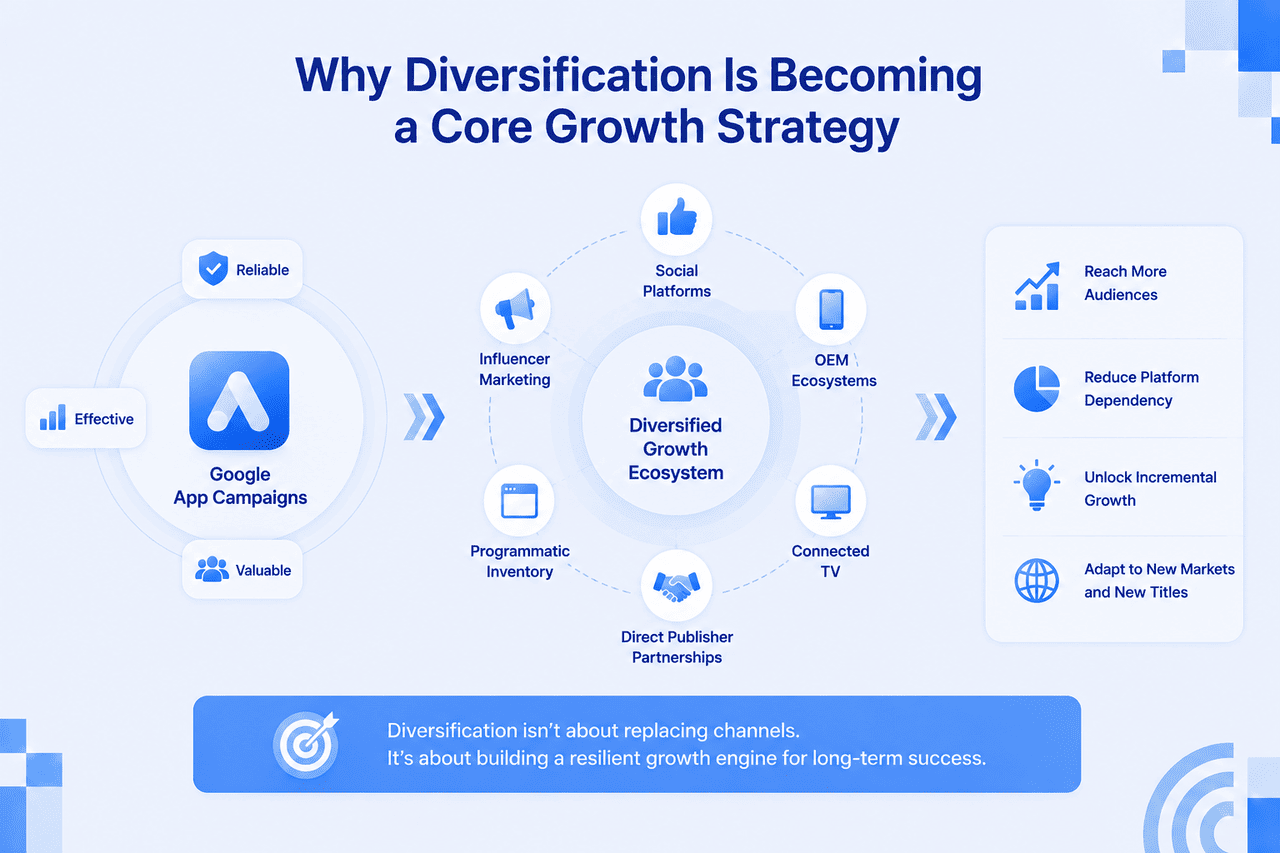
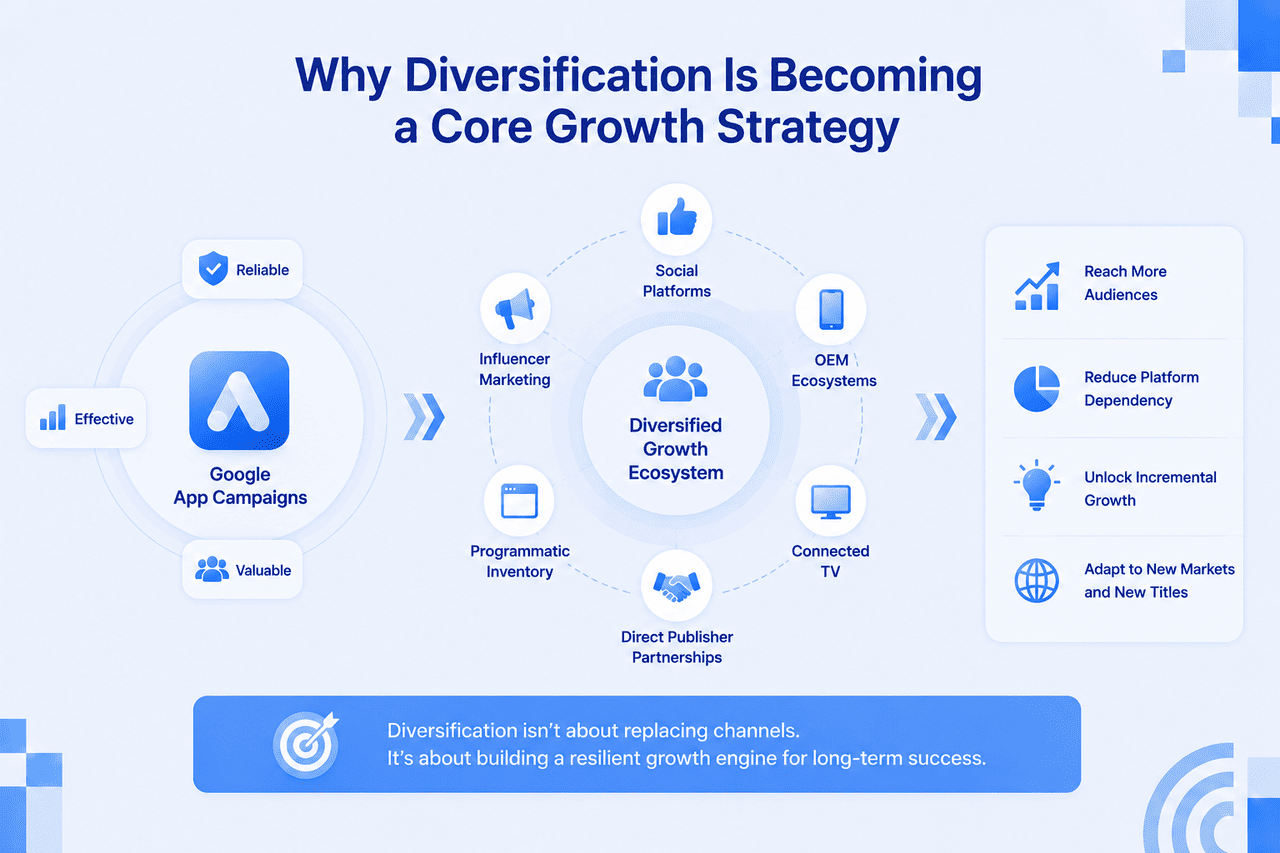
Google App Campaigns remain a valuable component of modern user acquisition strategies, and there is little evidence that this will change in the near future. However, many publishers are increasingly recognizing the risks associated with relying too heavily on any single traffic source.
As acquisition ecosystems mature, diversified growth models are becoming more common. In addition to Google, publishers are incorporating a broader mix of channels, including social platforms, influencer marketing, OEM advertising ecosystems, programmatic inventory, Connected TV, and direct publisher partnerships.
The objective is not to replace one channel with another. Instead, it is to create a more resilient acquisition framework that can reach different audience segments, reduce dependence on individual platforms, and unlock incremental growth opportunities as market conditions evolve.
This diversification also provides greater flexibility when entering new markets or launching new titles, allowing publishers to adjust their acquisition strategies based on specific business objectives.
Building the Next Generation of Mobile Game Growth
The future of mobile game marketing will belong to publishers that think beyond individual channels and focus on building integrated growth systems.
User acquisition will remain important, but it will increasingly operate alongside creative optimization, retention improvement, monetization strategy, localization, community development, and diversified media planning. Companies that successfully align these functions will be better positioned to navigate rising competition and changing market conditions.
Google App Campaigns will continue to serve as a powerful growth engine for many publishers. Yet the companies that achieve the strongest long-term results will be those that view growth as a comprehensive business strategy rather than a platform-specific tactic.
In a maturing mobile gaming market, sustainable scale is no longer about finding a single channel that can deliver unlimited volume. It is about building a balanced, adaptable, and resilient growth framework capable of evolving alongside players, platforms, and global market opportunities.
more posts
Driving Scale in SEA: Why Indonesia and Vietnam Are App UA Growth Hotspots (And How to Win via Programmatic Ads)
October. 15 2026
LEARN MORE


Mastering Mobile User Acquisition for Fintech Apps in 2026: What Actually Works
October. 08 2026
LEARN MORE
Programmatic Advertising vs. Google App Campaigns: How to Drive Incremental UA in 2026
September. 23 2026
LEARN MORE

The Complete Practical Guide to Mobile App User Acquisition in 2026: Bidding, Creatives, and Scaling
September. 22 2026
LEARN MORE