



Copyright © 2026 NOVABEYOND LIMITED (company number 2833487). All rights reserved.
Address: UNIT 616 6/F KAM TEEM INDUSTRIAL BUILDING 135 CONNAUGHT ROAD WEST SAI WAN HONGKONG.
Introduction
Most Moloco Ads campaigns do not struggle because the DSP cannot find users. They struggle because buyers judge the campaign before the optimization model has enough data to work.
This is especially common when teams compare a new ROAS campaign with an install campaign using CPI alone. ROAS optimization is designed to value users according to predicted revenue, so the campaign can accept a higher CPI when it expects stronger downstream value. Cutting the campaign because week-one CPI looks expensive can remove the very signal the model needs to optimize toward revenue.
The same problem appears when teams make too many changes at once. A buyer changes the target, adjusts the budget, replaces the optimization event, blocks inventory, and refreshes creative before the previous change has stabilized. The result is a moving target that becomes difficult to diagnose.
There is also a measurement problem. Platform ROAS and incremental ROAS are not the same metric. Platform ROAS describes the return associated with the campaign's optimization and attribution framework. iROAS asks a different question: how much additional revenue did the advertising actually cause compared with what would have happened without the ads?
That distinction matters when you decide whether to scale.
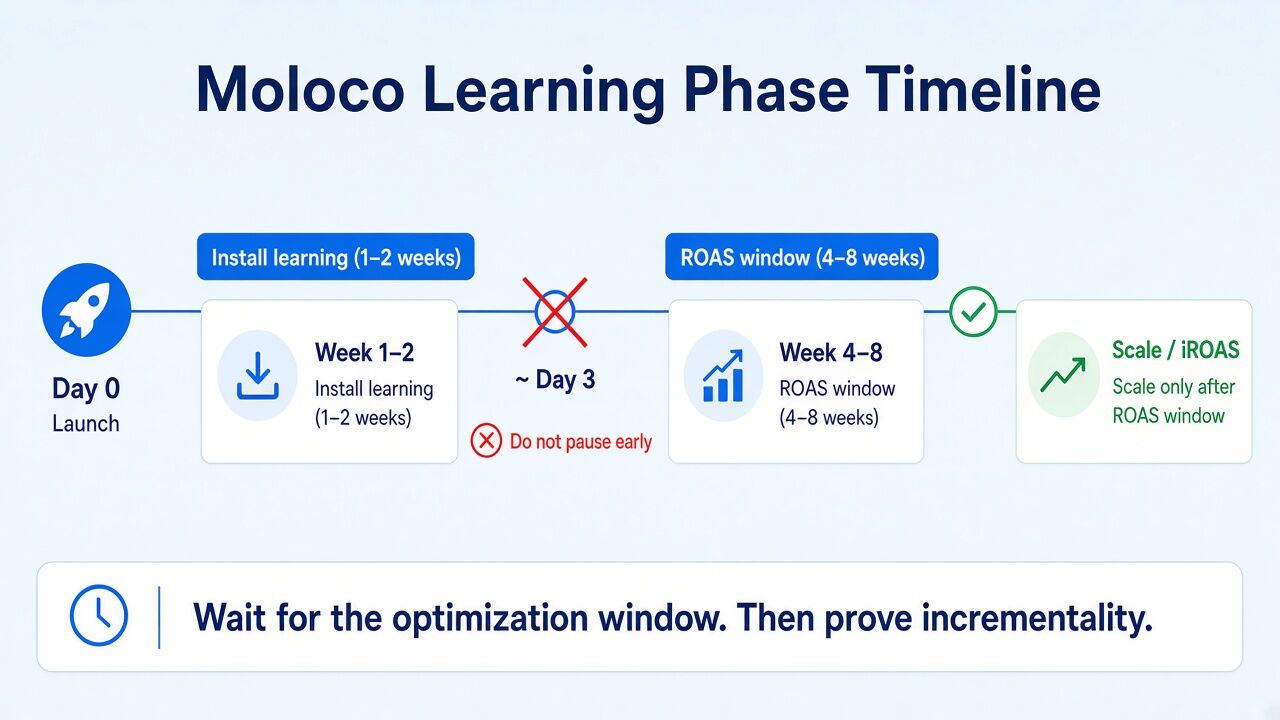
Moloco's campaign-goal guidance recommends roughly one to two weeks for install optimization and four to eight weeks for ROAS optimization, depending on the campaign and the depth of the conversion event. ROAS optimization also requires revenue data through MMP postbacks and full postbacks that include both attributed and unattributed purchase data.
If you still need the launch sequence, start with the step-by-step Moloco DSP launch guide, then use this guide to manage learning, ROAS optimization, and incremental scaling.
Get a Moloco campaign readiness review with Novabeyond
Quick Answer
Moloco Ads optimization should follow the maturity of your data. Start with Install when your MMP signal is new, move to an in-app event when event volume becomes reliable, and use ROAS when you have enough purchase and revenue postbacks to train the model. Moloco recommends roughly one to two weeks for install optimization and four to eight weeks for ROAS optimization. Once platform ROAS is stable, use an incrementality test to determine whether the revenue is truly incremental before increasing spend. Make budget and targeting changes gradually, and give the campaign time to stabilize after each major change.
What the Moloco Learning Phase Actually Measures
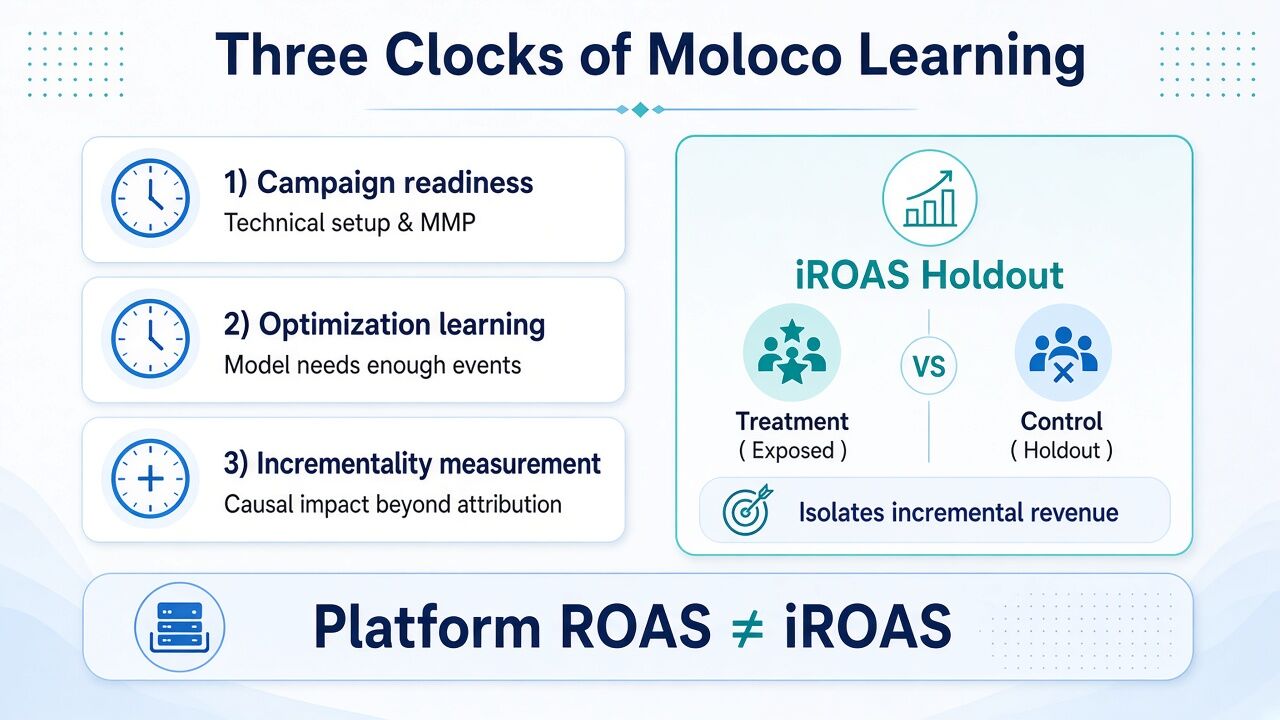
Buyers often use the "learning phase" to describe several different processes. Separating them makes campaign diagnosis much easier.
1. Campaign preparation
The first stage is technical readiness. Before optimization can begin, Moloco needs the campaign configuration, tracking setup, creatives, and relevant MMP data in place. Moloco's quick-start guidance emphasizes MMP integration and full postback settings as core parts of campaign preparation.
This stage should not be confused with performance learning. If a campaign is not ready to deliver because of a tracking, creative, configuration, or account issue, changing the bid will not solve the underlying problem.
2. Optimization learning
The second stage is statistical. Moloco's campaign-goal guidance states that installing optimization usually takes one to two weeks, while ROAS optimization generally requires longer. Moloco recommends four to eight weeks to fully optimize a ROAS campaign.
The deeper the optimization event, the more data the model needs. An install can happen immediately after acquisition. A purchase may happen several days later, and the revenue value of that purchase can vary substantially between users. A ROAS model therefore needs more time to understand which users are likely to generate valuable revenue.
That is why a campaign optimized for revenue should not be judged on the same timetable as a campaign optimized for installs.
3. Incrementality measurement
The third stage is causal measurement. A stable platform ROAS number does not automatically tell you how much incremental revenue the advertising created.
A useful way to think about the difference is:
Platform ROAS = How efficiently the campaign reports or optimizes attributed revenue.
iROAS = How much additional revenue the advertising generates because of the advertising.
Moloco supports incrementality testing and describes incrementality as a way to isolate the impact of advertising beyond existing UA partners.
For advertisers managing multiple paid channels, this distinction becomes increasingly important. A campaign can report strongly attributed ROAS while reaching users who would have converted through another channel or without the campaign.
The practical takeaway is simple: Do not use a day-three CPI result to answer a week-eight ROAS question.
Compare campaigns only after they have accumulated enough data for the optimization objective you are evaluating.
Audit your Moloco campaign goal and measurement setup with Novabeyond
Feed the Model Before You Judge Cost
Moloco's machine learning depends heavily on the event data it receives.
Its performance guidance describes postback data as one of the most important sources for the machine learning engine and recommends sharing as much relevant event data as possible. Full postbacks include both Moloco-attributed and unattributed events, giving the model more information about user behavior.
For ROAS optimization, the requirement becomes even more specific.
Moloco states that ROAS campaigns require full postbacks for in-app purchase events with revenue values. If revenue data is not available through MMP postbacks, ROAS optimization cannot run.
That makes signal quality the first optimization task.
Build the right postback foundation
Before changing a bid, check whether the model is receiving the data it needs.
Revenue must be available for ROAS optimization. If your MMP sends the purchase event but does not send the revenue value, the model cannot distinguish between a low-value purchase and a high-value purchase.
Full postbacks matter. Attributed and unattributed events give Moloco a broader view of user behavior. Moloco's AppsFlyer postback guidance, for example, recommends sharing comprehensive event data rather than limiting postbacks to Moloco-attributed users.
Event volume matters. Moloco notes that if targeted optimization events do not occur frequently enough, the model cannot learn properly.
Postback latency matters. A delayed or inconsistent event stream makes campaign diagnosis harder. If a tracker release changes the timing or volume of events reaching Moloco, investigate the MMP integration before assuming that bidding has deteriorated.
Use one clear optimization objective
The campaign goal should reflect the KPI you actually want the model to optimize.
Do not confuse the optimization event with the reporting conversion metric. Moloco's campaign setup documentation explains that the Conversion Setting is for reporting and does not affect the campaign goal or optimization. For user acquisition and re-engagement ROAS campaigns, the optimization event cannot be changed after the campaign is created. Changes to that reporting metric can take up to 24 hours to appear in Ads Manager.
This distinction is important because changing a reporting metric does not fix an incorrectly selected campaign goal.
Avoid unnecessary targeting restrictions
Moloco's model needs enough opportunity to explore the auction.
Long publisher blocklists, narrow audience restrictions, and overly aggressive traffic controls can reduce the available inventory pool. If delivery is weak, investigate whether the campaign has enough room to learn before making the bid more restrictive.
The same principle applies to creativity. Use a balanced mix of image, video, and native formats where appropriate, and give the model enough creative variation to identify useful combinations.
If delivery changes immediately after an MMP or tracking release, investigate the data pipeline first.
You can also apply the broader signal-diagnostic principles in Novabeyond's programmatic ROAS rescue checklist.
A practical pre-optimization checklist
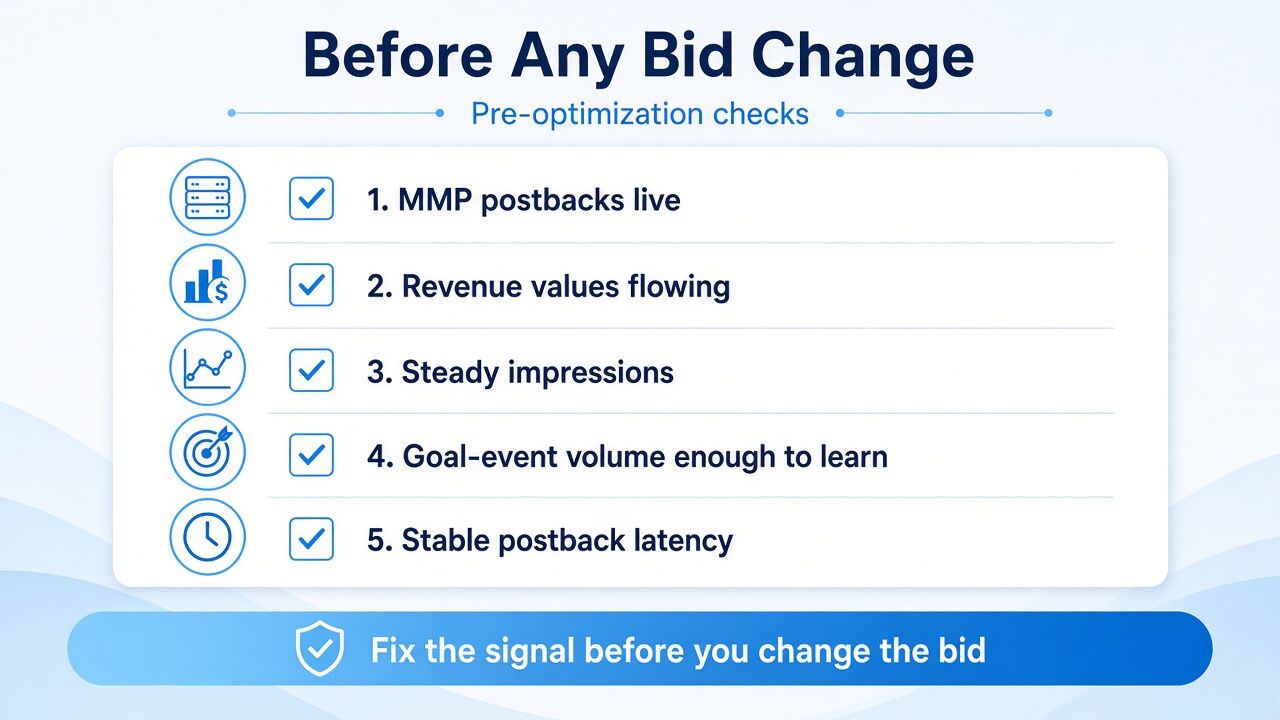
Before changing bids or targets, verify:
| Diagnostic | What to check | Why it matters |
| Delivery | Impressions and spend are arriving consistently | The model needs auction exposure to learn |
| Goal events | Installs, events, or purchases are occurring | Sparse events slow optimization |
| Revenue | Purchase values reach Moloco | Required for ROAS optimization |
| Postbacks | Attributed and unattributed data are available | Broader signals improve learning |
| Latency | MMP and Moloco data remain aligned | Delayed data can distort diagnosis |
| Target | CPI/CPC targets reflect market conditions | Unrealistic targets can restrict spend |
The important point is not to invent a universal conversion threshold.
Moloco does not publish one universal impression or conversion quota that applies to every campaign. The correct volume depends on the optimization goal, app category, market, and event frequency.
Install, Event, and ROAS: When Each Goal Should Take Budget
The optimization goal should match the quality and depth of the data available to the campaign.
For user acquisition, Moloco currently supports Install, In-App Event, and ROAS optimization goals. Re-engagement campaigns have their own set of optimization options.
Install optimization
Install optimization is usually the cleanest starting point when the MMP integration is new or the account does not yet have sufficient post-install data.
Moloco recommends starting with install optimization when the app has less than one week of postback integration history. This allows advertisers to evaluate the model before moving deeper into the funnel.
If you do not yet know the realistic CPI for your app and market, Budget can be a more useful starting point than an aggressive target CPI.
Moloco specifically warns that a target CPI that is too low compared with market price can restrict spending.
In-app event optimization
In-app event optimization becomes useful when the business KPI is a defined action rather than revenue value.
For example, you might optimize toward: registration, first deposit, level completion, subscription start, purchase.
The key distinction is that an event campaign focuses on the probability of the selected event, rather than the monetary value generated by that event.
Moloco provides a useful example: under purchase-based in-app event optimization, a user who purchases $1 and a user who purchases $5 are treated equally as purchase events. Under ROAS optimization, the higher-value purchase carries greater value to the model.
ROAS optimization
ROAS optimization becomes more appropriate when reliable purchase and revenue data are available.
The model is not simply trying to produce the cheapest install. It is trying to identify users whose expected revenue supports the campaign's return objective.
This can produce a higher CPI than an install campaign.
That difference does not automatically mean the ROAS campaign is inefficient.
A campaign acquiring users at $2 CPI with low downstream revenue can be less valuable than a campaign acquiring users at $4 CPI who generate substantially more revenue.
The correct comparison is therefore: CPI → cohort revenue → platform ROAS → incremental revenue
rather than CPI alone.
Moloco's official guidance confirms that ROAS optimization values purchase revenue, while purchase-based event optimization focuses on the likelihood of the purchase event itself.
The optimization decision framework
Use this sequence when deciding where the next dollar of budget should go:
New MMP integration or limited data
Install optimization
Reliable post-install event volume
In-app event optimization
Reliable purchase and revenue postbacks
ROAS optimization
Stable platform ROAS
Incrementality testing
Positive incremental return
Controlled budget scaling
This framework prevents teams from asking a deeper-funnel model to learn from data that does not yet exist.
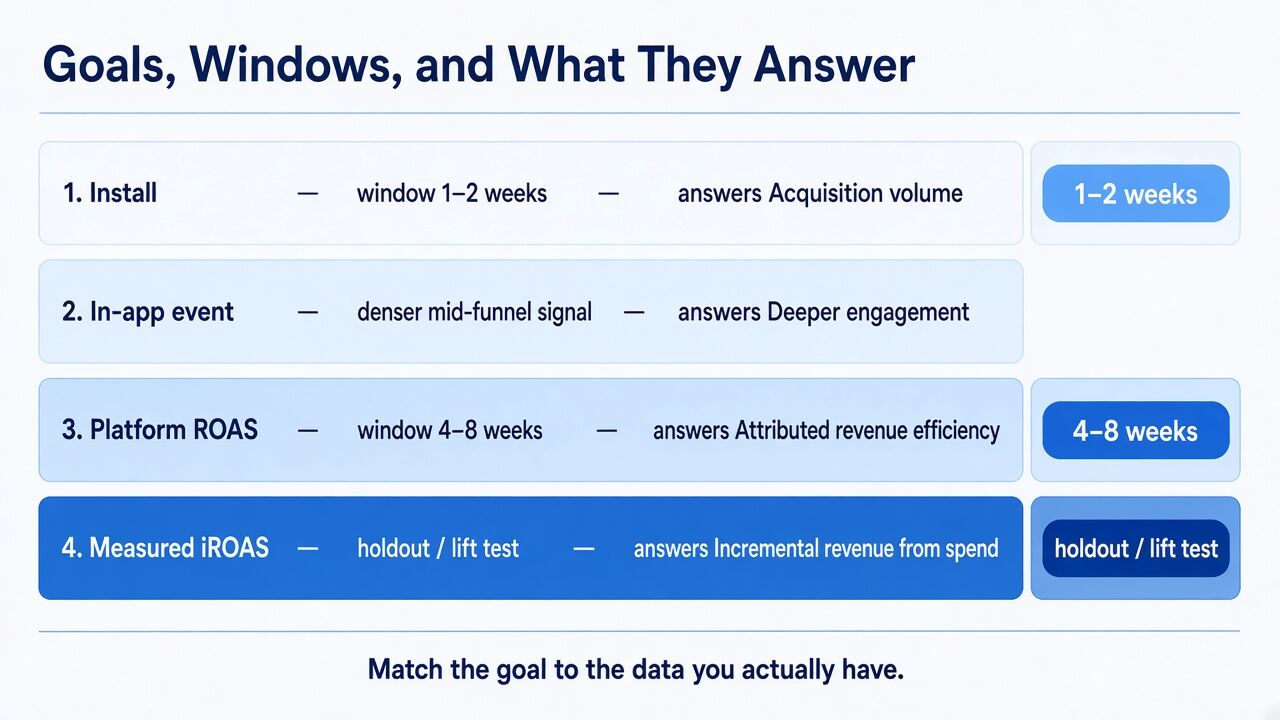
| Goal | What bidding optimizes | Data you must send | Typical optimization window | What it does not prove |
| Install | Install volume under Budget or target CPI | Install postbacks | About 1-2 weeks | Revenue quality or incrementality |
| In-app event | Probability of a selected event | Installs plus target event data | Depends on event depth and volume | Revenue value of each event |
| Platform ROAS | Purchase revenue relative to spend | Full purchase postbacks with revenue | Often 4-8 weeks | Causal lift versus a control |
| Measured iROAS | Incremental revenue divided by media cost | Controlled experiment or incrementality framework | Depends on test design and statistical power | A guaranteed future return |
Moloco explicitly recommends more time for deeper-funnel goals and states that ROAS campaigns typically require four to eight weeks to fully optimize.
When should you move deeper into the funnel?
Move deeper only when the next stage has enough signal to support learning.
If purchase volume is still sparse, forcing a ROAS campaign does not create more purchase data. It simply gives the model a thinner signal. In that situation, an event goal can provide a denser optimization signal while the account builds more purchase history.
Conversely, if the account already has reliable revenue postbacks and the business cares about revenue efficiency, staying on install optimization indefinitely may leave value on the table.
The objective should evolve with the quality of the data.
Keep re-engagement separate
Re-engagement should be managed as a distinct campaign strategy.
The audience, event flow, and measurement logic differ from user acquisition. Keep the user pools and campaign objectives clear enough that you can understand whether the campaign is acquiring new users or bringing existing users back.
Do not allow UA and re-engagement activity to create avoidable overlap and then interpret the resulting attribution as incremental growth.
Scale iROAS Without Disrupting Optimization
Scaling should begin only after the campaign has demonstrated stable performance against its optimization goal.
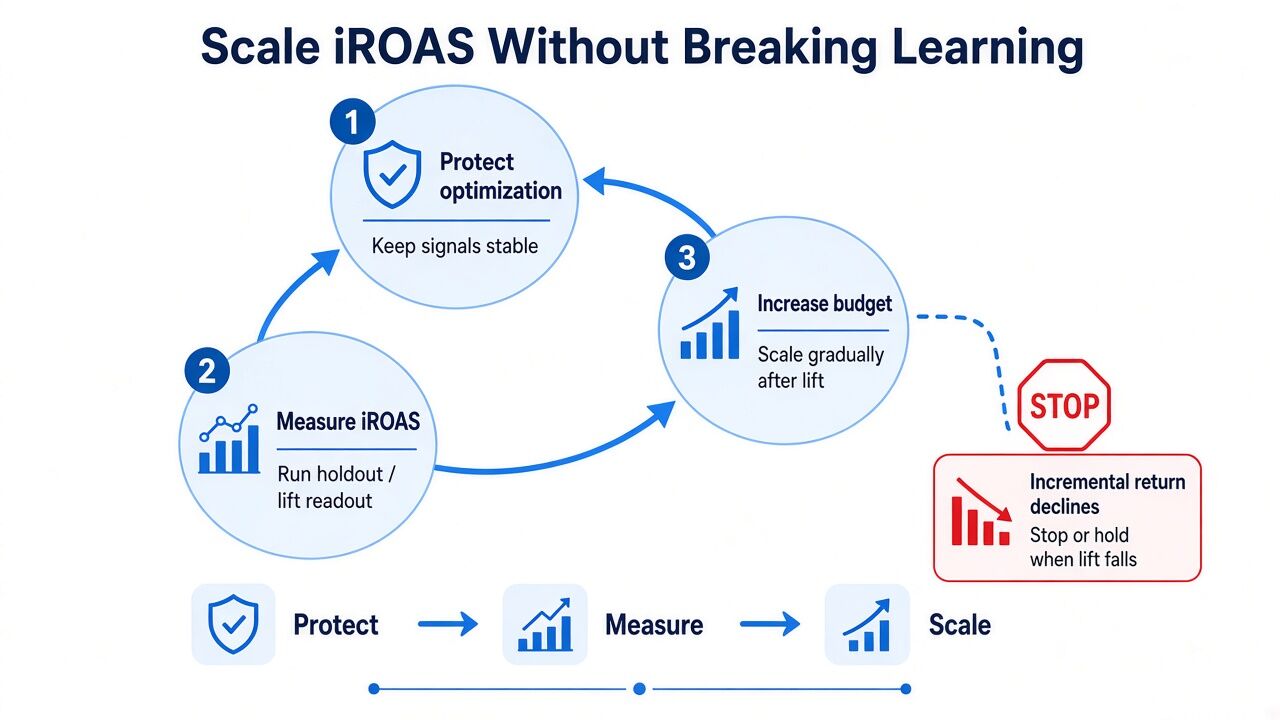
The process has three stages: protect the model, prove incrementality, increase budget gradually.
1. Protect the model
Moloco's agency-managed campaign guidance states that budget and bid-priority changes can temporarily destabilize performance while the model adjusts. It recommends incremental budget changes rather than large one-time increases.
Moloco's broader performance guidance also recommends watching the campaign for about a week after significant changes and advises keeping budget changes within 30% where possible.
That does not mean every campaign must follow one fixed percentage.
The important principle is to avoid making multiple large changes at the same time.
For example:
Bad sequence
Day 1: Increase budget
Day 2: Change target
Day 3: Replace creative group
Day 4: Add a publisher blocklist
Day 5: Judge ROAS
Better sequence
Make one material change.
Allow the campaign to stabilize.
Read delivery and cohort performance.
Then decide whether another change is necessary.
This gives you a much clearer cause-and-effect relationship.
2. Do not confuse platform ROAS with incremental ROAS
A high platform ROAS can still contain conversions that would have happened without the campaign.
Incrementality testing is designed to separate those outcomes.
Moloco currently supports incrementality testing and describes its approach as a way to isolate advertising impact beyond existing UA partners.
For a controlled test, the basic question is: What happened to a comparable group that was not exposed to the advertising?
That means the measurement framework needs to account for:
Treatment and control populations
Test duration
Conversion lag
Revenue windows
Other paid channels
Promotions and seasonality
Statistical significance
Do not call a short-term attribution report an iROAS study.
A day-seven result can also understate value when users normally monetize later. Align the measurement window with the actual business revenue cycle.
3. Scale the spend, not the noise
Once the campaign shows stable ROAS and the incrementality test supports additional spend, increase budget in controlled steps.
After each step, monitor: Spend, Delivery, CPI, Purchase volume, Cohort revenue, Platform ROAS, iROAS, Conversion lag.
If platform ROAS remains stable but iROAS falls as spend rises, the problem is not necessarily that the platform suddenly stopped optimizing. The campaign may be reaching users who are increasingly exposed to your other acquisition channels.
That is why incrementality should remain part of the scaling process rather than being a one-time validation exercise.
4. Treat new markets as new learning problems
A new country can change the auction, user behavior, CPI, purchase rate, and revenue curve.
Do not assume that a campaign that works in one market will scale identically in another.
Where the market represents a materially different acquisition environment, isolate the test so you can understand the new performance curve without contaminating the benchmark of the proven campaign.
For broader channel allocation, see Novabeyond's BIGO, Kwai, and Moloco strategy comparison.
5. Use the right account infrastructure
Cross-border Moloco campaigns can require coordinated account, tracking, payment, and MMP infrastructure.
If your workplace or agency setup is not ready, start with the Moloco ad account guide.
Once the account infrastructure is stable, optimization becomes primarily a question of signal quality, campaign design, measurement, and controlled scaling.
FAQ
1. How long should I wait before judging a Moloco ROAS campaign?
Do not judge a new ROAS campaign using the same timeline as an install campaign. Moloco states that install optimization usually takes one to two weeks and recommends four to eight weeks for a ROAS campaign to fully optimize.
You should also consider conversion lag. If purchases normally occur several days after installation, the latest acquisition cohorts will not yet contain their full revenue value.
2. Why is CPI higher on Moloco ROAS than on an install campaign?
A ROAS campaign values expected purchase revenue rather than simply minimizing CPI. As a result, the campaign can bid more for users who are expected to generate greater downstream value. That means a higher CPI is not automatically a negative signal.
Compare the campaigns using cohort revenue and ROAS, then use incrementality testing when you need to determine whether the additional revenue is truly caused by the campaign.
3. What postbacks does Moloco need before ROAS optimization will run?
Moloco states that ROAS optimization requires purchase postbacks containing revenue data, and that full postbacks should include both attributed and unattributed purchase data.
If the MMP sends purchase events without revenue values, the model does not have the information required for revenue optimization.
4. Can I change the optimization event after a ROAS campaign is live?
No. Treat the optimization goal as a core campaign design decision rather than a reporting setting.
Moloco's campaign setup documentation states that the optimization event on user acquisition and re-engagement ROAS campaigns cannot be changed after the campaign is created. The Conversion Setting used for reporting is separate. That reporting metric can be changed without changing the optimization goal, and reporting changes may take up to 24 hours to appear.
If the business KPI itself has changed, create a new campaign around the new optimization event. Editing the report does not repair a locked goal.
5. Is the ROAS number in Moloco Ads Manager the same as iROAS?
No. Platform ROAS and iROAS answer different questions.
Platform ROAS describes campaign return within the platform's attribution and optimization framework. iROAS measures incremental revenue generated because of advertising compared with a suitable control or holdout.
Moloco supports incrementality testing specifically to help advertisers isolate advertising impact beyond existing UA partners.
6. What should I check first if a new Moloco campaign is not spending?
Start with campaign readiness, bid control, postbacks, and targeting restrictions.
If you use a target CPI or target CPC, make sure the target reflects realistic market conditions. Moloco notes that an overly low target can restrict spend and recommends using Budget when you do not yet know the appropriate market cost. Then confirm that the MMP is sending the expected events and that the campaign has enough opportunity to reach users.
7. What should I check before I change a Moloco bid?
Check the signal before changing the price. Look at:
Whether impressions and spend are arriving consistently.
Whether the selected goal event is occurring.
Whether revenue values are arriving for ROAS optimization.
Whether postbacks include the required data.
Whether postback latency has changed.
Whether your target CPI or CPC is realistic for the market.
If one of these signals is broken, fix the signal first. Moloco's own performance guidance emphasizes event data quality and volume as important inputs for machine learning optimization.
8. How should I increase Moloco budget without disrupting optimization?
Increase budget incrementally rather than making a large one-time jump.
Moloco's agency-managed campaign guidance says that budget changes can temporarily destabilize performance and recommends incremental adjustments to give the optimization model more time to adapt. Its performance guidance also recommends keeping budget changes within 30% where possible and allowing time for performance to stabilize.
After each increase, monitor delivery, cohort revenue, platform ROAS, and iROAS rather than judging the change from one day's performance.
Conclusion
Moloco Ads optimization is not simply a matter of finding a bid that produces the lowest CPI.
The campaign needs the right data, the right optimization goal, enough time to learn, and a measurement framework that distinguishes attributed performance from incremental growth.
Start with Install when the MMP signal is new or post-install data is limited. Move toward an in-app event when a deeper event provides a reliable optimization signal. Use ROAS when purchase and revenue postbacks are strong enough to support revenue optimization. Moloco currently recommends roughly one to two weeks for install optimization and four to eight weeks for ROAS optimization.
Then separate platform ROAS from iROAS. A strong platform ROAS result tells you that the campaign is generating valuable attributed revenue within its optimization framework. An incrementality test helps answer the harder business question: how much of that revenue would not have happened without the advertising?
Finally, scale gradually. Protect the optimization model. Make controlled budget changes. Watch cohort revenue instead of relying on same-day results. Test incrementality before assuming that additional attributed revenue equals additional business growth.
For advertisers managing cross-border acquisition, complex MMP setups, and multiple paid channels, the difference between a campaign that spends and a campaign that scales profitably often comes down to signal quality and measurement discipline.
Novabeyond supports that process through Emerging Media Solutions, combining agency ad account infrastructure, MMP checks, campaign-goal design, optimization strategy, and controlled growth planning.
If your Moloco campaign is stuck in week-one CPI debates, start by checking the signal and the optimization goal. The next scaling decision should come from clean data, not another round of reactive changes.
more posts
Kwai Ads vs. SnackVideo Ads: 2026 Allocation Matrix for LATAM & Southeast Asia
September. 28 2026
LEARN MORE

Why NewsBreak is the Essential US UA Growth Engine in 2026: Platform Guide & Performance Analysis
September. 24 2026
LEARN MORE
Navigating Media Accessibility in Media Growth: Bottlenecks & Solutions
September. 23 2026
LEARN MORE
MediaGo Ads Not Delivering? Zero-Traffic Checklist to Restore Spend in 2026
September. 17 2026
LEARN MORE