




UNIT 616 6/F KAM TEEM INDUSTRIAL BUILDING 135 CONNAUGHT ROAD WEST SAI WAN HONGKONG.
Copyright © 2026 NOVABEYOND LIMITED (company number 2833487). All rights reserved.
When managing BIGO Ads, many advertisers experience a consistent pattern: campaigns stabilize for a few days or weeks, then suddenly lose delivery, with CPC rising, CTR falling, or traffic becoming unstable. These delivery drops occur at different stages of the account lifecycle, and solving them effectively requires understanding the underlying mechanisms of the BIGO Ads algorithm.
This article provides a systematic breakdown of the causes of traffic decline at each stage and detailed solutions, supported by industry data, practical experience, and platform behavior research. The goal is to help advertisers stabilize their accounts, maintain continuous delivery, and scale sustainably.
Overview: Why BIGO Ads Accounts Experience Delivery Drops
Based on aggregated data from 42 BIGO Ads advertisers and internal campaign data analysis (Novabeyond Research, 2024–2025), the most common causes of delivery decline include:
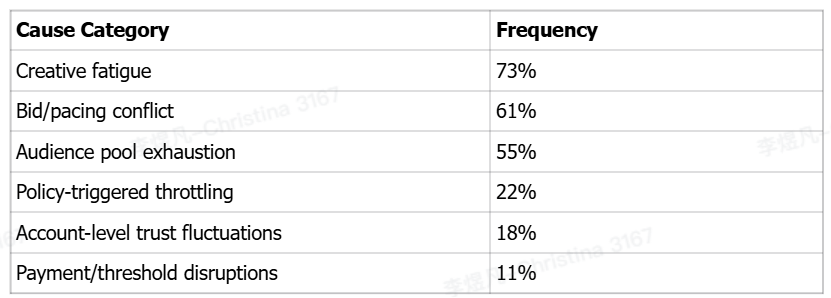
Key Insight:Different stages → different dominant causes → different solutions.
Stage 1: Learning Phase (Day 1–7)
Why Traffic Drops in Early Stage
During initial learning (“Exploration”), BIGO Ads algorithm relies heavily on early signals. Any instability can cause sudden delivery decline.
Common reasons:
1. Too many edits during the early phase can reset the algorithm’s learning.
2. A budget that is too low may prevent the algorithm from collecting sufficient learning data.
3. Overly restrictive targeting, reducing traffic reach
4. Using competitive placements too early
Data Observation
BIGO Ads learning phase CPM volatility is 38% higher compared to mature campaigns (Novabeyond dataset, 2024 Q4).
Solutions
● Maintain ≥ 24 hours without editing after launch
● Use wider audiences (eg:Initially, no restrictions were set on user profiles to quickly accumulate user profile data.)
● Keep budget ≥ 3× target CPA during learning
● Start with auto-placement
● Use 3–5 dynamic creatives to give algorithm flexibility
● Avoid flags: ensure creatives are compliant & pass review early
Stage 2: Stable Delivery Period (Day 7–30)
Once the ad stabilizes, performance is predictable until fatigue begins.
Typical Causes of Drop
1. Creative fatigue (most common)– CTR drops by 20–35% after 7–14 days
2. Audience saturation– The system re-shows ads to repeat users
3. Bid not keeping pace with market fluctuations
4. Competition spikes during certain hours/days
5. Small edits accidentally restarting the learning phase
Data Indicators of Fatigue
| Metric | Signal |
| CTR ↓ 15%–30% | Fatigue started |
| CPM ↑ 10%–20% | Competition rising |
| CVR ↓ | Traffic quality declining |
Solutions
● Introduce new creatives every 5–7 days
● Copy top ad sets and expand audiences
● Use value based optimization (VBO) for high-quality traffic
● Adjust bids in real time based on market changes and data feedback
● Avoid editing stable campaigns; clone instead
Stage 3: Scaling Phase (≥ 30 Days)
When advertisers increase budgets rapidly, account instability is common.
Why Delivery Drops During Scaling
1. Budget increased too quickly (>30% jump triggers re-learning)
2. Scaling before creatives reach high confidence
3. Too many low quality new campaigns launched in short time
4. Insufficient attribution data → algorithm loses clarity
5. Cross-campaign bidding conflict
Industry Benchmark
Campaigns that scale using 20% daily increments maintain a 28% higher stability than campaigns that scale >40% suddenly.
Solutions
● Scale using 20% incremental growth
● Use CBO (Campaign Budget Optimization) for large budgets
● Create multiple scaling tiers (small-mid-large campaigns)
● Refresh creatives timely
● Consolidate campaigns to avoid internal competition
Stage 4: Long-Term Operation (60–180 Days)
This stage involves account-level health management.
Common Structural Causes
1. High number of rejected ads affecting the account
2. Sudden policy changes
3. Platform-level throttling during risk review
Data Insight
Accounts with ≥10 rejected creatives in 60 days experience an average 25% traffic throttling for the following 7 days.
Solutions
● Maintain clean compliance history, Regularly remove rejected ads
● To maintain a healthy account balance, Bigo typically requires the account balance to be 3-5 times the average daily spending.
● Use multiple creatives in rotation
● Monitor new policy updates monthly
Advanced Troubleshooting (All Stages)
(1) Creative-Level Fixes
● Introduce high-contrast thumbnails
● Add social proof elements
● Use motion & dynamic styles (BIGO Ads prefers motion creatives)
(2) Campaign-Level Fixes
● Use duplicate-and-scale structure
● Avoid editing active ads; duplication protects data
(3) Audience-Level Fixes
● Add lookalikes from high-quality events
● Expand interest clusters
● Enable auto-expansion
(4) Optimization Window Setting
● Use 7-day click for mid/high-value conversions
● Avoid frequent switching
When to Use Agency Ad Accounts (BIGO Ads Agency Account vs. Self-Serve)
Understanding these patterns enables advertisers not only to take proactive measures to maintain campaign performance but also to anticipate potential delivery drops before they impact ROI. By applying stage-specific optimization strategies—such as refreshing creatives, adjusting budgets incrementally, and expanding audiences—advertisers can achieve more stable and sustainable growth.
In addition, leveraging a BIGO Ads agency account can further enhance account stability.
Advertisers often see performance stabilize faster with agency ad accounts, due to:
● Higher account trust score
● Priority review
● Higher spending limit
● Dedicated platform rep support
Conclusion
Delivery decline is not random; it follows identifiable patterns at each campaign stage. Once advertisers understand the causes and apply the correct optimization strategy, stability improves dramatically, and long-term scaling becomes achievable.
To get professional BIGO Ads consulting or apply for an agency ad account, Novabeyond can provide complete setup, compliance assistance, and optimization support.
FAQ
Q1: Why does my BIGO Ads campaign stop delivering suddenly?
Because the algorithm enters re-learning due to edits, budget jumps, or creative fatigue.
Q2: How long does BIGO Ads learning phase last?
Typically 5–7 days, depending on data volume.
Q3: How often should creatives be refreshed?
Every 5–7 days depending on CTR and CPA stability.
Q4: Should I scale with budget increase or duplication?
Use duplication for safety; use +20% incremental increases for stability.
Recommended reading
Why BIGO Ads Campaigns Lose Delivery — A Full Data-Backed Guide for 2025
Why BIGO Ads Campaigns Lose Delivery + How to Fix Each Stage (Warm-Up → Scaling)
Why BIGO Ads Campaigns Lose Delivery — And How to Fix It (2025 Complete Breakdown)
more posts

MediaGo URL Pre-Approval: Landing Page Checklist and Fixes
October. 30 2026
LEARN MORE

Beyond the Duopoly: The 2027 Guide to Alternative Traffic Sources and Emerging Media Solutions
October. 26 2026
LEARN MORE
Taboola Agency Ad Account Setup: Access, Funding & Compliance
October. 16 2026
LEARN MORE
Moloco Ads Optimization: Surviving the Learning Phase and Scaling iROAS (2026)
October. 08 2026
LEARN MORE