




Copyright © 2026 NOVABEYOND LIMITED (company number 2833487). All rights reserved.
Address: UNIT 616 6/F KAM TEEM INDUSTRIAL BUILDING 135 CONNAUGHT ROAD WEST SAI WAN HONGKONG.
If you've run ads on both TikTok and Meta, you've probably felt it: the two platforms demand completely different mindsets. On Meta, a seasoned media buyer can take mediocre creative and engineer a profitable campaign through sheer structural discipline: the right campaign objective, the right audience segmentation, and the right bidding strategy. On TikTok, even seasoned Meta media buyers watch technically perfect campaigns flatline, while rough, unpolished creator videos quietly generate 10x ROAS.
This isn't a coincidence. It's a product of how each platform was built, how its algorithm works, and, most importantly, what users actually came there to do.
1. The Algorithm Is the Audience
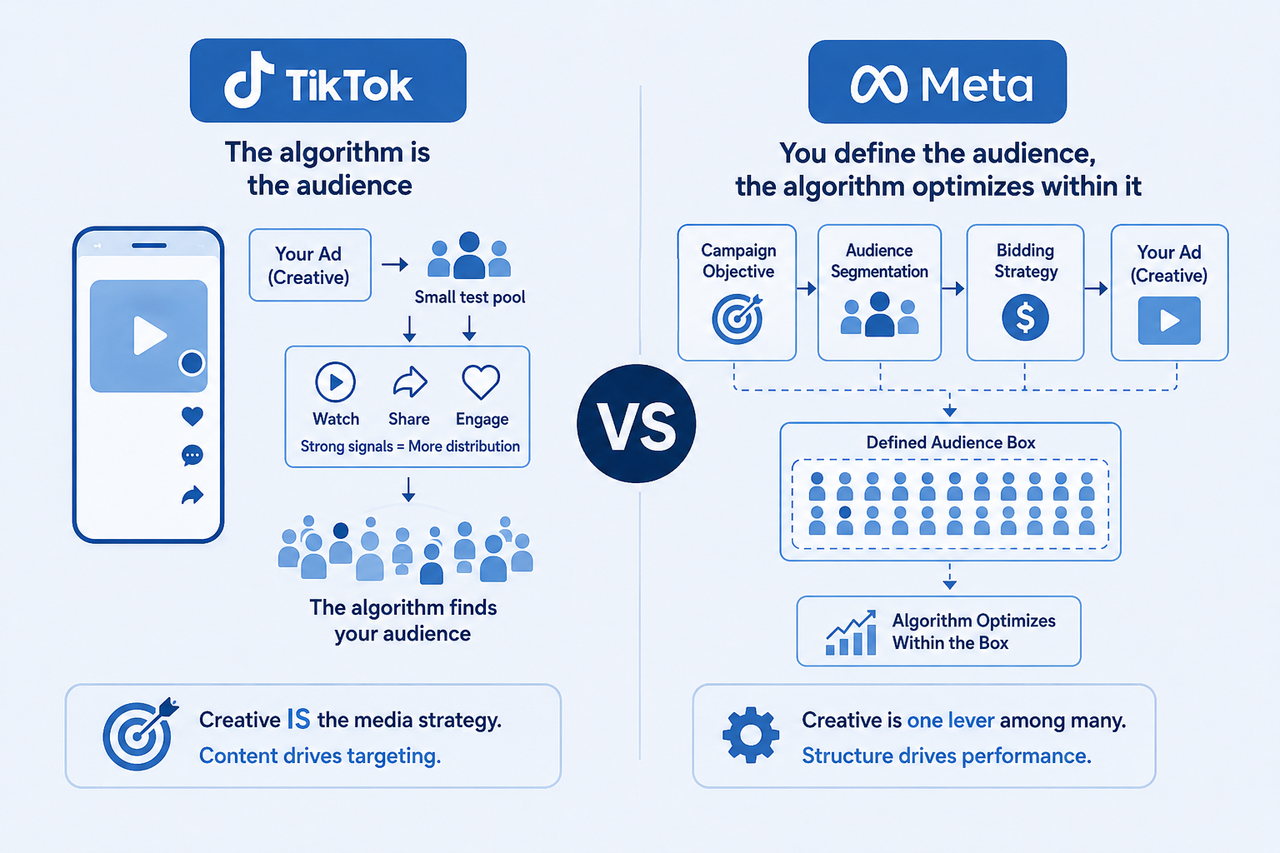
The most important thing to understand about TikTok is that the algorithm doesn't care who you target. Unlike Meta, where you're essentially buying access to an audience you defined, TikTok's distribution model is closer to organic content: your ad gets seeded to a small test pool, and if people watch it, share it, or engage with it, TikTok pushes it further. If they don't, it dies.
This has a radical implication: your creative is your targeting. A video about skincare for women in their 30s doesn't need precise demographic targeting. TikTok will find the right people if the content resonates. The algorithm reverse-engineers the audience from the signal the creative generates.
Meta, by contrast, is a permission-based system. You're buying access to defined audiences in defined placements. The algorithm optimizes within the box you build. Build a bad box with the wrong audience, wrong objective, or wrong funnel stage, and even great creative will underperform. Build a smart box, and the system does heavy lifting for you.
The implication: On TikTok, creative is the media strategy. On Meta, creative is one lever among many.
2. Native vs. Interruptive Formats
Meta's core ad formats (image, carousel, and video) are interruptive by nature. A user scrolling their Facebook or Instagram feed encounters your ad as a deliberate break from organic content. There's an implicit contract: users know these are ads, and they evaluate them as such.
TikTok ads works differently. Ads appear in a stream that users are already conditioned to receive as an infinite sequence of short videos from strangers. There is no visual border, no "sponsored" banner prominent enough to break the spell. If your ad looks and feels like TikTok content, users engage with it as TikTok content.
This is why the industry coined "TikTok-native creative" as a term, but you never hear "Instagram-native creative." On Instagram, the gap between organic and paid is understood and accepted. On TikTok, closing that gap is the entire creative challenge.
The implication: TikTok demands content that earns attention on its own terms. Meta rewards content that communicates value efficiently within a known ad format.
3. User Intent: Lean-Back vs. Lean-In
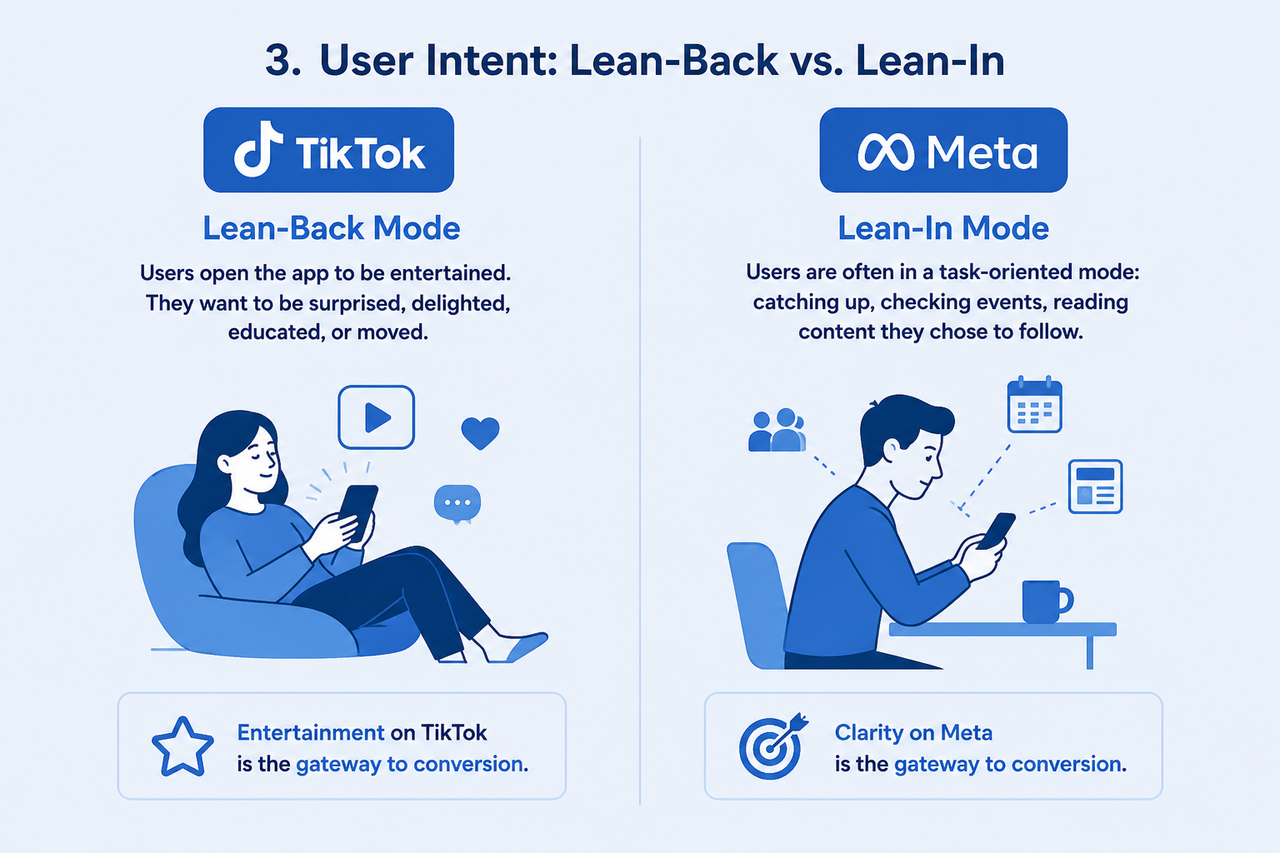
Think about the state of mind a user brings to each platform.
• TikTok users open the app to be entertained. They are in a passive, receptive, lean-back mode. They want to be surprised, delighted, educated, or moved. Deliver that, and they'll give you their full-screen, audio-on attention.
• Meta users (especially on Facebook) are often in a lean-in, task-oriented mode: catching up on people they know, checking events, reading content they chose to follow. Instagram is more passive, but even there, the expectation of entertainment is lower than TikTok.
This distinction shapes what "good creative" means on each platform. On TikTok, the highest-performing ads often feel like entertainment that happens to sell something. On Meta, the highest-performing ads often feel like clear, compelling offers that make it easy to act.
Entertainment on TikTok is the gateway to conversion. Clarity on Meta is the gateway to conversion.
4. The Hook Asymmetry
On TikTok, you have roughly 1–3 seconds before a user swipes. The hook (the opening frame, the first words, the visual pattern interrupt) is everything. TikTok's own internal data consistently shows that the first 3 seconds determine the majority of a video's performance. Changing the hook alone, while keeping the rest of the video identical, can double or triple results.
This creates what practitioners call the "creative lottery" dynamic: you often don't know which hook will work until you test it in the wild, because hook effectiveness is partly a function of cultural moment, algorithm cohort, and viewer psychology that no amount of pre-testing fully predicts.
Meta is more forgiving on hook mechanics. Because users encounter your ad already knowing it's an ad, their threshold for giving it a few more seconds is higher. Meta's algorithm also does more work smoothing over weak creative if structural elements (audience, objective, bid) are strong.
The implication: TikTok demands aggressive, iterative creative testing at the hook level. Meta rewards systematic structural optimization as much as creative iteration.
5. Creative Fatigue at Different Speeds
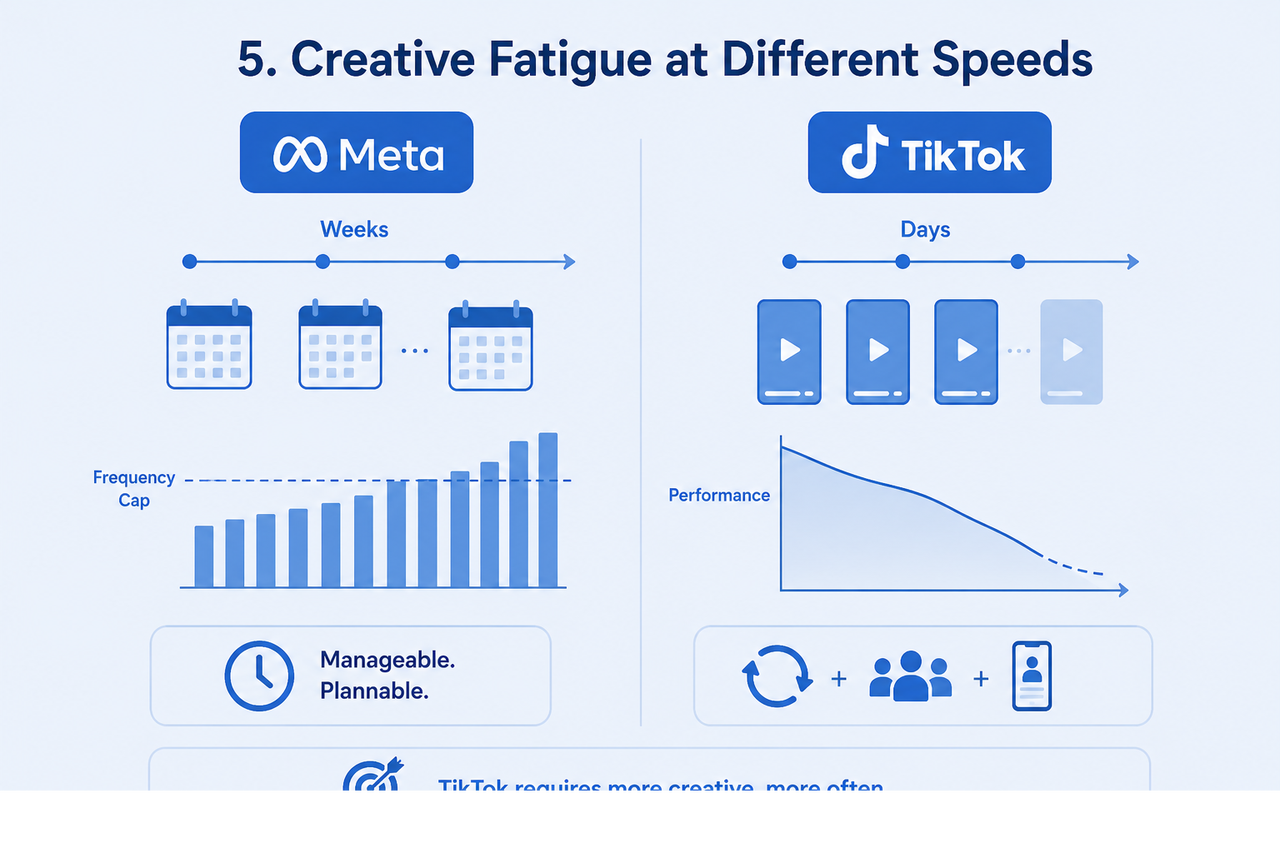
On Meta, a well-built audience can sustain a creative for weeks before frequency becomes a problem. Sophisticated buyers monitor frequency caps and rotate creative on a predictable schedule. This is manageable, plannable work.
On TikTok, creative fatigue is brutal and fast. The platform surfaces content based on engagement signals, and once a piece of content has been seen by the people most likely to engage with it, performance drops sharply. There is little you can do structurally to rescue a fatigued creative. The only answer is new creative.
This creates a creative volume problem that's unique to TikTok: brands need a higher volume of diverse creative assets, refreshed more frequently, to maintain performance. This is why TikTok's ecosystem gave rise to creator-partnerships, UGC (user-generated content) models, and the creator marketplace. Brands simply cannot produce enough polished studio content at the cadence TikTok requires. The solution was to bring in people who create natively and quickly.
6. What "Structure" Actually Means on Meta
When we say Meta rewards structure, we mean a specific set of decisions that compound over time:
• Campaign objective selection: Whether you optimize for awareness, traffic, leads, or purchases changes how the algorithm bids on your behalf and which users it pursues. Getting this wrong is expensive.
• Audience architecture: Cold prospecting vs. warm retargeting vs. lookalikes require different messaging, different budgets, and different creative.
• Funnel construction: Knowing what a user needs to see at each stage before they're ready to convert.
• Bidding strategy: Cost caps, bid caps, and highest-volume bidding behave very differently in different account maturities.
• Signal quality: Meta's algorithm is only as good as the conversion signals you feed it via the Pixel or CAPI. Brands with clean, complete server-side signals systemically outperform those without.
None of these structural elements matter on TikTok in the same way. TikTok's campaign structure is simpler by design, because the heavy lifting happens at the creative layer, not the setup layer.
7. The Creative-Structure Spectrum
It's worth saying clearly: this isn't an either/or. Both platforms care about both creative and structure. The question is the weighting.
A useful mental model:
| Dimension | TikTok | Meta |
| Primary lever | Creative | Structure |
| Algorithm behavior | Content-first distribution | Audience-first delivery |
| Format contract | Native / entertainment | Interruptive / ad |
| Hook importance | Critical (1–3 sec) | High but more forgiving |
| Creative fatigue speed | Fast | Moderate |
| Targeting control | Low (algorithm-led) | High (buyer-led) |
| Volume of creative needed | High | Moderate |
| Key optimization skill | Ideation + testing velocity | Funnel design + signal quality |
8. Practical Takeaways for Marketers
If you're running TikTok:
• Invest in creative infrastructure before media budget. A bigger budget on weak creative doesn't work; it just burns faster.
• Test more hooks than you think you need. Three versions of the same video with different opening 3 seconds is a legitimate test plan.
• Partner with creators and media buyers who understand the platform natively. Their instincts about what feels "TikTok" are worth more than a polished studio production.
• Build a pipeline, not a campaign. TikTok advertising is a content production operation with a media budget attached.
If you're running Meta:
• Audit your structure before assuming creative is the problem. A misaligned campaign objective or a dirty pixel will sink good creative.
• Invest in signal quality before scaling, specifically server-side API integration and clean conversion event mapping.
• Think in funnels, not ads. A cold audience needs different messaging than someone who visited your product page.
• Creative still matters enormously; but creative alone won't fix structural problems.
Conclusion: Know What Game You're Playing
The marketers who struggle most are those who bring their Meta playbook to TikTok, or their TikTok mindset to Meta. They optimize the wrong thing, measure the wrong metrics, and draw the wrong conclusions.
The underlying logic is simple: Meta is an advertising system that also shows content. TikTok is a content system that also shows ads. Everything follows from that.
On Meta, the smartest advertiser wins. On TikTok, the most creative one does. In practice, the best brands figure out how to be both, building teams and processes that serve each platform on its own terms.
more posts
Diversified Acquisition Strategies for Global Advertisers: A Framework for Evaluating New Channels
September. 11 2026
LEARN MORE

The Hidden Cost of Platform Dependency: What One Policy Change Can Destroy
August. 27 2026
LEARN MORE
How Incremental Growth Is Changing Performance Marketing
August. 25 2026
LEARN MORE
Incremental Growth Thinking: Why User Acquisition Must Go Beyond ROAS
August. 24 2026
LEARN MORE