




Copyright © 2026 NOVABEYOND LIMITED (company number 2833487). All rights reserved.
Address: UNIT 616 6/F KAM TEEM INDUSTRIAL BUILDING 135 CONNAUGHT ROAD WEST SAI WAN HONGKONG.
Native advertising is no longer just a “recommended articles” widget sitting below publisher content. Platforms like Taboola, Outbrain, and MediaGo have evolved into large-scale traffic acquisition ecosystems used by e-commerce brands for customer acquisition, content distribution, and performance marketing.
Although all three platforms distribute ads within editorial-style environments, they function very differently when it comes to traffic behavior, optimization systems , creative strategy , audience intent and conversion suitability.
Note: Parts of the native advertising industry have gone through acquisitions and consolidation over recent years. However, advertisers and media buyers still commonly refer to these platforms by their historical market names, so this article continues using MediaGo, Taboola, and Outbrain for simplicity and industry familiarity.
Taboola: Scale and Conversion Efficiency
Taboola is best understood as a scale-first native advertising platform.
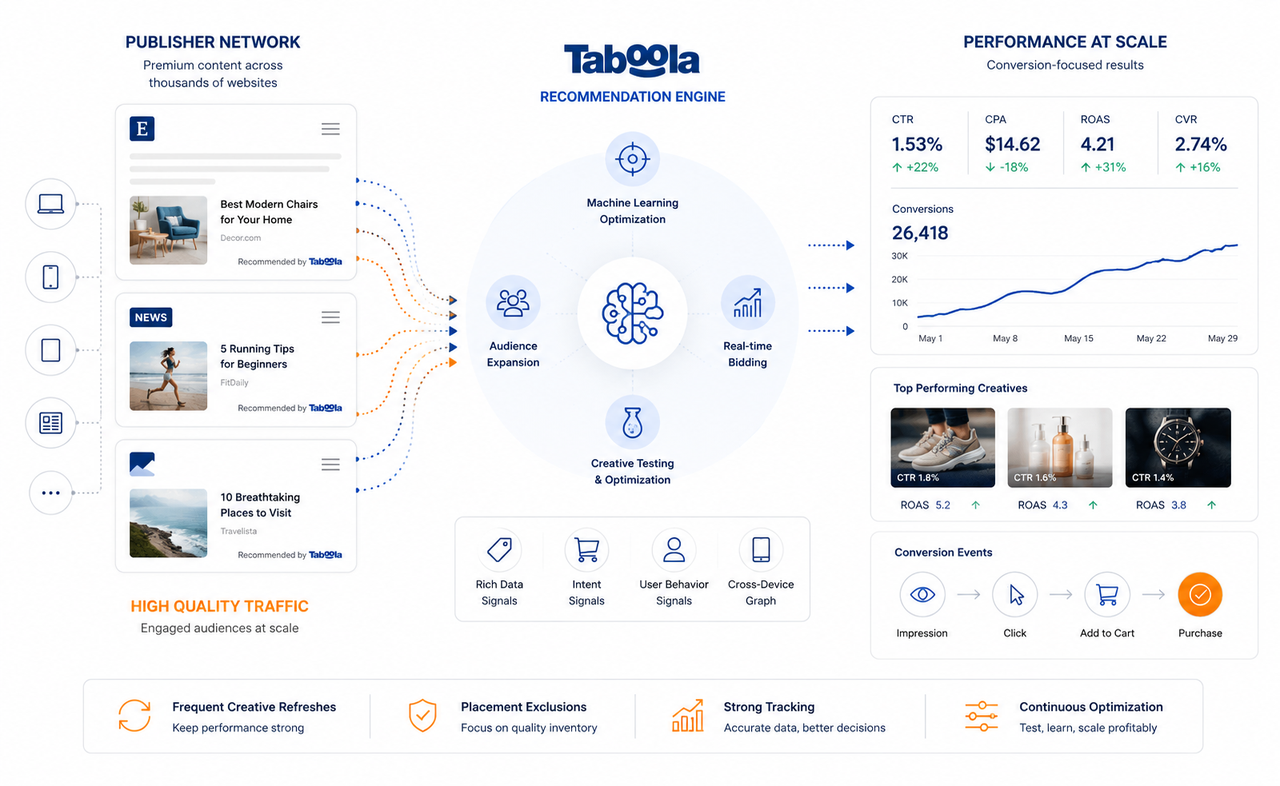
Its strength comes from the size of its publisher network and recommendation infrastructure. The platform is designed to process large amounts of conversion data quickly, which makes it particularly attractive for performance-focused e-commerce campaigns.
For brands running:
• Broad consumer offers
• Aggressive creative testing
• High-volume acquisition campaigns
• Conversion-focused optimization
Taboola often becomes the easiest native platform to scale.
Its system increasingly resembles performance social advertising rather than traditional content discovery. Automated bidding, conversion optimization, audience expansion, and commerce-oriented machine learning all push the platform toward direct-response advertising use cases.
The tradeoff is that scale also introduces variability. Traffic quality can fluctuate heavily across placements and publishers, which means successful advertisers usually rely on:
• Frequent creative refreshes
• Placement exclusions
• Strong tracking infrastructure
• Continuous optimization discipline
Brands expecting “set-and-forget” performance often struggle once campaigns begin scaling.
Outbrain: Editorial Discovery and Mid-Funnel Quality
Compared with Taboola, Outbrain generally performs better in content-led acquisition strategies.
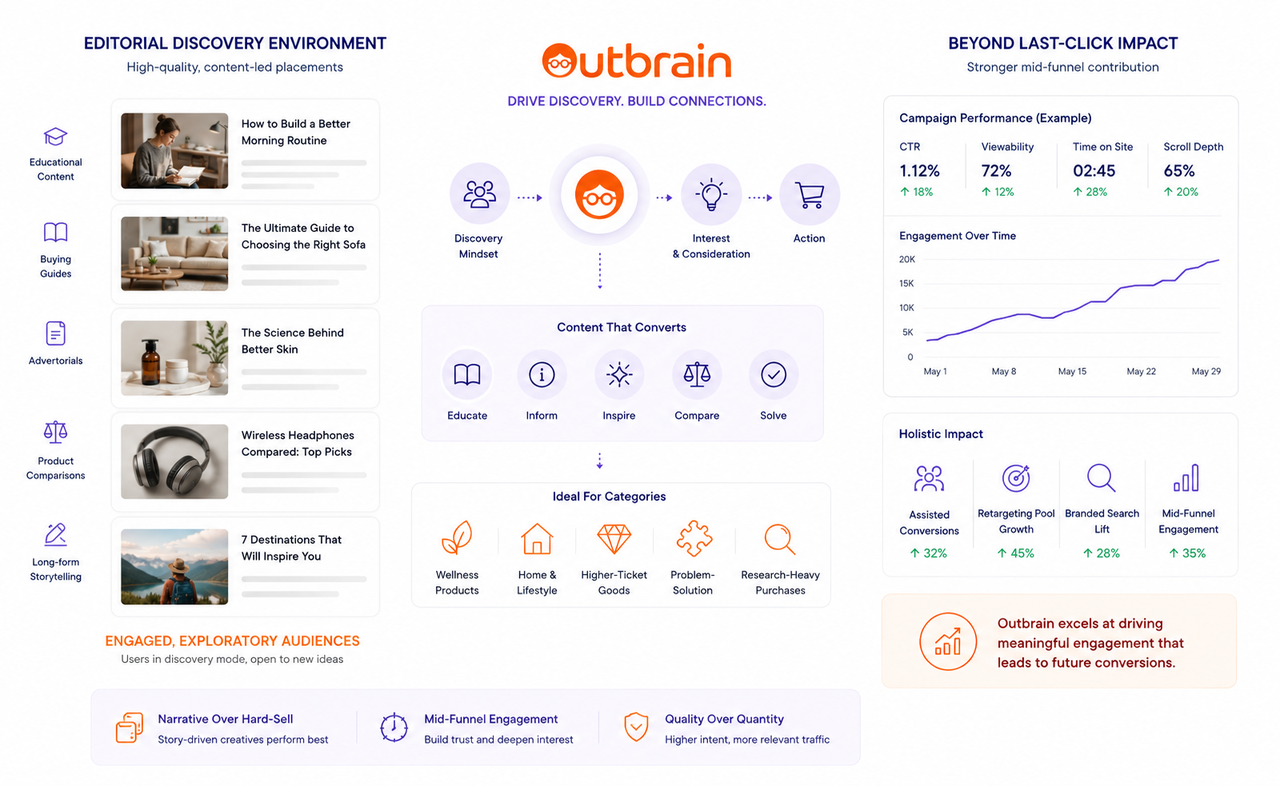
Its traffic environment tends to align more naturally with:
• Educational content
• Buying guides
• Advertorials
• Product comparisons
• Longer-form storytelling
Users on Outbrain placements are often in exploration mode rather than immediate purchase mode. Because of this, aggressive hard-sell creatives may underperform compared with narrative-driven campaigns that gradually educate users before conversion.
For e-commerce brands selling products that require more consideration, this can be valuable.
Categories that often fit well include:
• Wellness products
• Home and lifestyle products
• Higher-ticket consumer goods
• Problem-solution products
• Research-heavy purchases
Outbrain campaigns also frequently contribute to:
• Assisted conversions
• Retargeting pool growth
• Branded search lift
• Mid-funnel engagement
As a result, brands measuring only last-click ROAS may underestimate the platform’s actual contribution.
MediaGo: Programmatic Native Buying
MediaGo differs from both Taboola and Outbrain because it operates closer to a programmatic native DSP environment.
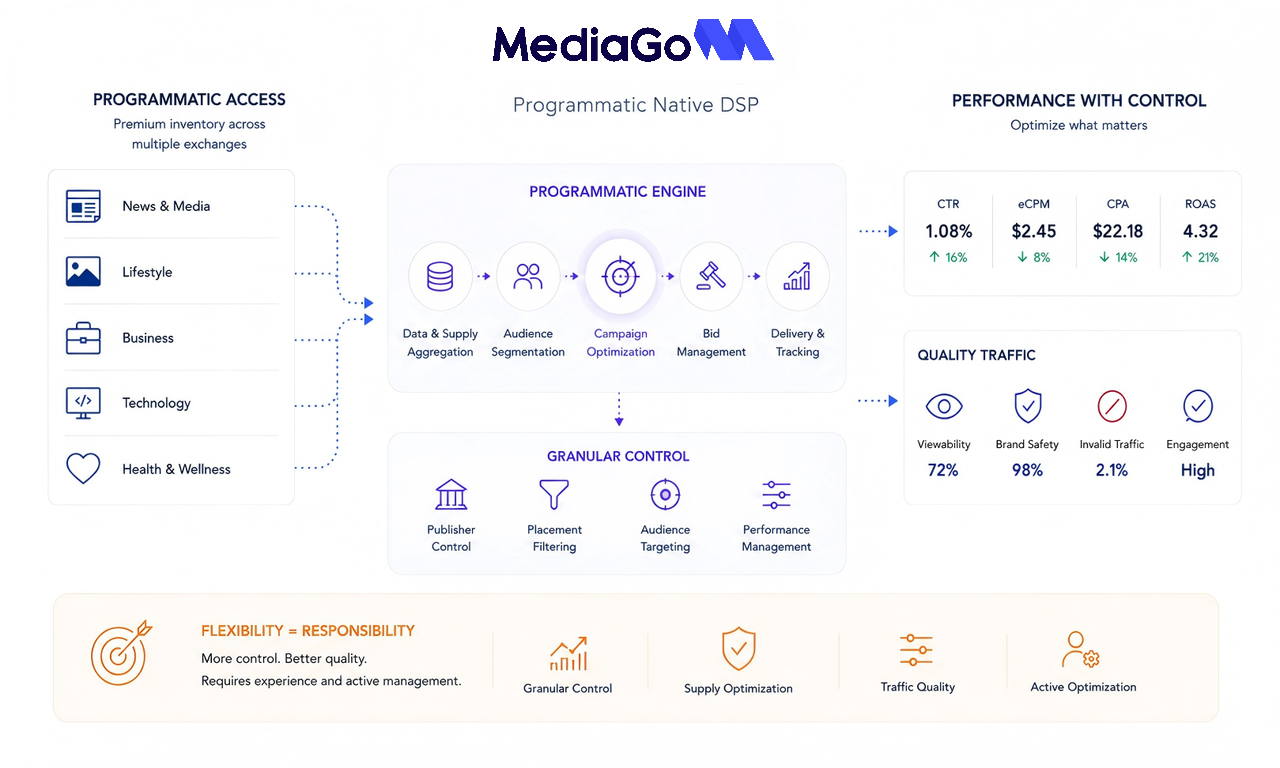
Instead of functioning mainly as a closed recommendation network, MediaGo focuses more heavily on:
• Programmatic inventory access
• Publisher-level control
• Supply path optimization
• Granular traffic segmentation
• Cross-exchange buying flexibility
For advanced media buying teams, this creates significantly more control over where ads run and how traffic is optimized.
However, that flexibility also increases operational complexity.
Unlike heavily automated ecosystems, MediaGo generally requires:
• Stronger optimization experience
• Better attribution analysis
• More active traffic management
• Publisher-level decision making
For agencies and sophisticated performance teams, this can be a major advantage because it allows tighter control over acquisition quality.
For smaller e-commerce brands without mature optimization infrastructure, the learning curve can be much steeper.
The Biggest Difference: User Intent
The most important distinction between these platforms is not inventory size or CPC pricing. It is user intent.
Taboola traffic is often optimized toward scale and conversion velocity.
Outbrain traffic tends to align more closely with editorial engagement and content consumption behavior.
MediaGo provides flexibility to shape traffic quality manually through programmatic optimization.
This directly affects creative strategy.
On Taboola, fast-moving product creatives and aggressive testing cycles often perform best.
On Outbrain, educational storytelling and advertorial continuity usually matter more.
On MediaGo, success depends heavily on traffic segmentation and supply management discipline.
Many e-commerce brands fail on native advertising because they use identical creatives across all three platforms without adapting to how users behave within each ecosystem.
Which Platform Fits Best for E-commerce Brands?
There is no universal “best” native advertising platform. The right fit depends on factors such as funnel structure, creative resources, attribution maturity, operational expertise, and campaign goals.
| Platform | Best Suited For | Typical Strengths |
| Taboola | Brands focused on aggressive scaling and performance acquisition | Large-scale acquisition, conversion-focused campaigns, high creative testing velocity, broad consumer products |
| Outbrain | Brands using content and storytelling to drive conversions | Content-led acquisition, educational funnels, mid-funnel nurturing, advertorial strategies |
| MediaGo | Advanced advertisers requiring deeper optimization control | Programmatic optimization, granular traffic control, sophisticated attribution workflows, advanced media buying operations |
Final Thoughts
Native advertising platforms may appear similar from the outside, but for e-commerce brands, the operational differences are substantial.
Taboola focuses on scalable performance infrastructure.
Outbrain leans more heavily into editorial discovery and content engagement.
MediaGo offers deeper programmatic flexibility and traffic control.
The brands that succeed with native advertising are usually not the ones chasing the cheapest traffic. They are the ones that understand how audience behavior, creative structure, and platform optimization logic differ across each ecosystem, and build campaigns accordingly.
more posts
Moloco Ads Optimization: Surviving the Learning Phase and Scaling iROAS (2026)
October. 08 2026
LEARN MORE

Kwai Ads vs. SnackVideo Ads: 2026 Allocation Matrix for LATAM & Southeast Asia
September. 28 2026
LEARN MORE
Why NewsBreak is the Essential US UA Growth Engine in 2026: Platform Guide & Performance Analysis
September. 24 2026
LEARN MORE
Navigating Media Accessibility in Media Growth: Bottlenecks & Solutions
September. 23 2026
LEARN MORE