




Copyright © 2026 NOVABEYOND LIMITED (company number 2833487). All rights reserved.
Address: UNIT 616 6/F KAM TEEM INDUSTRIAL BUILDING 135 CONNAUGHT ROAD WEST SAI WAN HONGKONG.
Global app marketing spend hit $109 billion in 2025, with user acquisition alone accounting for $78 billion, up 13% year over year. On the surface, that looks like a healthy, growing industry. Dig one layer deeper, and a more complicated picture emerges.
Despite record-level spend, 36% of app marketers now cite "scaling user growth without skyrocketing acquisition costs" as their single biggest challenge. Growth teams are paying more, reaching fewer net-new users, and watching their marginal returns compress with every budget cycle. The mainstream channels that built the mobile growth industry , Meta and Google , are still essential, but they can no longer carry a scaled growth strategy alone.
This article breaks down exactly why that's happening and what it means for how teams need to rethink their channel architecture.
What "Mainstream Channels" Actually Means in 2026
When growth practitioners say "mainstream channels," they typically mean:
•Meta (Facebook/Instagram): The dominant social UA platform, historically offering powerful audience targeting and creative scale
•Google App Campaigns (UAC): The default search and YouTube-based acquisition engine for Android and iOS apps
•TikTok Ads: A rapidly scaled platform now considered mainstream for under-35 audiences
•Apple Search Ads (ASA): The high-intent, iOS-exclusive channel
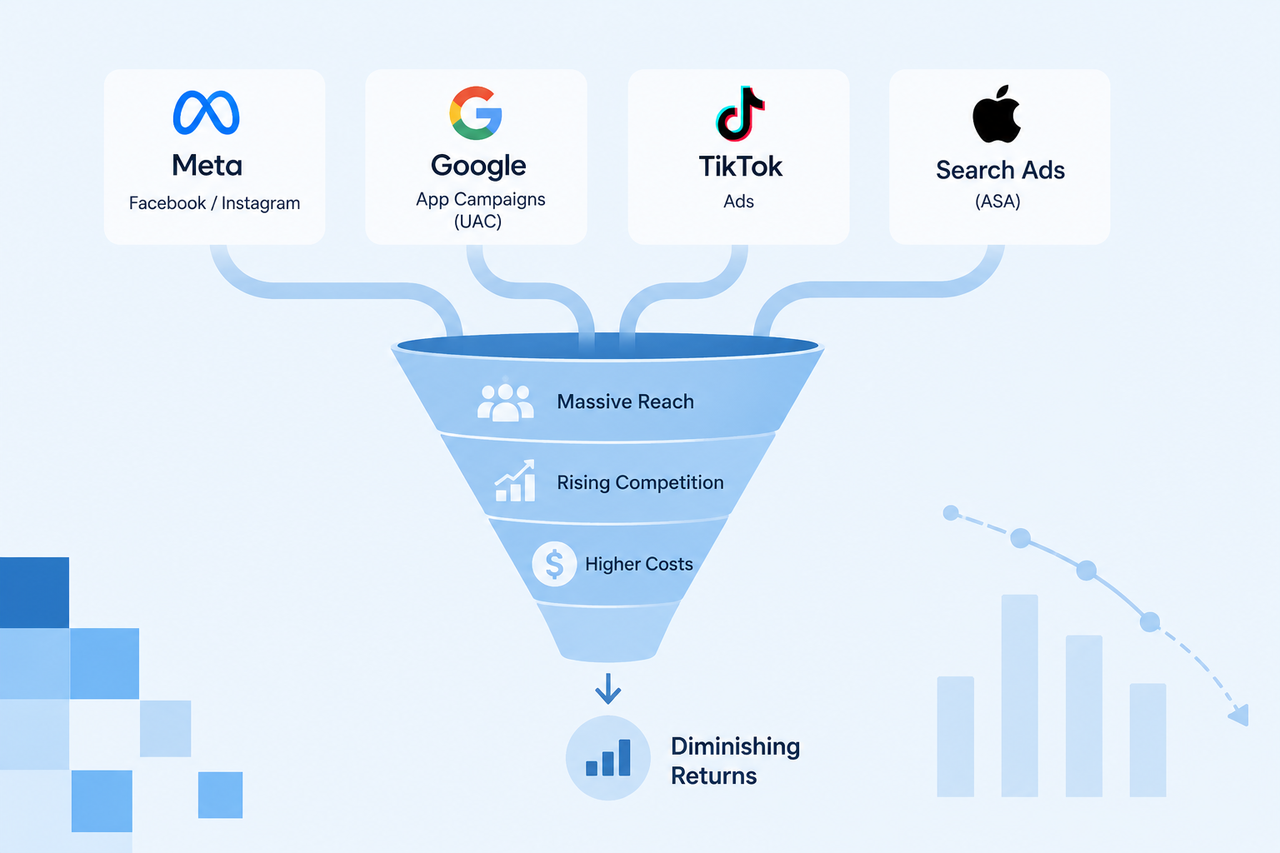
These four platforms still account for the bulk of global UA spend. They provide scale, reach, and algorithmic optimization that smaller networks simply can't match. But each faces structural headwinds that compound with budget size, meaning the more you spend, the faster you hit diminishing returns.
Three Structural Forces Killing Mainstream Scale
1. Audience Saturation and Inventory Overlap
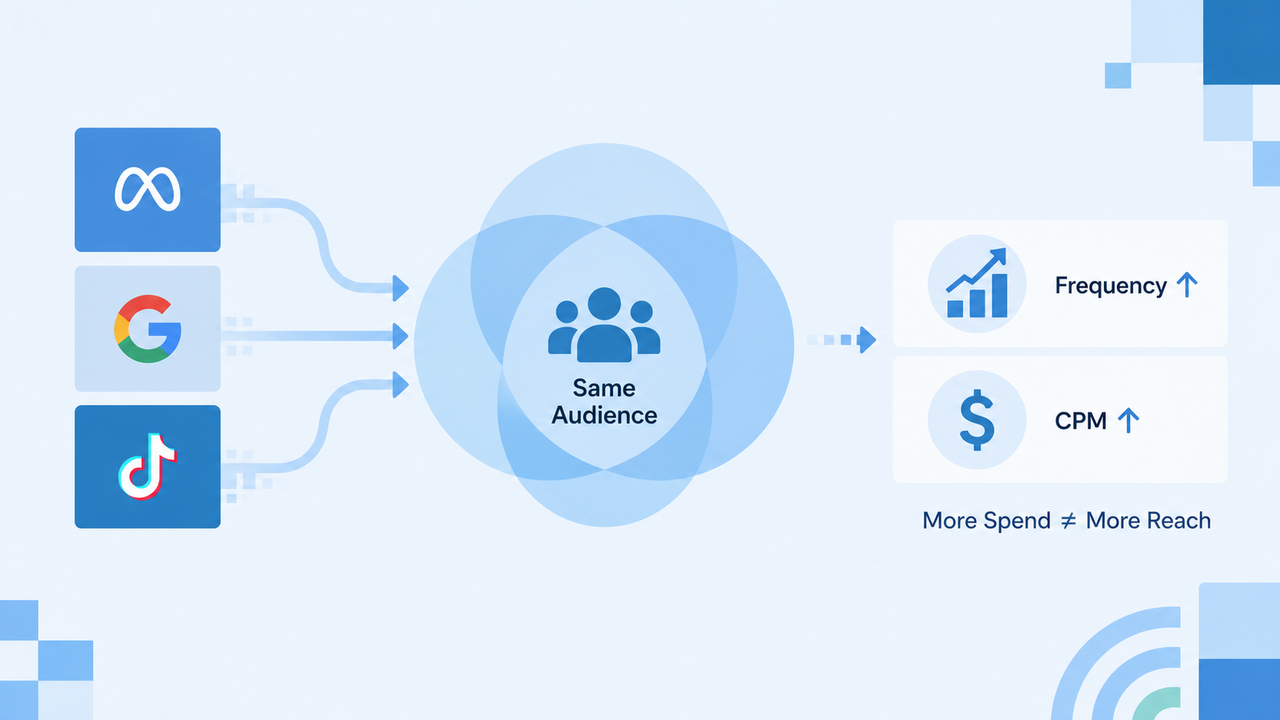
Meta, Google, and TikTok compete for the same pool of mobile users. They don't just compete with each other for advertiser dollars, their algorithms increasingly pull from overlapping user inventory. A mobile gamer in Germany who fits your ICP is being targeted simultaneously by your campaigns, your competitors' campaigns, and dozens of unrelated verticals.
The consequence: as you increase budget on any one platform, you don't reach proportionally more people. You reach the same people more often, at higher frequency, with higher CPMs. The unit economics of scale break down.
Industry data from adjoe confirms this plainly: traditional UA channels like Google and Meta "often end up cannibalizing one another's traffic by tapping into already explored supply sources without contributing to actual growth."
2. Privacy Architecture Erosion
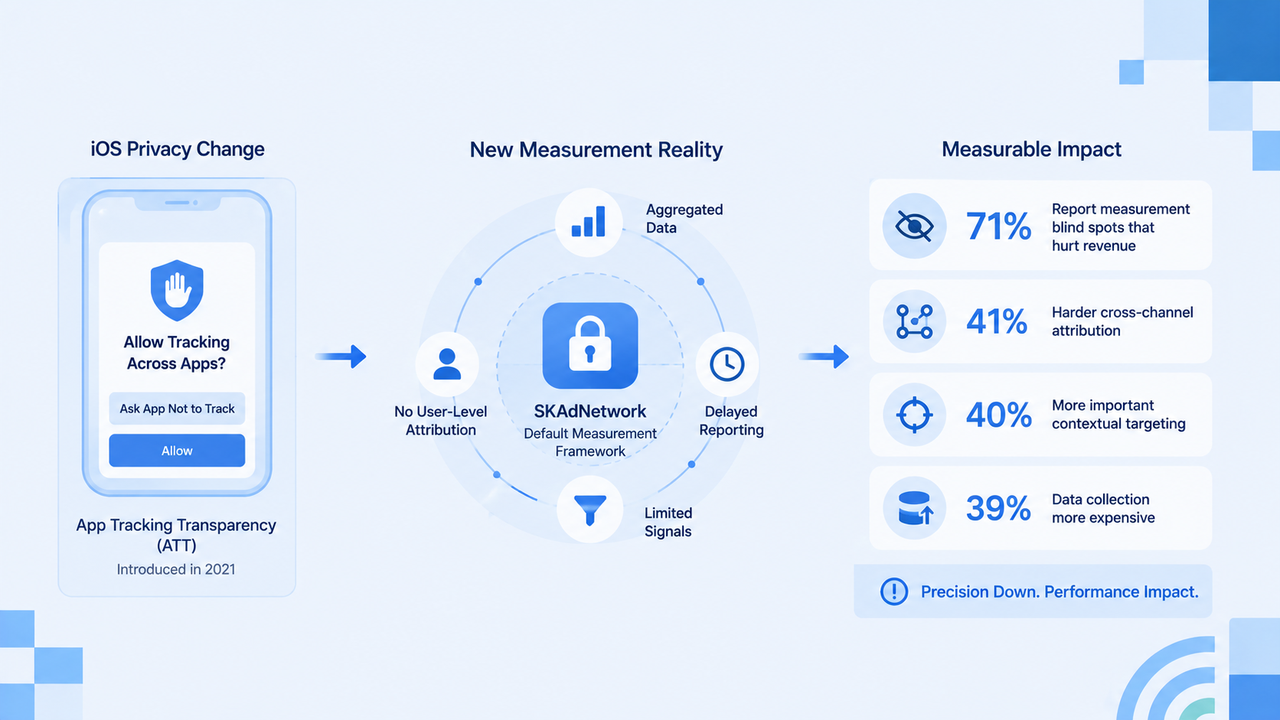
Apple's App Tracking Transparency (ATT), introduced in 2021, permanently altered iOS attribution. SKAdNetwork became the de facto measurement framework, but it remains imprecise , aggregated, delayed, and constrained in the user-level signals it surfaces.
The downstream effects are measurable. According to Branch's 2025 State of App Growth report, 71% of app marketers say privacy regulations have created measurement blind spots that hurt revenue. Cross-channel attribution is harder (41% of respondents), contextual targeting has become more important (40%), and data collection has gotten more expensive (39%).
For Meta and Google, platforms that built their performance advantage on deterministic, user-level targeting , this is a structural capability loss, not a temporary technical problem. The optimization flywheel that once made these channels extraordinarily efficient now spins with less precision.
3. Creative Saturation and Rising CPMs
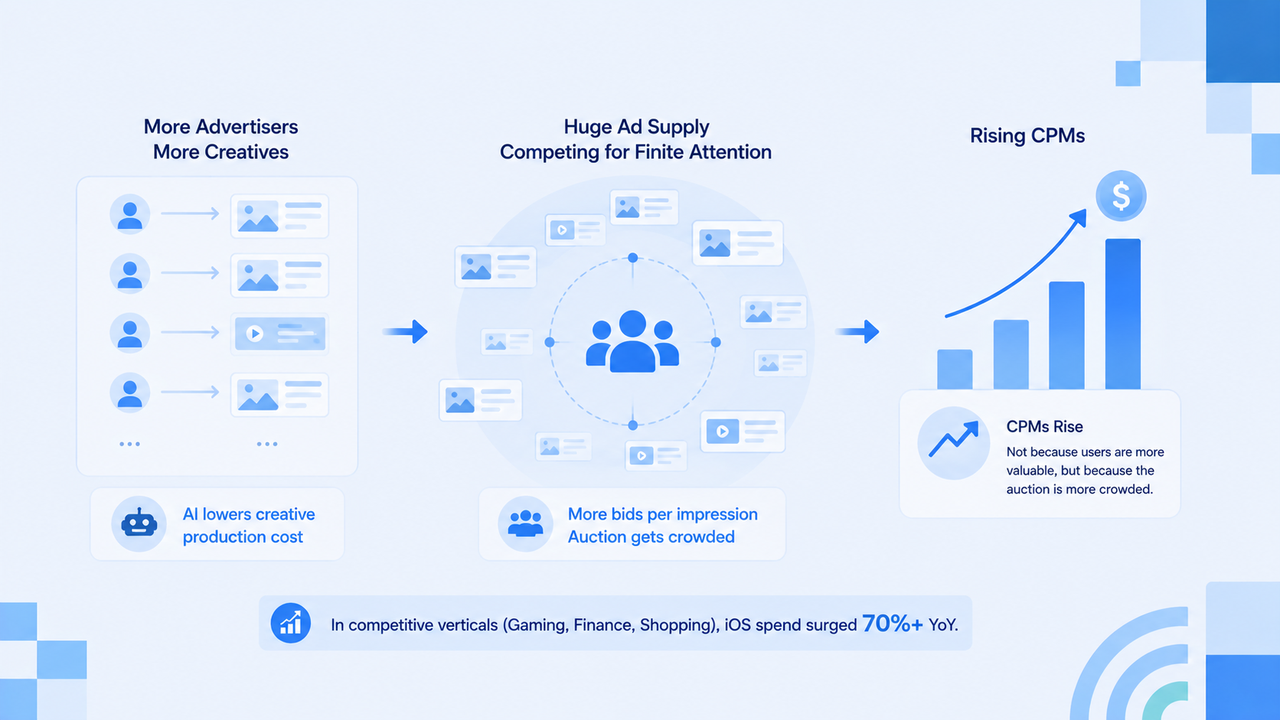
The barriers to launching ads on Meta or Google are near-zero. Generative AI has further collapsed creative production costs. The result is an enormous, ongoing flood of ad supply competing for finite user attention.
More advertisers, more creatives, more bids per impression. CPMs rise not because users are more valuable, but because the auction is more crowded. For app marketers competing in Gaming, Finance, or Shopping verticals, where AppsFlyer data shows iOS spend surged 70%+ year over year . This competitive pressure is severe.
The Platform Dependency Problem
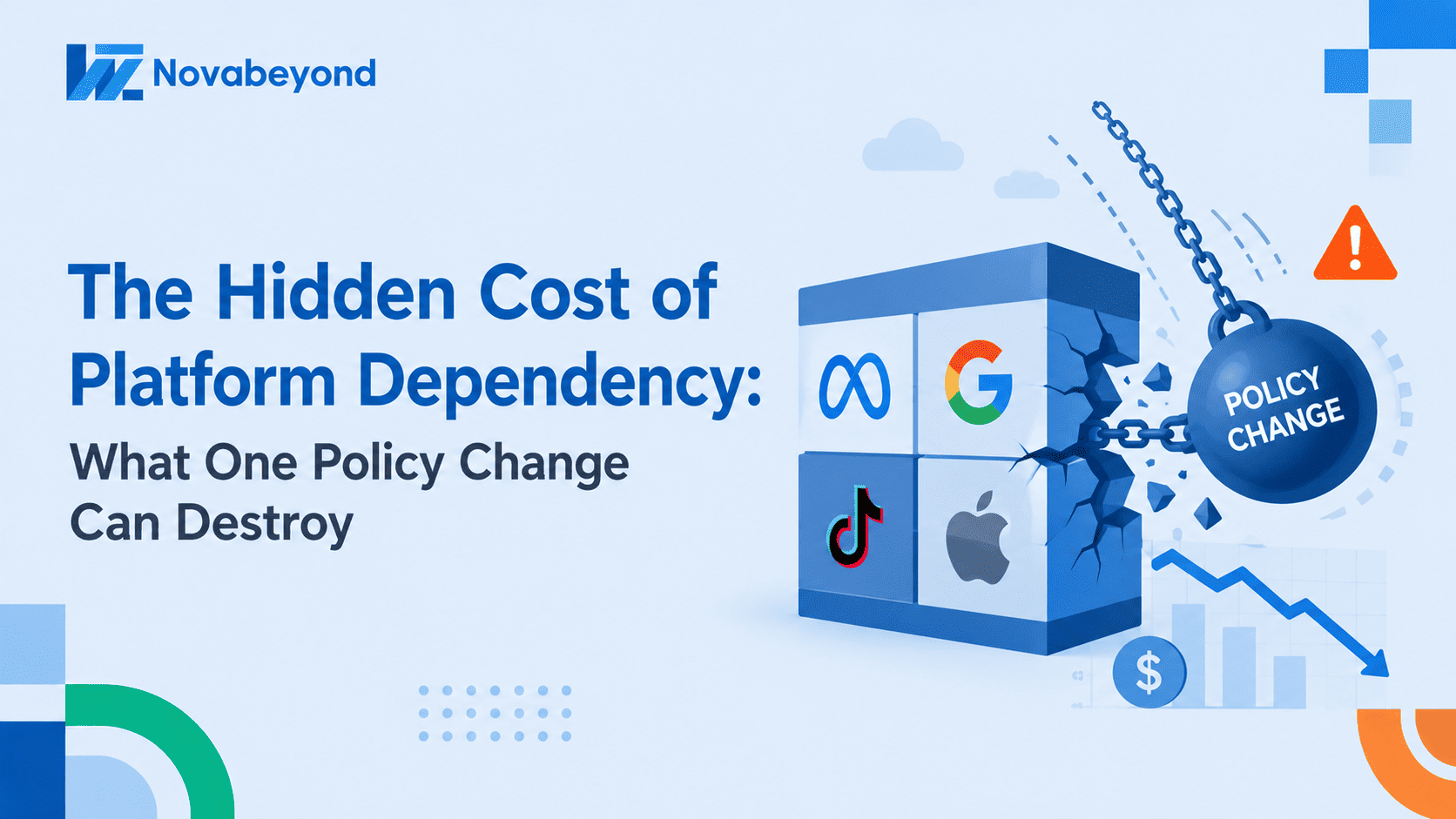
Beyond diminishing returns, there's a second-order risk that growth teams underestimate: platform dependency.
A channel strategy built on two or three mainstream platforms isn't just inefficient at scale, it's fragile. AppLovin changing its ROAS goal policy overnight has destabilized campaigns for studios that concentrated their budgets there. Meta algorithm updates can shift delivery patterns within hours. A policy change from any of these platforms can materially damage a business that depends on them for the majority of its growth.
This isn't hypothetical. It's a recurring event in the history of app marketing, and the frequency of such disruptions is increasing as platforms mature and their policy teams become more active.
The Retention Dimension Mainstream Channels Can't Fix
Mainstream channels are optimized for installs. But the fundamental economics of app growth have shifted: acquiring users is increasingly less important than keeping them.
The data is stark. Up to 80% of users abandon an app within the first three days post-installation. Multichannel strategies are now standard, with teams managing an average of 3.8 growth channels , yet nearly half of marketers (47%) still struggle to activate user data for personalization or measure post-install engagement effectively.
No amount of Meta or Google spend fixes a retention problem. And when retention is broken, every dollar spent on acquisition accelerates losses rather than compounding growth.
What This Means Practically
The mainstream channels aren't going away. Meta and Google still provide the best combination of raw reach and algorithmic optimization available in paid media. Any growth team that abandons them entirely is making an equally bad mistake.
But treating them as the ceiling, rather than the floor of a growth strategy is where most teams lose. The structural reality of 2026 is that budget doubling on mainstream channels produces sub-linear growth returns. True incremental scale requires channels that access users those platforms don't.
The practical implication is growth teams need to build diversified channel architectures where mainstream platforms provide stable volume and alternative channels including OEM networks, rewarded UA, DSP programmatic, CTV, regional platforms, provide genuine incrementality.Data clearly shows that multichannel teams managing 4–6 channels simultaneously are consistently outperforming those concentrated on two.
Understanding why mainstream channels hit their ceiling is the prerequisite for building what comes next.
more posts

Diversified Acquisition Strategies for Global Advertisers: A Framework for Evaluating New Channels
September. 11 2026
LEARN MORE

The Hidden Cost of Platform Dependency: What One Policy Change Can Destroy
August. 27 2026
LEARN MORE
How Incremental Growth Is Changing Performance Marketing
August. 25 2026
LEARN MORE
Incremental Growth Thinking: Why User Acquisition Must Go Beyond ROAS
August. 24 2026
LEARN MORE