




UNIT 616 6/F KAM TEEM INDUSTRIAL BUILDING 135 CONNAUGHT ROAD WEST SAI WAN HONGKONG.
Copyright © 2026 NOVABEYOND LIMITED (company number 2833487). All rights reserved.
Introduction
Your Mintegral campaign is approved, your creatives are live, and your budget is ready, but delivery remains weak. The campaign may even start well, generate installs, and then suddenly stop scaling. Because the campaign remains active, identifying the cause is not always straightforward.
Increasing the budget does not always solve the problem. Making several changes at once can make the situation even harder to diagnose.
A stalled Mintegral campaign often involves more than one campaign setting. Target ROAS, learning conditions, conversion signals, and creative performance can all influence delivery.
Mintegral's current Target ROAS guidance emphasizes sufficient traffic and stable campaign conditions during the learning phase. The learning period typically lasts around 10–14 days. Major changes to budgets, creatives, placements, or geographic coverage can also affect optimization.
The right response is not to change settings at random.
The goal is to identify the delivery bottleneck first.
Once you know where the problem starts, you can make a targeted adjustment and measure the result more accurately.
Quick Answer
Why is my Mintegral campaign not spending?
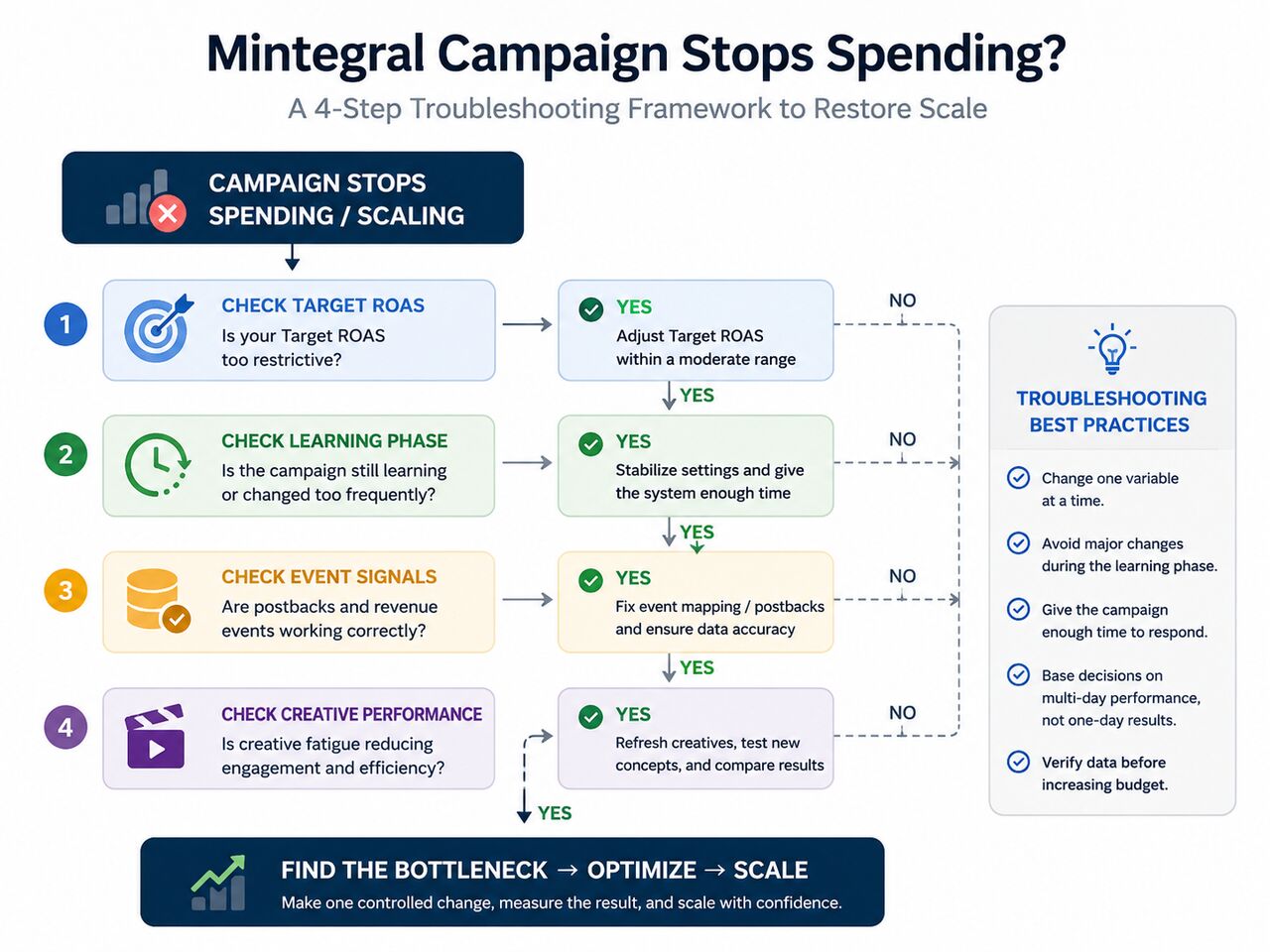
Start by checking these four areas:
Target ROAS may be too restrictive for the campaign's current data volume or performance.
Frequent budget or campaign changes may disrupt the learning process.
Event signals or postbacks may be incomplete, delayed, or incorrectly mapped.
Creative performance may have declined, reducing engagement and limiting efficient delivery.
Use this troubleshooting sequence:
Check Target ROAS → Check learning status → Verify event postbacks → Review creative performance.
Do not change all four areas at the same time. Make one controlled adjustment, allow enough time for the campaign to respond, and then evaluate the result.
If these checks do not explain the problem, you may need a deeper review of the account and campaign structure.
Get a Free Mintegral Campaign Audit
Ask Novabeyond to review your Target ROAS, learning conditions, event signals, and creative performance before you increase your advertising budget.
1. Check Whether Your Target ROAS Is Too Restrictive
Target ROAS helps advertisers optimize toward user value instead of simply maximizing installs.
This approach can work well for performance-focused app campaigns. However, an aggressive target can restrict delivery when the campaign lacks sufficient conversion data.
When the system has too few opportunities to find users who meet the target, delivery may slow instead of expanding.
Mintegral supports Target ROAS optimization for different monetization models, including IAP, IAA, and hybrid apps. Its documentation also highlights the importance of sufficient data and suitable campaign settings when advertisers use ROAS optimization.
What should you do?
Before changing Target ROAS, compare the campaign's current ROAS with its target and check whether the campaign has completed learning. Then review conversion volume and revenue data. If delivery declined shortly after a ROAS adjustment, that timing can provide an important clue. At the same time, confirm that Mintegral receives the revenue events required for optimization.
If the campaign has completed learning, avoid making large or repeated changes.
Mintegral's current guidance recommends moderate Target ROAS adjustments, generally within ±10%, with changes made no more than twice per week.
The objective is not simply to lower ROAS until the campaign starts spending.
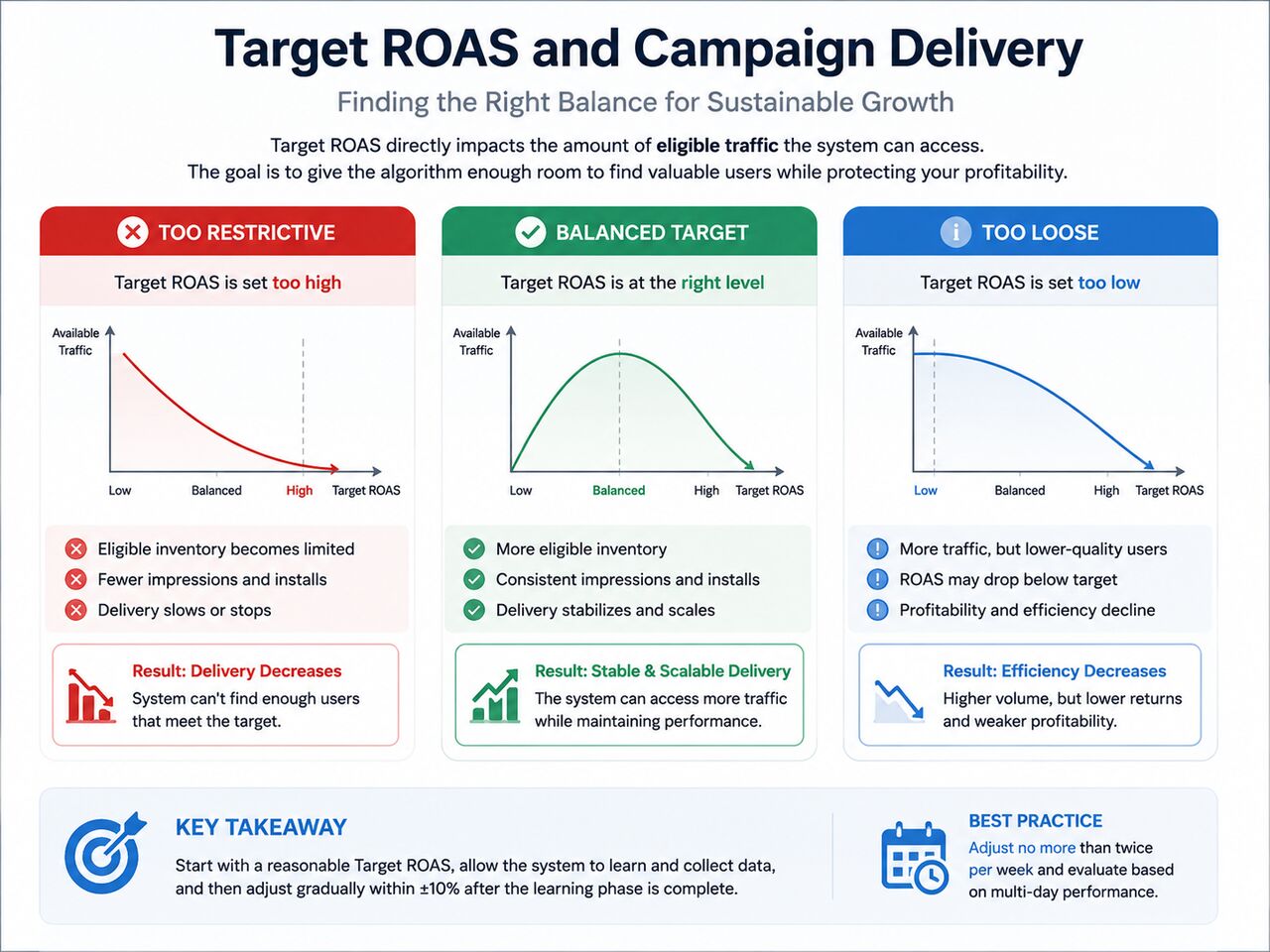
Instead, find a target that gives the system enough room to acquire users while keeping the campaign aligned with your business economics.
For a broader look at Mintegral advertising costs and budget planning, see Novabeyond's Mintegral Ad Cost Guide.
2. Protect the Learning Phase
Performance marketers often react quickly when delivery changes.
The campaign spends less today, so the advertiser changes the budget.
Performance drops the next day, so targeting changes.
A few days later, the advertiser replaces the creatives.
At that point, several variables have changed, making it difficult to determine which change affected performance.
Mintegral states that the Target ROAS learning phase typically lasts around 10–14 days, although the actual period can vary with traffic volume, budget, and region. Performance may fluctuate during this period as the system collects data.
A better approach
During the initial learning period:
Keep major campaign settings stable and avoid changing several variables at once.
Give the campaign enough time and traffic to collect meaningful data before judging performance.
Evaluate performance over several days instead of reacting to short-term fluctuations.
You should also be cautious about expanding into multiple new markets while the core campaign is still unstable. Adding new geographic variables can make performance harder to interpret and may create another layer of uncertainty during optimization.
If you make a major change, treat the campaign as entering a new optimization period rather than expecting the previous performance pattern to continue immediately.
The same principle applies to scaling.
A larger budget does not automatically produce more efficient growth.
The campaign still needs enough quality data to convert additional spend into additional results.
For advertisers reviewing their campaign architecture, Novabeyond's Mintegral Ad Account Structure Guide provides additional guidance on structuring campaigns for growth.
3. Audit Your Event Signals and Postbacks
If your Target ROAS and learning conditions look reasonable, check your data next.
This step matters especially for ROAS campaigns.
Mintegral's optimization system uses conversion and revenue signals to evaluate user value. When those signals are missing or incorrectly mapped, the system has less reliable information for optimization.
The impact becomes more significant when you use Target ROAS optimization. The system needs reliable conversion and revenue signals to distinguish valuable users from lower-value traffic. If the campaign receives installs but fails to receive consistent downstream events, the system has less information to evaluate user value. That can limit its ability to optimize toward your ROAS goal.
This is why a campaign can appear technically active while delivery remains weak. The issue may not be the ad itself. The optimization system may simply lack the data it needs to make confident delivery decisions.
Check these four areas
| Area | What to Check | Potential Problem |
| Event Mapping | Are app events mapped to the correct Mintegral events? | Wrong optimization signal |
| Postbacks | Are key events reaching Mintegral successfully? | Insufficient conversion data |
| Revenue Data | Is purchase or ad-revenue data transmitted correctly? | Weak ROAS signal |
| Attribution | Do campaign and measurement data broadly align? | Data discrepancies |
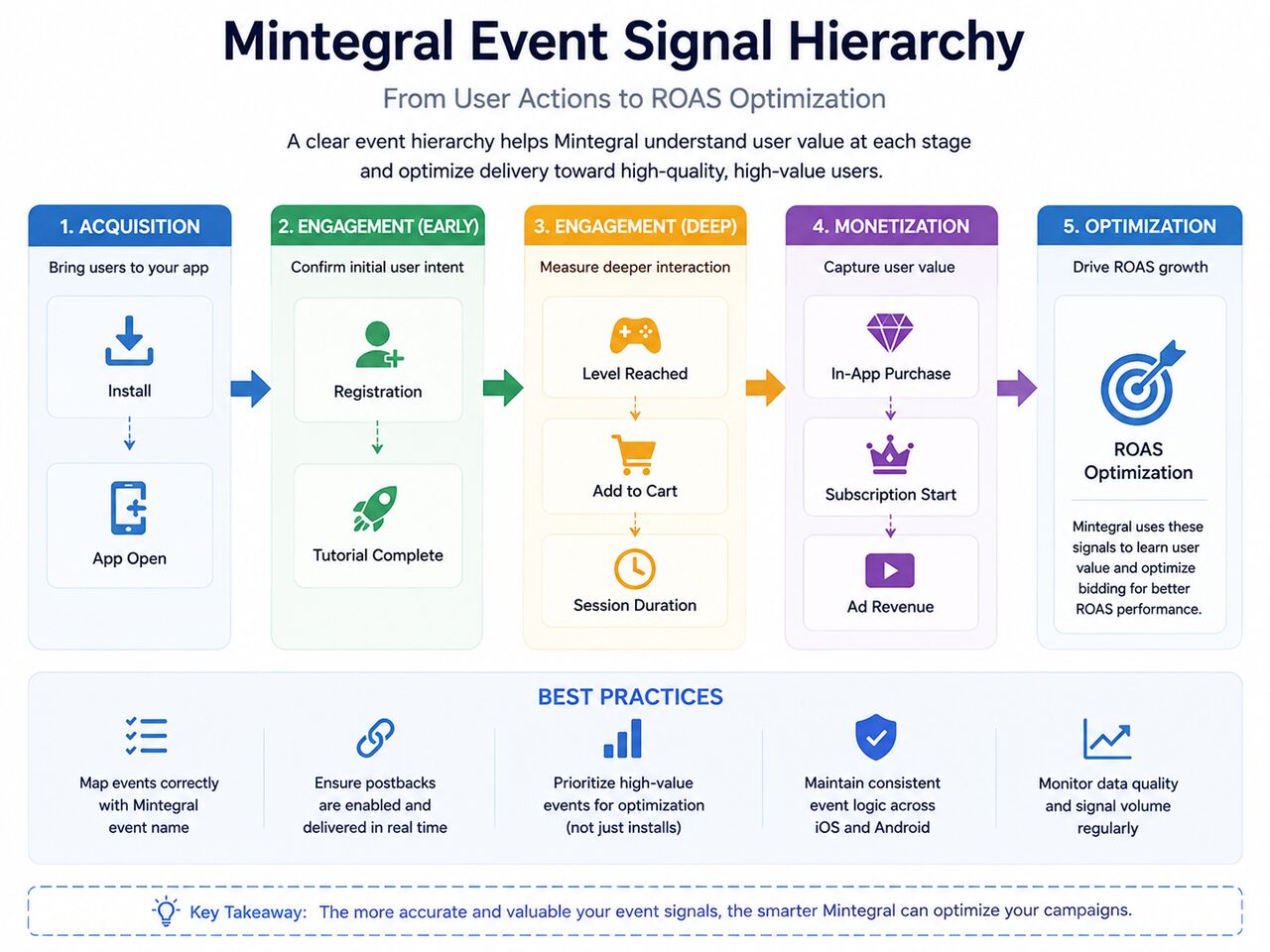
A practical event structure is:
Early signals: Install, App Open, Registration
Engagement signals: Tutorial Complete, Level Reached, Trial Start, Add to Cart
Monetization signals: Purchase, Subscription, Ad Revenue
The right hierarchy depends on your app's business model.
The key is to use optimization events that represent meaningful user actions.
More events do not automatically create better optimization data. Poorly defined or inconsistent events can create noise instead of useful signals.
What should you verify?
Before scaling, verify that your key events map correctly, postbacks are enabled, and revenue values reach Mintegral as expected. It is also worth comparing your measurement data with the data Mintegral receives. Significant discrepancies can point to attribution or event configuration issues that should be resolved before you increase spend.
Check Your Mintegral Data Before Scaling
If you are unsure whether event mapping or postbacks are limiting campaign performance, Novabeyond can help review the setup and identify potential signal issues.
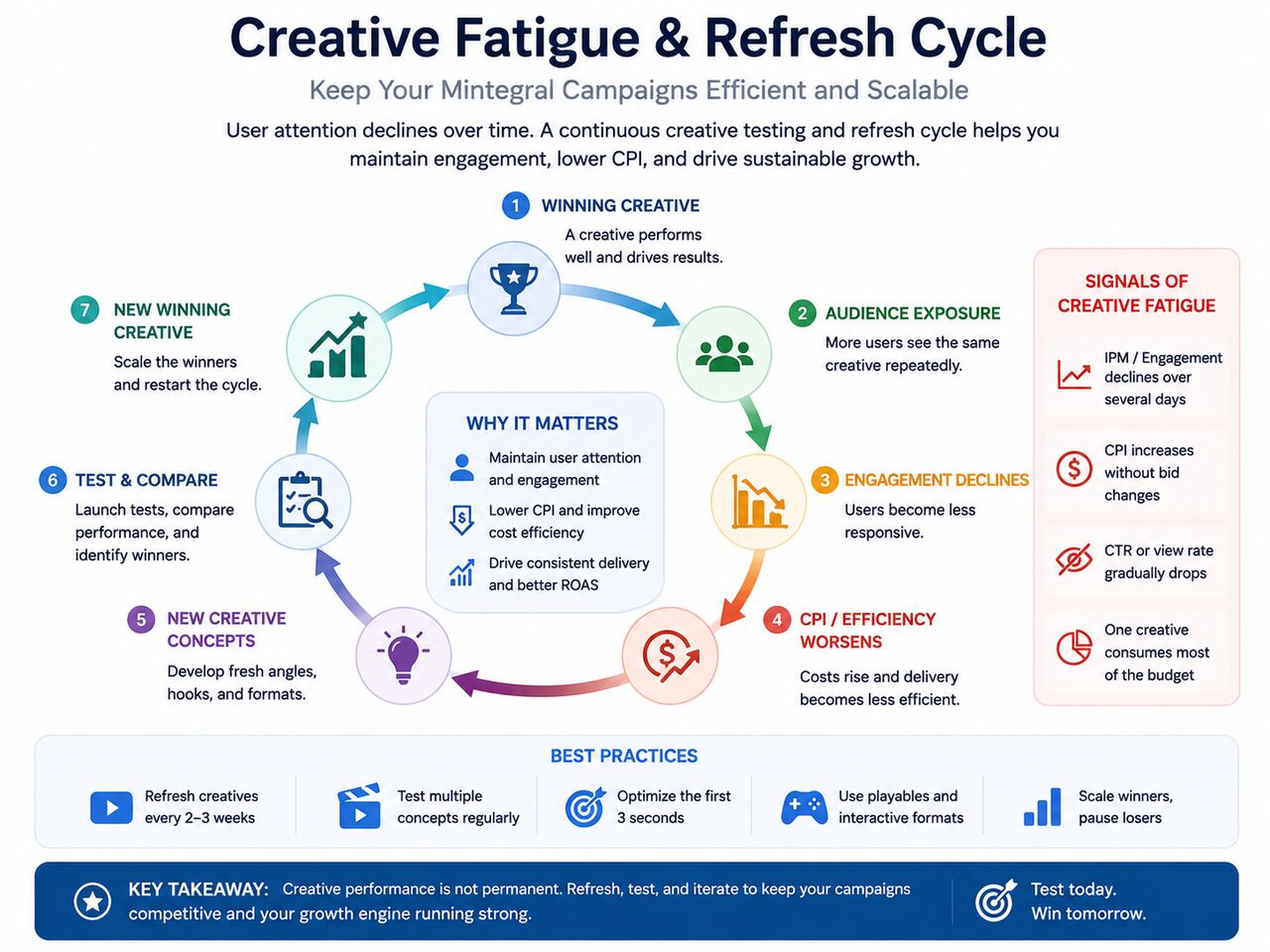
4. Check Creative Fatigue Before Increasing the Budget
If bidding and data look healthy, review your creatives before increasing the budget.
A campaign can lose momentum even when targeting, bidding, and budget remain unchanged. When users become less responsive to existing ads, engagement can decline and acquisition efficiency can weaken.
This matters particularly for mobile app campaigns that rely on video and playable formats.
Mintegral's own materials highlight creative variety and playable advertising as important components of mobile user acquisition.
Signs of creative fatigue
Look for several of these signals at the same time:
IPM or engagement declines over several days.
CPI increases without a major bidding change.
Previously strong creatives lose their advantage.
One creative receives most of the campaign's spend.
You may also notice that newly launched assets consistently underperform established winners. This becomes more meaningful when the decline continues across several days rather than appearing as a one-day fluctuation.
How to respond
Do not replace every creative at the same time.
Instead:
Keep a control creative.
Introduce new concepts and hooks.
Compare new assets with existing winners.
Shift spend gradually toward sustained performers.
The goal is not to replace every existing asset. Keep at least one proven creative as a control so you can compare new concepts against a known baseline. Test different hooks, visual angles, and value propositions rather than producing minor variations of the same ad.
Creative testing should remain an ongoing process rather than a one-time campaign task.
A campaign that performs well today still needs new creative concepts to maintain momentum as audience response changes.
When Campaign Optimization Is Not Enough: Consider a Mintegral Agency Ad Account
Sometimes a campaign does not scale because of one setting.
The larger issue may be the operational process behind the campaign.
Advertisers managing multiple markets, larger budgets, or several app campaigns can face challenges across account setup, campaign structure, event configuration, optimization, creative testing, and scaling.
This is where agency support can add value.
Novabeyond provides Mintegral Advertising Services for advertisers looking to launch and scale mobile user acquisition campaigns.
An Agency Ad Account does not replace sound campaign fundamentals. If your target ROAS is unrealistic or your event data is incorrect, changing the account structure alone will not solve the underlying problem.
If the same delivery problems appear across multiple campaigns, the issue may extend beyond individual campaign settings. At that point, advertisers need to look at the account, setup process, measurement framework, and optimization workflow as a whole. This is where structured agency support can become useful.
The value comes from having additional operational and optimization support around those fundamentals.
| Area | Self-Managed | Novabeyond Support |
| Account Setup | Advertiser-managed | Guided onboarding |
| Campaign Structure | Internal planning | Campaign setup support |
| Event Configuration | Self-managed | Event and postback guidance |
| Optimization | Internal analysis | Performance support |
| Creative Testing | Internal process | Creative performance recommendations |
| Scaling | Trial and adjustment | Structured scaling support |
For businesses that repeatedly encounter delivery problems, first determine whether the bottleneck sits at the campaign, data, creative, or account level.
Talk to Novabeyond About Mintegral Scaling
If your campaign is approved but spending below expectations, Novabeyond can review the account and campaign setup and help identify the most likely scaling bottleneck.
Frequently Asked Questions
1. Why is my Mintegral campaign not spending?
Common causes include an overly restrictive Target ROAS, insufficient learning data, frequent campaign changes, weak event signals, or declining creative performance. Check these areas before increasing your budget.
2. How long does the Mintegral learning phase take?
Mintegral states that a Target ROAS campaign typically takes around 10–14 days to complete its learning phase. The actual period can vary according to traffic volume, budget, and region.
3. Should I lower Target ROAS if my Mintegral campaign stops spending?
Not automatically. First check whether the campaign is still learning, whether it has enough conversion data, and whether revenue postbacks work correctly. If you need to adjust the target after learning, Mintegral recommends moderate changes rather than large increases or decreases.
4. How often should I adjust Target ROAS on Mintegral?
Mintegral's current guidance recommends moderate changes, generally within ±10%, and no more than twice per week.
5. Why are postbacks important for Mintegral?
Postbacks send Mintegral information about installs, key in-app events, and monetization. Accurate data helps the optimization system evaluate user value and improve delivery decisions.
6. How do I know if my Mintegral creatives are fatigued?
Look for sustained declines in IPM or engagement, rising CPI, and weaker performance from previously successful creatives. Compare trends across several days instead of judging fatigue from a single day's results.
7. Should I change the budget, targeting, and creatives at the same time?
Generally, no. Changing several variables at once makes it difficult to identify the cause of a performance change and may interfere with learning. Mintegral recommends avoiding major campaign changes during the learning period.
8. Can a Mintegral Agency Ad Account help a campaign that is not scaling?
Agency support can help with account setup, campaign structure, event configuration, optimization, and scaling processes. However, an Agency Ad Account cannot replace accurate data, suitable bidding, or strong creative performance. Novabeyond provides Mintegral account and campaign support for advertisers.
Conclusion
A Mintegral campaign that stops spending does not necessarily mean the campaign has failed.
In many cases, the problem comes from four areas:
Target ROAS → Learning Phase → Event Signals → Creative Performance.
Start with the bidding target. Then check whether the campaign has enough stable learning data. Next, verify event mapping and postbacks. Finally, review creative performance and maintain a consistent testing pipeline.
Most importantly, avoid changing everything at once.
A controlled troubleshooting process makes it easier to identify the real bottleneck and choose the right optimization step.
For advertisers managing larger budgets or multiple markets, campaign troubleshooting can become a significant operational burden. An experienced Mintegral agency partner can provide additional support across account setup, campaign management, data configuration, and scaling.
If your Mintegral campaign is currently stuck, do not increase your budget blindly. Identify the bottleneck first.
Get in touch with Novabeyond to request a Mintegral campaign audit and discuss the next step for scaling your app user acquisition.
more posts
Taboola Agency Ad Account Setup: Access, Funding & Compliance
October. 16 2026
LEARN MORE

Moloco Ads Optimization: Surviving the Learning Phase and Scaling iROAS (2026)
October. 08 2026
LEARN MORE
Kwai Ads vs. SnackVideo Ads: 2026 Allocation Matrix for LATAM & Southeast Asia
September. 28 2026
LEARN MORE

Why NewsBreak is the Essential US UA Growth Engine in 2026: Platform Guide & Performance Analysis
September. 24 2026
LEARN MORE