




Copyright © 2026 NOVABEYOND LIMITED (company number 2833487). All rights reserved.
Address: UNIT 616 6/F KAM TEEM INDUSTRIAL BUILDING 135 CONNAUGHT ROAD WEST SAI WAN HONGKONG.
For years, the playbook for global user acquisition was straightforward: put most of the budget into Meta and Google, optimize creative, scale what works. That playbook is breaking down. CPMs on the walled gardens keep climbing, iOS privacy changes have made attribution murkier, and advertisers who depend on one or two channels are discovering just how fragile that dependency is when a single platform changes its auction dynamics or its policies.
The response from a lot of marketing teams has been to "diversify," but diversification without a method is just noise. Adding more new channels because they're available isn't a strategy, it's activity. What's missing for most teams isn't a list of alternative channels, it's a consistent way to decide which ones are worth the investment of time, budget, and organizational attention.
This is where a Diversified Acquisition Strategies framework becomes useful. Rather than treating channel expansion as an ad hoc series of experiments, the framework asks a simple question before any budget moves: on the dimensions that actually determine whether a channel will work for this business, how does it score?
Why Most Channel Evaluations Fail Before They Start
The typical process looks like this: someone hears about a promising channel, runs a small test, and judges it on one metric, usually CPA or ROAS in the first two weeks. Good number, more budget. Bad number, shelved.
The problem is that a single early-stage metric tells you almost nothing about whether a channel deserves a place in a long-term acquisition mix.
• A channel can post a great early CPA and still be a poor strategic fit, because it can't scale, the data coming back is too thin to optimize against, or the compliance exposure isn't worth the return.
• A channel with a mediocre early CPA might be exactly the diversification play a business needs, if it reduces platform concentration risk and the audience is genuinely incremental.
A more disciplined evaluation looks at a channel across several dimensions at once, weighs them against the business's actual priorities, and only then makes a call.
The Five Evaluation Dimensions
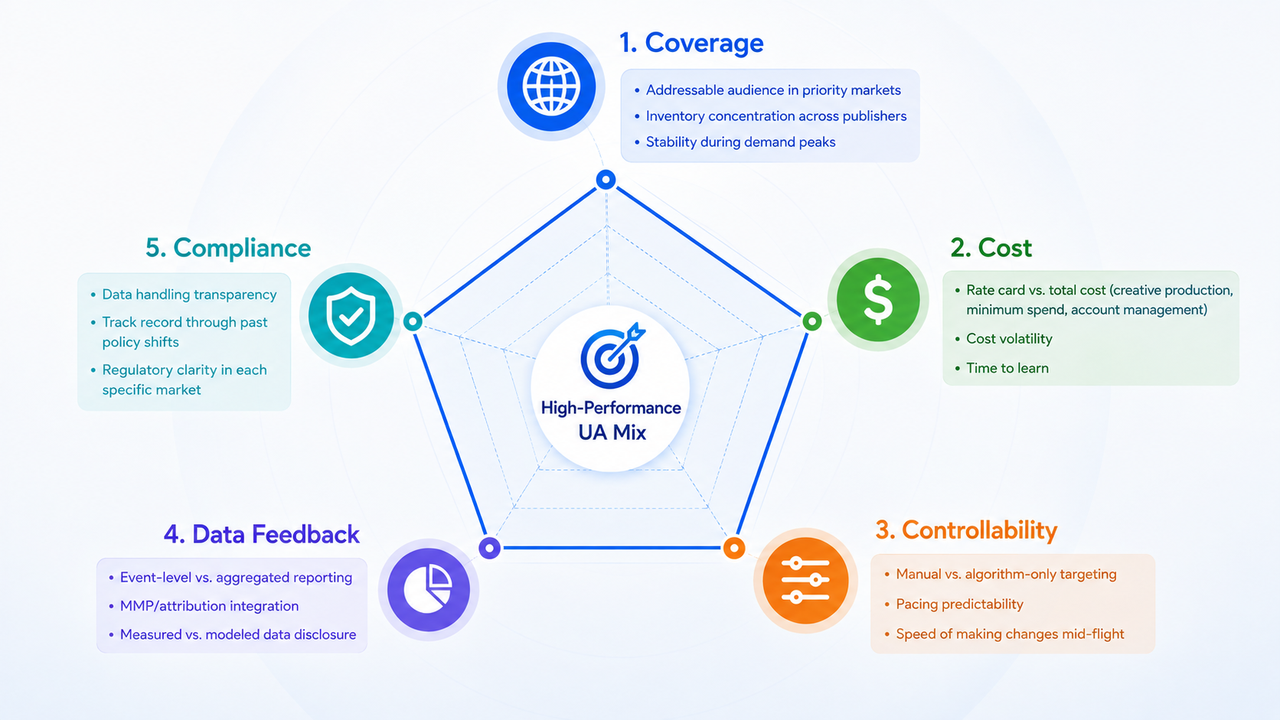
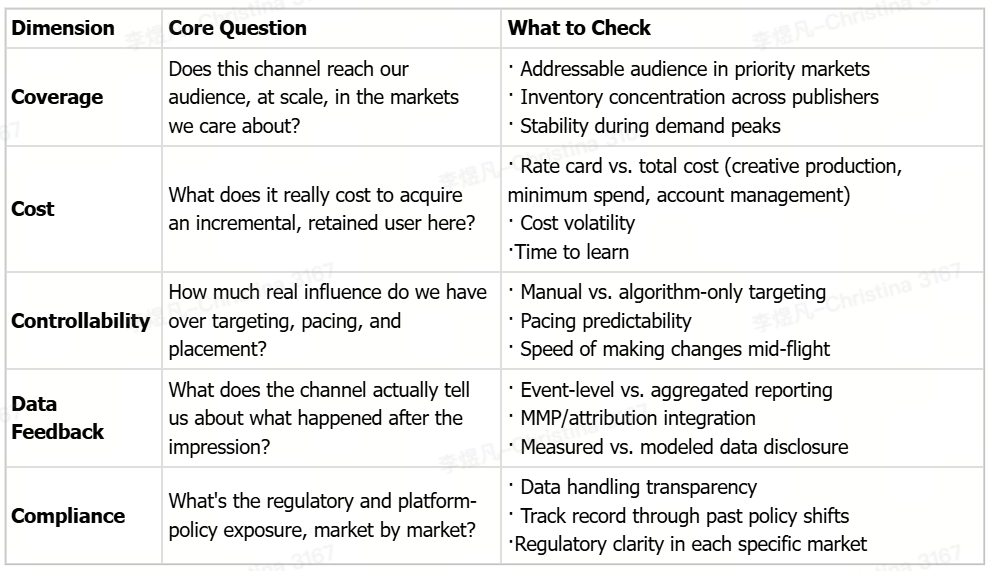
Each is worth a closer look.
1. Coverage
Coverage sounds obvious but is the dimension most often assumed rather than verified. A channel might post impressive global user numbers while barely registering in the specific markets that matter. CTV penetration in Southeast Asia doesn't look like the US market, and "regional coverage" claims need to be checked against actual market level data, not blended global figures.
Coverage also has a depth component:
• Is this premium placement, or remnant inventory?
• Is traffic concentrated in a handful of apps or publishers, quietly reintroducing the same concentration risk the diversification effort is meant to solve?
A channel that technically "covers" a market through a narrow slice of low quality inventory doesn't solve the problem, it just relocates it.
2. Cost
Cost is more than the headline CPM or CPI. The full picture includes:
• The platform's benchmark
• Creative production requirements
• Minimum spend during the cold-start phase
• Internal team time to learn a new interface and new optimization levers
• Cost volatility during the learning period, which has its own budget cost
The right comparison isn't "channel A's CPM vs. channel B's CPM." It's total cost per incremental, retained user, inclusive of operational overhead, measured over a window long enough to cover the learning curve.
3. Controllability
Controllability is how much genuine influence the advertiser has over targeting, frequency, placement, and pacing, versus how much is dictated by a black box algorithm or a rigid partner structure.
This has grown more important as major platforms push toward broad, automated targeting that trades manual control for algorithmic trust. That trade-off works when the algorithm has enough signal. It works poorly on newer channels that haven't yet accumulated enough conversion data to optimize well.
Direct inventory partnerships and open web programmatic can actually have a structural advantage here: negotiated terms, custom frequency capping, and granular placement control that a pure auction environment doesn't offer.
Quick checklist:
• Can targeting be adjusted manually, or only via automated bidding?
• Is pacing predictable day to day?
• If a creative needs to be pulled or budget shifted immediately, how fast can that actually happen?
4. Data Feedback
This is the dimension most likely to be underweighted in a fast evaluation, and often the one that decides whether a channel survives past six months.
The core question is what the channel actually tells you about what happened after the click or impression.
• Granular, event-level reporting that integrates with existing attribution stacks, versus
• Aggregated, delayed, or partial data that makes optimization guesswork
In a post-IDFA world, modeled data is common across the board, but modeling quality varies a lot by platform. A channel that can't provide reasonable confidence in its reported outcomes is hard to defend internally, no matter how the raw numbers look.
Worth confirming before committing real budget:
• Does it support the existing MMP or in-house attribution setup?
• Event-level or aggregate only?
• How much of the reporting is directly measured vs. modeled, and is that disclosed?
5. Compliance
Compliance covers data privacy regulation, platform policy risk, and reputational exposure from less established or less transparent inventory sources.
For advertisers expanding across markets, navigating conflicting regulations and uneven enforcement creates an inherent operational risk. A channel operating in a regulatory gray area can perform well for a while, then face an abrupt shift from a policy change, an app store crackdown, or a new privacy law, sometimes with little notice.
For advertisers spanning Southeast Asia, Greater China, Latin America, and MENA, compliance needs to be evaluated market by market, not as one global judgment. A channel that's clean and well established in one region may sit on much shakier regulatory ground in another.
Practical check:
• Clear, verifiable data handling practices?
• Track record of stability through past policy changes on relevant app stores or ad platforms?
• Operating within a clear regulatory framework in this specific market, or relying on ambiguity that could close without warning?
Putting the Framework to Work
None of the five dimensions should be scored in isolation, and none should automatically outweigh the others. Score a candidate channel across all five, weighted by what the business needs most right now:
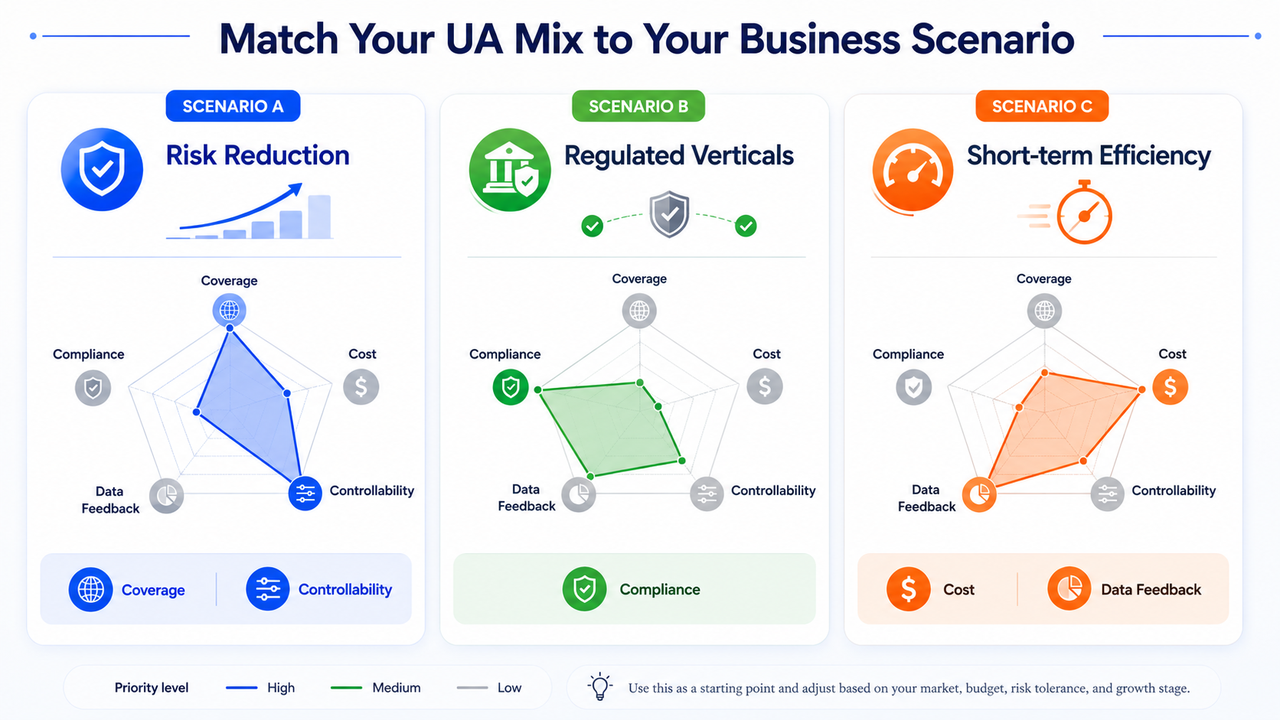
What the framework prevents is the common failure mode: judging a new channel purely on an early CPA number, then either overcommitting to something structurally unsound or abandoning something too early because the first few weeks didn't impress.
Diversification isn't valuable for its own sake. A scattered mix of channels each chosen for a different, inconsistent reason is arguably worse than concentration, since it adds operational complexity without necessarily reducing risk. The value comes from deliberately building a portfolio of channels that are each strong on the dimensions that matter, and that collectively reduce dependency on any single platform's algorithm, policy decisions, or pricing power.
Where This Fits for Advertisers Expanding Overseas
Applying this framework is more straightforward in theory than in practice. Evaluating coverage depth in a specific Southeast Asian market, negotiating controllability into a direct inventory deal, or confirming data feedback quality on an OEM channel all require access, relationships, and operational experience that most in-house teams building out a new region don't yet have.
This is the gap Novabeyond works in. As a global performance marketing and media buying company focused on non-mainstream, long-tail channels across Southeast Asia, RU & CIS, Latin America, and MENA, Novabeyond helps advertisers, particularly brands expanding overseas, get direct access to OEM, CTV, open web programmatic, and direct inventory partnerships, along with the on-the-ground evaluation needed to score those channels honestly on coverage, cost, controllability, data feedback, and compliance before budget moves.
For advertisers navigating the current environment, especially brands expanding into new markets where channel maturity and regulatory clarity vary widely, that kind of structured evaluation, backed by a partner who already operates in those channels, is the difference between a media plan that can absorb a platform shock and one that can't.
Ready to diversify your media mix beyond the walled gardens?
Reach out to the Novabeyond team today to get a customized channel evaluation checklist and discover untapped growth opportunities in your key target markets.
more posts
The Hidden Cost of Platform Dependency: What One Policy Change Can Destroy
August. 27 2026
LEARN MORE

How Incremental Growth Is Changing Performance Marketing
August. 25 2026
LEARN MORE

Incremental Growth Thinking: Why User Acquisition Must Go Beyond ROAS
August. 24 2026
LEARN MORE

Diminishing Returns: What to Do When You Double the Budget but Scale Doesn't Follow
August. 20 2026
LEARN MORE