



Copyright © 2026 NOVABEYOND LIMITED (company number 2833487). All rights reserved.
Address: UNIT 616 6/F KAM TEEM INDUSTRIAL BUILDING 135 CONNAUGHT ROAD WEST SAI WAN HONGKONG.
In the 2026 mobile marketing landscape, escalating Customer Acquisition Costs (CAC) across walled gardens and traditional social channels have made Programmatic Advertising the default growth engine for mobile app user acquisition (UA).
By leveraging Demand-Side Platforms (DSPs), Supply-Side Platforms (SSPs), and Real-Time Bidding (RTB) protocols, programmatic UA enables marketers to evaluate, bid on, and win targeted ad impressions in milliseconds. This guide provides a comprehensive blueprint covering bidding mechanics, creative technical specifications, a step-by-step scaling framework, fraud prevention, and future-proofing strategies.
1. Programmatic Bidding Mechanics & Algorithm Selection
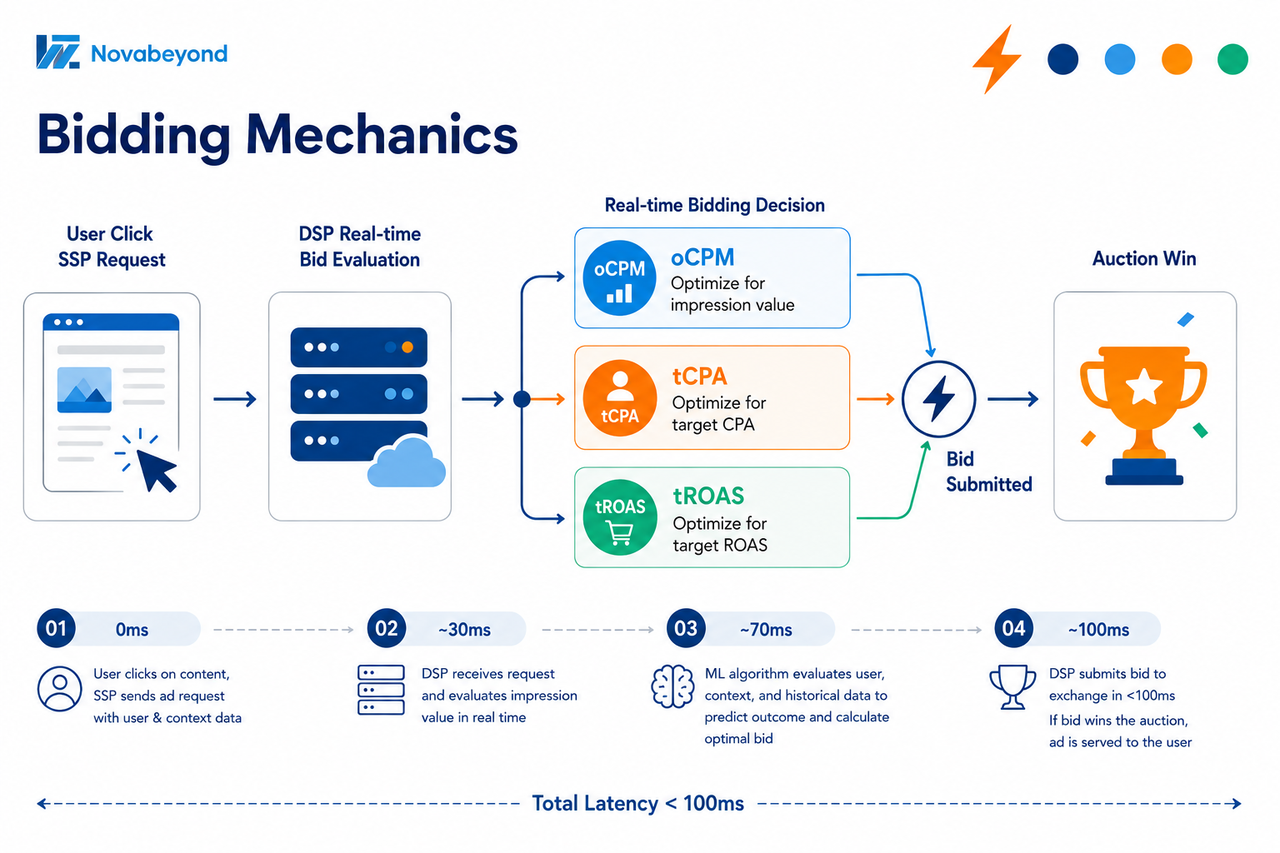
Programmatic UA relies on machine learning models evaluating user value dynamically. Choosing the right bidding mechanism dictates whether your campaigns hit cost-per-install (CPI) targets or achieve sustainable post-install return on ad spend (ROAS).
Bidding Models Overview
| Bidding Model | Mechanics & Purpose | Best Suited For | Advantages & Trade-offs |
| oCPM (Optimized Cost Per Mille) | You pay per 1,000 impressions; the algorithm auto-adjusts bids based on predicted conversion probability. | Cold start phase / Utilities / Hyper-casual games | Pros: Rapid impression delivery, fast event aggregation. Cons: Less control over down-funnel retention/purchases. |
| tCPA (Target Cost Per Acquisition) | Bids are constrained by a fixed cost-per-action (e.g., registration, level completion). | Mid-core games / Fintech / Subscription apps | Pros: Stable acquisition costs, filters out low-intent users. Cons: Requires high event volume for model convergence. |
| tROAS (Target Return on Ad Spend) | Uses Value-Based Bidding (VBB) to adjust bid price according to predicted LTV. | In-app purchase (IAP) games / High-ARPU apps | Pros: Directly optimizes for revenue and high-value whales. Cons: High entry CPMs; risks under-spending if conversion data is sparse. |
Winning Bids & Win-Rate Diagnosis
• First-Price Auction Rules: Modern programmatic exchanges operate on first-price logic—what you bid is what you pay. DSPs rely heavily on bid shading algorithms to calculate the minimum winning price and avoid overpaying.
• Diagnosing Win Rates:
• Win Rate < 5%: Indicates overly restrictive targeting, bids set below SSP bid floors, or insufficient algorithm learning history.
• Win Rate > 40%: Signals overbidding (eroding margin/ROAS) or self-competition across overlapping supply paths.
• Optimal Target Zone: Aim for a 8% – 20% win rate for sustainable efficiency and scale.
2. Creative Standards & Technical Requirements
As automated bidding algorithmically handles audience matching, creatives have become the single most crucial lever for campaign performance.
High-Performing Ad Formats
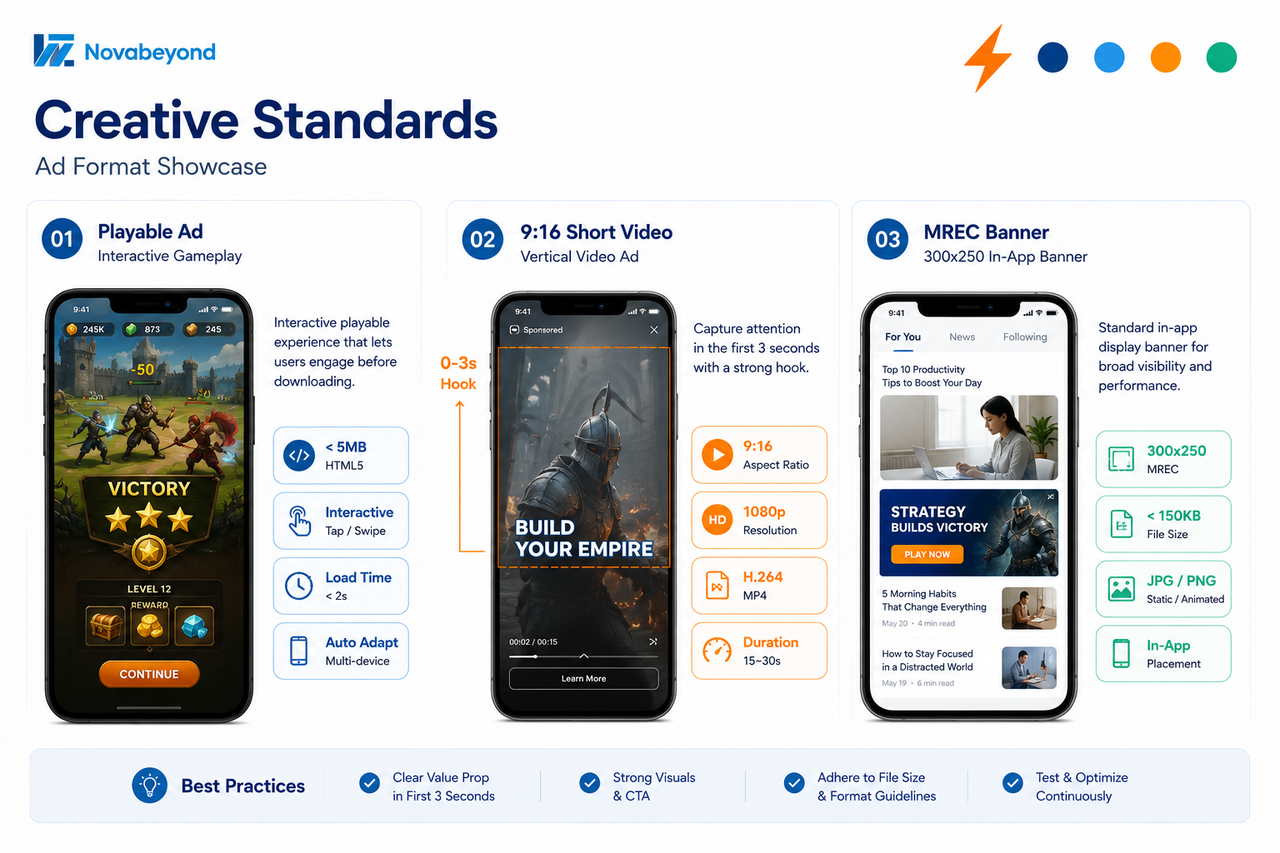
1. Playable Ads (Interactive HTML5)
• Use Case: Highest conversion rate on in-app programmatic networks (e.g., AppLovin, Mintegral).
• Specs: HTML5 bundles must remain under 5MB with zero latency. Core interactions must be intuitive within the first 3 seconds.
2. Short-Form Video Ads
• Ratios: 9:16 (Vertical, 1080x1920), 16:9 (Horizontal), and 1:1 (Square).
• Duration: 15–30 seconds. The first 3 seconds must establish visual friction or address a direct user pain point.
3. Native & MREC Banners
• Ratios: 300x250 (Medium Rectangle) and 320x50 (Standard Mobile Leaderboard).
• Use Case: Low-cost impression fill, retargeting, and incremental reach.
Technical & Compliance Specs
Programmatic exchanges automatically enforce strict validation rules. Non-compliant assets trigger immediate rejections or bid throttling.
• Load Latency: Encode video via H.264/AAC at 1080p resolution. Ensure first-frame render times stay under 1.5 seconds.
• Privacy Compliance (SKAN 4.0+ / Privacy Sandbox): Ensure click destinations utilize validated Web-to-App or StoreKit invocation protocols to eliminate attribution drops caused by privacy redirects.
3. The Scaling SOP: From Cold Start to Volume
Scaling a programmatic UA campaign requires a structured, data-led methodology. Avoiding reckless budget spikes prevents algorithmic model reset.
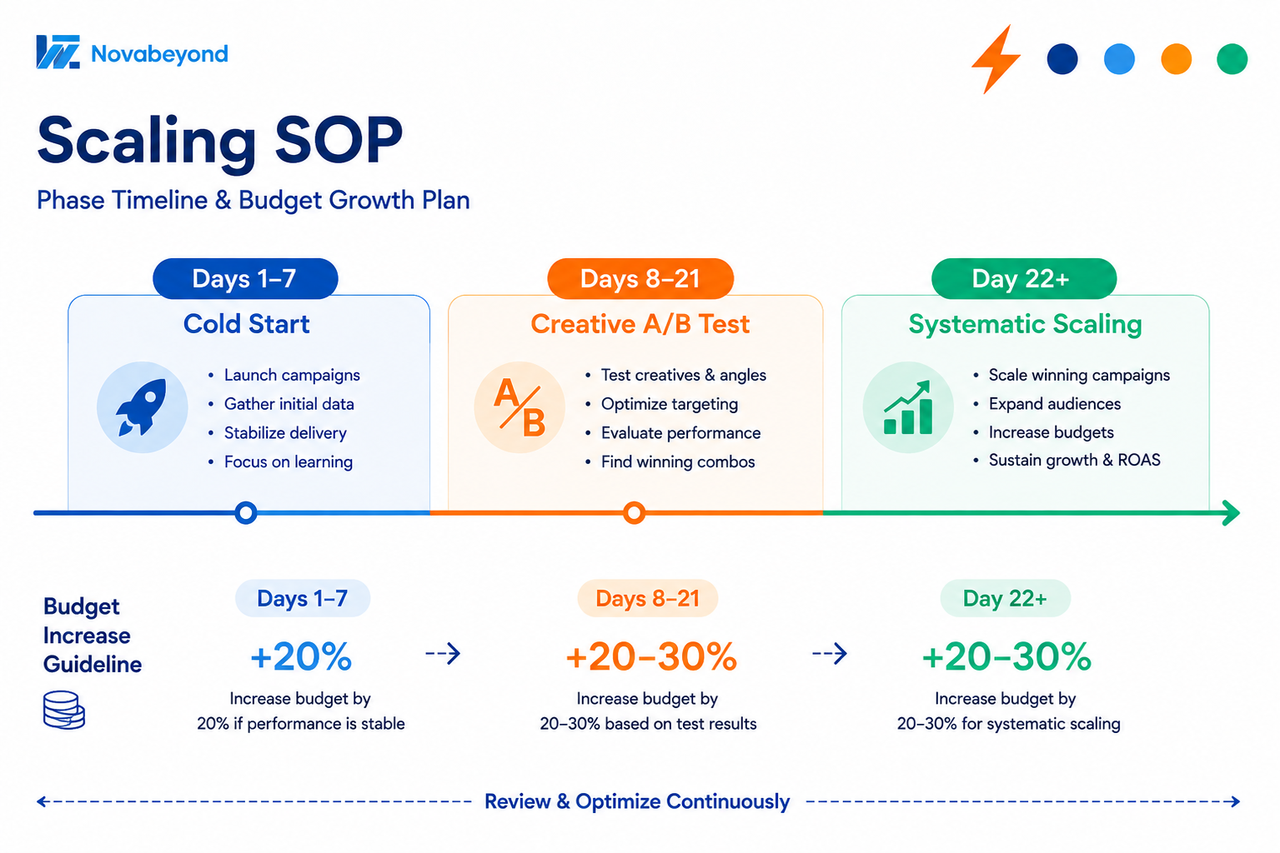
Phase 1: Cold Start & Model Calibration (Days 1–7)
• Attribution Infrastructure: Integrate a Mobile Measurement Partner (MMP) and configure real-time Server-to-Server (S2S) event callbacks. Send full funnel data—Install, Registration, and In-App Purchase—back to the DSP.
• Initial Bidding Setup: Deploy oCPM or a moderate tCPA. Aim to generate at least 20–50 conversion events per ad group daily to exit the learning phase.
• Budget Allocation: Set initial daily budgets at 10x–15x your target CPA per ad group to give the algorithm adequate testing headroom.
Phase 2: Creative Iteration & Testing (Days 8–21)
● Modular A/B Testing: Keep targeting parameters static. Swap single creative variables (Hook, Core Body, CTA) to isolate drivers of performance.
● Creative Triage Matrix:
• High CTR / Low CVR: Misleading asset (clickbait). The post-install landing experience does not match creative expectations.
• Low CTR / High CVR: High intent, narrow appeal. Iterate on the opening 3-second hook to broaden top-of-funnel reach.
● Cut any creative asset that consumes 2x–3x target CPA without driving conversions.
Phase 3: Systematic Budget Scaling (Day 22+)
• Incremental Budget Increases: Scale daily budgets by 20%–30% every 48–72 hours for campaigns consistently hitting ROAS targets. Avoid doubling budgets overnight to prevent model destabilization.
• Supply Path Optimization (SPO): Diversify across 2–3 DSPs with unique SSP supply relationships. Continually maintain blacklists (Exclusion Lists) for publisher app IDs delivering low-retention traffic.
4. Fraud Mitigation & Privacy Frameworks
Programmatic channels offer massive scale, but maintaining traffic purity requires active vigilance against ad fraud and strict adherence to evolving privacy frameworks.
Mitigating Programmatic Ad Fraud
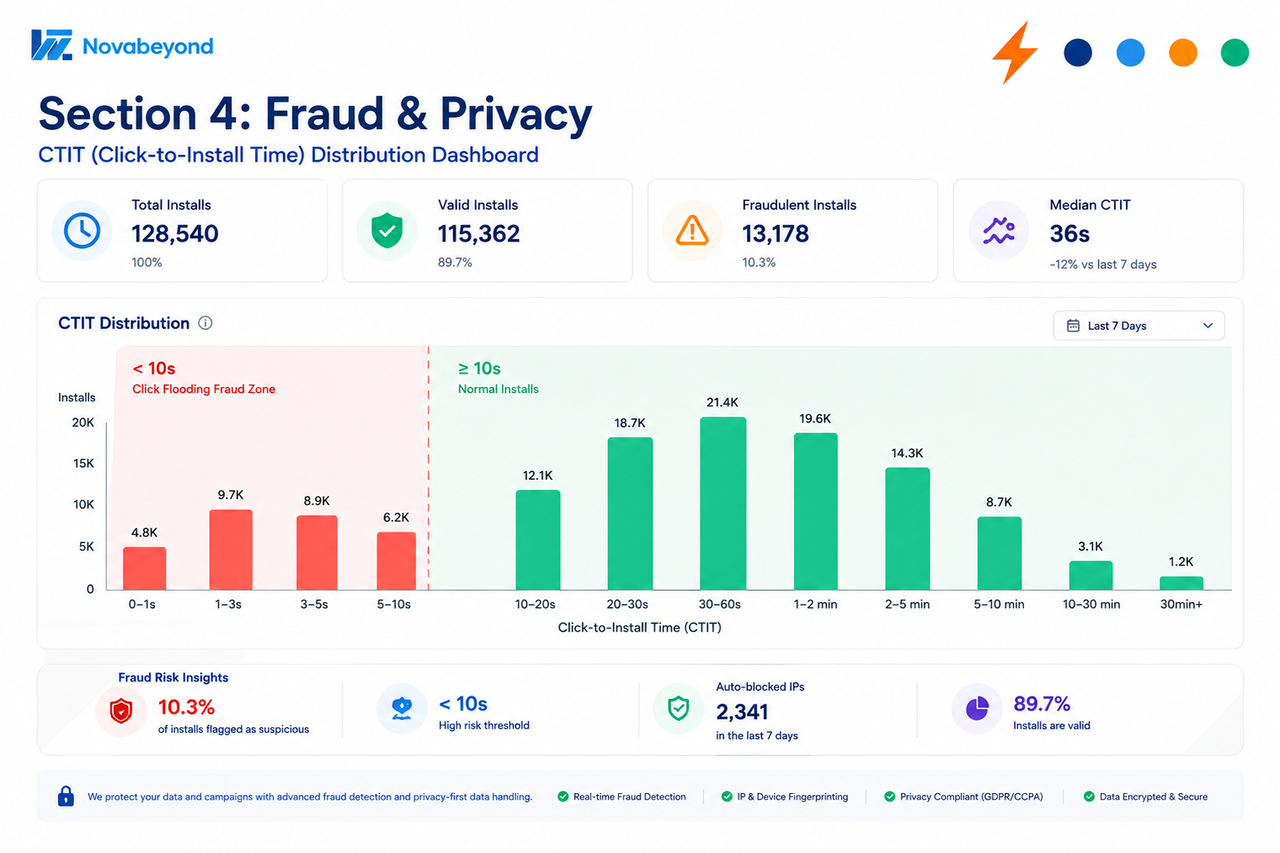
• Click Flooding: Fraudulent publishers flood attribution windows with low-quality clicks to claim organic installs. Monitor Click-to-Install Time (CTIT) distributions; installs clustering under 10 seconds indicate click spamming.
• SDK Spoofing: Attackers simulate real app installs via stolen device tokens. Enforce cryptographic signature verification and require MMP fraud detection modules on all incoming traffic.
• Publisher Blacklisting: Automatically purge site IDs showing zero post-install engagement or abnormal conversion rate spikes.
Navigating Privacy Changes
• First-Party Data Strategy: Build robust zero-party and first-party data capture mechanisms in-app to feed privacy-compliant machine learning models.
• SKAdNetwork (SKAN 4.0+) & Privacy Sandbox: Transition campaign structures toward contextual signal targeting and coarse-grained conversion values to retain visibility in privacy-first environments.
Scale Your Global UA Growth with Novabeyond
Navigating the complexities of real-time bidding, supply path optimization, and regional ad networks requires more than basic automation, it demands deep performance marketing expertise and direct media integrations.
At Novabeyond, we empower app developers and global brands to unlock incremental user growth across top-tier programmatic platforms, OEM channels, and emerging regional media networks. From algorithmic bidding management and fraud-free traffic verification to high-converting creative localization, our end-to-end performance marketing solutions ensure every ad dollar delivers measurable business outcomes.
Ready to scale your app's user acquisition with precision? Contact our growth team today at sales@novabeyond.com to claim your custom programmatic growth strategy and elevate your campaign ROAS.
more posts
Mastering Mobile User Acquisition for Fintech Apps in 2026: What Actually Works
October. 08 2026
LEARN MORE

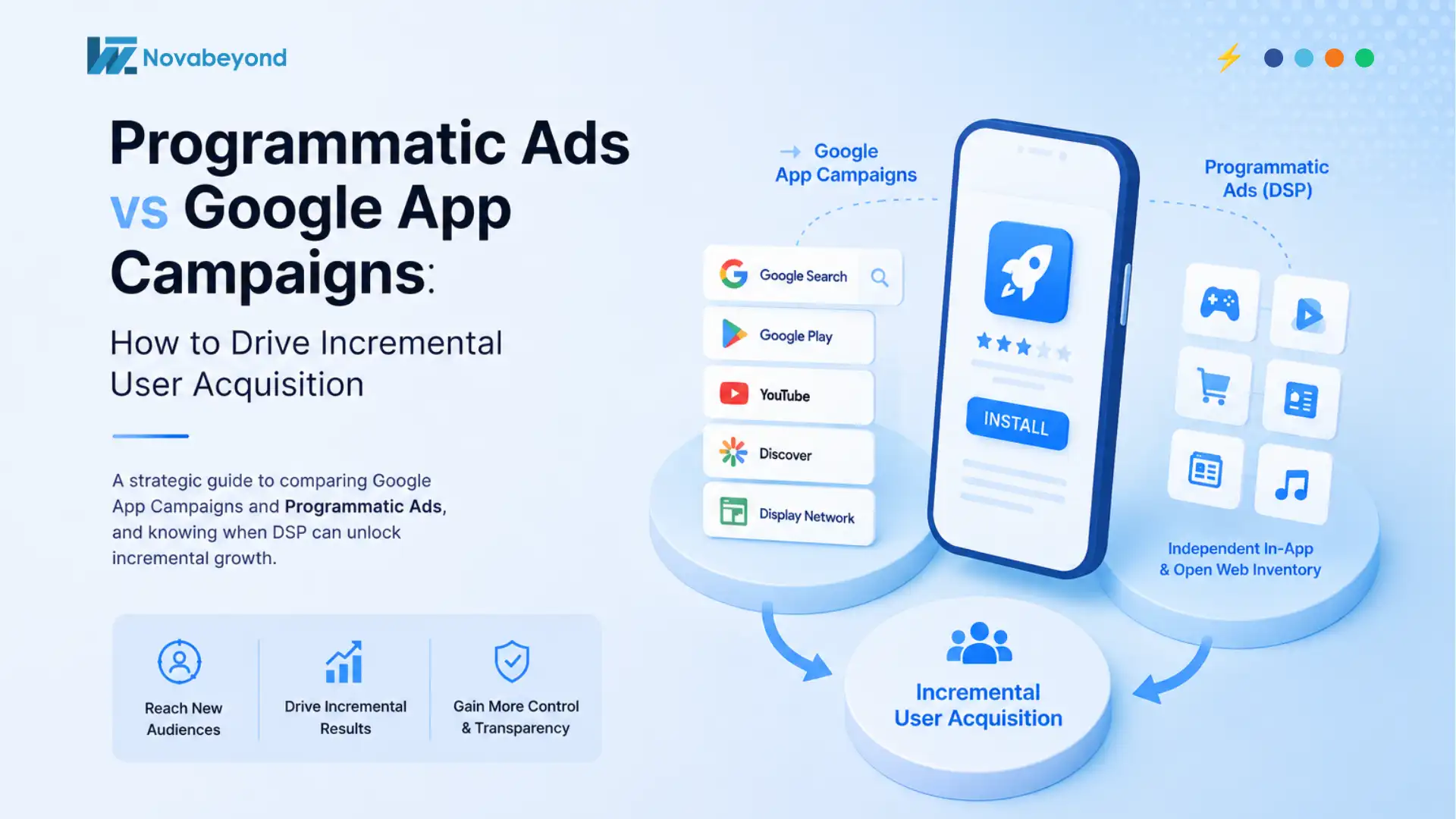
Programmatic Advertising vs. Google App Campaigns: How to Drive Incremental UA in 2026
September. 23 2026
LEARN MORE
Programmatic Campaign Underperforming? 5 Data-Driven Fixes to Rescue ROAS in 2026
August. 31 2026
LEARN MORE
Beyond Google UAC: Rethinking Growth Strategies for Mobile Game Publishers in a Maturing Market
July. 21 2026
LEARN MORE