




Copyright © 2026 NOVABEYOND LIMITED (company number 2833487). All rights reserved.
Address: UNIT 616 6/F KAM TEEM INDUSTRIAL BUILDING 135 CONNAUGHT ROAD WEST SAI WAN HONGKONG.
Introduction
Many 2026 media plans still carry one line called Kwai for Latin America and Southeast Asia. The buy then looks efficient on a blended report but weak in the country that was supposed to grow. The usual problem is not always a bad bid. It can be a wrong app, a weak local offer, or a conversion path that does not match the market.
In Brazil and much of Latin America, the short-video audience sits in Kwai. In Indonesia, the short-video audience buyers need is SnackVideo. Both sit inside Kwai for Business, but a shared commercial parent does not mean a shared consumer audience.
The mix-up often appears in creative reviews. A Portuguese price cue gets pasted onto an Indonesian cut. A Brazilian film creator is resized for Bahasa Indonesia and called localization. Learning from one country is then averaged into the other, so neither delivery system receives a clean signal.
The January 2026 Kwai for Business opening conference made the distinction easier to brief. Commercial leads described a product matrix of Kwai Pro, Kwai Lite, and SnackVideo, while positioning Brazil as an important overseas growth market and highlighting brand and performance work, short drama, and ecommerce as growth opportunities.
Southeast Asia does not disappear from that picture. It needs its own market logic.
Emerging Media Solutions is the Novabeyond service line for this kind of regional access, including onboarding, local policy, and execution that follows the market instead of forcing every country into one global template.
The key planning principle is simple: Do not allocate by platform family alone. Allocate by market, consumer app, creative fit, commerce path, and measurable business outcome.
Plan a Kwai and SnackVideo split with Novabeyond
Quick Answer
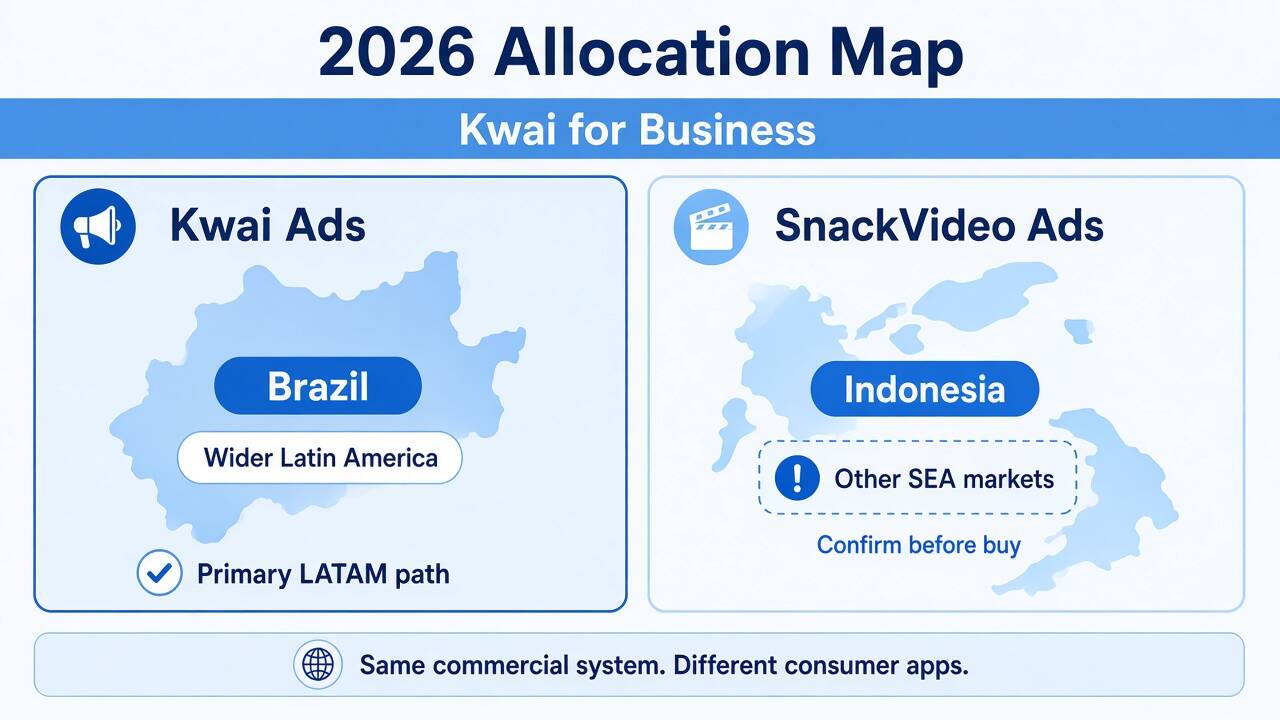
Use Kwai Ads when the revenue goal is in Latin America, especially Brazil, or in other markets where the consumer app is Kwai rather than SnackVideo. Use SnackVideo Ads when the goal is in Indonesia and when the local inventory and conversion path are available. Do not split a first test evenly across both apps simply because they share Kwai for Business. Choose the country first, then confirm the consumer app, local language, creative format, checkout path, and measurement model. A lower CPM in the wrong country is not necessarily efficient. For the first test, concentrate most of the budget on the market that clearly fits the commercial brief, then add the second app only after the first market produces stable cost and quality signals.
One Commercial System, Two Consumer Apps
Kwai for Business is Kuaishou's overseas advertising system. It is the layer where objectives, delivery, and partner support live. The apps underneath it are not aliases.
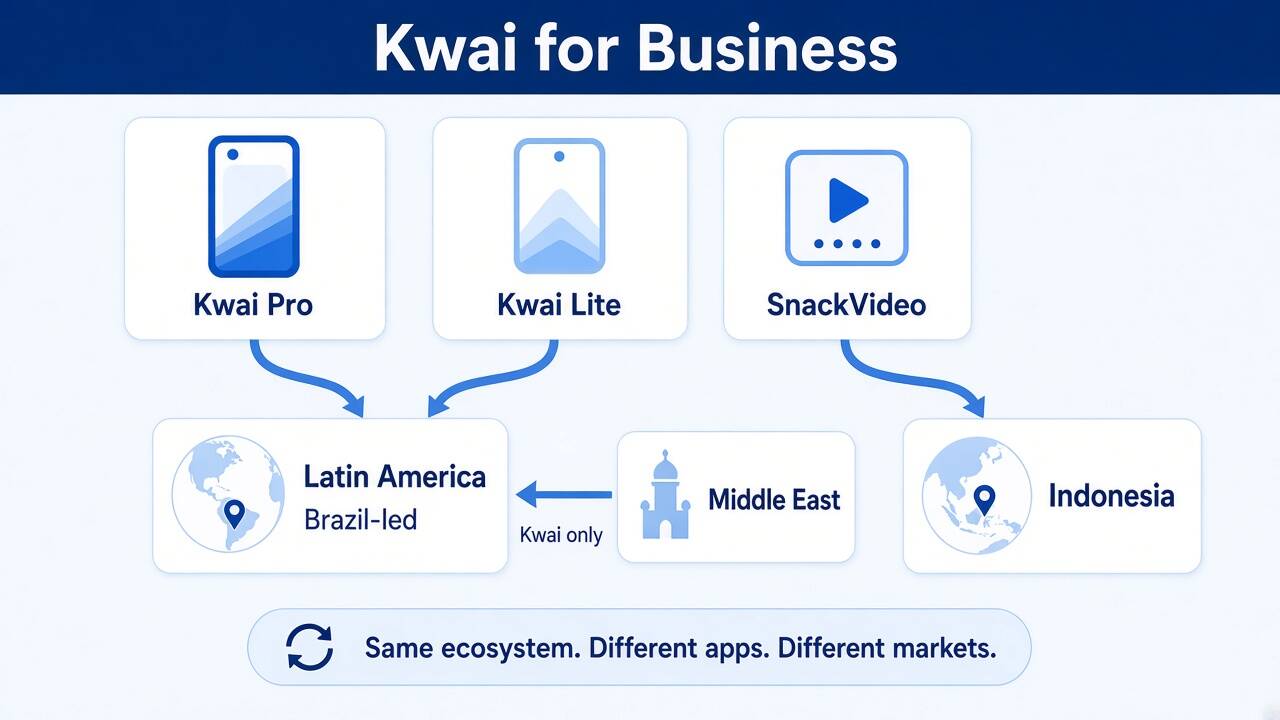
At the 2026 opening conference, the company described a product matrix of Kwai Pro, Kwai Lite, and SnackVideo, built to raise activity and time spent, with smarter delivery moving from manual setup toward AI-assisted buying.
Treat that matrix as the commercial planning frame. Treat each consumer app as a different audience and market environment.
Kwai is the consumer brand most buyers meet in Brazil and across much of Latin America. It is also the name attached to Middle East planning in many international briefs. The 2026 conference kept Brazil as an important overseas anchor, with brand building and consumer conversion presented together rather than as separate growth stories.
Short drama, shops, independent sites, and platform ecommerce were identified as potential growth paths. That means a Brazil Kwai program can support both brand and performance objectives, as long as advertisers build campaigns around the correct conversion goal rather than treating the entire account as one audience pool.
SnackVideo is the consumer brand built for Southeast Asia, with Indonesia as the market that can be briefed most directly. Launch coverage describes Kwai for Business as the advertising layer on SnackVideo in Indonesia.
Local product coverage has also described formats such as live-stream ads, simple in-app landing pages, shop deep links toward marketplaces such as Shopee, and native ads from a brand account. These options make the Indonesia opportunity different from a standard Brazil in-feed campaign because the commerce path itself can become part of the media strategy.
A Brazil in-feed unit and an Indonesia live unit should not be treated as if they share one creative specification or one optimization model.
Teams still type "Kwai Ads" for both jobs. That search behavior names the commercial system, not necessarily the consumer app that the target audience uses in Indonesia.
The practical distinction is therefore: Same commercial ecosystem. Different consumer app. Different market. Different creative. Different conversion path.
Account access is a separate job from this matrix. Kwai Ads does not offer a casual self-serve switch between a personal profile and a business profile. International advertisers generally enter through an authorized partner and an agency ad account.
If you still need the onboarding model, use the Kwai Ads agency ad account guide.
This page starts after access exists and asks a harder question: Which app should receive the next dollar?
The 2026 Allocation Matrix
A useful allocation decision should start with the business brief rather than the platform logo.
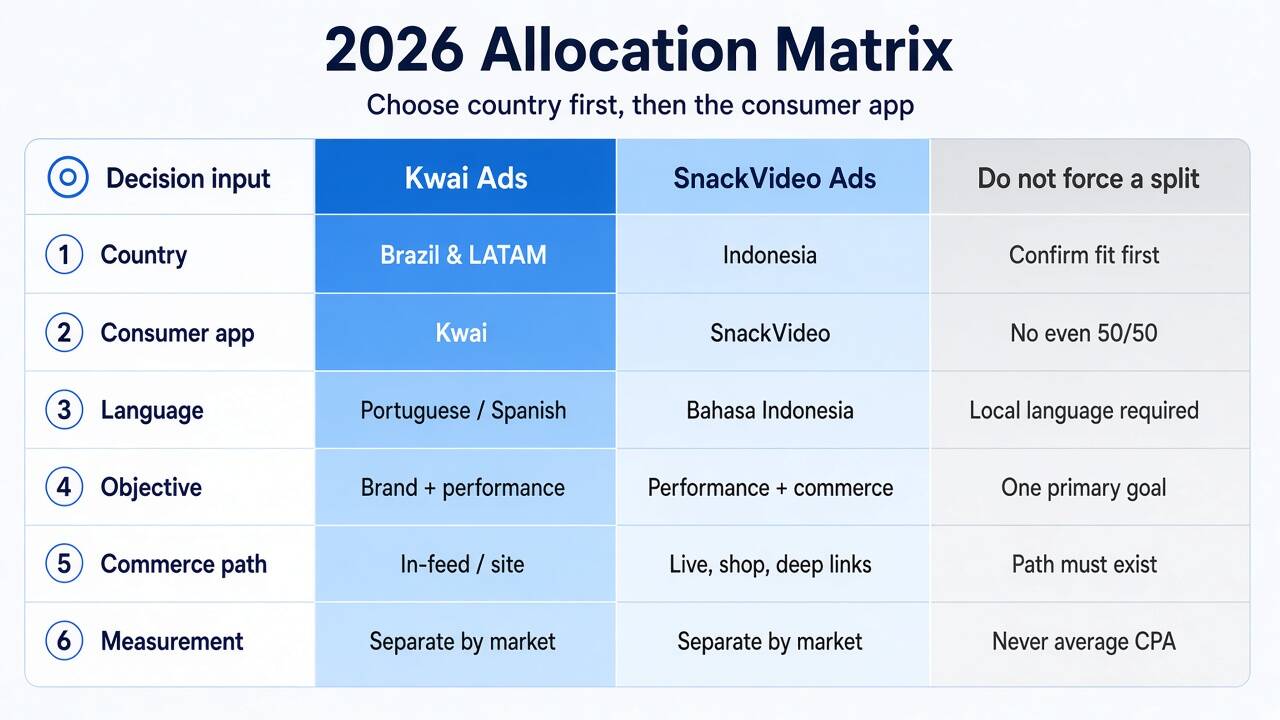
Score the brief across six inputs:
| Decision input | Weight Kwai Ads | Weight SnackVideo Ads | Do not force a split |
| Primary country | Brazil first, then other Latin American markets where the business can fulfill orders | Indonesia first. Other Southeast Asian markets only after ad inventory is confirmed | A region with no clear sales path |
| Consumer app | Kwai, including the local build of Kwai Pro or Kwai Lite | SnackVideo | Middle East or another Kwai market assigned to SnackVideo by habit |
| Language of the cut | Portuguese in Brazil. Spanish in specific Spanish-speaking countries | Bahasa Indonesia as the default test language | One English global asset only |
| Objective | Brand and performance, short-drama installs, ecommerce, games, fintech, and local services | App installs, ecommerce traffic, beauty, fashion, home, and services with an Indonesia checkout | A global brand film with no local offer or local conversion path |
| Commerce path | A website, app, or in-platform shop in Brazil or wider Latin America | In-app pages, shop deep links, or a checkout local consumers already trust | One pixel and one currency used to judge both markets |
| First budget | Enough for one Latin American country to finish learning | Enough for the Indonesia market to finish learning | A 50:50 split that cannot teach either delivery system |
The table should be read from the country row down, not from the logo you already recognize.
A beauty brand with warehouses in Jakarta and no Portuguese support should not open on Kwai simply because a conference slide highlighted Brazil. A fintech with a Brazil license and no Bahasa landing page should not open on SnackVideo because Southeast Asia appears cheaper on a spreadsheet.
Novabeyond Planning Rule
If four or more decision inputs clearly point to one app, concentrate the majority of the initial test budget there instead of forcing an even split.
A practical starting point is to place roughly 80% of the first 30-day test budget behind the market that wins the majority of the decision inputs, while reserving the remainder only when there is a clear reason to validate the second option.
This is a Novabeyond planning framework, not a universal platform benchmark.
The purpose is to protect the learning process.
A 50/50 test may look balanced in a media plan, but it can leave both markets underfunded. Neither delivery system gets enough time or volume to produce a useful signal, and the advertiser ends up comparing two weak tests rather than two viable opportunities.
Read the decision this way: Country → Consumer app → Language → Objective → Commerce → Measurement → Budget
If the first five inputs already point clearly toward one market, do not manufacture uncertainty by splitting the budget equally.
The Middle East is in Kwai. Do not park it in the SnackVideo column simply because both are emerging markets.
Philippines, Thailand, and other Southeast Asian countries are not automatic SnackVideo buys. Secondary market coverage can group them together, but advertisers should still evaluate the actual app, inventory, and ad product available for the intended market.
A confirmed Indonesia program is a more useful first test than a five-country spray with no local sales path.
If the matrix says Brazil, go deeper on market setup in the Kwai Brazil advertising guide after the allocation call, not before it.
Country setup without a clear reason to be in that country only creates another underfilled account.
Creative, Commerce, and Measurement Rules That Change the Split
Geography picks the app. Creative and checkout decide whether the app can scale.
Both audiences respond to short video that feels native to the feed: a hook early in the video, a visible product, a language people use naturally, and an offer they can understand without translation.
That shared creative principle is exactly why teams reuse files. It is also why reuse can fail.
The joke, price, payment cue, creator context, social proof, and call to action all need to make sense locally. Resizing the same global asset is not the same as localization.
Brazil and Kwai: Build for Local Recognition
On Kwai in Brazil, community tone can matter more than a polished global brand film.
Everyday scenes, local humor, Portuguese on screen, and Portuguese voiceover can make the creative feel native to the feed. The commercial agenda also creates opportunities around cultural calendars, including football, Carnival, and the World Cup window.
Use those moments as flight timing and creative context, not as a substitute for a strong offer.
If the product is a short drama service, game, ecommerce product, or local service, the end card should lead directly to the appropriate action.
The objective is not simply to generate views, to turn attention into a measurable business event.
Indonesia and SnackVideo: Build Around the Commerce Path
On SnackVideo in Indonesia, start in Bahasa Indonesia.
Beauty, fashion, home, and everyday commerce have been frequently cited in local advertising coverage, which aligns with a broader mobile commerce environment where users can move quickly from content to product consideration.
If the available setup supports live-stream ads, in-app landing pages, or shop deep links, test those paths against a simpler click-to-web campaign where appropriate.
Do not import a Brazilian creator's face, currency, or slang and call it a localized variant.
Native placements that help grow a local brand account can support trust, but they do not replace a working product page or checkout process.
Why Native and UGC Do Not Burn at the Same Pace
Both feeds can reward native and UGC-style creativity. They do not necessarily require the same refresh calendar.
Native and UGC are production styles, not universal creative expiration rules.
Copying Kwai's creative rotation directly onto SnackVideo, or the reverse, can kill a healthy asset too early in one market while allowing fatigue to build in another.
On Kwai in Brazil, a native unit can feature a creator or everyday personality who feels local to the feed. The value often comes from recognition: the setting, language, humor, complaint, or product experience feels familiar.
That kind of creative can remain relevant through a cultural window because the audience is responding to the context as well as the offer.
On SnackVideo in Indonesia, the product itself may need to carry more of the conversion message. Price, proof, product benefit, and the path into a shop or landing page should be easy to understand.
The face can remain fresh while the offer becomes tired. That distinction matters.
If users continue watching but stop clicking, changing the offer or end card may be more useful than reshooting the entire creator concept.
If users click but stop ordering, investigate the product page, price, payment path, and checkout before assuming the creator has fatigued.
A new face cannot fix a broken conversion path.
Measure Each Market on Its Own Economics
Measurement should follow the allocation. Give each app its own campaigns, conversion events, budgets, and weekly reporting.
Define success according to the market's current business economics:
Cost per install for an app.
Cost per purchase for ecommerce.
Cost per qualified lead for lead generation.
Revenue or return metrics when sufficient purchase data exists.
A quality metric such as retained install, approved lead, paid order, or repeat purchase.
Do not average Brazil and Indonesia into one CPA.
This is one of the most important rules in a multi-market program.
The cheaper country can still be the worse business if refunds, payment failures, approval rates, retention, or customer value sit outside the media report.
A practical reporting pack should therefore contain four core lines per app:
| Metric | What it tells you |
| Spend | How much budget this market actually spent |
| Primary conversion | Whether users completed the target action |
| Cost per conversion | What it costs to get that target action |
| Quality metric | Whether those conversions create real business value |
Keep creative testing inside one country until you have a control.
Three to five strong local cuts can be enough to establish an initial creative learning loop. A large pile of resized global exports mostly shows that the files were not made for the feed.
Audience refinement comes after the creative control exists, which is why the Kwai Ads targeting guide belongs later than this allocation matrix.
Ask Novabeyond to pressure-test your country split
How to Sequence Budget Before You Run Both?
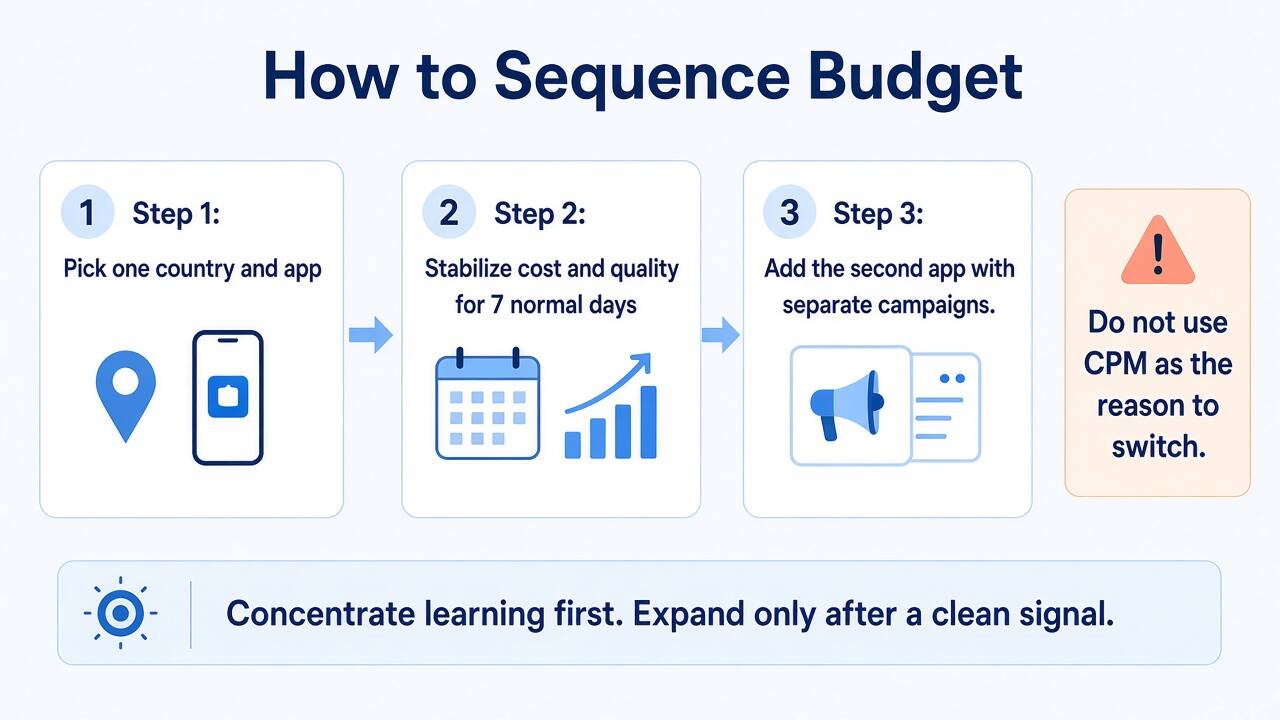
Parallel programs are a phase, not a starting setting.
Sequence the money, so each delivery system gets a fair learning window.
Step 1: Choose One Primary Country
Start with one primary country from the matrix.
Confirm the consumer app name in that country before trafficking. Build the landing path in the local language and currency, including payment methods people already use. Then fund one primary objective.
Mixing brand reach and purchase optimization in the first week can make both objectives look average because the campaign does not have a clean optimization signal.
Step 2: Keep the Initial Learning Pool Clean
Keep the first flight inside a single learning pool.
A shared agency ad account can hold more than one market later. It should not blend Brazil and Indonesia into one ad set while you are still deciding market fit.
Use for eparate campaigns, budgets, naming conventions, conversion event, and reporting.
If finance needs one invoice, that is an operations decision. It is not a reason to share optimization signals.
Step 3: Add the Second App Only When the First Test Is Stable
Add the second app when three conditions are true.
First, the initial market has a stable cost against the target for at least a week of normal delivery rather than one unusually strong day.
Second, creative fatigue is not the main constraint you are trying to escape.
Third, the second country already has its own offer, language, landing page, and checkout path.
If one of these conditions is missing, another week of useful learning in the first market may provide more value than a symbolic second-market test at 10% of total spend.
Step 4: Reallocate on Incremental Quality, Not CPM
When both apps are live, do not move budget simply because one has a lower CPM.
Move the next tranche according to accepted conversions and business quality.
For example, a lower CPM is not enough if the traffic produces fewer paid orders. Likewise, a higher CPM can still make sense if the resulting users have stronger purchase or retention quality.
Leave a maintenance budget on the other app when appropriate so learning does not reset, but do not protect a weak market purely for the sake of maintaining an equal split.
Step 5: Review the Allocation Monthly
Teams that also buy other short-video ecosystems should keep this matrix inside the Kwai family.
Choosing Kwai versus SnackVideo is not the same decision as choosing Kwai versus another short-video network in another geography.
For that wider map, read the short-video geography comparison, then return here to split Latin America and Southeast Asia inside Kwai for Business.
Review the split once a month using four questions:
Does the country mix still match the original business brief?
Is creative age increasing faster than conversion quality?
Are conversions producing acceptable downstream quality?
Does a new product, market, or format deserve a controlled test?
Kill formats that cannot be tracked.
Keep the matrix in the channel plan so the two apps are not collapsed into one line item again.
FAQ
1. Are Kwai Ads and SnackVideo Ads the same platform?
They share Kwai for Business as the commercial system, and the 2026 product matrix places Kwai Pro, Kwai Lite, and SnackVideo side by side. They are not the same consumer audience. Plan Kwai for Latin America, led by Brazil, and SnackVideo for Indonesia first. Confirm the appropriate app and ad product before expanding into additional Southeast Asian markets.
2. Can one agency ad account run both markets?
Often yes, once a partner has opened access, but the campaigns should stay separate. A shared agency ad account is an access and billing structure. It is not permission to mix Brazil and Indonesia into one learning pool. Keep campaigns, budgets, conversion events, and reporting separated by market.
3. What if the brief also includes the Middle East?
Keep the Middle East on Kwai. Do not assign it to SnackVideo simply because both markets sit outside the United States and Western Europe. Language, creative review, offer design, and conversion paths need their own market assessment. This matrix should not be stretched to cover a different regional strategy by default.
4. Should English creative be the control?
No. English can be a reference cut for internal review, but it should not be the only asset in either market. Brazil needs Portuguese. Indonesia needs Bahasa Indonesia. Spanish enters when a specific Spanish-speaking Latin American country is included in the brief. If you cannot produce the local language, you are not ready to buy that market at scale.
5. How do we avoid colliding with a Brazil program we already run?
If Brazil Kwai is already a healthy line, do not launch a second Brazil program simply because this matrix exists. Use the framework to decide whether Indonesia SnackVideo deserves incremental budget. Keep Brazil optimization on the existing campaigns and judge SnackVideo on its own conversion and quality signals. Overlap in reporting is fine. Overlap in learning is not.
6. Which metric should move budget between the two apps?
Use the primary conversion you would defend to finance, plus one quality check. Cost per purchase with a paid-order rate, or cost per install with early retention, is more useful than a leaderboard based only on CPM or CTR. Move incremental budget toward the app that produces stronger accepted conversions at a cost the business can defend.
7. Can I use the same creative concept on Kwai and SnackVideo?
You can reuse the underlying creative idea, but the execution should be localized. Adapt language, creator context, currency, offer, CTA, product proof, and landing path for each market. The same concept can create efficiency in production, but the same finished asset should not automatically become the control for both apps.
8. When should I move budget from one app to the other?
Do not reallocate because of one strong day or a lower CPM. Give each market enough normal delivery to produce a useful conversion and quality signal. Then compare cost against the same business outcome within each market. If one app produces stronger accepted conversions while the other struggles with quality or checkout, move the next tranche toward the stronger business signal rather than preserving an artificial 50/50 split.
Conclusion
Kwai Ads and SnackVideo Ads are a 2026 allocation problem, not a logo preference.
Kwai for Business can hold both, and the reported product matrix places them within the same commercial ecosystem. The first dollar should still follow the country, consumer app, language, creative environment, commerce path, and measurable business outcome.
Brazil and wider Latin America default to Kwai. Indonesia defaults to SnackVideo. Other Southeast Asian markets require a clear market and product fit before budget is committed. The Middle East should not be filed under SnackVideo simply for convenience.
The most important operational rule is to keep the learning pools clean.
Run one market until cost and quality are stable. Then add the second app with separate campaigns, separate creative, separate measurement, and a reallocation model based on accepted conversions rather than CPM alone.
For brands expanding into emerging short-video channels, the challenge is not simply getting access to another platform. It is knowing where to put the next dollar, what creativity to build, how to measure the result, and when to scale.
That is where Novabeyond can add value.
more posts
Moloco Ads Optimization: Surviving the Learning Phase and Scaling iROAS (2026)
October. 08 2026
LEARN MORE

Why NewsBreak is the Essential US UA Growth Engine in 2026: Platform Guide & Performance Analysis
September. 24 2026
LEARN MORE
Navigating Media Accessibility in Media Growth: Bottlenecks & Solutions
September. 23 2026
LEARN MORE
MediaGo Ads Not Delivering? Zero-Traffic Checklist to Restore Spend in 2026
September. 17 2026
LEARN MORE