




UNIT 616 6/F KAM TEEM INDUSTRIAL BUILDING 135 CONNAUGHT ROAD WEST SAI WAN HONGKONG.
Copyright © 2026 NOVABEYOND LIMITED (company number 2833487). All rights reserved.
When an offer performs well on one advertising platform, the natural next step is to replicate it across other channels. The same headline, creative, landing page, and bidding strategy seem like an efficient way to expand reach.
Yet the results can differ significantly when the offer moves from a news feed to a social story feed.
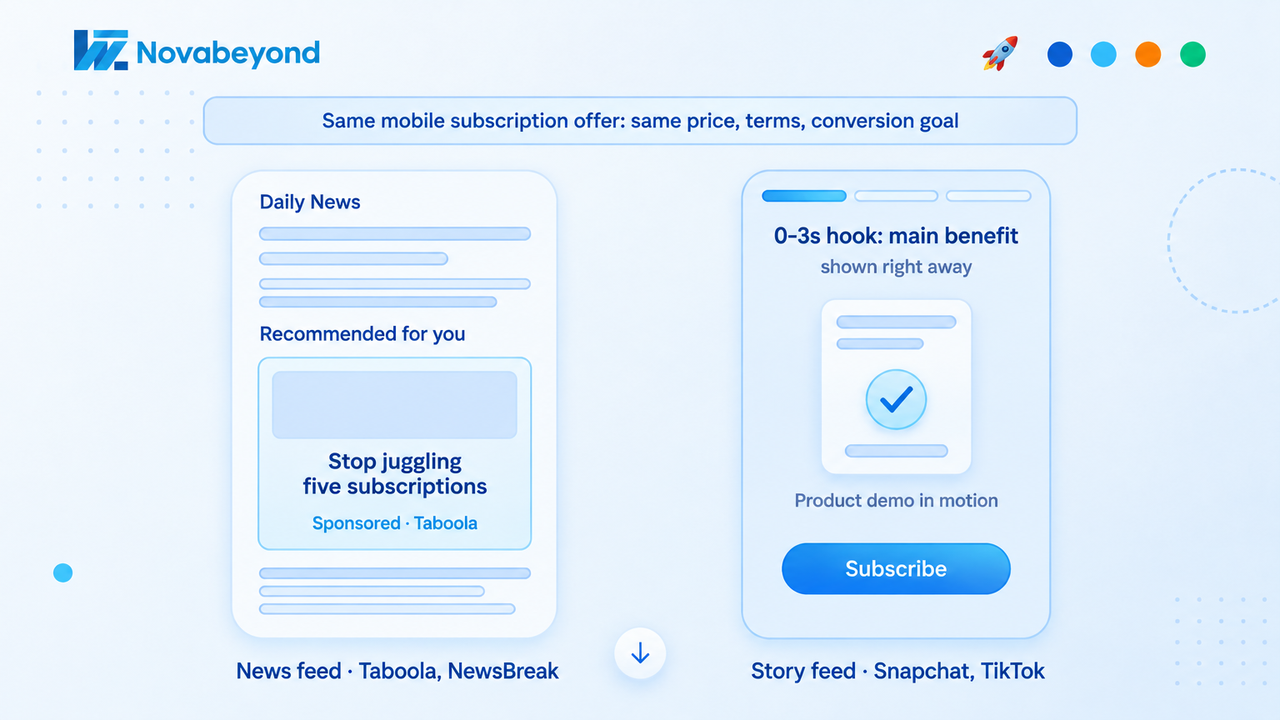
Consider a mobile subscription offer. On a news recommendation platform such as Taboola, a user may encounter the offer while reading an article or browsing recommended content. On Snapchat or TikTok, the same user may discover it while watching videos or exploring a personalized feed. The offer remains unchanged, but the context in which users encounter it, and the signals the advertising system uses to deliver it can be very different.
For growth teams expanding beyond mainstream media, understanding these differences is essential. The objective is to adapt the campaign to each platform's environment while keeping the offer economics and conversion goals consistent.
1. Start with the Platform: Two Different Discovery Environments
News feeds and social story feeds both use recommendation systems to match content with users. However, their content environments and advertising formats create different opportunities for presenting an offer.
News feeds: Win attention through relevance and context
Platforms such as Taboola and NewsBreak place advertising within content discovery environments. Taboola recommends content, products, and services across publisher properties, using signals such as context, geography, device, and user behavior.
NewsBreak offers native placements across its news app and other inventory, including in-feed and in-article formats. Its advertising system can also automatically distribute campaigns across eligible placements according to campaign goals.
For advertisers, this creates an opportunity to connect an offer with the content users are already consuming.
A financial service, educational product, or subscription offer may benefit from a headline that identifies a relevant problem and a landing page that explains the solution. The user needs enough information to understand why the offer is worth considering.
The key strategic considerations are:
• Contextual relevance: Does the message relate to the interests or needs that brought users to the content?
• Headline and image alignment: Does the ad communicate a clear reason to click without creating misleading expectations?
• Landing-page continuity: Does the destination provide the information promised in the ad?
Native advertising should not be treated as a guaranteed high-intent traffic source. User intent varies by placement, audience, and offer, so conversion quality must be validated through campaign data.
Social story feeds: Win attention through immediate appeal
Snapchat and TikTok provide different creative environments, where video, movement, sound, and fast-paced content discovery can play a central role.
Snapchat offers single-image and video ads, Story Ads, and other formats designed for different campaign objectives. Story Ads can present a sequence of images or videos, making them suitable for introducing a product or explaining an offer across several frames.
TikTok's short-form video environment similarly creates opportunities to demonstrate a product, present a relatable scenario, or communicate a benefit quickly.
In these environments, users may encounter an offer while consuming entertainment or browsing content unrelated to the product category. The creative often needs to establish relevance before the user decides whether to engage.
The strategic priorities shift accordingly:
• Immediate attention: Introduce the main benefit in the opening seconds.
• Visual demonstration: Show how the product works or why the offer matters.
• Native execution: Match the placement's pacing and format instead of simply resizing a banner.
• Low-friction action: Make the next step clear and consistent with the landing page.
Social feeds can also support consideration and re-engagement. The distinction is not that news users research while social users act impulsively; it is that each environment offers different ways to earn attention and communicate value.
2. The Algorithm Difference: Optimize for the Signals Each Platform Can Use
Creative differences are only part of the strategy. Campaign delivery and optimization also depend on the platform's available signals, campaign objective, and conversion data.
Taboola and NewsBreak: Connect content engagement with campaign outcomes
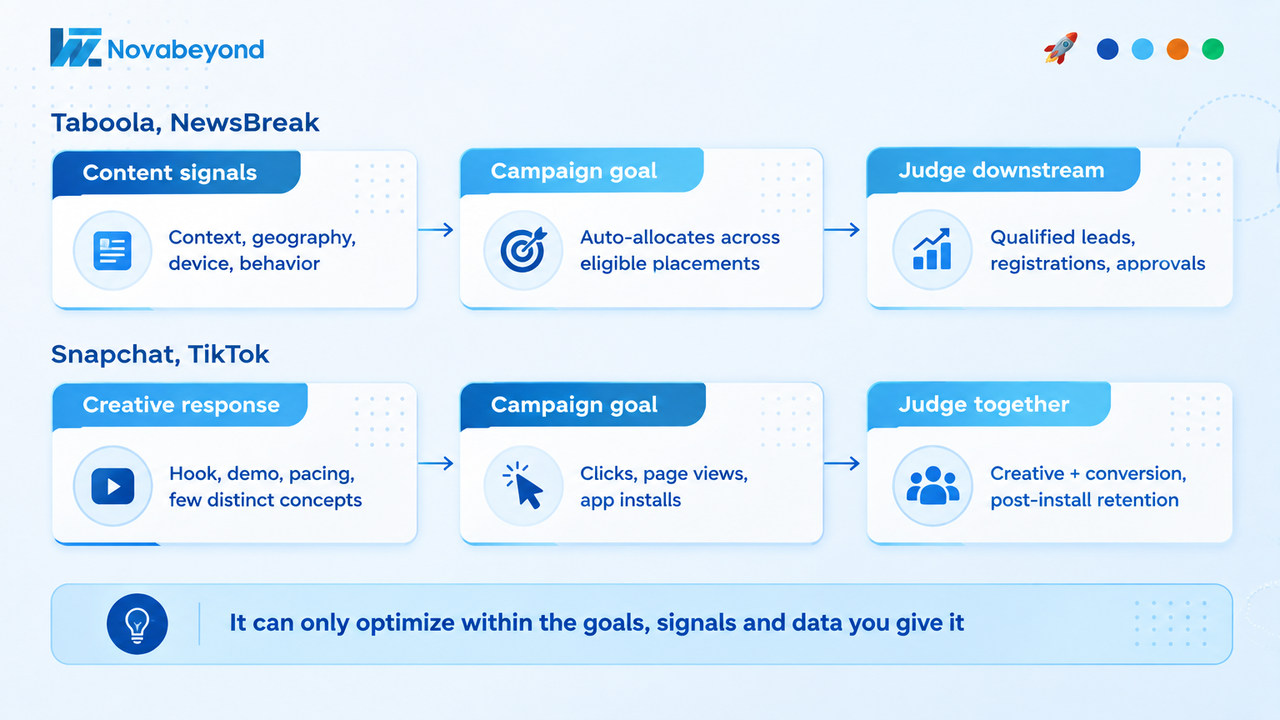
Native recommendation systems evaluate multiple signals to determine which content or advertisements are likely to engage users. Taboola describes using contextual and behavioral signals to match recommendations with audiences.
NewsBreak's advertising system can automatically allocate delivery across eligible placements to pursue the campaign's selected performance goal.
For advertisers, this means the campaign setup should give the platform a clear objective and enough reliable feedback to evaluate results.
If your offer requires users to read an explanation before converting, start by ensuring that the headline, creative, and landing page form a consistent journey. Then evaluate downstream metrics such as qualified leads, completed registrations, or approved conversions, depending on the offer.
A high click-through rate is useful only when the resulting traffic has a reasonable chance of producing business value.
Snapchat and TikTok: Connect creative response with conversion signals
Social advertising systems also use campaign objectives and performance signals to guide delivery. On Snapchat, for example, available performance goals include clicks, landing-page views, app installs, and other objective-specific outcomes.
For social campaigns, creative performance and conversion feedback should be evaluated together. A video that attracts attention may not generate qualified users, while a less dramatic creative may bring fewer clicks but stronger downstream results.
Start with a small set of distinct creative concepts rather than numerous minor variations of the same ad. Compare the results against the campaign's actual objective, and give the optimization system reliable conversion events wherever the platform supports them.
Across both environments, the same principle applies: the algorithm can optimize only within the objectives, signals, and data available to it. Neither a news-feed placement nor a social-story placement guarantees better traffic quality.
3. One Offer, Two Creative and Landing-Page Strategies
Suppose you are promoting the same subscription product through both news feeds and social stories. The price, promotional terms, and final conversion event remain unchanged.
The campaign can still require two distinct approaches.
Strategy A: Taboola and NewsBreak
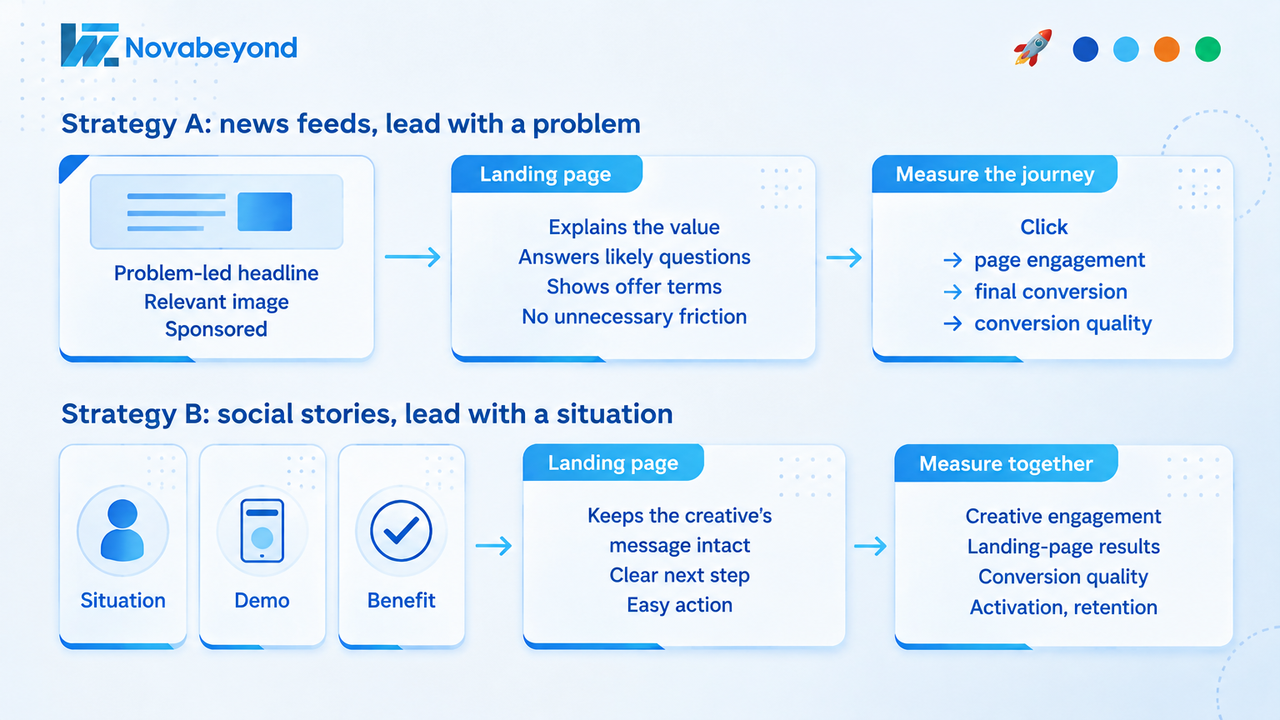
Lead with a specific user problem or a relevant benefit. Use a clear headline and supporting image to establish why the offer deserves attention.
The landing page should continue the story, explain the product's value, answer likely questions, and present the offer terms clearly. If users need more information before converting, the page should provide it without unnecessary friction.
Measure the complete journey, from click and landing-page engagement to the final conversion and its quality.
Strategy B: Snapchat and TikTok
Start with a recognizable situation, a product demonstration, or a concise benefit statement. Use vertical video or other suitable native formats to communicate the value quickly.
The landing page should preserve the message introduced by the creative. Avoid making users reconstruct the offer's meaning after clicking, and keep the conversion action easy to understand.
Measure creative engagement alongside landing-page performance and downstream conversion quality. For app campaigns, include post-install activation or retention where relevant.
The offer itself does not need to change. What changes is how the value proposition is introduced, explained, and carried through the conversion journey.
4. Choosing the Right Starting Point
The best starting point depends on the offer's complexity, the audience, and the action you want users to take.
Consideration | Taboola / NewsBreak | Snapchat / TikTok |
Discovery context | Content and news recommendation environments | Social and video content feeds |
Creative starting point | Headline, image, and relevant context | Opening hook, visual demonstration, and native video |
Landing-page role | Explain value and support evaluation | Continue the creative's message and make the next step clear |
Initial testing focus | Content relevance and post-click quality | Creative response and conversion quality |
Key validation | Qualified conversions and downstream value | Qualified conversions and downstream value |
This comparison is a starting framework, not a fixed rule. Both channel groups can support different objectives, and actual performance depends on the specific offer, market, inventory, and campaign setup.
Availability also matters. NewsBreak is particularly relevant to advertisers targeting audiences in the United States, while Taboola operates across a broader publisher ecosystem. Snapchat and TikTok require their own market, audience, and advertising-policy checks. Confirm eligible inventory and account access before allocating test budgets.
The Takeaway
One offer can create different opportunities across different media environments. News recommendation platforms provide ways to connect offers with content discovery, while social story feeds create opportunities to communicate value through fast-moving visual content.
For growth teams, the practical priority is to align the creative, landing page, and conversion measurement with the platform's environment, then validate the results against consistent business objectives.
Start with one offer, develop a strategy for each channel group, and run a controlled comparison. Use the results to identify where your offer attracts qualified users, where the conversion journey needs improvement, and which channel deserves further investment.
A broader media mix creates more opportunities to learn. The value comes from adapting your strategy to each platform and turning those insights into measurable incremental growth.
more posts
Category × Platform: Three Questions to Find Your First Emerging Media Test
November. 19 2026
LEARN MORE

The 7 Days After the Big Sale: Why December Is the Golden Window to Test Emerging Media
November. 16 2026
LEARN MORE

MediaGo URL Pre-Approval: Landing Page Checklist and Fixes
October. 30 2026
LEARN MORE
Beyond the Duopoly: The 2027 Guide to Alternative Traffic Sources and Emerging Media Solutions
October. 26 2026
LEARN MORE