




UNIT 616 6/F KAM TEEM INDUSTRIAL BUILDING 135 CONNAUGHT ROAD WEST SAI WAN HONGKONG.
Copyright © 2026 NOVABEYOND LIMITED (company number 2833487). All rights reserved.
“Which new channel should we test first?” is one of the most common questions growth teams face, and one of the hardest to answer by comparing platform lists alone. Beyond mainstream giants like Google, Meta, and TikTok, every emerging ad network and long-tail publisher pitch sounds promising. Every comparison chart seems to offer a compelling case. Without a clear decision framework, channel selection can easily become a matter of opinion rather than strategy.
A better approach is to start with your product, not the platform. How do users discover it, what drives their decisions, and what does it take for them to convert? Three questions can help narrow a crowded field of non-mainstream networks and emerging ad platforms to one or two promising candidates: Where does user intent emerge? How complex is the conversion journey? Where does the journey begin?
This article breaks down these three questions, explains how to use them to evaluate channel fit across emerging media platforms, and provides a practical worksheet for planning your first emerging media test.
Why “the Best Channel” Is the Wrong Starting Point
No channel is universally effective. A vertical news feed that works well for a financial education app may deliver little value for a casual game. An emerging rewarded ad network or native story format that drives impulse installs may be less effective for a product requiring deep research and comparison.
The key is to match the way your product attracts and converts users with the way an emerging media platform reaches and engages them.
Three factors help establish that fit: user mindset when encountering your product, complexity of the path to conversion, and the environment where their journey begins. Together, they provide a practical framework for choosing where to test first among alternative ad platforms.
Question 1: Where Does User Intent Emerge?
Start by considering what users are thinking or doing when they encounter your product category. Their intent generally falls into three patterns.
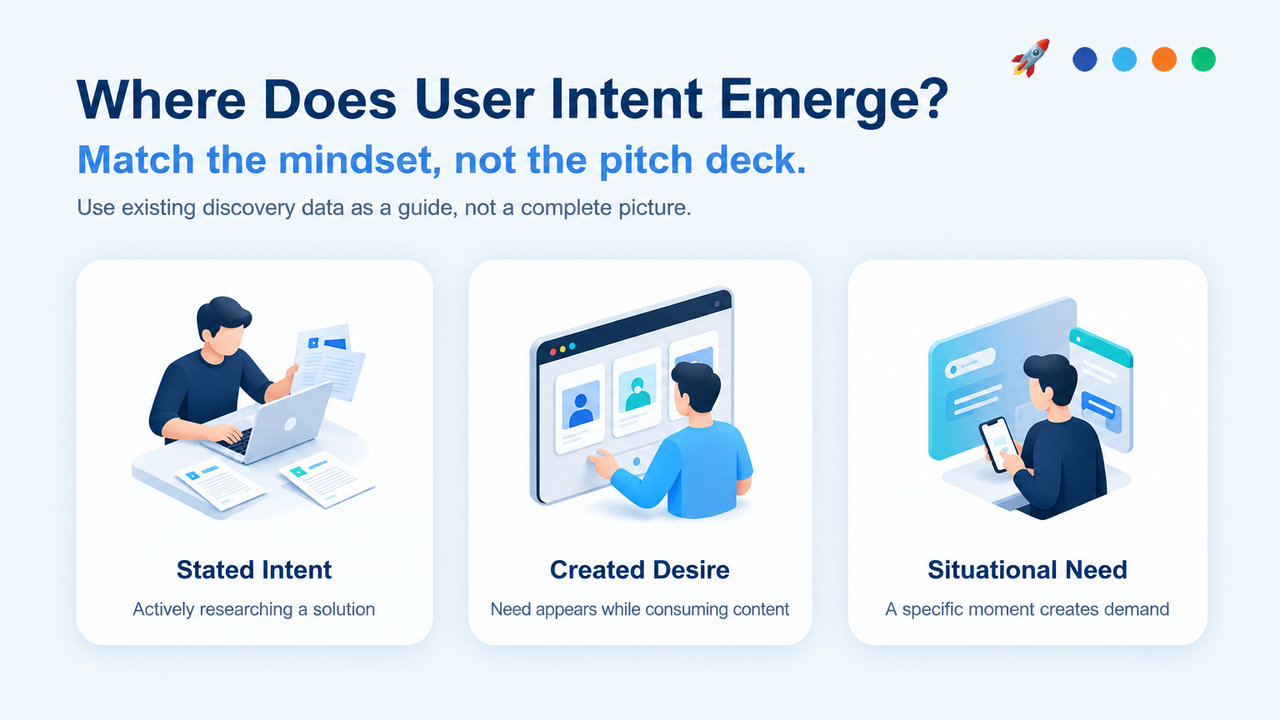
• Stated intent: Users are actively looking for a solution.
They may be comparing financial products, researching language-learning methods, or looking for a travel booking tool. These users are already exploring options and need information to evaluate them. Independent news sites, niche vertical blogs, and content curation networks provide a suitable environment for introducing your product and explaining its value.
• Created desire: Users discover a need while consuming content.
They may not be looking for a new game or lifestyle product until something catches their attention. In these cases, discovery-driven emerging networks such as rewarded ad networks, native content feeds, and specialized in-app video placements can help turn passive attention into active interest.
• Situational need: Users need a solution at a particular moment.
The need may arise when setting up a new device, organizing utility apps, or responding to a specific immediate context. OEM app stores, device negative-one screens, and contextually targeted utility app networks offer relevant touchpoints for capturing this moment.
How to assess your fit: Look at how your highest-value users first discovered your product. Did they arrive after searching for information, through content recommendations, or in response to a specific need or usage context? Your existing acquisition data can provide a useful starting point, although it should be treated as a guide rather than a complete picture of future channel performance.
Question 2: How Complex Is the Conversion Journey?
Once you understand what drives initial interest, consider how much effort it takes for that interest to become a valuable action.
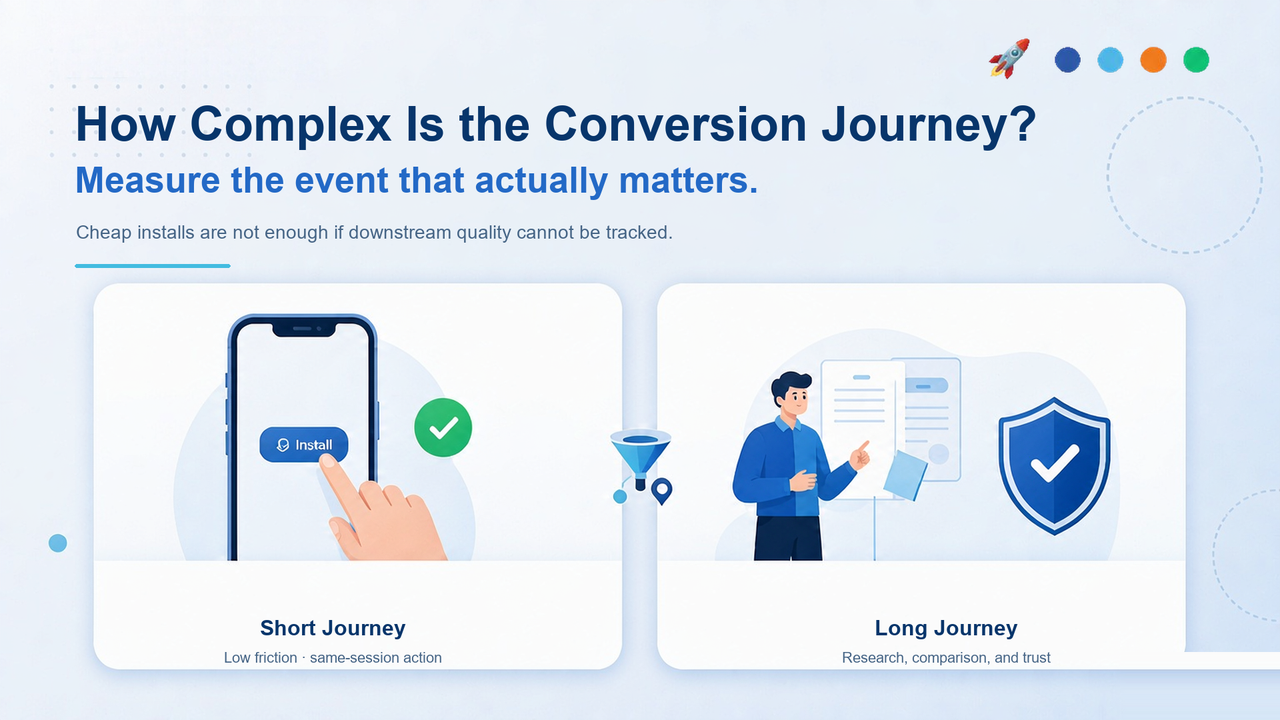
• Short conversion journey: Users can act quickly.
For casual games, utility apps, and low-commitment products, users can install, register, and complete an initial meaningful action within a single session. Emerging networks offering instant play, rewarded units, or direct app-to-app installs fit well because they minimize friction between seeing an ad and trying the product.
• Long conversion journey: Users need more time to decide.
Financial products, higher-priced subscriptions, and considered purchases require users to research, compare options, seek reassurance, or return later. For these products, premium independent editorial feeds and high-intent native ad placements offer the depth needed to build trust over time.
The distinction is not simply about how quickly users install. It is about how long they take to reach the event that actually matters to your business.
Check the measurement setup, too. Can the emerging network integrate seamlessly with your Mobile Measurement Partner (MMP) or attribution tool? Can it support the downstream conversion events you need to optimize for?
An emerging ad platform may generate inexpensive installs, but if you cannot measure downstream user quality, you will struggle to determine whether the test is worth scaling.
Question 3: Where Does the User Journey Begin?
The final question is about the environment where users first encounter your product or recognize a need. This helps translate your understanding of user behavior into a more concrete emerging media shortlist.
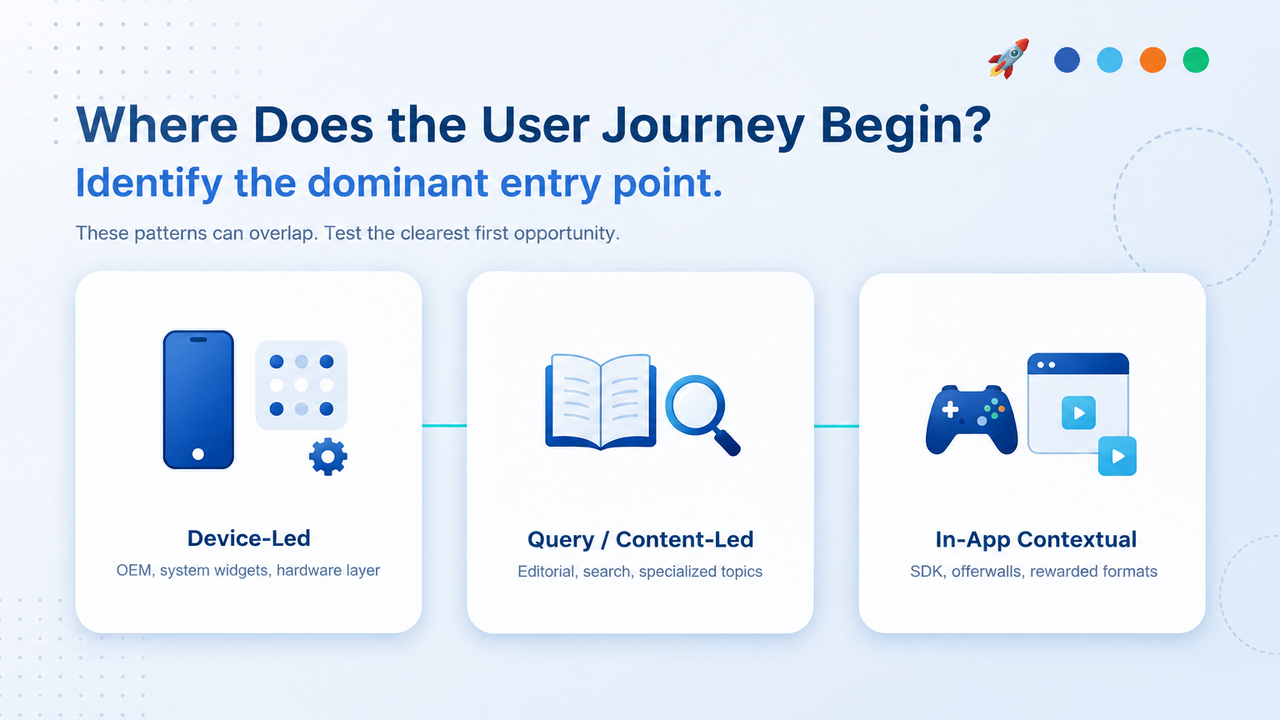
• Device-led journeys
The device itself creates the opportunity for discovery. Users may be unboxing a new phone, browsing system app recommendation widgets, or checking phone management tools. OEM factory pre-installs, carrier ad solutions, and device-level app hubs reach users directly at the hardware layer.
• Query-led or content-led journeys
Users begin by looking for answers, reading information, or engaging with a specialized topic. Independent news portals, specialized web publishing networks, and native editorial widgets offer strong context when users need explanation before converting.
• In-app / Contextual-led journeys
Users discover products while active inside other applications, such as playing casual games, using utility tools, or browsing niche communities. Emerging SDK ad networks, offerwalls, and rewarded format networks serve as primary touchpoints for engaging these active users.
These patterns are not mutually exclusive. The goal is not to assign every user to a single path, but to identify the dominant entry point that offers the clearest opportunity for an initial test outside your primary channels.
Turning Your Answers Into a Channel Shortlist
With the three questions answered, you can form an initial hypothesis about which emerging media platform deserves a test.
For each question, identify the pattern that best describes your target audience. Use a threshold such as 60% of your target users as a practical screening rule to identify the dominant pattern. If no single pattern dominates, record the split rather than forcing a single answer.
Dominant Pattern | Emerging Channels to Consider First | Representative Examples / Platforms |
Stated intent + longer conversion journey + query-/content-led discovery | Native Discovery & Content Recommendation Networks | Taboola, Outbrain, MSN Ads, Yahoo Native |
Created desire + short conversion journey + in-app/content-led discovery | SDK Ad Networks, Rewarded Video & In-App Ad Platforms | Unity Ads, AppLovin, ironSource, Mintegral, Vungle/Liftoff |
Situational need + short conversion journey + device-led discovery | OEM / Hardware Ad Platforms | Xiaomi Ads, Samsung Ads, OPPO/vivo Ad Networks, Transsion (TECNO/Infinix) |
Created desire / Stated intent + variable conversion journey + social/community discovery | Niche Social & Community Platforms | Reddit, Pinterest, Quora, Snapchat, Discord (Sponsorships) |
These combinations are starting hypotheses, not fixed rules. For example, a finance app may also test specialized native widgets on Taboola, while a casual game may find quality volume through AppLovin or Xiaomi system app recommendations.
If your answers point in different directions, treat that as useful information. Rather than forcing a single channel, consider two small, controlled tests across different emerging media types that reflect your strongest competing hypotheses.
From Channel Selection to a Test Plan
Choosing an emerging media partner is only the first step. To make the test useful, define what you want to learn before committing budget.
Use this worksheet to turn your channel hypothesis into an executable plan:
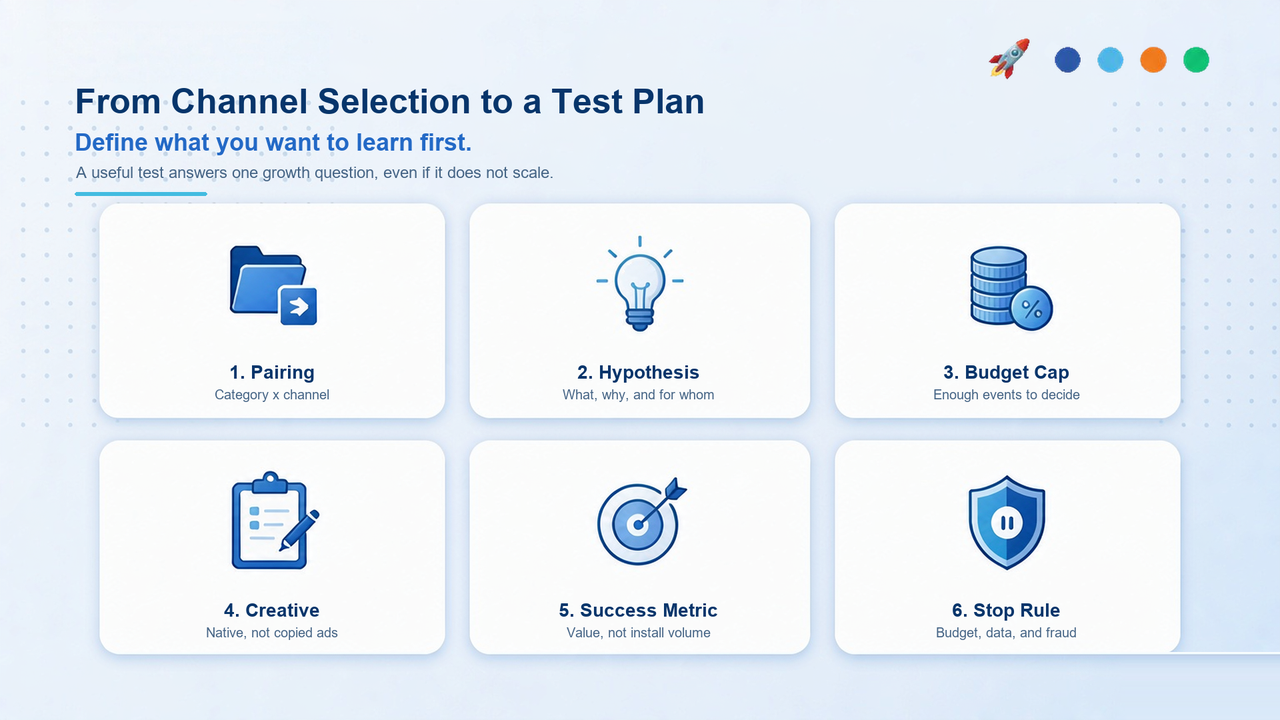
1. Category and channel pairing.
Record your product category, dominant user-intent pattern, conversion journey complexity, and the proposed emerging channel, such as an OEM platform like Xiaomi Ads, a rewarded SDK network like AppLovin, or a native ad network like Taboola.
2. Hypothesis.
State what you expect the channel to achieve and why. Example: “Testing Xiaomi OEM system app recommendations will acquire incremental utility users at a cost that supports our target 30-day LTV.”
3. Budget cap.
Set a fixed testing budget based on the volume and quality of conversion events needed to evaluate the hypothesis. If the budget cannot generate enough meaningful data, narrow the targeting parameters or extend the test duration.
4. Creative plan.
Start with one core concept and two or three format-specific variations. Adapt the execution to the emerging platform's unique native environment rather than simply copying creatives designed for Meta or TikTok.
5. Success metric.
Choose one primary metric tied to business value, such as qualified user cost, activation rate, or Day-7 retention. Use install volume as a diagnostic indicator, not the final measure of success.
6. Stop rule.
Define in advance when to pause the test, including hard budget limits, minimum attribution data thresholds, and anti-fraud signals such as unusually high click-to-install time anomalies.
7. Review date and ownership.
Set a date to evaluate performance with your MMP data, and assign ownership for deciding whether to iterate, pause, or scale.
A well-designed test should answer a specific growth question. Even if the emerging channel does not meet your efficiency target, the results will clarify whether the issue lies in audience overlap, creative adaptation, ad fraud or measurement quality, or conversion friction.
Common Pitfalls to Avoid
• Choosing based on network pitch decks.
High impressions or low nominal CPMs quoted by long-tail ad networks mean little if downstream user retention is poor.
• Reusing creative without adapting to native formats.
Direct copies of TikTok or Meta ads often perform poorly on native or SDK ad networks. Rebuild assets to match the target app's native user experience.
• Launching without verified MMP integration.
Always verify that the emerging media partner supports clean postback tracking through your MMP, such as AppsFlyer, Adjust, or Singular, before spending budget.
• Drawing broad conclusions from one test.
A single failed test reflects a specific combination of ad network, creative execution, and targeting settings. Use it to refine your acquisition criteria rather than writing off an entire class of emerging media.
The Takeaway
Finding your first emerging media channel beyond mainstream platforms starts with understanding where your audience, conversion journey, and platform capabilities align. A clear hypothesis and a structured test enable you to unlock incremental growth beyond saturated acquisition channels.
Start with the three questions, narrow your non-mainstream options to one or two strong candidates, and validate your assumptions through controlled testing. Use the insights to diversify your channel mix, optimize acquisition costs, and build a resilient performance marketing strategy.
more posts
The 7 Days After the Big Sale: Why December Is the Golden Window to Test Emerging Media
November. 16 2026
LEARN MORE

Same Offer, Two Playbooks: How News-Feed and Social-Story Platforms Differ
November. 13 2026
LEARN MORE

MediaGo URL Pre-Approval: Landing Page Checklist and Fixes
October. 30 2026
LEARN MORE
Beyond the Duopoly: The 2027 Guide to Alternative Traffic Sources and Emerging Media Solutions
October. 26 2026
LEARN MORE