





UNIT 616 6/F KAM TEEM INDUSTRIAL BUILDING 135 CONNAUGHT ROAD WEST SAI WAN HONGKONG.
Copyright © 2026 NOVABEYOND LIMITED (company number 2833487). All rights reserved.
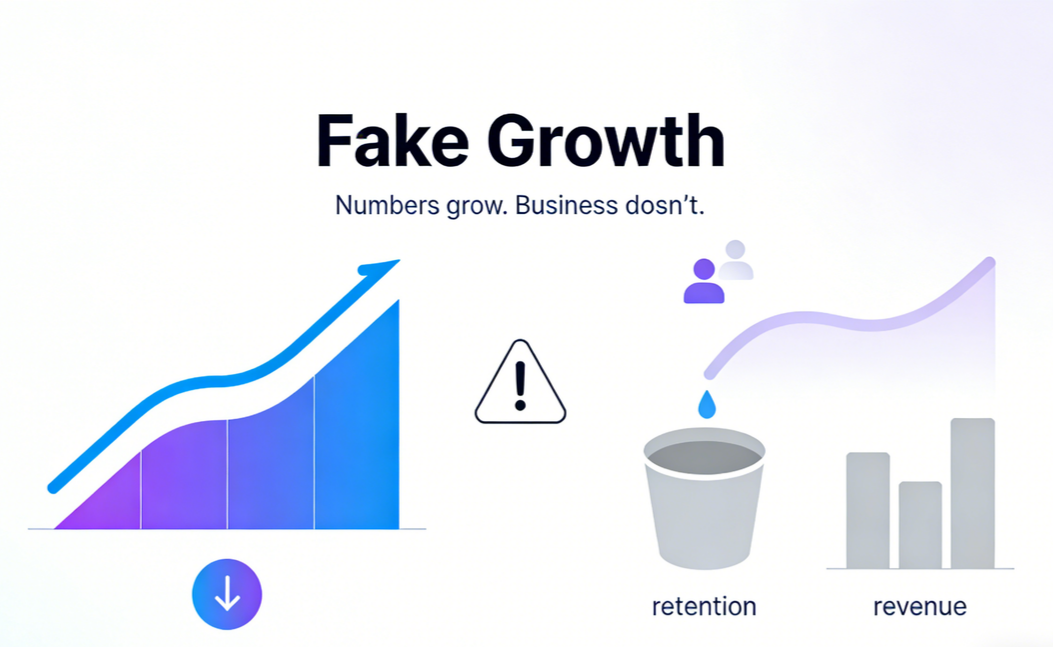
In today’s mobile ecosystem, growth has become the ultimate metric of success. Downloads surge, dashboards look impressive, and acquisition numbers climb rapidly. Yet behind many of these promising curves lies a hidden reality: not all growth is real.
As competition intensifies and user acquisition costs continue to rise, many app teams unknowingly fall into what industry insiders call “fake growth” , growth that appears strong on paper but fails to generate sustainable business value.
Understanding this trap is now essential for marketers, product teams, and app publishers aiming to build long-term success rather than short-term vanity metrics.
What Is “Fake Growth” in Mobile Apps?
Fake growth refers to user acquisition or engagement metrics that inflate performance indicators without contributing to meaningful retention, monetization, or long-term scalability.
It does not always involve fraud. More often, it results from misaligned incentives, poor measurement frameworks, or over-optimization toward superficial KPIs.
Common symptoms include:
• Rapid install spikes followed by sharp retention drops
• High traffic but low active usage
• Strong CPI performance but weak ROI
• Engagement metrics disconnected from revenue outcomes
In short: the numbers grow, but the business does not.
Why Fake Growth Is Becoming More Common
Several structural changes in the mobile ecosystem have made fake growth easier to create and harder to detect.
1. KPI-Driven Marketing Culture
Many growth teams are evaluated based on installs, CTR, or short-term conversion rates. When success metrics prioritize volume instead of value, campaigns naturally optimize toward the easiest wins rather than the right users.
This leads to acquisition strategies that maximize installs instead of lifetime value (LTV).
2. Algorithm Optimization Loops
Modern advertising platforms optimize delivery using machine learning models. While powerful, these systems learn from the signals advertisers provide.
If optimization events focus on installs or early actions rather than downstream value, algorithms may increasingly target incentivized users, low-intent audiences or promotion-driven traffic
The result is efficient acquisition of inefficient users.
3. Attribution Complexity and Signal Loss
Privacy changes and platform restrictions have reduced visibility into user journeys. With limited attribution signals, teams sometimes rely on modeled or incomplete data, making it easier for low-quality traffic to appear legitimate.
Measurement gaps create room for misleading performance interpretations.
4. Over-Reliance on Growth Hacks
Growth hacks can generate temporary spikes : viral loops, reward systems, aggressive promotions, but often fail to build sustainable engagement.
Without product-market alignment, these tactics amplify acquisition without strengthening retention.
The Most Common Forms of Fake Growth
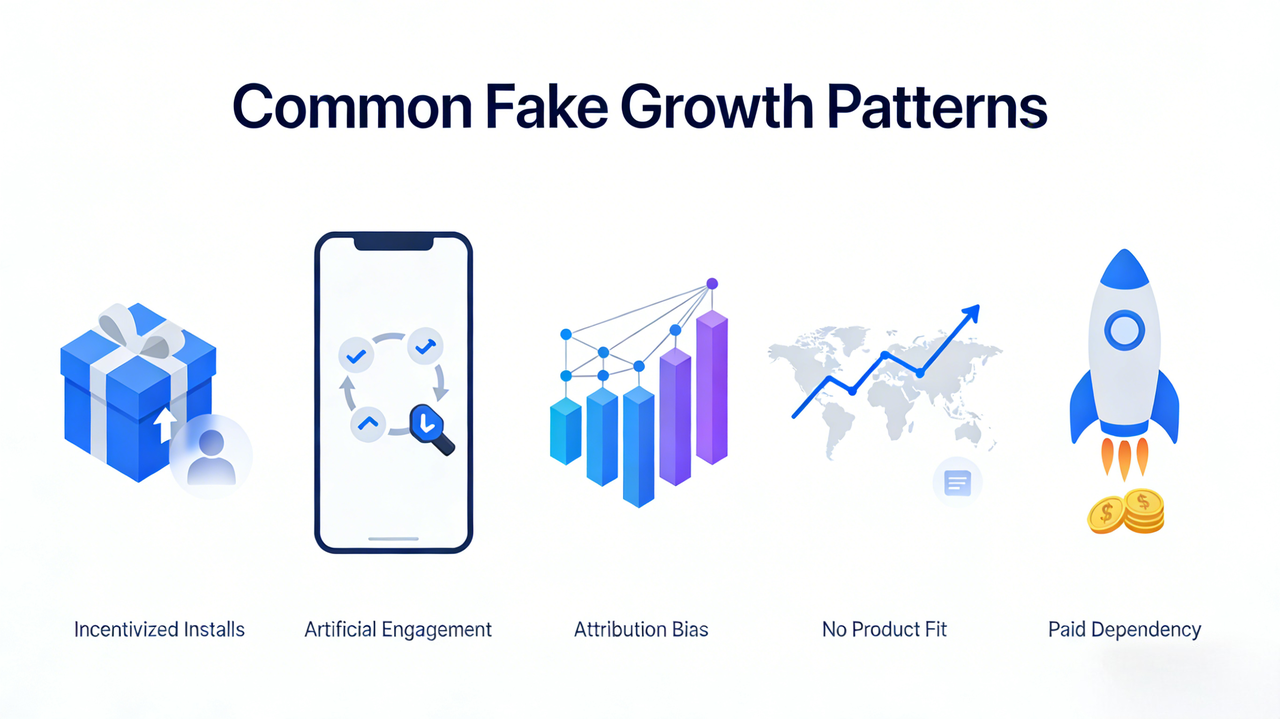
1. Incentivized Install Inflation
Users download an app primarily to receive rewards rather than to use the product. Once incentives disappear, so do the users.
Indicators:
• Extremely low Day-7 retention
• High uninstall rates
• Minimal feature adoption
2. Misleading Engagement Metrics
Metrics such as session counts or screen views may rise due to UI triggers, push notifications, or forced flows rather than genuine user interest.
Engagement becomes mechanical instead of meaningful.
3. Channel Attribution Bias
Some channels capture disproportionate credit due to attribution models, even when they are not driving incremental users.
This creates a false perception of channel effectiveness.
4. Geographic Expansion Without Product Fit
Expanding into low-cost markets can dramatically reduce CPI and increase download numbers. However, if localization, payment infrastructure, or cultural alignment is missing, monetization remains weak.
Growth appears global but lacks depth.
5. Paid Growth Masking Product Issues
Aggressive acquisition budgets can temporarily hide retention problems. As long as new users replace churned users, top-line metrics remain stable until acquisition costs rise.
This creates dependency on paid traffic.
The Real Cost of Fake Growth
Fake growth is not harmless. It creates long-term strategic risks:
1. Budget Misallocation
Marketing spend flows toward channels that appear efficient but generate little value.
2. Algorithm Degradation
Ad platforms learn from poor-quality signals, worsening targeting over time.
3. Product Misdiagnosis
Teams may believe the product is succeeding, delaying necessary improvements.
4. Investor and Stakeholder Risk
Inflated metrics can lead to unrealistic forecasts and strategic misalignment.
How to Detect Fake Growth Early
Leading growth teams are shifting from volume metrics toward quality diagnostics.
Key indicators to monitor:
• LTV/CAC ratio by channel
• Retention cohorts beyond Day-30
• Revenue per retained user
• Feature adoption depth
• Organic lift following paid campaigns
A simple test:
If acquisition stops and growth collapses immediately, growth was likely artificial.
Building Real, Sustainable App Growth
Avoiding fake growth requires aligning marketing, product, and data strategy.
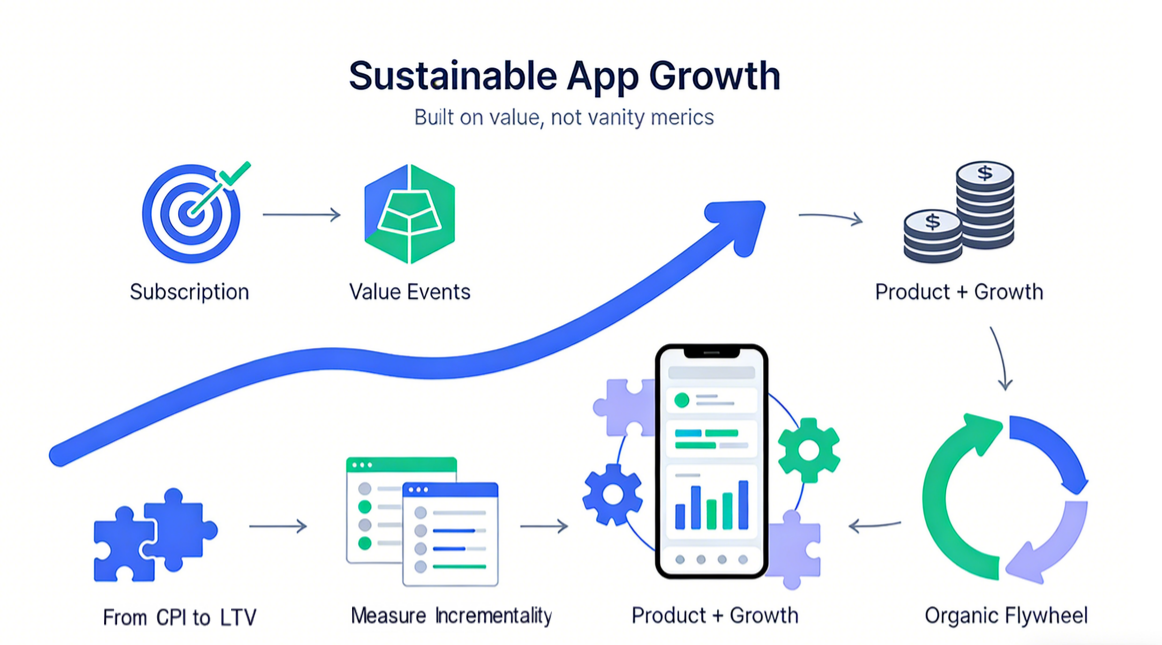
1. Optimize for Value Events, Not Installs
Train advertising algorithms using meaningful conversion signals such as subscriptions, purchases, or long-term engagement milestones.
2. Shift from CPI to LTV Thinking
Lower acquisition cost does not equal better performance. High-value users often cost more but generate sustainable returns.
3. Integrate Product and Growth Teams
Retention is a product problem as much as a marketing problem. Growth teams must collaborate closely with UX and product analytics.
4. Measure Incrementality
Use experiments, geo testing, or holdout groups to understand whether campaigns create new demand or simply capture existing intent.
5. Build Organic Flywheels
Content, community, referrals, and brand trust create compounding growth effects that paid acquisition alone cannot replicate.
The Future of App Growth: From Scale to Quality
The mobile growth landscape is entering a new phase. Privacy regulations, AI-driven optimization, and rising acquisition costs are forcing a shift away from superficial metrics toward sustainable performance.
Winning apps will not necessarily acquire the most users, they will acquire the right users.
Growth is no longer about how fast numbers rise, but about how long value lasts.
Fake growth is rarely intentional. It emerges when teams chase visible metrics instead of meaningful outcomes. Recognizing the difference between activity and impact is now a core competitive advantage.
For companies navigating global mobile growth, the challenge is clear: move beyond growth that looks good, and build growth that actually works.
Ready to Move Beyond “Fake Growth”?
If you're seeing strong top-line numbers but questioning real ROI, it’s time to take a deeper look.
At Novabeyond, we help app marketers and publishers:
• Identify hidden inefficiencies in acquisition channels
• Rebuild measurement frameworks around LTV and incrementality
• Optimize campaign strategies for real users, not just installs
• Align media buying with product-driven growth
Book your free audit today or reach out to our team to start building growth that actually scales.
more posts

Driving Scale in SEA: Why Indonesia and Vietnam Are App UA Growth Hotspots (And How to Win via Programmatic Ads)
October. 15 2026
LEARN MORE


Mastering Mobile User Acquisition for Fintech Apps in 2026: What Actually Works
October. 08 2026
LEARN MORE
Programmatic Advertising vs. Google App Campaigns: How to Drive Incremental UA in 2026
September. 23 2026
LEARN MORE

The Complete Practical Guide to Mobile App User Acquisition in 2026: Bidding, Creatives, and Scaling
September. 22 2026
LEARN MORE