




Copyright © 2026 NOVABEYOND LIMITED (company number 2833487). All rights reserved.
Address: UNIT 616 6/F KAM TEEM INDUSTRIAL BUILDING 135 CONNAUGHT ROAD WEST SAI WAN HONGKONG.
In mobile growth, the “30-day ceiling” is not an edge case, it’s a pattern.
An app launches, acquisition ramps up, performance looks strong, and then growth stalls. CPIs rise, conversion efficiency declines, and additional budget fails to generate proportional results.
Many teams interpret this as a product or retention issue. But in reality, more often than not, the bottleneck sits earlier in the funnel: The traffic system has reached its structural limit.
1. Early Growth Is Real , But Not Scalable
The first 30 days are driven by what looks like strong, repeatable performance. In reality, this phase is built on a temporary advantage.
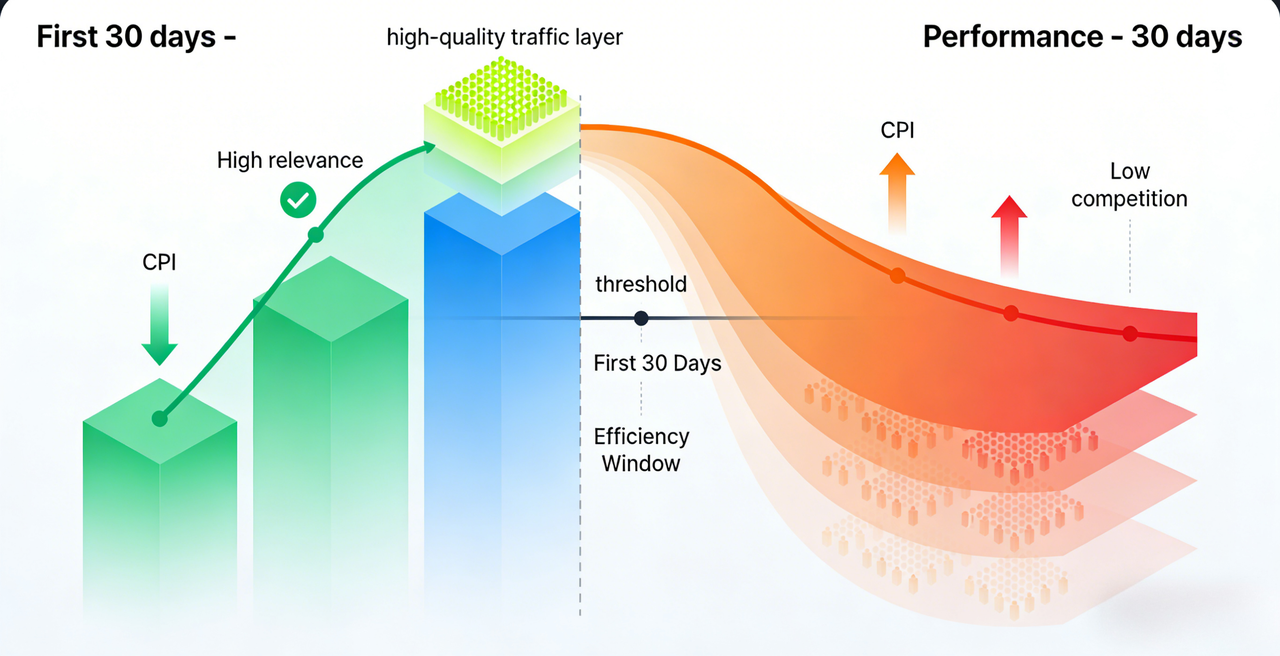
Platforms prioritize your campaigns toward the most responsive users first. At the same time, your creatives are new, audience overlap is low, and auction pressure is relatively light.
This creates a short-lived efficiency window characterized by:
• Low CPIs driven by high relevance
• Strong conversion rates from early adopters
• Stable scaling within a limited budget range
However, this is not a scalable state. It is simply the highest-quality layer of available traffic being consumed first.
Once this layer is exhausted, performance does not plateau gently, it starts to decay.
2. The Real Bottleneck: Channel Saturation
The most common structural issue behind stalled growth is over-concentration in a small number of channels.
In most cases, apps rely heavily on platforms like Meta and TikTok. While powerful, these ecosystems are inherently limited:
• Audience pools are finite
• Auction competition intensifies with spend
• Frequency increases lead to diminishing returns
As budget scales, you are not accessing new demand, you are competing more aggressively within the same demand pool.
This leads to a predictable pattern: CPMs increase, Conversion rates decline, CAC rises faster than spend.
At this point, the issue is not optimization, it is capacity. The channel has reached its efficient ceiling.
3. Why Scaling Breaks: A Linear Strategy in a Non-Linear System
Most growth strategies assume that scaling is linear: If a campaign works, increase budget, expand targeting, and duplicate structure.
This works early on because there is still room within the system. But traffic ecosystems behave differently.
They are layered, not infinite:
• A small portion of inventory delivers high efficiency
• The majority delivers progressively worse performance
• Marginal cost increases accelerate after saturation
This means that beyond a certain point, every additional dollar becomes less efficient at a faster rate.
Scaling fails not because teams lack effort, but because they are extracting more from a system that has already been fully tapped.
4. Breaking the Ceiling Starts with Expanding the Traffic System
To move beyond the plateau, the focus needs to shift from “how do we scale campaigns” to: How do we expand the total acquisition surface?
This requires building a multi-channel structure where each source contributes differently to growth.
Instead of relying on a single dominant platform, advanced setups typically include a mix of:
• Paid social channels for scalable demand capture
• Search channels for high-intent traffic
• Programmatic and ad networks for incremental reach
• Emerging platforms or alternative traffic sources for diversification
The key is not diversification for its own sake, but ensuring that growth is no longer constrained by a single system’s limits.
5. Separate Scaling from Exploration (or Growth Will Stall Again)
One of the most common hidden mistakes is treating all budget as performance budget.
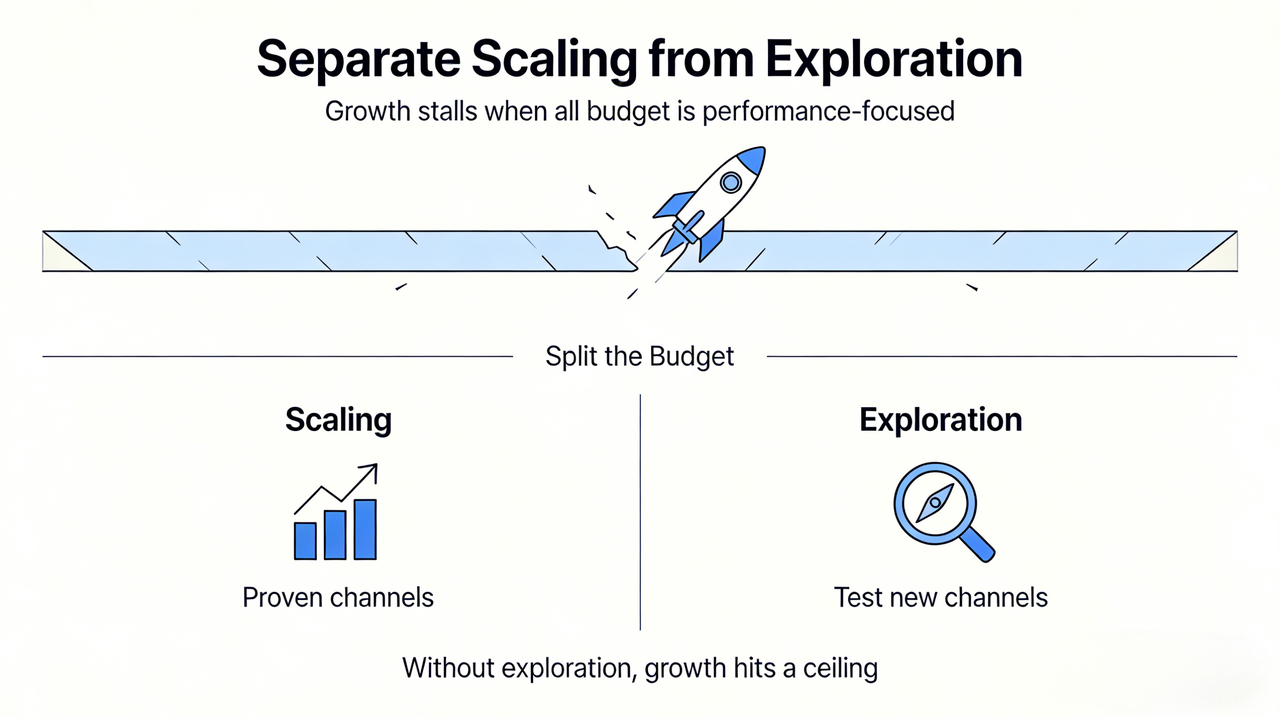
When every dollar is forced to meet short-term ROI targets, teams stop exploring. As a result:
• No new channels are validated
• No new audiences are discovered
• Future growth capacity shrinks over time
A more sustainable model separates budget into two roles:
• Scaling budget: focused on proven channels and stable performance
• Exploration budget: continuously testing new traffic sources, formats, and markets
This is not just a tactical adjustment, it is a structural requirement.
Without ongoing exploration, any growth system will eventually hit another ceiling.
6. Geo Expansion Only Works When It’s Structured
Expanding into new geographies is often treated as a quick way to unlock growth. In practice, it rarely works without a clear role for each market.
Different regions behave fundamentally differently in terms of cost, user behavior, and conversion dynamics.
A more effective approach is to treat geographies as layers within the acquisition system:
• Efficiency markets (e.g. US, UK): high cost, strong monetization
• Scale markets (e.g. Western Europe, Japan, Korea): balanced volume and efficiency
• Volume markets (e.g. Southeast Asia, LATAM): lower cost, larger reach
When structured this way, geo expansion is no longer just about lowering CPI, it becomes a way to balance cost, volume, and scalability across the system.
7. Growth Beyond Auctions: Unlocking Incremental Traffic
Most early-stage growth is heavily dependent on auction-based platforms. The problem is that these environments become increasingly competitive over time.
To break through this constraint, high-performing teams introduce non-auction traffic sources, such as:
• Direct publisher partnerships
• OEM and device-level distribution
• Affiliate and performance-based ecosystems
These channels provide access to users outside of traditional bidding environments, which helps:
• Reduce competitive pressure
• Stabilize acquisition costs
• Reach incremental audiences
In many cases, this is where the next phase of scalable growth comes from.
8. The Shift That Actually Matters
At a surface level, breaking the 30-day ceiling looks like better channel mix or smarter budget allocation.
But fundamentally, the shift is deeper:
• From optimizing campaigns → to designing acquisition systems
• From scaling budgets → to scaling inventory access
• From relying on one algorithm → to orchestrating multiple traffic sources
Once this shift happens, growth is no longer tied to the limits of a single channel.
Conclusion
The 30-day growth ceiling is not random. It is the natural outcome of a traffic strategy that successfully captures early demand, but fails to evolve beyond it.
Early efficiency comes from low competition and high-quality audiences. Plateau comes from saturation, signal dilution, and channel limits. Breaking through requires one key change: Stop trying to scale harder within the same system, and start building a bigger system.
Because growth doesn’t stall when users disappear. It stalls when your traffic strategy runs out of room.
more posts
Programmatic Campaign Underperforming? 5 Data-Driven Fixes to Rescue ROAS in 2026
August. 31 2026
LEARN MORE


Beyond Google UAC: Rethinking Growth Strategies for Mobile Game Publishers in a Maturing Market
July. 21 2026
LEARN MORE
AI’s Impact on Gaming, Short Drama, and Live Commerce Advertising: Why Traffic Reallocation Is Reshaping App Growth
June. 15 2026
LEARN MORE
Middle East / Southeast Asia / LATAM: Regional Growth Differences & Strategy Guide for Mobile Apps
June. 08 2026
LEARN MORE