




UNIT 616 6/F KAM TEEM INDUSTRIAL BUILDING 135 CONNAUGHT ROAD WEST SAI WAN HONGKONG.
Copyright © 2026 NOVABEYOND LIMITED (company number 2833487). All rights reserved.
Most mobile UA strategies begin with the assumption that user acquisition happens inside apps and browsers through social feeds, search results, and display networks. OEM advertising starts earlier in the user journey, at the device level itself, during the moment a new phone is activated and before user behavior patterns have been established.
This distinction matters more in emerging markets than anywhere else because emerging markets are expected to drive much of the future growth in mobile users.
What OEM Advertising Actually Is
OEM advertising refers to partnerships with smartphone manufacturers such as Xiaomi, Samsung, OPPO, Vivo, Transsion, and Huawei that allow app marketers to place their apps directly on devices. Rather than competing in auctions against hundreds of advertisers for the same in-app or in-feed inventory, OEM advertising provides placement within the device ecosystem itself.
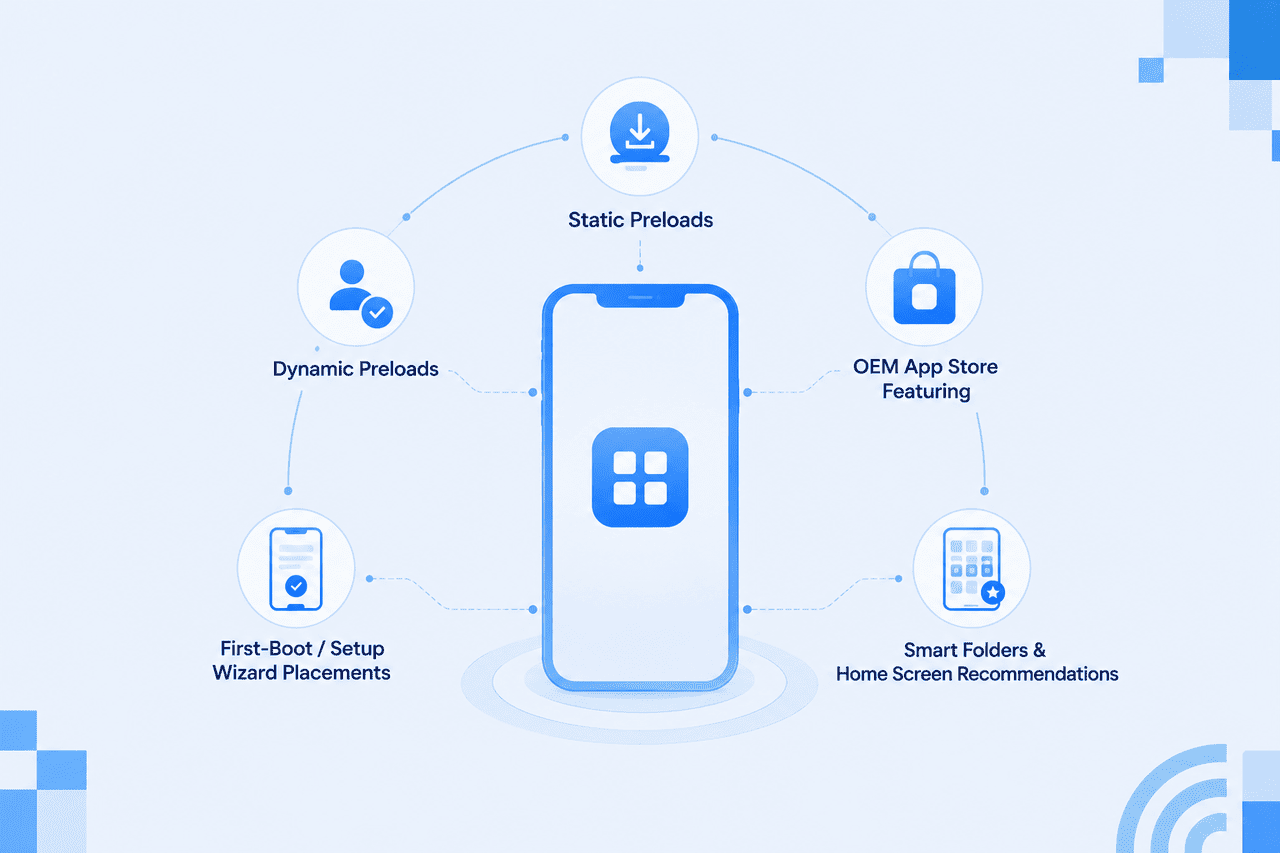
The core formats include:
Static Preloads
The app is installed on every device of a given model before it reaches the consumer. When users turn on their new phones, the app is already present. There is no friction and no competition for discovery.
Dynamic Preloads
Rather than installing the same apps on all devices, OEMs use demographic, device, and regional data to customize which apps appear during setup. A user activating a device in Jakarta may see different suggested apps than a user in Warsaw, based on their profile at a moment when receptivity is particularly high.
First-Boot / Setup Wizard Placements
During the initial device configuration process, users are presented with a curated selection of apps to install. Placement within this screen allows your app to reach users who are actively deciding how to configure their device, creating a high-intent environment with minimal advertising fatigue.
OEM App Store Featuring
Xiaomi's GetApps, Huawei's AppGallery, Samsung's Galaxy Store, and OPPO's own app marketplace all drive significant download volume, particularly in markets where Google Play has lower penetration. Featured placements within these stores create discovery opportunities outside the mainstream app store competitive landscape.
Smart Folders and Home Screen Recommendations
OEMs create curated folders such as Finance, Social, and Shopping, as well as home-screen recommendation widgets where promoted apps appear as native suggestions. These placements benefit from the credibility of the device manufacturer because the app appears as a recommendation rather than a traditional advertisement.
Why Emerging Markets Make OEM Advertising Essential
Android holds approximately 71% of the global smartphone market. In many high-growth emerging markets, that share is even higher, exceeding 85% in countries such as India, Brazil, and Indonesia. In these markets, however, app discovery through Google Play or the App Store is often not the primary path to user acquisition.
Instead, users frequently discover apps through the device itself, including preloaded apps, setup recommendations, and manufacturer suggestions. For advertisers seeking to reach mobile-first consumers across Southeast Asia, Africa, Latin America, and Eastern Europe, OEM advertising is more than an alternative channel. In many cases, it represents the primary path to users during their natural app discovery journey.
The Performance Case for OEM
OEM advertising delivers measurable efficiency advantages over traditional mobile advertising, particularly in markets where OEM ecosystems are highly developed.
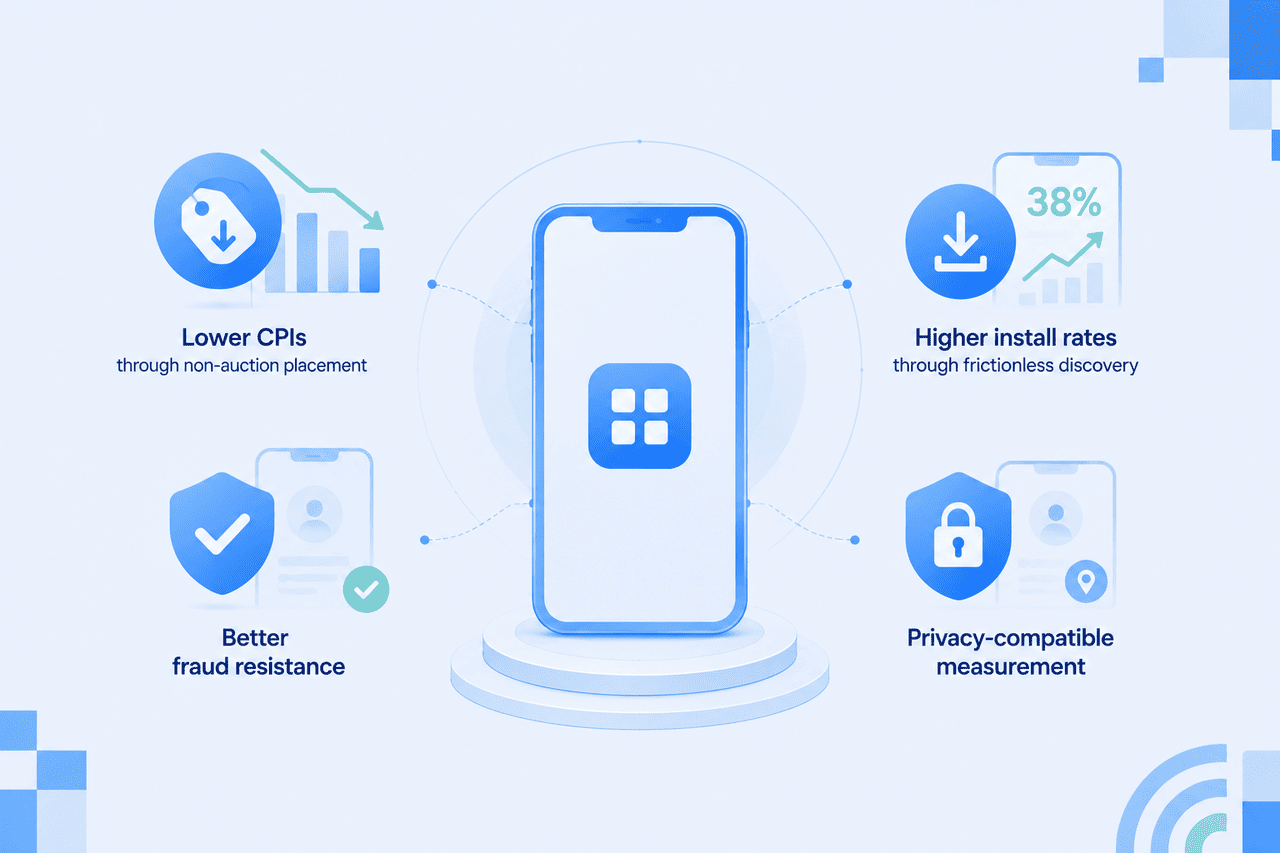
Lower CPIs through non-auction placement.
On Meta and Google, CPI is influenced by real-time competition among hundreds of advertisers bidding for the same inventory. OEM placements are typically negotiated directly with manufacturers or through aggregator platforms, resulting in more predictable pricing and reduced exposure to auction-driven inflation.
Higher install rates through frictionless discovery.
Pre-installed apps have been shown to generate approximately 38% higher install rates than apps that are not pre-installed. Users who encounter an app during device setup are actively exploring options, which creates a fundamentally different environment from scrolling past an advertisement in a crowded feed.
Better fraud resistance.
OEM placements exist on real physical devices. The mechanics of device-level placement significantly reduce exposure to spoofed clicks, fake installs, and other fraud patterns commonly associated with open programmatic environments.
Privacy-compatible measurement.
OEM advertising relies primarily on first-party manufacturer data such as device model, price segment, and geographic location rather than cross-app behavioral tracking. This makes OEM channels naturally compatible with post-ATT and post-IDFA measurement environments.
The OEM Ecosystem: Key Players in 2026
1. Xiaomi
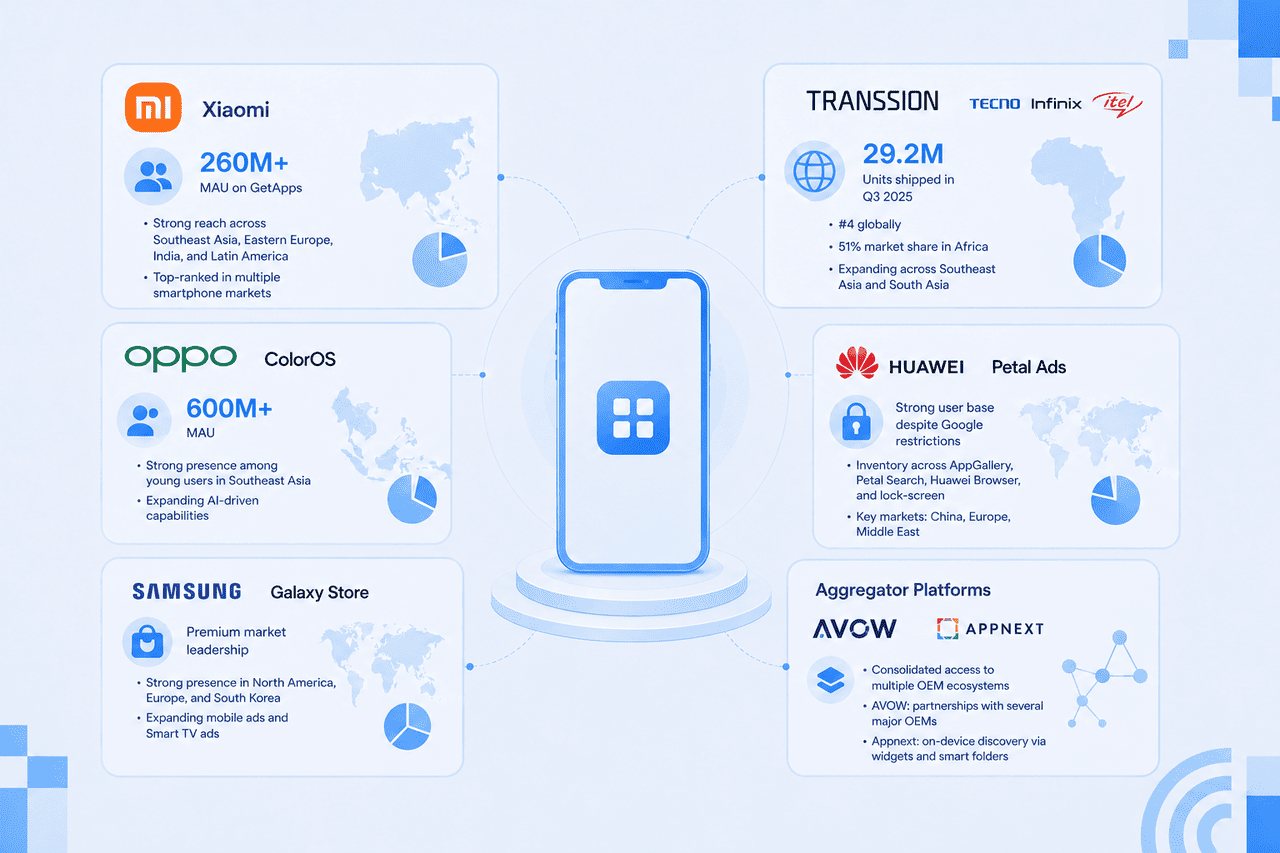
Strong reach across Southeast Asia, Eastern Europe, India, and Latin America. GetApps serves more than 260 million monthly active users, supported by the Mi Ads self-serve platform. Xiaomi consistently ranks among the leading smartphone manufacturers across multiple regions.
2. Transsion (Tecno, Infinix, itel)
Ranked fourth globally in Q3 2025 with 29.2 million units shipped. The company remains Africa's dominant smartphone manufacturer with 51% market share while also expanding rapidly across Southeast Asia and South Asia.
3. OPPO / ColorOS
More than 600 million monthly active users. The ecosystem has a particularly strong presence among younger consumers in Southeast Asia and continues to expand its AI-driven capabilities.
4. Huawei / Petal Ads
Despite restrictions related to Google services, Huawei maintains a substantial user base through its own ecosystem. Petal Ads provides inventory across AppGallery, Petal Search, Huawei Browser, and lock-screen placements, making it particularly valuable for advertisers targeting China, Europe, and the Middle East.
5. Samsung / Galaxy Store
Samsung offers one of the strongest OEM ecosystems in premium markets such as North America, Europe, and South Korea. The company continues expanding its mobile advertising capabilities alongside its established Smart TV advertising business.
6. Aggregator Platforms
For advertisers without direct manufacturer relationships, aggregators provide consolidated access to multiple OEM ecosystems. AVOW maintains partnerships with several major OEMs, while Appnext focuses on on-device discovery through recommendation widgets and smart folders.
What OEM Advertising Is Best For
OEM advertising is not a universal solution. It performs best under specific conditions.
Strong fit
Android-focused apps, emerging market expansion strategies across Southeast Asia, Africa, Latin America, Eastern Europe, and MENA, as well as transactional business models such as fintech, e-commerce, mobility, and dating. It is also highly effective for categories where early habit formation is important, including finance, health, and productivity apps.
Weaker fit
iOS-focused acquisition strategies, brand-awareness campaigns without a clear install objective, and markets where Google Play remains overwhelmingly dominant in app discovery.
Measurement Considerations
OEM attribution requires a different setup because placements occur before a traditional ad click takes place. Standard click-based attribution models are therefore insufficient.
Most Mobile Measurement Partners, including Adjust, AppsFlyer, and Singular, support preload attribution. In these cases, install attribution is tied to a predefined list of device IDs supplied by the OEM. This setup must be completed before the campaign launches because retroactive attribution is generally not possible.
Post-install metrics are more important than raw install volume when evaluating OEM performance.
Key metrics
• Activation Rate: What percentage of preloaded apps are actually opened and used?
• Day 1, Day 7, and Day 30 Retention: How do OEM-acquired users compare with users from other acquisition channels?
• Downstream Revenue Events: First purchases, subscription conversions, and LTV at 30 and 90 days.
Attribution windows should also be configured carefully. OEM placements can influence installs over longer decision cycles than traditional direct-response advertising. A user may encounter an app during device setup and only activate it several days later. Short attribution windows often fail to capture this behavior accurately.
The value of OEM advertising isn't simply lower acquisition costs. It's access to users that traditional channels often struggle to reach.
As app marketers search for new sources of incremental growth, OEM ecosystems are evolving from niche acquisition channels into strategic components of diversified growth portfolios. The advertisers that understand how to leverage them effectively will be better positioned to scale beyond the limits of mainstream media.
more posts
OEM & CTV Advertising: A Cross-Screen Strategy for Brand Growth
October. 29 2026
LEARN MORE

How OEM Advertising Unlocks App Scale in Emerging Markets
October. 09 2026
LEARN MORE
How to Measure CTV ROI in 2026: From Multi-Touch Attribution to Geo-Lift & iROAS
September. 30 2026
LEARN MORE
Why Most Brands Miss the Full Potential of OEM Advertising — How to Drive Smarter App Growth
August. 24 2026
LEARN MORE