



Copyright © 2026 NOVABEYOND LIMITED (company number 2833487). All rights reserved.
Address: UNIT 616 6/F KAM TEEM INDUSTRIAL BUILDING 135 CONNAUGHT ROAD WEST SAI WAN HONGKONG.
Introduction
Mobile advertising is undergoing a fundamental shift. Rising customer acquisition costs and stricter privacy regulations are pushing brands to look beyond traditional advertising platforms for scalable growth.
For years, search engines and social media have dominated mobile user acquisition. Search and social still play an important role. However, stronger competition, overlapping audiences, and weaker targeting signals make it harder to maintain efficient growth with the same media mix.
In response to these changes, OEM Advertising has emerged as one of the fastest-growing acquisition channels for app developers and global brands. Brands can use advertising inventory built directly into smartphones and connected devices, advertisers can reach users throughout the native ecosystem, from initial setup and app discovery to lock screens, system recommendations, and smart TV homepages.
Today, many advertisers are expanding beyond traditional channels to reach new audiences, diversify media investments, and improve scalable growth.
Quick Answer
What Is OEM Advertising?
OEM Advertising places ads directly within smartphone, tablet, and Smart TV operating systems. OEM Advertising delivers ads through native mobile experiences, including manufacturer app stores, lock screens, launchers, app vaults, setup wizards, notification centers, and Smart TV homepages.
These placements sit inside the operating system, so users can move from discovery to installation with fewer steps. Many formats support direct downloads or one-click app installation, helping reduce user drop-off compared with traditional app install campaigns.
Leading OEM ecosystems include Xiaomi, Samsung, Huawei, OPPO, vivo, HONOR, Transsion, and realme. Smart TV manufacturers also provide valuable OEM advertising inventory, giving brands access to billions of connected devices worldwide.
OEM Advertising Becomes the Third Pillar of User Acquisition
For more than a decade, digital media buying has been dominated by two primary channels: Search and Social. Together, they have fueled app installs, ecommerce growth, and brand awareness across virtually every industry.
However, the digital advertising landscape has changed significantly.
As more advertisers compete for the same audiences, inventory has become increasingly saturated. Higher bidding pressure, rising CPIs, and growing audience overlap have made it harder to achieve sustainable growth simply by increasing advertising budgets.
OEM Advertising has become the third pillar of mobile user acquisition because it introduces an entirely different source of advertising inventory.
OEM Advertising reaches users directly through their devices during key moments, including:
Device activation
Native app discovery
System recommendations
Manufacturer app stores
Lock screen experiences
Smart TV home interfaces
Brands can reach users before they open competing apps, creating more opportunities to influence their decisions.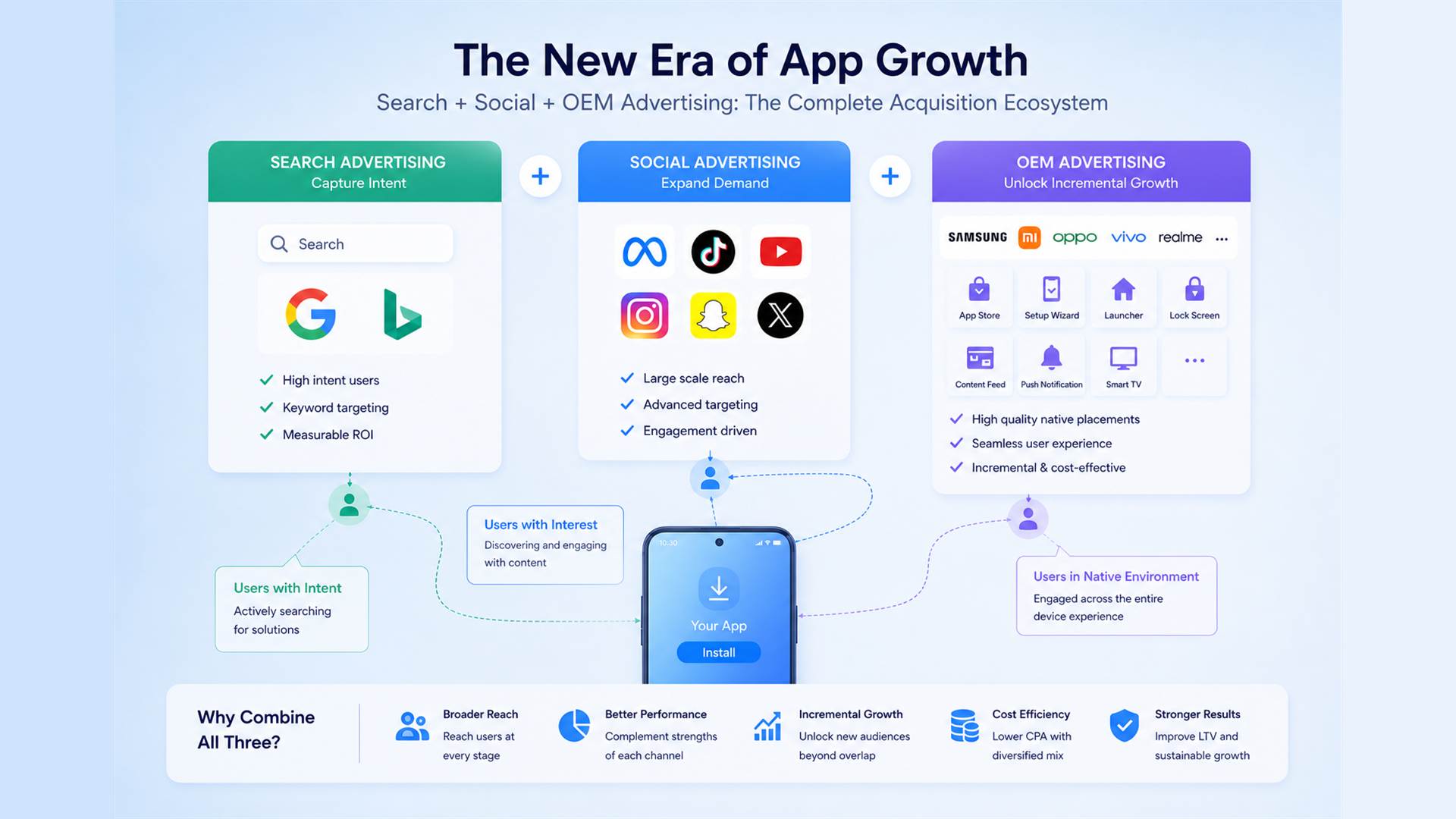
Device manufacturers own OEM ecosystems and integrate advertising directly into their operating systems. This gives brands access to premium inventory while maintaining a seamless user experience.
The Challenges Facing Traditional Mobile Advertising
Several industry-wide changes have significantly reshaped mobile advertising performance over the past few years.
Rising Customer Acquisition Costs
As digital advertising budgets continue to increase worldwide, competition for premium inventory has intensified across nearly every major platform. Many advertisers now experience diminishing returns as acquisition costs rise faster than user growth.
Privacy-Driven Signal Loss
Apple's App Tracking Transparency (ATT), Google's Privacy Sandbox, and expanding global privacy regulations have reduced the availability of deterministic user signals.
With less granular tracking available, advertisers face greater challenges in attribution, audience targeting, campaign optimization, and performance measurement.
Increasing Installation Friction
Traditional app acquisition often follows a multi-step process:
Ad → Landing Page or App Store → Install → Open App
Each additional step creates opportunities for users to abandon the journey before completing an installation.
Many OEM advertising formats streamline this process by integrating app discovery directly into the device ecosystem, reducing friction and improving the overall user experience.
Audience Saturation
Many brands advertise simultaneously across Meta, Google, TikTok, and other major platforms.
Although campaigns run on different networks, they frequently compete for highly overlapping audiences, making long-term growth increasingly difficult.
Looking to diversify your acquisition strategy beyond search and social?
Novabeyond helps global advertisers access premium OEM advertising inventory across leading smartphone brands and Smart TV ecosystems.
Our team supports market expansion with localized campaign planning and performance optimization.
Understanding the OEM Advertising Ecosystem
According to IDC, Android device manufacturers shipped over 1.1 billion smartphones globally in 2025, with Samsung, Xiaomi, Transsion, OPPO, and vivo collectively accounting for more than 60% of total shipments. These devices represent a vast, often untapped advertising inventory that exists outside the walls of search and social ecosystems.
Device manufacturers build OEM Advertising Solutions directly into their operating systems and native services, allowing brands to engage users throughout the device experience. Brands can engage users throughout the device lifecycle—not only while they browse apps or websites.
Instead of relying on a single placement, advertisers can leverage a portfolio of native inventory that blends naturally into the user experience. Each placement supports different marketing goals, including brand awareness, app discovery, user acquisition, and re-engagement.
Major Android OEM Advertising such as Samsung, Xiaomi, OPPO, vivo, Huawei, HONOR, Transsion, and realme have each built their own advertising ecosystems. These platform help brands reach users during moments that traditional media buying often misses.
Typical OEM advertising inventory includes:
Placement | Typical Objective |
Manufacturer App Store | App discovery and installs |
Device Setup Wizard | New user acquisition |
Launcher & Home Screen | Brand exposure and engagement |
Lock Screen | High-frequency awareness campaigns |
App Vault & Content Feed | Content discovery and traffic generation |
Push Notifications | User re-engagement |
Smart TV Home Screen | Brand awareness and streaming promotion |
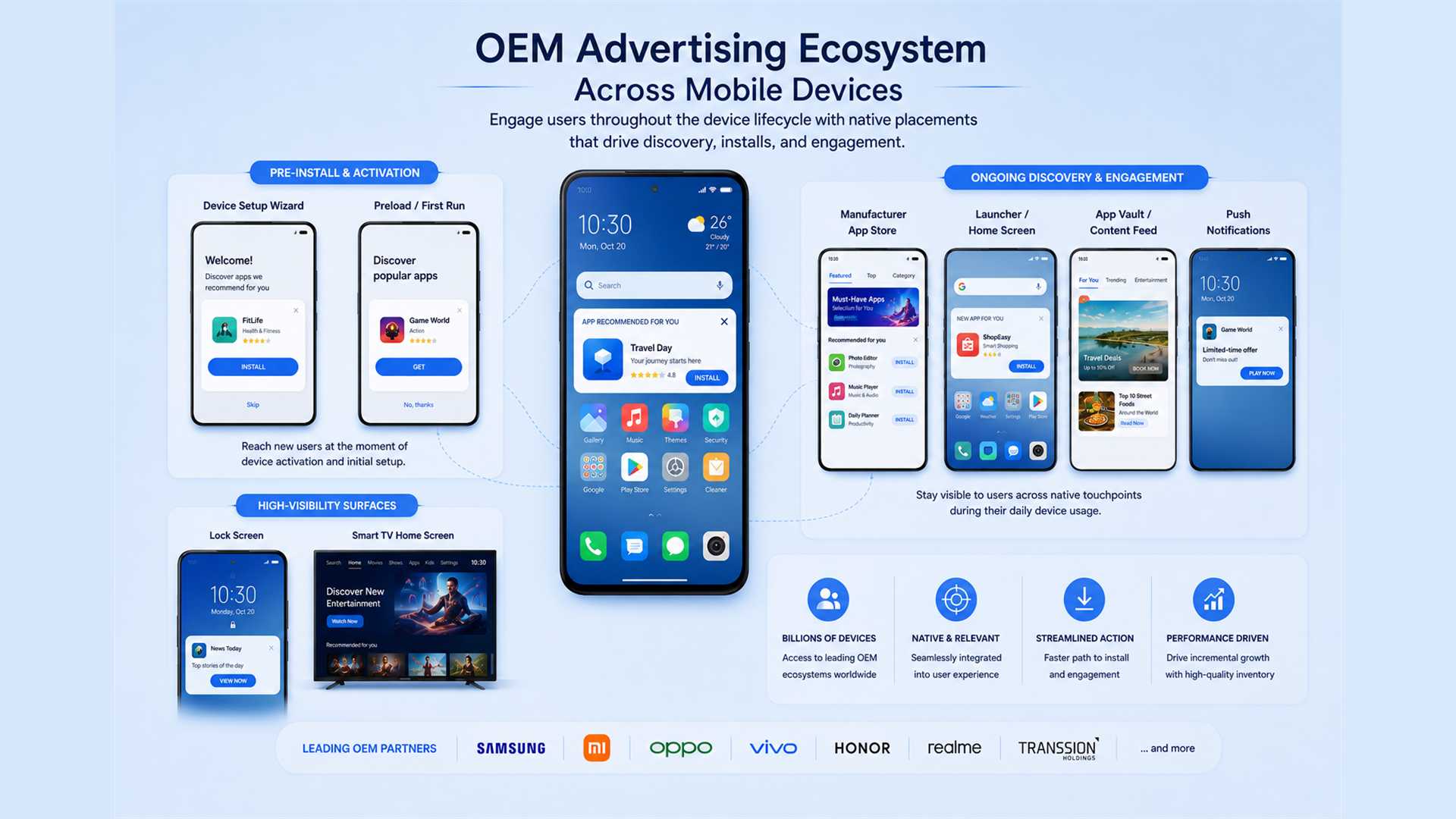
These native placements create a smoother user journey, reduce installation friction, and increase visibility throughout the operating system environment.
OEM Advertising Compared with Traditional Mobile Advertising
Although both OEM advertising platform and traditional mobile advertising aim to attract users, they operate in fundamentally different environments.
Traditional advertising depends on third-party platforms where advertisers compete for impressions inside apps or search results. OEM Advertising, by contrast, leverages inventory owned by device manufacturers, creating additional opportunities to reach users before they enter competing applications.
Feature | OEM Advertising | Traditional Mobile Advertising |
Inventory Source | Device operating system and manufacturer services | Third-party apps and advertising platforms |
User Touchpoints | Native ecosystem | In-app or WAP browsing |
Installation Journey | Often supports direct or simplified installation | Usually redirects through an app store |
Audience Reach | Incremental device users | Highly competitive existing audiences |
Competition | Lower inventory overlap | Higher bidding competition |
Best For | App growth, brand awareness, user acquisition | Broad digital marketing campaigns |
Rather than replacing search or social advertising, OEM Advertising works best as part of a diversified media strategy. Many advertisers combine OEM campaigns with traditional channels to improve incremental reach and reduce dependence on a single traffic source.
Expand your media mix with trusted OEM partnerships.
Novabeyond connects advertisers with global OEM manufacturers across smartphones and Smart TVs.
We help brands build localized campaigns, simplify campaign management, and uncover new growth opportunities across global markets.
Major OEM Advertising Formats
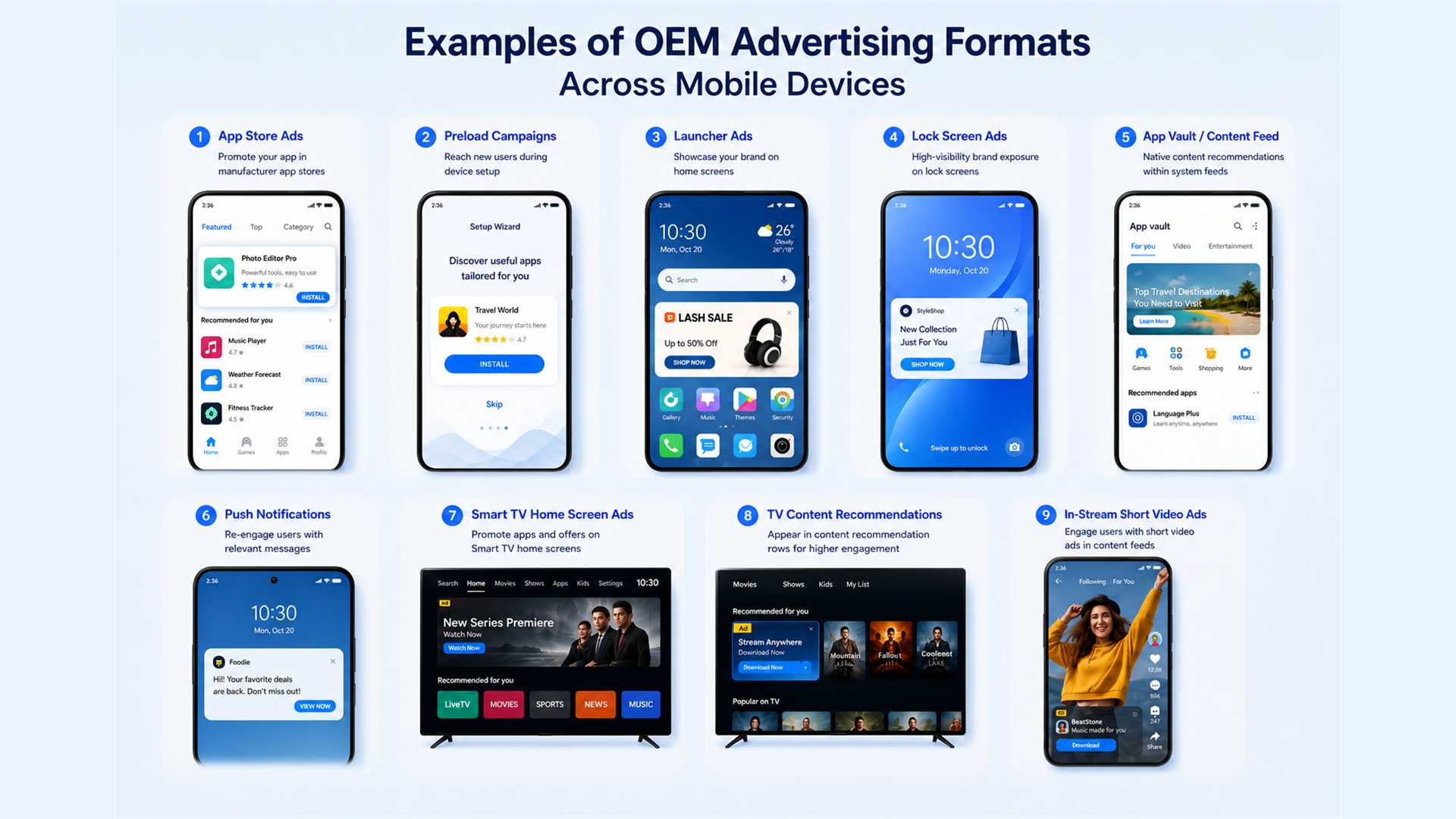
OEM advertising platforms offer a wide range of advertising formats. Brands can match different placements to different campaign objectives.
Ad Format | Primary Objective | Common Placement |
App Store Ads | Drive app installs | Manufacturer app stores |
Preload Campaigns | Immediate user acquisition | Devices before activation |
Launcher Ads | Increase visibility | Home screens and launchers |
Lock Screen Ads | Build brand awareness | Device lock screen |
App Vault Recommendations | Promote content discovery | System content feeds |
Push Notifications | Re-engage existing users | Notification center |
Smart TV Ads | Reach connected TV audiences | TV homepages and recommendation feeds |
Different OEM ecosystems provide different inventory combinations, so advertisers typically select formats based on business goals, target markets, and available device partnerships.
Industries That Benefit Most from OEM Advertising
OEM Advertising is highly flexible and supports a wide range of industries. However, businesses with mobile-first products or digital services often achieve the greatest value because native device placements shorten the path between discovery and conversion.
Some of the most common use cases include:
Mobile Apps: Drive installs through manufacturer app stores, setup flows, and recommendation feeds.
Mobile Gaming: Acquire high-value players using immersive native placements and localized creatives.
Ecommerce: Increase app downloads, promote seasonal campaigns, and support customer retention.
Financial Services: Introduce banking, payment, and investment apps to users during device onboarding and app discovery.
Travel and Lifestyle: Reach consumers planning trips, shopping, or entertainment through high-visibility device placements.
Streaming and Entertainment: Promote video, music, and content platforms across Smart TVs and mobile devices.
AI and Productivity Apps: Improve visibility for emerging applications by appearing in native recommendation environments
Successful advertisers combine OEM inventory with search, social, and other digital channels to build a more diversified acquisition strategy.
Best Practices for Building High-Performance OEM Marketing Campaigns
OEM Advertising performs best when advertisers tailor campaigns to each market and device ecosystem. Simply replicating creatives from social media or search campaigns rarely unlocks the full potential of OEM inventory.
Advertisers that consistently achieve strong performance typically focus on the following best practices.
Localize Creative Assets for Each Market
Mobile OEM advertising often reaches users across diverse regions, where language, cultural preferences, and purchasing behavior vary significantly.
Instead of translating existing creatives, adapt messaging, visuals, and calls to action to align with local user expectations. A campaign that performs well in Southeast Asia may require a completely different creative approach in Latin America or the Middle East.
Localization is especially important for industries such as ecommerce, gaming, fintech, and travel, where consumer behavior differs widely between markets.
Match Ad Formats to Campaign Objectives
The best-performing campaigns match each OEM format to a specific business goal instead of using the same placement for every campaign.
Use App Store Ads and Preload Campaigns for user acquisition.
Choose Launcher and Lock Screen Ads for brand visibility.
Combine Push Notifications with re-engagement campaigns.
Extend streaming promotions through Smart TV inventory.
Aligning inventory with campaign objectives helps maximize both user experience and advertising efficiency.
Measure Beyond Cost Per Install
AppsFlyer benchmarks show that traditional in-app ad networks continue to face rising CPIs and signal loss. Native device-level acquisition channels, however, often deliver stronger early retention signals.
Growth teams should monitor post-install engagement metrics such as CVR, retention rate, and cost per first action. They should also track ROAS and LTV across OEM cohorts to measure long-term business impact.
Build an Omnichannel Acquisition Strategy
OEM Advertising campaigns generate stronger long-term results when combined with other marketing channels.
Many advertisers use OEM campaigns to complement search, social, influencer marketing, and programmatic advertising. This diversified approach helps expand incremental reach while reducing dependence on a single platform.
As privacy regulations continue to reshape digital marketing, a balanced media strategy has become increasingly important for sustainable growth.
Common Mistakes Advertisers Should Avoid
OEM Advertising offers clear advantages, but many brands still approach it like traditional mobile advertising.
Avoiding the following mistakes can significantly improve campaign performance.
Treating OEM Advertising as Just Another App Store
Many advertisers mistakenly assume mobile OEM ads are limited to manufacturer app stores.
OEM ecosystems include far more than manufacturer app stores. Brands can also use lock screens, launchers, setup flows, recommendation feeds, notification centers, and Smart TV interfaces.
Viewing OEM as a complete ecosystem, not a single placement, opens far more opportunities for user acquisition and brand exposure.
Reusing Creatives from Other Platforms
Creative assets designed for social feeds or search ads often underperform in native device environments.
OEM placements have different layouts, interaction patterns, and user expectations. Optimizing creative formats, messaging, and visual hierarchy for each placement typically leads to stronger engagement.
Focusing Only on Short-Term Acquisition
Many campaigns prioritize immediate installs while overlooking long-term customer value.
Evaluating retention, engagement, and downstream conversions provides a more accurate understanding of campaign effectiveness and supports more sustainable growth.
Ignoring Regional Differences
OEM ecosystems vary by manufacturer and geography.
For example, Xiaomi may have stronger market penetration in certain regions, while Samsung, OPPO, vivo, or Transsion devices dominate others. Campaign planning should reflect regional device distribution rather than assuming a one-size-fits-all strategy.
Overlooking Measurement and Attribution
Accurate measurement remains essential.
Before launching a campaign, advertisers should configure their mobile measurement partners (MMPs), analytics platforms, and conversion tracking to ensure accurate performance measurement. Reliable attribution enables continuous optimization and more informed budget allocation across multiple OEM ecosystems.
Ready to unlock new growth opportunities with OEM Advertising?
Looking for the right OEM advertising strategy? Our specialists can help you identify the best OEM ecosystems, localize creatives, and optimize campaigns for sustainable growth.
Frequently Asked Questions
1. Is OEM Advertising only available for Android devices?
No. While Android smartphone manufacturers account for the majority of OEM advertising inventory, the ecosystem extends beyond mobile phones. Many Smart TV manufacturers also provide native advertising opportunities through home screens, content recommendations, and connected TV (CTV) environments. Available placements vary by manufacturer and market.
2. How is OEM Advertising different from Google Ads or Meta Ads?
The biggest difference is where the ads appear.
Google Ads and Meta Ads primarily display ads within search results, websites, or social applications.OEM Advertising uses inventory owned by device manufacturers. This allows brands to reach users through app stores, launchers, lock screens, and recommendation feeds.
Most advertisers use OEM campaigns alongside traditional advertising platforms to expand incremental reach and strengthen existing acquisition strategies.
3. Which industries benefit most from OEM Advertising?
OEM Advertising supports most digital-first businesses, particularly those focused on mobile apps, including utilities, ecommerce, gaming, financial services, and streaming platforms.
4. Can OEM Advertising support global campaigns?
Yes. Leading OEM manufacturers operate across multiple international markets, enabling advertisers to launch campaigns. For example, in Southeast Asia, Latin America, the Middle East, Europe, and other high-growth mobile markets.
Available inventory, targeting options, and ad formats vary by OEM partner and market. Localized planning helps advertisers choose the right strategy.
5. What advertising formats are available?
OEM platforms support multiple native formats, including placements for app discovery, brand awareness, re-engagement, and Smart TV advertising. The exact inventory available depends on the OEM ecosystem and target market.
6. How should advertisers measure campaign performance?
While Cost Per Install (CPI) remains an important benchmark, advertisers should evaluate broader business outcomes, including:
Conversion Rate (CVR)
Return on Ad Spend (ROAS)
Customer Lifetime Value (LTV)
Retention Rate
Incremental User Growth
Using multiple performance indicators provides a more complete view of campaign effectiveness than installation volume alone.
7. Is OEM Advertising suitable for brand awareness campaigns?
Absolutely. Many advertisers use OEM Advertising for app promotion and user acquisition. Native placements also help brands increase awareness and reach large audiences.
And some combine awareness and performance campaigns throughout different stages of the customer journey.
8. What should businesses do before launching OEM Advertising?
Start by defining your campaign goals, target markets, and the OEM ecosystems that best match your audience.
An experienced OEM advertising partner can simplify inventory access, campaign planning, creative localization, measurement setup, and optimization—especially for brands running campaigns across multiple countries.
Conclusion
As device manufacturers continue investing in their own software ecosystems, OEM advertising is evolving from a niche acquisition channel into an essential part of modern media planning. Brands that diversify beyond traditional advertising platforms today will be better positioned to capture incremental growth opportunities in the years ahead.
From manufacturer app stores and lock screen placements to launcher recommendations and Smart TV ecosystems, OEM Advertising enables brands to engage users throughout the device experience while reducing acquisition friction and expanding incremental reach.
The most successful advertisers do not view OEM Advertising as a replacement for existing channels. Instead, they integrate OEM campaigns into a diversified acquisition strategy, combining native device inventory with search, social, programmatic, and other digital marketing efforts to maximize long-term performance.
The continued growth of alternative app stores, connected TV ecosystems, on-device AI experiences, and privacy-first advertising models is expected to further expand OEM advertising opportunities. As device manufacturers invest more heavily in their own software ecosystems, native advertising inventory is likely to become an increasingly important component of global media buying.
Scale beyond traditional advertising with Novabeyond.
Whether you're entering new markets or improving acquisition efficiency, Novabeyond gives you access to premium OEM advertising resources.
From media planning to creative localization and campaign optimization, our team helps you build scalable OEM campaigns for long-term growth.
more posts
How OEM Advertising Unlocks App Scale in Emerging Markets
October. 09 2026
LEARN MORE

How to Measure CTV ROI in 2026: From Multi-Touch Attribution to Geo-Lift & iROAS
September. 30 2026
LEARN MORE
Five Misconceptions About CTV Advertising That Are Holding Growth Teams Back
July. 28 2026
LEARN MORE
OEM Advertising : How Device-Level Placements Drive App Growth in Emerging Markets
July. 13 2026
LEARN MORE