



Copyright © 2026 NOVABEYOND LIMITED (company number 2833487). All rights reserved.
Address: UNIT 616 6/F KAM TEEM INDUSTRIAL BUILDING 135 CONNAUGHT ROAD WEST SAI WAN HONGKONG.
Introduction
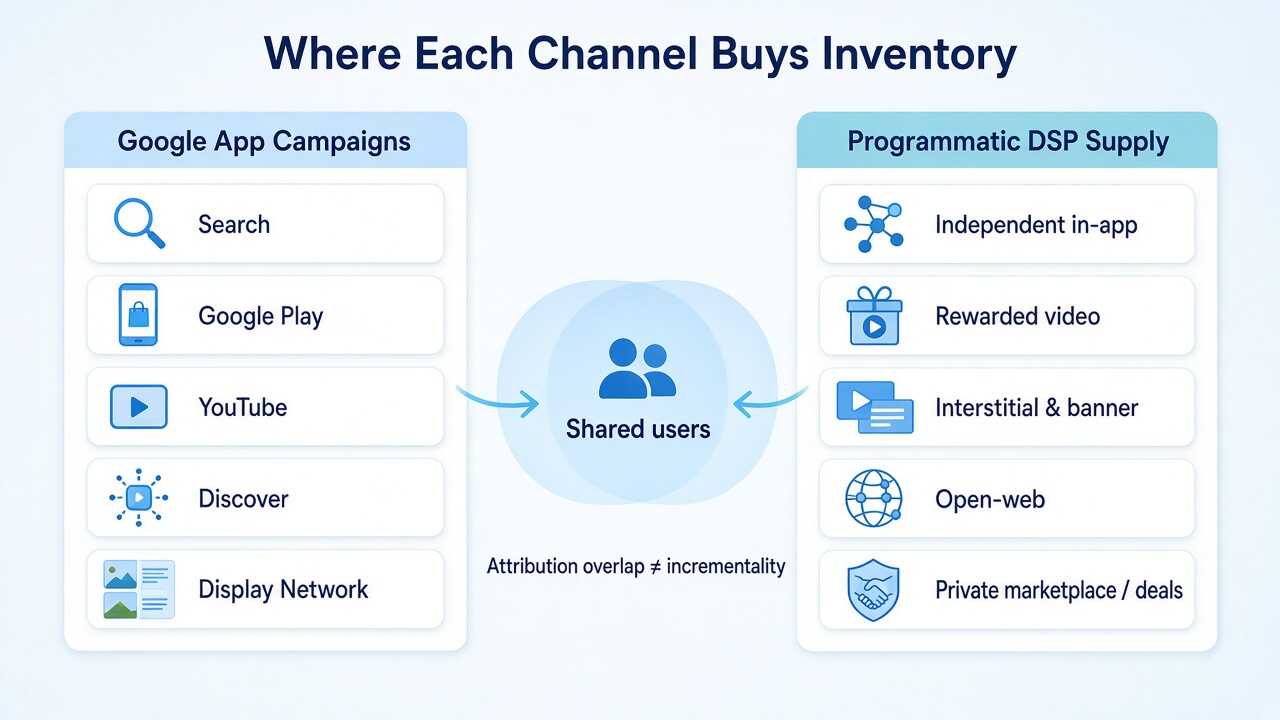
Google App Campaigns still look like the default answer for app installs. You provide assets, a bid, a budget, and a conversion goal, and Google automatically distributes ads across its major properties. According to Google's official App campaigns documentation, App campaigns can reach users across Search, Google Play, YouTube, Discover, and the Google Display Network.
For many Android apps, this can produce highly competitive reported CPI, especially when existing Search and Google Play demand is strong. The harder question appears when you increase spend. CPI may rise, conversion efficiency may flatten, and reported installs may no longer tell you how many users were genuinely created by the next dollar.
Programmatic advertising is not simply a cheaper alternative to Google App Campaigns. A demand-side platform buys independent in-app and open-web inventory through exchanges, SSPs, and direct or private marketplace relationships. It operates with a different inventory graph and provides different supply controls. The useful question is therefore not which channel "wins." It is: when does a DSP add users that Google would not efficiently reach on its own?
That is the question this guide answers for media buyers, growth leads, and app marketers who already run Google App Campaigns and are considering programmatic as an incremental acquisition channel.
If you are unsure whether your Google campaigns have reached an incremental ceiling, share your target GEOs, conversion event, and current CPI range with Novabeyond.
Talk to Novabeyond about an incremental DSP test.
Quick Answer
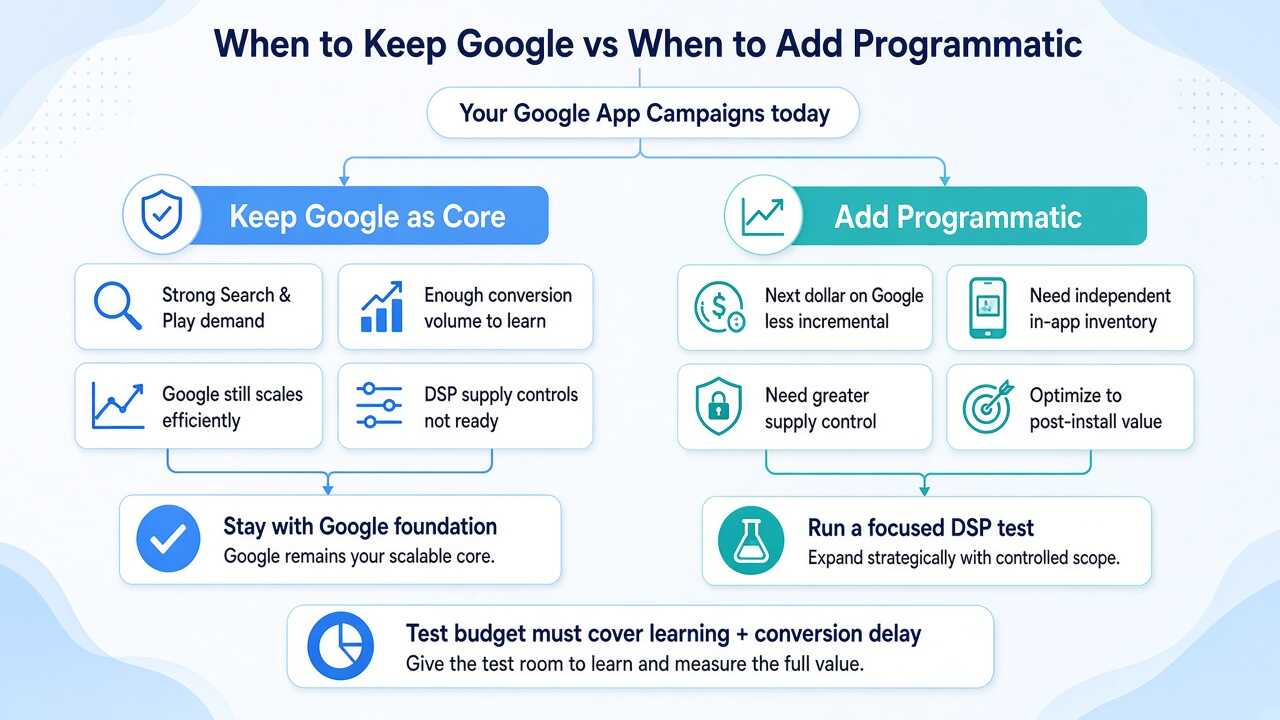
Use Google App Campaigns as the core when Google-native demand remains efficient, Search and Play intent are important to your acquisition strategy, and your campaigns have enough conversion volume and budget to learn. Google automatically combines creative assets and optimizes delivery across its available networks.
Add a programmatic DSP when the next dollar on Google becomes less efficient, you need independent in-app inventory, you require greater supply control, or your optimization goal has moved beyond installs toward registration, purchase, subscription, or revenue.
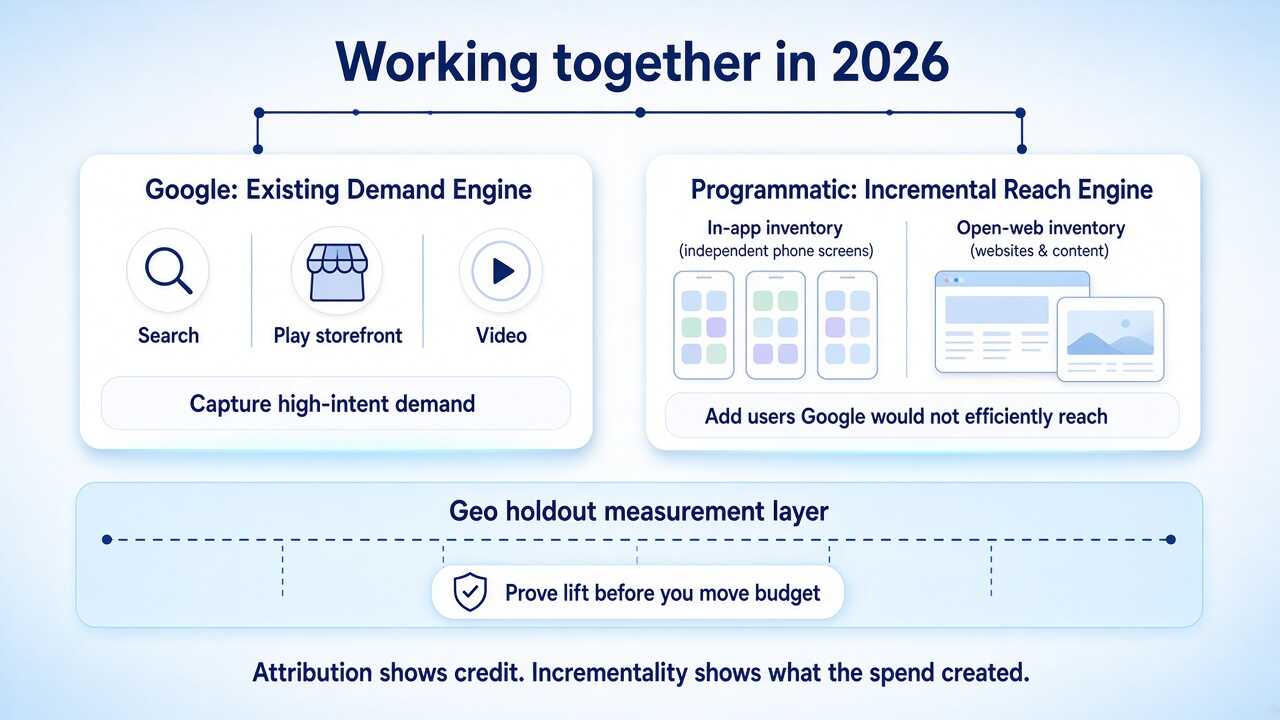
The key is measurement. Platform-reported CPI, CPA, or ROAS tells you which source receives credit. It does not by itself prove that the conversion would not have happened without the media spend. Attribution answers "who gets credit?" Incrementality answers "what happened because we spent?"
For a serious budget decision, keep Google stable, run the DSP in a matched test GEO or holdout design, define one primary incremental KPI, and scale only after the test shows measurable lift.
What Each Channel Actually Buys
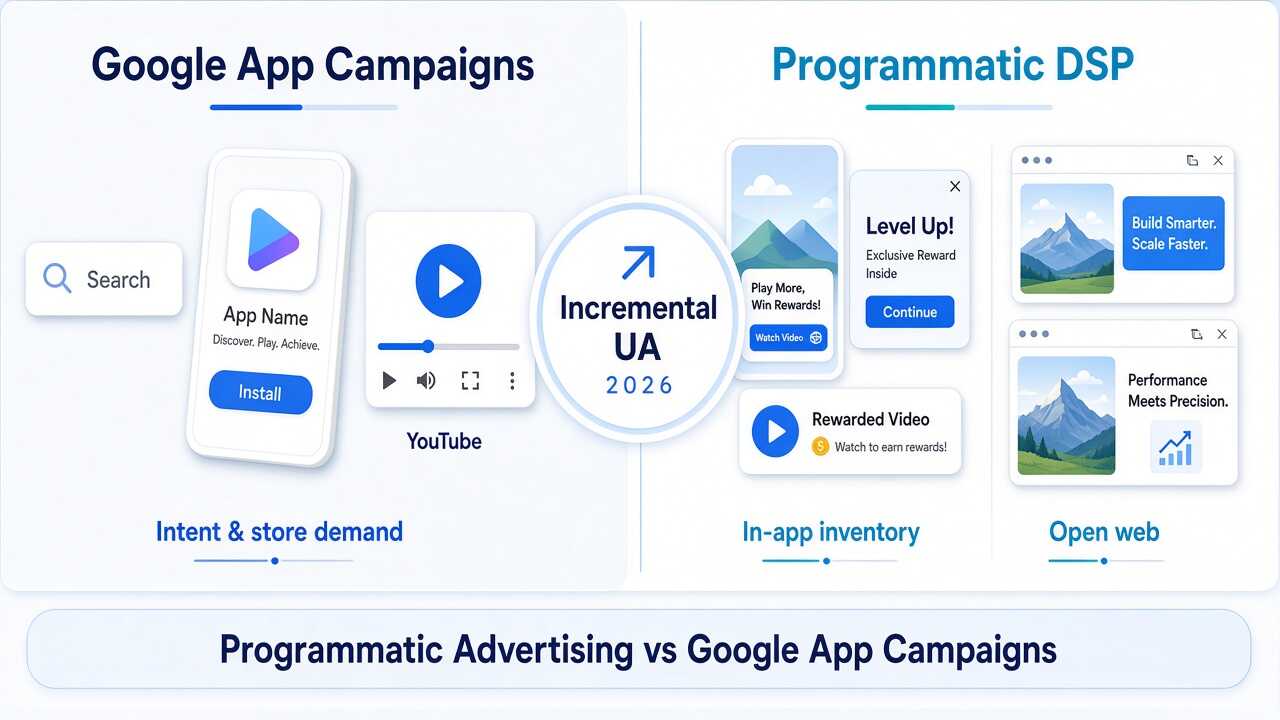
Google App Campaigns provide broad automated distribution across Google's ecosystem. Google states that advertisers can provide text, images, video, bids, and other assets while the system automatically tests combinations and optimizes delivery against the selected goal.
That setup is powerful because it reduces operational complexity. You do not need to build separate campaigns for every Google property or manually select every placement. The system uses signals such as location, device, search queries, placements, app usage, and other contextual information to predict conversion likelihood. The trade-off is control.
A programmatic DSP operates on a different layer of the media ecosystem. It can access independent app and web inventory through exchanges, SSPs, deals, and other supply relationships. Depending on the DSP and setup, buyers can apply app lists, deal-level controls, frequency rules, fraud filters, traffic-quality requirements, and post-install optimization signals. That difference matters when the objective is not simply to acquire another attributed install, but to expand the pool of users your current channel mix can reach.
Overlap is still real. A user might discover an app through Google Play, see an ad inside another mobile app later, and eventually install. An MMP can attribute that journey according to its attribution rules, but attribution does not automatically establish causality. A cheap DSP CPI can therefore be non-incremental. A higher DSP CPI can be incremental. The price of the installation is only one part of the decision.
Side-by-Side: Where Control and Measurement Diverge
Decision Google App Campaigns Programmatic DSP What it means for incrementality Inventory Search, Google Play, YouTube, Discover, Display Network Independent app and open-web supply via exchanges, SSPs, and deals Reach beyond a single platform Setup Assets, bid, budget, location, and conversion goal MMP events, creatives, supply rules, bid model, and often an agency ad account A separate acquisition test cell Control Highly automated, limited placement-level control More control over supply, apps, deals, frequency, and traffic quality Easier to isolate incremental supply Optimization Google conversion and value signals Post-install events and MMP data, depending on the DSP Optimize toward real user value Reporting Google platform reports plus MMP data DSP reports, MMP data, and sometimes finer placement detail Attribution alone does not prove cause Early job Capture and extend Google-native demand Reach independent supply and test new demand Check whether the next dollar adds outcomes Main risk Paying for demand that already exists Buying low-quality or non-incremental traffic Needs a controlled test
The first practical rule is simple: do not starve Google just to make a DSP look better.
Google's current App campaign guidance recommends specific bid-to-budget ratios. For install-volume campaigns using target CPI, Google recommends a daily budget of at least 50 times the target CPI. For install campaigns using target CPA, the recommended ratio is at least 10 times the target CPA. For engagement campaigns, Google recommends about 15 times target CPA.
For example, a $2 target CPI implies a recommended daily budget of at least $100 for an install-volume campaign. Google also advises allowing campaigns enough time to gather conversion data and notes that early CPI can be inflated by conversion delays. That creates an important baseline for any comparison. If Google is underfunded, a DSP test does not prove that programmatic is better. It only proves that a properly funded campaign can outperform a starved one.
Novabeyond's guide to launching campaigns on Moloco DSP provides more detail on DSP setup and launch considerations. This comparison focuses on the higher-level budget decision: when programmatic deserves an incremental place alongside Google.
When Should You Keep Google as the Core?
Google should remain the foundation of the acquisition mix when its current strengths match the growth problem.
1. Search and Google Play demand already exists
If users actively search for your category, brand, product, or app, Google can capture that intent close to the point of conversion. Google Play also provides app-specific discovery surfaces, including search results and recommendation areas. A programmatic interstitial does not replace that intent. If your brand already has strong demand inside Google's ecosystem, reducing Google simply to fund a DSP test can remove valuable high-intent traffic before you have proved that programmatic can replace it.
2. Your app or conversion event is still early
New apps often need install volume before they have enough data to optimize toward deeper events. Google recommends aligning campaign goals with available conversion data and allowing the system enough budget and time to learn. The same principle applies to programmatic. If purchases or subscriptions are rare, a DSP may not have enough event density to optimize efficiently toward them. Start with an event that occurs often enough to support learning, then move toward deeper value signals as data accumulates.
3. Your programmatic supply controls are not ready
Programmatic offers more control, but control also creates operational responsibility. Traffic-quality rules, MMP fraud detection, app-ads.txt validation, app and site allowlists, frequency management, and supply monitoring all matter. IAB Tech Lab describes app-ads.txt as a framework designed to improve transparency and help address inventory fraud in mobile applications. If those processes are not ready, adding another buying layer can increase complexity without producing better acquisition.
4. Google efficiency is still improving with additional spend
Diversification should solve a growth constraint. It should not replace a channel that still has room to scale efficiently. If increasing Google spend continues to generate valuable users at an acceptable target, there is less reason to move budget simply for the sake of channel diversification.
App campaigns for engagement are also a different use case. They focus on existing users and in-app actions rather than pure prospecting. If the objective is reactivation, consider Google engagement campaigns or a dedicated retargeting strategy such as Novabeyond's app retargeting through programmatic advertising.
When Should You Add a DSP?
A DSP earns a place in the mix when it solves a problem that the current Google setup cannot solve efficiently.
1. The next dollar on Google is becoming less incremental
Do not define the problem only as "Google CPI is rising." Look deeper. You may see target CPI or CPA becoming harder to maintain, spend moving toward more expensive inventory, or additional reported installs producing weaker downstream value. The key question is whether the additional spend is creating users who would otherwise have installed organically or through Google. This is where incrementality becomes more important than platform attribution.
2. You need independent in-app inventory
Google App Campaigns can reach users across a broad ecosystem, including other apps through eligible Display Network inventory. A DSP provides another buying environment with independent supply and different auction dynamics. This can matter in GEOs where users spend significant time inside local apps and games, particularly when your existing Google acquisition strategy has already captured much of the available intent. The objective is not to escape Google. It is to find additional reach that behaves differently enough to create incremental outcomes.
3. You need greater supply control
Some advertisers need stronger control over the environments where their ads appear. Brand-sensitive categories, inventory-quality requirements, exclusion rules, frequency management, and preferences around rewarded or specific app environments can all make supply controls more important. Novabeyond's Programmatic Growth Strategies approach addresses this layer through diversified supply, CPI/CPA/CPM buying, traffic scoring, and fraud checks. The important distinction is that more control does not automatically mean more incrementality. It simply gives you more tools to build and manage the test.
4. Post-install value matters more than install volume
A $1.50 install is not necessarily better than a $2.20 install. Suppose the $1.50 cohort produces fewer registrations, purchases, or retained users. The cheaper acquisition cost can hide lower downstream value. Once purchase, subscription, registration, or another meaningful event is available at sufficient volume, optimize toward that event instead of treating install volume as the final KPI. Google itself supports App campaign goals beyond installs, including in-app actions. The same principle applies to programmatic.
5. You can find a real learning cell
A DSP test needs enough budget to generate meaningful events. There is no universal DSP budget that guarantees a valid test because required spend varies by GEO, OS, event density, bid strategy, inventory costs, and campaign objective. The more useful rule is to budget for enough impressions, installs, and post-install events to reach a meaningful readout. Do not launch a DSP for two days, collect a handful of installs, and conclude that the channel cannot scale.
Sequence the test instead. Start with one primary DSP, a controlled GEO or market cell, a focused creative set, a defined optimization event, and a written kill rule. If delivery or ROAS breaks after launch, use Novabeyond's programmatic campaign rescue checklist before deciding that the channel itself has failed.
If these conditions match your account, Novabeyond can structure a focused DSP test against your existing App campaigns rather than treating programmatic as a broad platform experiment.
Ask Novabeyond to design a Google versus DSP test cell.
Attribution vs. Incrementality: What Should You Actually Measure?
This distinction is central to the entire Google versus DSP decision. Attribution tells you which channel receives credit. Incrementality asks what additional outcome the advertising actually created. These are related, but they are not the same measurement problem. This is why a platform ROAS report should not be treated as proof of incrementality.
Measurement Core question What it tells you Main limit Platform attribution Who gets conversion credit? Reported conversions and efficiency Can include demand that already existed MMP attribution Which media source gets the conversion? Cross-channel credit under MMP rules Still attribution, not cause Geo holdout What changed after ads were added? Difference between test and control markets Needs matched markets and enough data Conversion lift How many extra conversions did ads create? Incremental impact in a controlled test Needs a structured test and enough scale Cohort analysis What value did acquired users create? Retention, revenue, and user quality Cannot prove cause by itself
A Google campaign can report strong ROAS because it captures existing high-intent demand. A DSP can report strong ROAS because its attribution window receives credit for conversions that were already likely to happen. Neither result automatically answers the counterfactual: what would have happened if this advertising had not run? That is the question a holdout is designed to address.
How to Prove Incremental UA Before You Move Budget
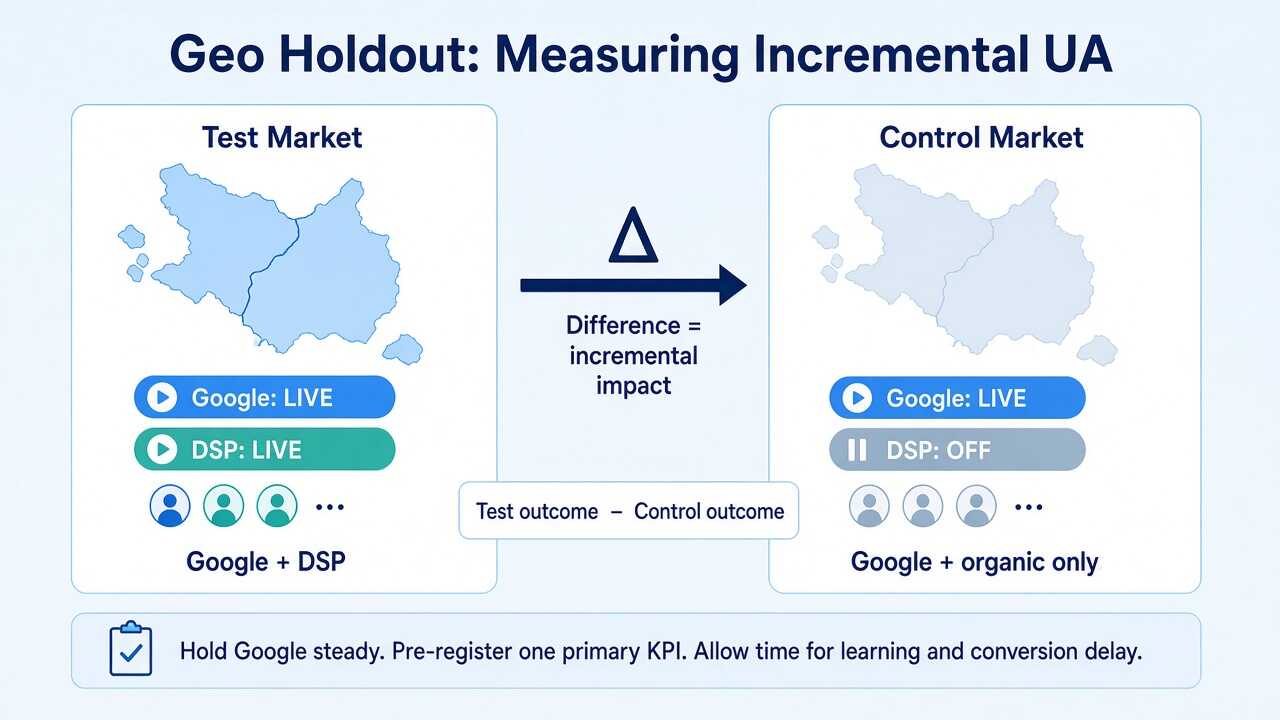
A practical test does not need to be complicated. For many app teams, a matched GEO holdout provides a workable way to compare a test market with a control market while keeping the existing Google baseline in place.
1. Hold Google steady
Keep Google bidding logic, budgets, conversion goals, and major creative changes as stable as practical. You are testing the incremental contribution of the DSP. You are not rebuilding the entire acquisition system at the same time.
2. Split matched GEOs
Choose comparable countries or regions. Run the DSP in the test group and keep the control group on the existing Google and organic mix. The closer the markets are in baseline behavior, seasonality, conversion rate, and user value, the more useful the comparison becomes.
3. Pre-register one primary metric
Choose the metric before the test starts. Possible primary metrics include incremental installs, incremental registrations, incremental purchasers, incremental revenue, or incremental ROAS. CPI should remain a diagnostic metric, but it should not automatically become the final decision metric.
4. Allow enough time for learning and conversion delay
Do not compare a mature Google cohort with a two-day DSP cohort. Google itself notes that App campaigns can experience conversion delays and that CPI may be inflated during the first days or weeks of a campaign. Google also recommends allowing roughly 7 to 14 days for campaigns to stabilize after significant changes in certain campaign setups. The exact test window for a DSP should depend on the conversion cycle and event density, not an arbitrary three-day deadline.
5. Reconcile attribution, then make the decision using the test design
Use the MMP to understand attribution overlap. Then use the test-versus-control difference to assess incremental impact. If the DSP test market produces no meaningful improvement in the predefined primary metric after the planned observation period, do not scale simply because the DSP reported a good platform ROAS. If it produces measurable incremental value, scale gradually and continue monitoring the holdout or another suitable measurement framework.
Novabeyond's practical programmatic framework for limited spend can help structure a controlled approach when the available test budget is constrained.
Cost and Latency: Why Week-One eCPA Can Mislead
A DSP can produce incremental users and still look worse than Google during the first several days. That does not automatically mean the channel is failing.
eCPA can move sharply during early learning
Google App Campaigns aggregate performance across multiple eligible networks and use automated optimization to pursue the selected conversion goal. A programmatic campaign may have a more visible mix of supply types, apps, placements, and auction conditions. Daily eCPA can therefore move substantially. Use cohort-based reporting instead of comparing yesterday's DSP eCPA with a more mature Google result.
Post-install events arrive after installs
An install may be recorded quickly while registration, purchase, subscription, or revenue events arrive later. If the business evaluates eCPA before the normal conversion window has matured, the DSP may appear less efficient simply because some downstream conversions have not arrived yet. Set the readout around the actual event lag in your measurement stack.
Test budget needs enough runway
A DSP test should have enough budget to survive the learning period and the post-install measurement window. Stopping a campaign because the first few days look expensive creates a structural bias toward channels with faster reporting rather than channels that generate better incremental value.
The pilot brief should therefore define the learning period, conversion delay, primary KPI, observation window, minimum spend, kill rule, and scale rule. That turns the test from a platform comparison into a measurable growth experiment.
Android vs. iOS: The Measurement Context Is Different
The strongest Google-native advantage discussed in this comparison applies to Android because Google Play creates an app-specific discovery and intent environment. Google App Campaigns can also promote apps available through the Apple App Store. However, the measurement environment differs on iOS. Privacy restrictions limit the level of user-level attribution and deterministic measurement available to advertisers. That means the same incremental framework should be applied across both operating systems, but the exact methodology, data availability, and confidence level can differ.
For iOS, programmatic can still provide additional in-app reach, but buying more inventory does not solve the underlying measurement constraints. The right question remains the same: can the additional media create measurable incremental outcomes beyond the existing acquisition baseline?
FAQ
1. Is Google App Campaigns programmatic advertising?
Google App Campaigns use automated bidding, machine learning, and automated placement across Google's ecosystem, but they are not the same buying environment as an independent DSP. Google controls the campaign's automated delivery across eligible Google properties and inventory, while a DSP buys programmatic inventory through exchanges, SSPs, deals, and other supply relationships.
2. Should we pause App campaigns when we launch a DSP?
No. In most cases, the better test design is to keep Google funded at a level that supports its optimization and add the DSP as a separate acquisition cell. Google's current guidance includes minimum bid-to-budget ratios for App campaigns, so starving the existing campaign can distort the comparison. Only consider reducing Google after the evidence shows that the spend being moved is less valuable than the incremental opportunity elsewhere.
3. Why is DSP CPI sometimes higher than Google CPI?
Google can capture users with existing intent across Search and Google Play, while a DSP may reach users in independent app environments where the advertiser must create demand rather than capture an existing search or store action. A higher DSP CPI can therefore still be acceptable if the users are incremental and generate stronger downstream value. Conversely, a lower CPI is not proof of incremental value.
4. Why does DSP eCPA look worse in the first week?
Early DSP performance can be affected by learning, supply mix, and conversion delay. A purchase or registration may occur after the initial install, so day-two or day-three eCPA can understate the eventual value of the cohort. Google also warns that early CPI can be inflated because of conversion delays. Use a lagged cohort readout that matches your actual conversion cycle.
5. What budget do we need before a DSP test is fair?
There is no universal DSP test budget. The required amount depends on GEO, OS, event volume, bid strategy, inventory costs, and the optimization event. Start by making sure the Google baseline itself is properly funded. Google recommends a daily budget of at least 50 times target CPI for install-volume campaigns and at least 10 times target CPA for install campaigns using target CPA. For the DSP, budget enough to generate a meaningful number of installs and post-install events during the planned test window.
6. How is this different from fixing an underperforming programmatic campaign?
This article answers a channel allocation question: should programmatic be added alongside Google App Campaigns? Novabeyond's programmatic campaign rescue checklist addresses a different problem: what to do when an existing programmatic campaign is already live but stops spending, loses efficiency, or misses its ROAS target. Test the channel's incremental role first. Optimize the campaign after it has earned a place in the media mix.
7. Do we need an agency ad account to run programmatic UA?
The setup depends on the DSP, market, and commercial arrangement. Some performance-oriented DSP campaigns use managed onboarding, agency relationships, or an agency ad account for account setup, tracking, billing, and campaign operations. An agency ad account is an access and operating structure. It does not replace measurement. Regardless of account setup, the campaign should still have a clear MMP configuration, conversion event, supply-quality framework, and incrementality measurement plan.
8. Can programmatic replace Google for iOS as well as Android?
Programmatic can provide additional in-app reach on both operating systems, but Google has a particularly distinct role on Android because of Google Play. On iOS, privacy restrictions create additional measurement challenges. The strategic framework is therefore the same for both: maintain a measurable baseline, add independent reach, and test incremental outcomes rather than comparing platform-reported CPI alone.
Conclusion
Programmatic advertising and Google App Campaigns solve different user acquisition problems. Google is designed to automate app promotion across a broad Google ecosystem, including Search, Google Play, YouTube, Discover, and the Display Network. Programmatic provides another route to independent in-app and open-web supply, with different inventory access, supply controls, and optimization possibilities.
The important 2026 question is not "Which channel has the lower CPI?" It is "Which channel creates users or revenue that would not have happened without the spend?" That distinction changes how growth teams allocate budget.
Keep Google as the core when it still captures valuable demand efficiently. Add a DSP when the next dollar on Google becomes less incremental, when independent supply can expand reach, when supply control becomes important, or when post-install value becomes the primary acquisition objective. Then prove the decision. Keep the Google baseline stable, build a controlled DSP test, define one primary incremental KPI, and allow enough time for learning and conversion delays. Use MMP data to understand attribution, but use the test design to evaluate incremental impact.
Novabeyond's Programmatic Growth Strategies approach is built around that broader growth problem: combining diversified programmatic supply, event-based optimization, traffic-quality controls, and measurable acquisition strategy rather than treating programmatic as another isolated media channel.
If you are deciding whether your app is ready for an incremental DSP test, share your current Google targets, GEOs, conversion events, and acquisition goals with Novabeyond.
more posts
Mastering Mobile User Acquisition for Fintech Apps in 2026: What Actually Works
October. 08 2026
LEARN MORE

The Complete Practical Guide to Mobile App User Acquisition in 2026: Bidding, Creatives, and Scaling
September. 22 2026
LEARN MORE
Programmatic Campaign Underperforming? 5 Data-Driven Fixes to Rescue ROAS in 2026
August. 31 2026
LEARN MORE
Beyond Google UAC: Rethinking Growth Strategies for Mobile Game Publishers in a Maturing Market
July. 21 2026
LEARN MORE