



Copyright © 2026 NOVABEYOND LIMITED (company number 2833487). All rights reserved.
Address: UNIT 616 6/F KAM TEEM INDUSTRIAL BUILDING 135 CONNAUGHT ROAD WEST SAI WAN HONGKONG.
In today’s saturated global e-commerce market, we’ve noticed a recurring pattern while managing client accounts: Native Ad Dependency.
It’s understandable. Native ads blend seamlessly into content, lower user resistance, and have historically delivered strong ROI. For years, they were the fastest way to move performance metrics in the right direction.
But as more advertisers crowd into the same feed environments, native inventory has become increasingly competitive. CPMs are climbing, scaling is getting harder to sustain, and cold-start phases stretch longer with every new campaign. What once felt efficient now feels fragile.
If you want to break through the current growth ceiling, you have to break the mindset of "Native Only."
Today, combining MediaGo’s underlying algorithmic logic with our frontline experience, we break down how to build a more robust growth model using a Display + Native approach.
1. Why the “Native Only” Approach is Failing
In our account diagnostics, we often see a specific curve: native ads ramp up volume quickly at low budgets, but the moment you increase the budget, CPA spikes. Why? The "Fish Pond" Theory.
Native ads are great for generating interest, but their inventory is finite , mostly limited to content feeds. It’s like fishing in a small, high-quality pond; eventually, you run out of fish. No matter how strong your messaging is, the audience pool is finite.
Display ads play a very different role inside the MediaGo ecosystem. Rather than blending into content, display ads are built for reach and visibility. They occupy vast inventory across high-impact placements on platforms like MSN and Yahoo, and can often acquire massive exposure at a significantly lower CPC.
Think of it this way:
● Native ads create depth of understanding
● Display ads create breadth of exposure
Only by combining them can you cover the full user journey, from first impression to final conversion, without forcing a single format to do all the work.
2. One Framework, Two Execution Paths
Not all products need the same mix. You need to adapt based on price point, brand maturity, and decision cycles.
In practice, we apply two distinct MediaGo playbooks.
Path One: Display to Scale, Native to Convert
Best for FMCG, unbranded goods, low-AOV items
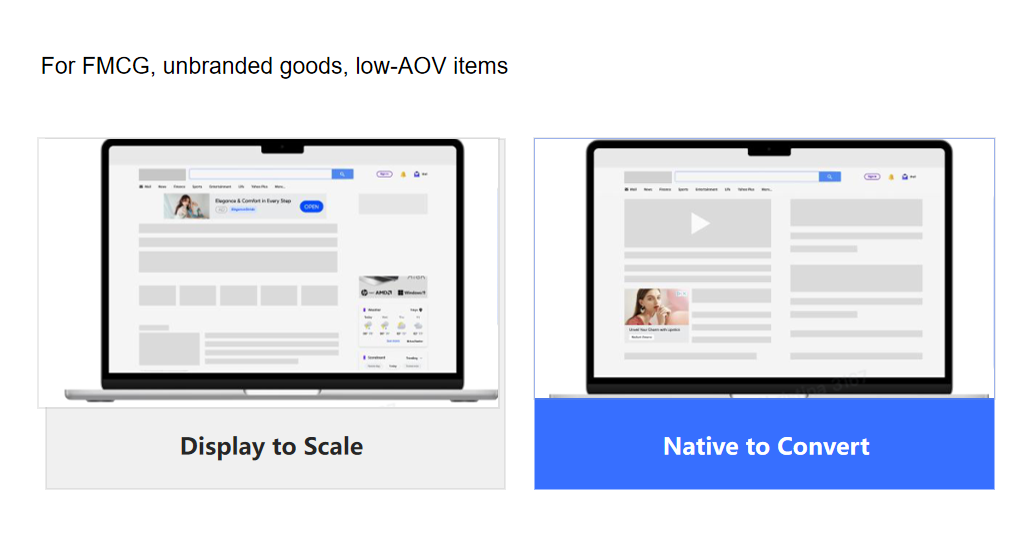
For categories like 3C accessories or daily necessities, where decisions are quick, the bottleneck is usually volume, not trust.
Phase 1: Scale with Display Ads
Use high-contrast visuals and direct offers to generate rapid exposure. Because Display inventory is huge and cost-efficient, you can accumulate click data rapidly, helping MediaGo’s deep learning model exit the “cold start” phase quickly.
Phase 2: Close with Native Ads
Once users recognize the product, retarget their content feeds with native ads focusing on usage scenarios, social proof, and reassurance to remove final friction and trigger the sale.
Path Two: Native to Educate, Display to Close
Best for premium brands, high-AOV products, niche boutiques
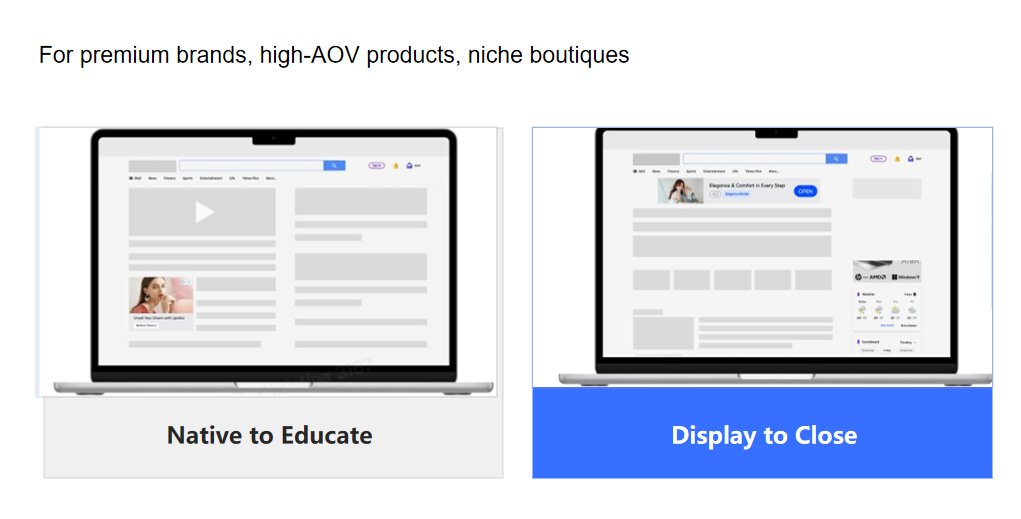
For beauty brands or high-tech appliances, immediately slamming users with a hard-sell banner rarely works.
Phase 1: Native for Telling a Story
Use native ads for telling stories, comparisons, reviews, and brand narratives to build trust. Don’t obsess over immediate ROI here; look at "Add to Cart" rates and "Time on Site." Success at this stage is measured by engagement.
Phase 2: Display for Remarketing
When a user is interested but hasn’t bought yet, display ads become the reminder. We use MediaGo’s algorithm to follow these users across the web with branded banners that reinforce the core selling point until the conversion happens.
3 . Execution: How to Run This Like a Pro
Understanding the framework is only half the battle. Execution determines outcomes. Based on MediaGo’s SmartBid 3.0 capabilities, here are two keys to success.
3.1 Maintain Visual Consistency
A common mistake is having one for display and another for native ads separately, resulting in a disconnected look.
Visual continuity triggers memory recall and builds brand accumulation. Consistent colors, messaging, and visual cues ensure that users instantly recognize the brand, even when encountering it across different placements and formats.
3.2 Use Bidding Models Strategically, Not Rigidly
Cold Start Phase: Use Max CV mode with display ads to accelerate audience discovery and shorten the learning period.
Scaling Phase: Switch to tCPA mode once conversion signals stabilize. MediaGo’s algorithm is excellent at controlling CPA, typically maintaining variance within 1.15x. With the broad audience pool built by display ads, your backend native ads will convert more efficiently, lifting your overall ROAS.
MediaGo’s strength isn’t just its access to premium global inventory. Its real advantage lies in how flexibly that traffic can be orchestrated. A Display + Native strategy isn’t about stacking two ad formats. It’s about aligning with human psychology and browsing behavior.
As an official MediaGo agency partner, Novabeyond helps global advertisers build scientific account structures to find new growth paths.
If you’re struggling with high costs and low scale on single-format campaigns, try this combination strategy. It may be time to stop “walking on one leg” and start growing with a more balanced, full-funnel approach.
more posts
Moloco Ads Optimization: Surviving the Learning Phase and Scaling iROAS (2026)
October. 08 2026
LEARN MORE

Kwai Ads vs. SnackVideo Ads: 2026 Allocation Matrix for LATAM & Southeast Asia
September. 28 2026
LEARN MORE
Why NewsBreak is the Essential US UA Growth Engine in 2026: Platform Guide & Performance Analysis
September. 24 2026
LEARN MORE
Navigating Media Accessibility in Media Growth: Bottlenecks & Solutions
September. 23 2026
LEARN MORE