





UNIT 616 6/F KAM TEEM INDUSTRIAL BUILDING 135 CONNAUGHT ROAD WEST SAI WAN HONGKONG.
Copyright © 2026 NOVABEYOND LIMITED (company number 2833487). All rights reserved.
CTV has existed for years, yet its role in performance marketing has remained limited. Historically, it was treated as a premium branding channel: high-impact, high-attention, but difficult to measure and disconnected from direct outcomes.
What has changed is not the screen, but the architecture around it.
Streaming has become the default viewing behavior. Smart TVs are always connected. Content consumption now naturally spans television, mobile, and in-app environments. Users discover brands on one screen and convert them to another. Growth paths are no longer linear, and they are no longer confined to a single device.
As performance marketing moves beyond last-click logic, growth is increasingly influenced by what happens before the conversion moment. CTV sits precisely at that point.

Why Performance Teams Have Hesitated on CTV
Despite its scale and engagement, most performance budgets have approached CTV cautiously. The reason is straightforward: traditional CTV buying methods were never designed for performance outcomes.
Common limitations include:
• Targeting based on households or devices rather than actionable user signals
• Exposure on TV with conversions occurring elsewhere, without a reliable connection
• Measurement frameworks relying on probabilistic attribution, inferred lift, or post-exposure trends
For growth teams accountable to CPI, ROAS, and LTV, a channel without a feedback loop isn't a growth channel, it's a black box.Without determinism, feedback loops, and optimization control, CTV could not function as a scalable performance channel.
The opportunity was always there. The execution model was not.
Repositioning CTV Within the Performance Stack
When CTV is implemented through a performance lens, its function becomes clear. It is not a conversion channel. It is a conversion accelerator.
CTV influences how users respond to subsequent acquisition efforts. It improves recognition, intent, and readiness before the moment of action. In practice, this leads to stronger performance across downstream channels rather than isolated TV metrics.
For growth teams, this reframes the question from “Does CTV convert?” to “Does CTV improve how efficiently we acquire users?”
Novabeyond's Solutions Making CTV Measurable Inside Performance Systems
At Novabeyond, CTV is not treated as a standalone branding channel or a parallel media experiment.
It is activated as part of the performance stack, working alongside DSP-driven acquisition and measured through the same attribution logic performance teams already use.
Our approach is designed for teams who want to unlock CTV’s scale without stepping outside performance discipline.
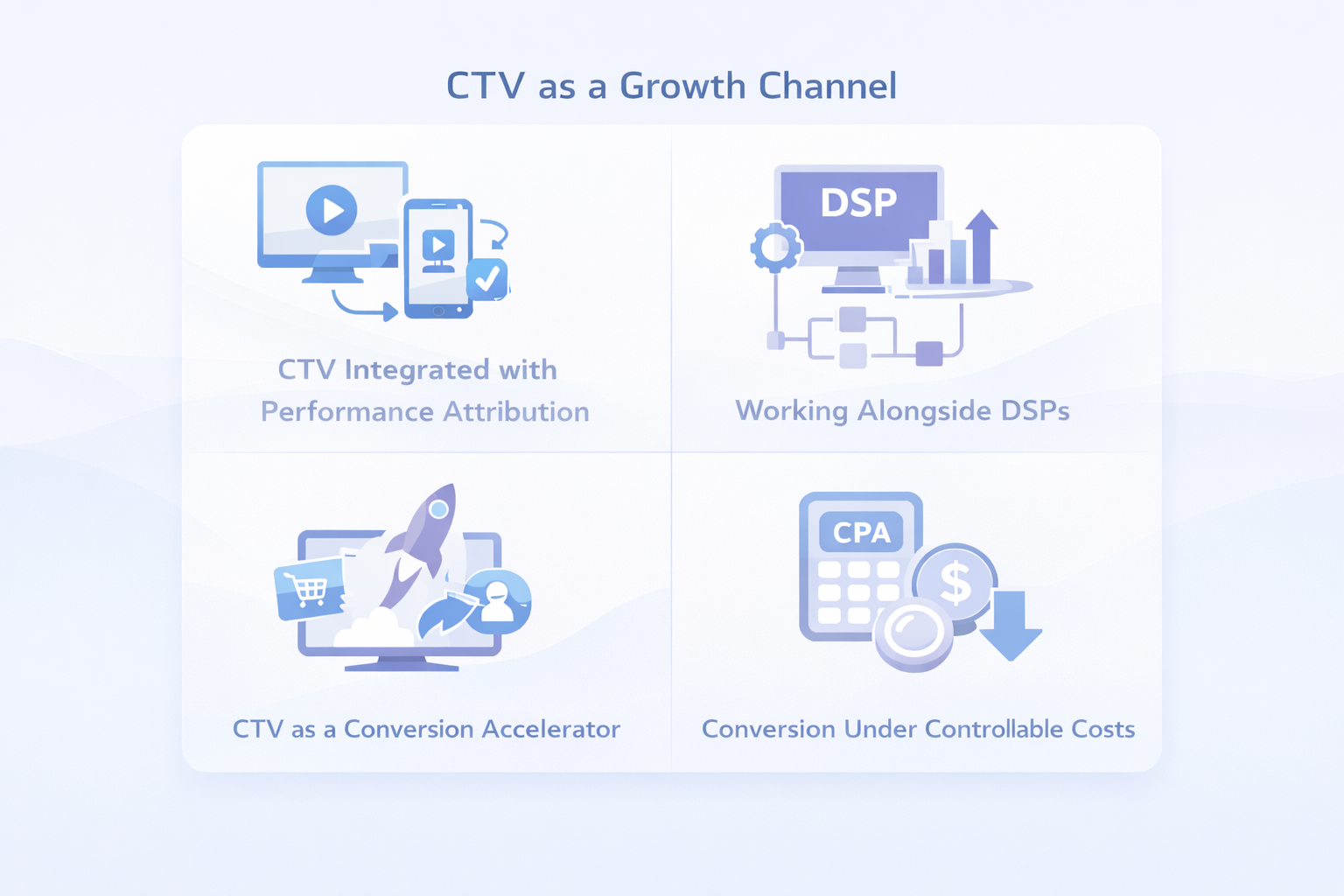
1. CTV Integrated with Performance Attribution
A core barrier to performance-led CTV has always been attribution.
CTV impressions are connected to downstream user actions: installs, registrations, and conversions, using the same attribution standards applied to app-based user acquisition.
This allows CTV performance to be evaluated using consistent metrics, comparable benchmarks, and familiar reporting logic.
2. Working Alongside DSPs, Not Replacing Them
• Budgets are planned with clear performance constraints, not branding assumptions
• Exposure is evaluated by its incremental impact on downstream acquisition efficiency
• Scaling decisions follow performance validation, not reach-based expectations
CTV becomes part of the same optimization conversation, not a separate line item.
3. CTV as a Conversion Accelerator
CTV’s role is not to capture the final click.
Its value lies in how it improves the efficiency of acquisition that follows.
By influencing awareness, intent, and readiness earlier in the journey, CTV strengthens the performance of mobile and web campaigns downstream.
This contribution is reflected in improved conversion efficiency, stronger user quality, and more stable performance at scale as observed through attribution and performance KPIs.
4. Conversion under controllable costs
CTV activation under defined performance constraints, including CPA-based optimization goals.
CTV spend is guided by clear efficiency thresholds, allowing performance teams to scale impact while maintaining cost discipline, rather than committing to open-ended brand budgets.
CTV's Real Value in Modern Growth
CTV does not replace mobile or search. It strengthens them.
When deployed correctly, CTV expands high-quality reach, improves downstream conversion efficiency, and stabilizes growth performance at scale. It transforms growth from a series of isolated optimizations into a coordinated system.
In an era where performance marketing can no longer rely on a narrow set of channels, this system-level advantage matters more than ever.
more posts
OEM & CTV Advertising: A Cross-Screen Strategy for Brand Growth
October. 29 2026
LEARN MORE


How OEM Advertising Unlocks App Scale in Emerging Markets
October. 09 2026
LEARN MORE
How to Measure CTV ROI in 2026: From Multi-Touch Attribution to Geo-Lift & iROAS
September. 30 2026
LEARN MORE
Why Most Brands Miss the Full Potential of OEM Advertising — How to Drive Smarter App Growth
August. 24 2026
LEARN MORE