





UNIT 616 6/F KAM TEEM INDUSTRIAL BUILDING 135 CONNAUGHT ROAD WEST SAI WAN HONGKONG.
Copyright © 2026 NOVABEYOND LIMITED (company number 2833487). All rights reserved.
Introduction
Why Traffic Arbitrage Still Matters in 2026?
Traffic arbitrage has always been about one core principle: acquiring traffic at a lower cost and monetizing it at a higher value. While the concept hasn't changed, the environment has.
By 2026, traffic arbitrage is no longer a “quick win” tactic. Rising media costs, stricter platform policies, smarter algorithms, and more demanding users are reshaping the game. Arbitrage is evolving into a data-driven, AI-powered, compliance-first performance model.
This article breaks down the key traffic arbitrage trends for 2026, the most effective tools to stay competitive and actionable strategies to build sustainable arbitrage systems.
Discuss a traffic acquisition and measurement plan with Novabeyond
Quick Answer
Traffic arbitrage in 2026 means acquiring relevant visits and creating enough confirmed monetization and downstream value to exceed media and variable operating costs. Short video, AI-assisted testing, diversified supply, compliant messaging and LTV measurement all matter. Start with one appropriate offer and traffic source, connect cost to qualified visits and confirmed revenue, and set quality and margin thresholds before increasing spend. Tools help with attribution, creative production and landing-page experiments; none substitutes for sound economics or human review. The five trends and four original tool categories below remain the starting point; the added operating guidance shows how to put them to work.
Key Traffic Arbitrage Trends in 2026
1. Video-First Arbitrage Is No Longer Optional
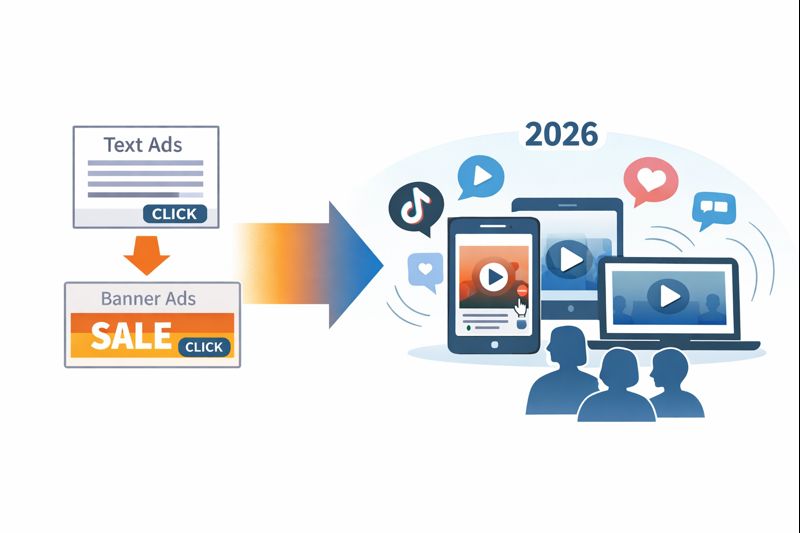
Text-based clickbait and static creatives are rapidly losing effectiveness. In 2026, short-form video dominates traffic acquisition, especially across social and native channels.
Why video wins:
• Higher CTR and engagement
• Better storytelling for pre-qualification
• Native alignment with platform algorithms
For arbitrageurs, landing pages, advertorials, and even pre-landers are shifting toward short explainer videos, UGC-style creatives and dynamic visual storytelling. If your funnel doesn't include video, you're already paying a premium for lower-quality traffic.
2. AI Becomes the Core Engine of Arbitrage

AI is no longer a productivity boost, it has become the foundation of modern arbitrage operations. In 2026, it is deeply embedded across key functions, from creative generation and iteration to automated bid and budget optimization, real-time traffic quality scoring, and predictive performance modeling.
As a result, competitive advantage now depends on how effectively AI is integrated into decision-making. The strongest teams combine automation with human judgment and use AI to scale testing and learning without proportionally increasing costs.
3. Platform Costs Rise, Alternative Traffic Gains Value
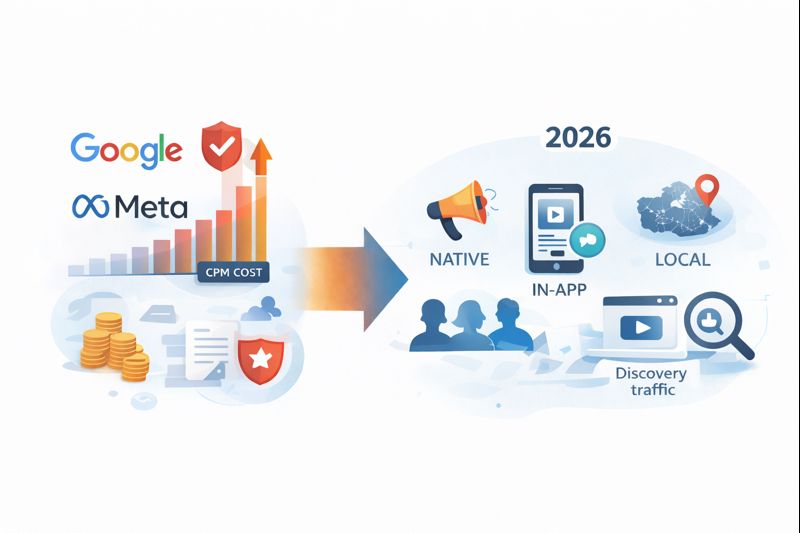
Major platforms like Google and Meta continue to raise the barrier, with higher CPMs, stricter review processes, and faster account enforcement becoming the norm.
As a result, arbitrage is steadily expanding into alternative and emerging channels, including native and discovery traffic, in-app placements, community-driven and contextual environments, as well as region-specific platforms with lower competition. In this landscape, diversification is no longer optional, it is a matter of survival.
4. Compliance & Traffic Quality Become Profit Multipliers
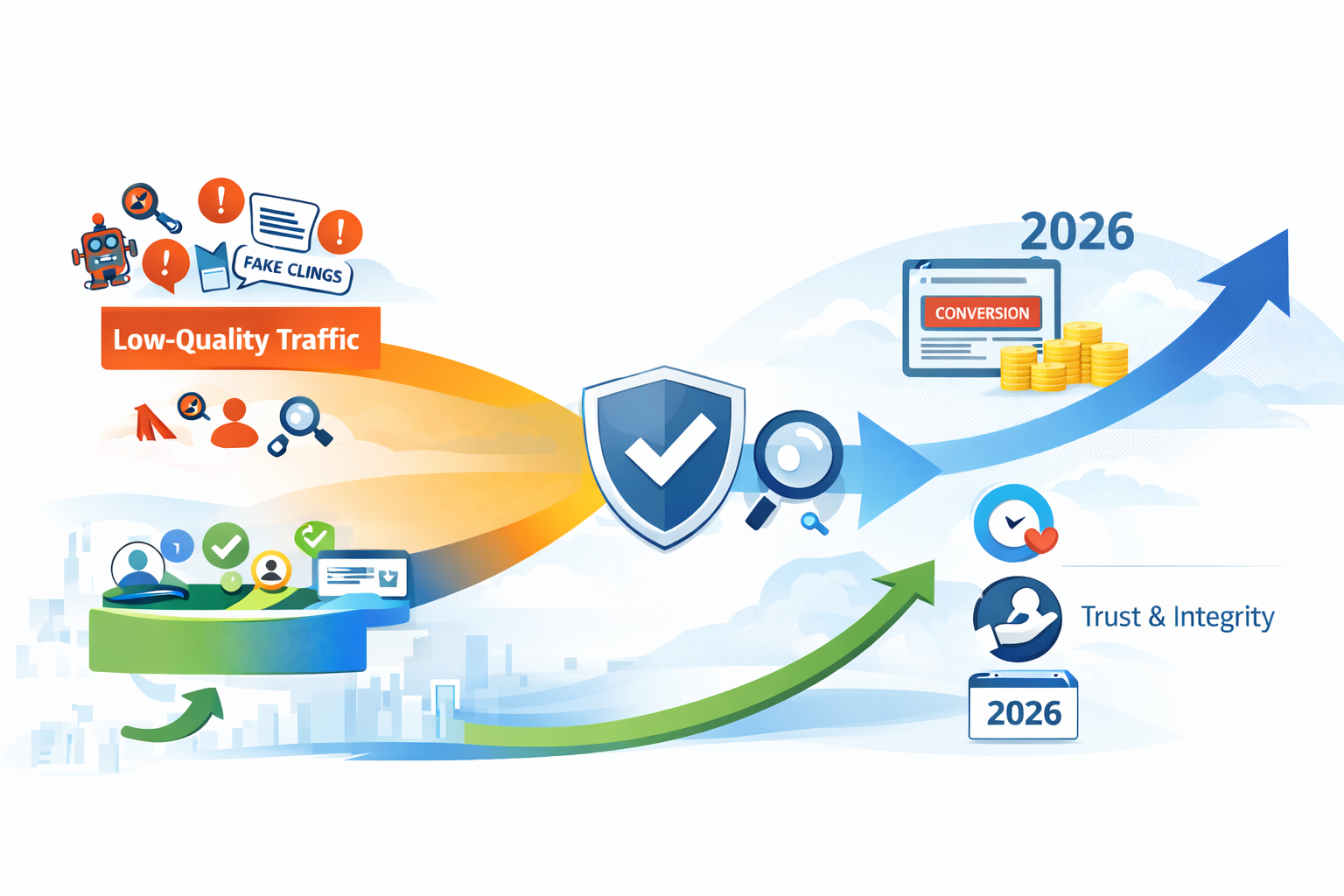
Low-quality or misleading traffic is being filtered faster than ever as algorithms increasingly evaluate post-click user behavior, engagement depth, bounce and dwell patterns, and conversion integrity. In 2026, clean traffic not only converts better but also lasts longer.
As a result, arbitrage models that prioritize transparent messaging, accurate user intent matching, and effective quality filtering consistently outperform short-term, aggressive tactics.
5. Arbitrage Shifts from CPA Thinking to LTV Thinking
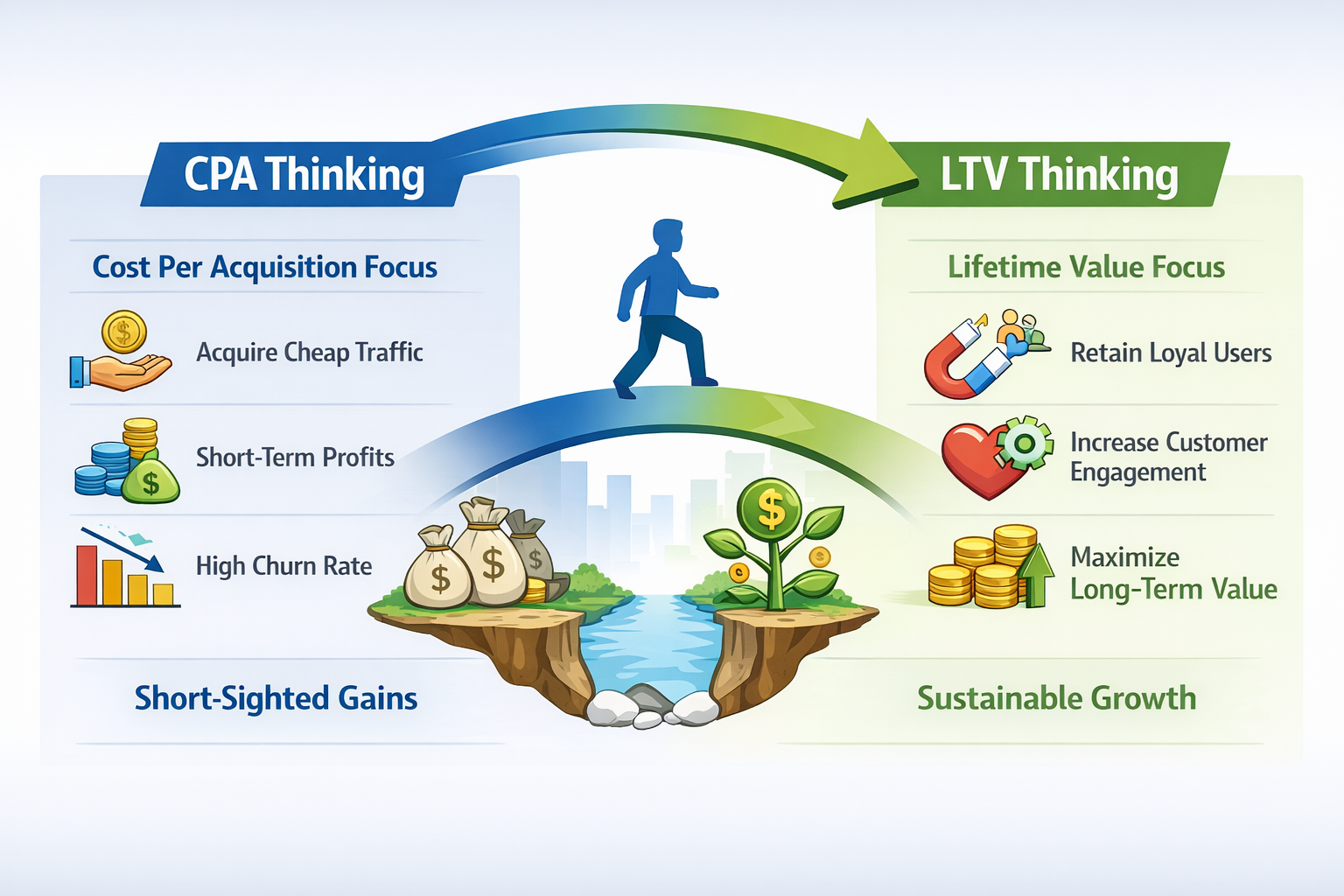
Pure “click-to-conversion” arbitrage is increasingly being replaced by value-based monetization. Successful operators now focus on retention funnels, email and push re-engagement, multi-step monetization paths, and long-term user value. The key question is no longer whether a click is converted, but what that user is worth over time.
Measure contribution margin, not just clicks
Contribution margin = confirmed monetization revenue + measurable downstream value − media cost − variable operating cost. Include tracking, landing infrastructure, creative production and revenue-share costs; account for refunds, rejected events and payout delays when reviewing a campaign. Compare margin per qualified visitor by source, placement, device and creative. A lower CPA is not a win if leads are rejected or customers do not retain; a higher CPA can still make sense when verified LTV justifies it. Decide how long conversions need to mature before making a scale decision.
[Image Idea: Unit-economics flow from media cost to qualified visits, confirmed revenue, downstream value and contribution margin | Alt Text: Traffic arbitrage contribution margin and LTV calculation in 2026]
Match intent, format and supply
Search can fit explicit demand but needs strong query-to-page relevance. Social and short video suit demonstrable offers but need frequent creative tests. Native and discovery placements support contextual, content-led journeys, while programmatic display and video require placement and traffic-quality controls. In-app and OEM environments can extend mobile reach, and direct publisher inventory can offer clearer placement context; owned audiences support retention rather than instant acquisition volume. No source is universally best: choose against offer eligibility, audience intent, geography, creative capacity, measurement and cash-flow tolerance, then test one baseline before adding channels.
[Image Idea: Decision matrix matching search, social video, native, programmatic, OEM and direct supply to audience intent and measurement needs | Alt Text: Comparing traffic sources for traffic arbitrage by intent, format and quality controls]
Essential Traffic Arbitrage Tools for 2026
1. Tracking & Attribution Tools
| Tool | Best For |
| Clickflare | Search arbitrage & affiliate tracking with rule-based routing and automation |
| Keitaro | Flexible self-hosted tracking for web & affiliate campaigns |
| Binom | High-performance click tracking for large-scale traffic testing |
| AdsBridge | Integrated tracking with landing pages and traffic distribution |
| BeMob | Cost-effective multi-channel tracking for small to mid-size teams |
2. Account Safety & Environment Management
| Tool | Use Case |
| AdsPower | Multi-account browser management for media buying teams |
| Dolphin Anty | Fingerprint isolation for large-scale ad account operations |
| GoLogin | Secure team collaboration with isolated browser profiles |
| Multilogin | Enterprise-grade browser fingerprint management |
| Kameleo | Advanced fingerprint customization for complex environments |
3. Creative & Content Generation Tools
| Tool | Purpose |
| ChatGPT / Claude | Ad copy ideation, headlines, and advertorial drafts |
| Canva / Figma | Static creative design and layout collaboration |
| CapCut | Short-form video editing for social and native ads |
| Pictory / InVideo | Template-based video ads for rapid testing |
| HeyGen / Synthesia | AI avatar videos for explainer-style creatives |
4. Landing Page & CRO
| Tool | Purpose |
| Unbounce | Rapid landing page deployment with built-in A/B testing |
| Instapage | Conversion-focused landing pages with ad integrations |
| ClickFunnels | Multi-step funnels for complex affiliate flows |
| PureLander | Lightweight landing page builder for quick setup |
| Landingi | Template-driven landing pages for beginners |
From first test to controlled scale
Define the monetization event, confirmation window and reversible revenue; select an eligible offer and audience.
Test one source first. Align the creative, pre-lander, landing page and final offer, including claims and user expectations.
Connect campaign, placement, creative, device, cost and revenue identifiers. Set a test budget, stop-loss, minimum decision sample, quality checks and target contribution margin.
Review qualified visits, conversion integrity and confirmed revenue by segment. Change one major variable at a time and expand spend only when margin and quality remain consistent.
Choose tools for event accuracy, access controls, data ownership, deployment and total cost, not a product ranking alone. Use business browsers for authorized team access and workspace governance in accordance with platform rules, not to bypass enforcement. AI can prioritize hypotheses and draft variants, but a reviewer should verify claims, sources, brand suitability and landing-page consistency before launch. Check anomalous or invalid activity, engagement, lead acceptance and payout status before raising budgets.
Channel coordination for growing teams
Novabeyond connects acquisition and measurement across Emerging Media Solutions, OEM & CTV Growth Channels, Programmatic Growth Strategies, and Direct Inventory Partnerships. Evaluate incremental audiences and supply-path clarity against the same margin, quality and reporting standards rather than adding channels for their own sake.
Review channel fit, quality checks and scaling thresholds with Novabeyond
FAQ
1. What is traffic arbitrage?
It is acquiring or sourcing traffic, guiding visitors through a relevant journey and monetizing them at a value above the full acquisition and variable delivery cost.
2. Is traffic arbitrage still profitable in 2026?
It can be when confirmed revenue and measurable LTV exceed media and operating costs. Cheap clicks alone do not establish profit, especially if events are rejected or payouts are delayed.
3. Which traffic source should a beginner test first?
Choose one eligible offer and one source that matches audience intent and available creative. Implement attribution and a limited test budget before expanding to a second channel.
4. How should I calculate traffic arbitrage profitability?
Subtract media and variable operating costs from confirmed monetization revenue plus measurable downstream value. Review the result by placement, device, geography and time period.
5. Which AI tools help, and what still needs human review?
AI can assist with creative variants, anomaly summaries and test prioritization. People should check factual claims, policy fit, offer accuracy and whether model suggestions match the actual data.
6. How do I assess traffic quality before scaling?
Compare engagement, event integrity, accepted leads or orders, refunds and confirmed payouts by source. Set a minimum quality threshold alongside contribution margin.
7. How is search arbitrage different from traffic arbitrage generally?
Search arbitrage monetizes downstream search or feed intent and is one subset of the broader traffic-arbitrage model; query relevance and feed requirements need particular attention.
Conclusion
By 2026, traffic arbitrage is no longer about exploiting gaps; it is about engineering performance. The winners will be those who embrace AI and automation, invest in traffic quality, think beyond single conversions, and build compliant, scalable systems. Traffic arbitrage isn't disappearing, it's growing up.
more posts
2027 Mobile Marketing Trends: 4-Pillar Strategy for Global App Growth
October. 22 2026
LEARN MORE


Diversified Acquisition Strategies for Global Advertisers: A Framework for Evaluating New Channels
September. 11 2026
LEARN MORE
The Hidden Cost of Platform Dependency: What One Policy Change Can Destroy
August. 27 2026
LEARN MORE
How Incremental Growth Is Changing Performance Marketing
August. 25 2026
LEARN MORE