




Copyright © 2026 NOVABEYOND LIMITED (company number 2833487). All rights reserved.
Address: UNIT 616 6/F KAM TEEM INDUSTRIAL BUILDING 135 CONNAUGHT ROAD WEST SAI WAN HONGKONG.
On programmatic platforms like BIGO Ads, ad formats are far more than creative containers. They directly determine where ads appear, how users perceive them, and how efficiently campaigns scale. In many cases, unstable performance is not caused by creative quality or bidding strategy, but by a misalignment between ad format and the advertiser’s growth stage.
From a growth-funnel perspective, each ad format plays a fundamentally different role:
• Some formats are best suited for cold start, helping the algorithm learn and validate early market signals
• Others excel at filtering high-intent users, improving retention and monetization quality
• Some are designed for scalable reach and cost efficiency
Only by understanding these differences can advertisers avoid “format misplacement” and build sustainable, long-term growth strategies.
This article systematically breaks down the core BIGO Ads formats using a unified analytical framework, focusing on primary objectives, audience relevance , cost and ROI characteristics, suitable advertiser types and creative best practices (and common pitfalls).
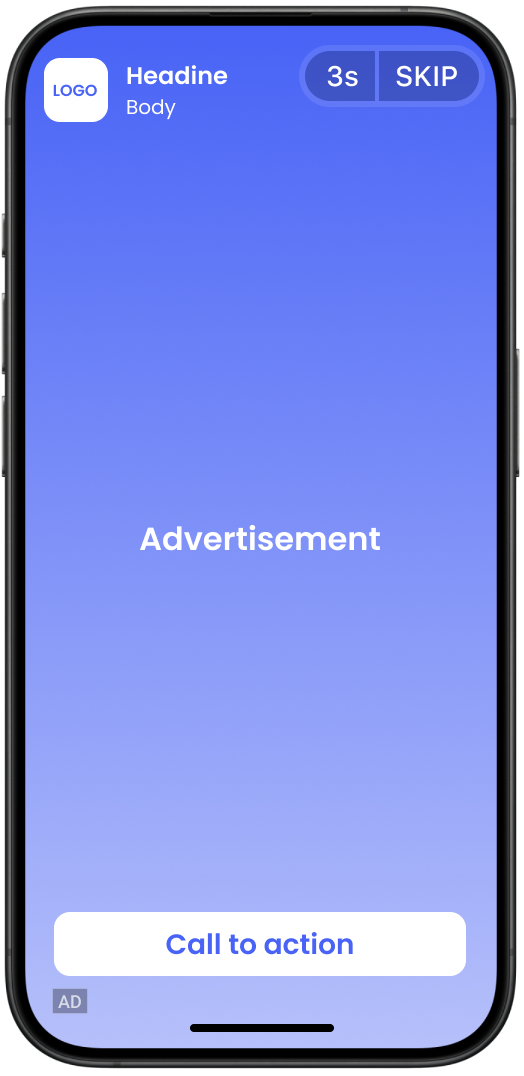
1. App Open Ads
Objectives & Growth Stage
• Primary goal: Rapid brand awareness and maximum exposure
• Best stage: New product launches, major campaign warm-ups, early market entry
• Use with caution: When budgets are tight or direct conversions (payments, leads) are the main KPI
Audience Relevance
Users encounter Splash Ads the moment they open the app, before their attention is fully engaged. They are in a passive reception state. Ads that match the app’s context (e.g., dating ads in social apps) feel natural, while mismatched products may trigger resistance.
Cost & ROI Profile
• Stable and predictable CPM, especially on high-DAU apps
• Generally low CVR, but strong uplift in brand search and organic traffic
• ROI is mid- to long-term, enhancing performance across other channels
Best-Fit Advertisers
• Global brands entering new or emerging markets
• Games or social apps aiming for early chart momentum
• E-commerce brands warming up major sales events
Creative Tips & Pitfalls
Best Practices
• Brand visible within the first 3 seconds (dynamic logo + sound cue)
• Ultra-simple messaging: 1 key benefit + 1 clear CTA
• Add countdown indicators (“Skip in 5s”) to reduce user anxiety
Avoid
• Long copy
• Heavy or lagging animations
• Tiny or unclear CTA buttons
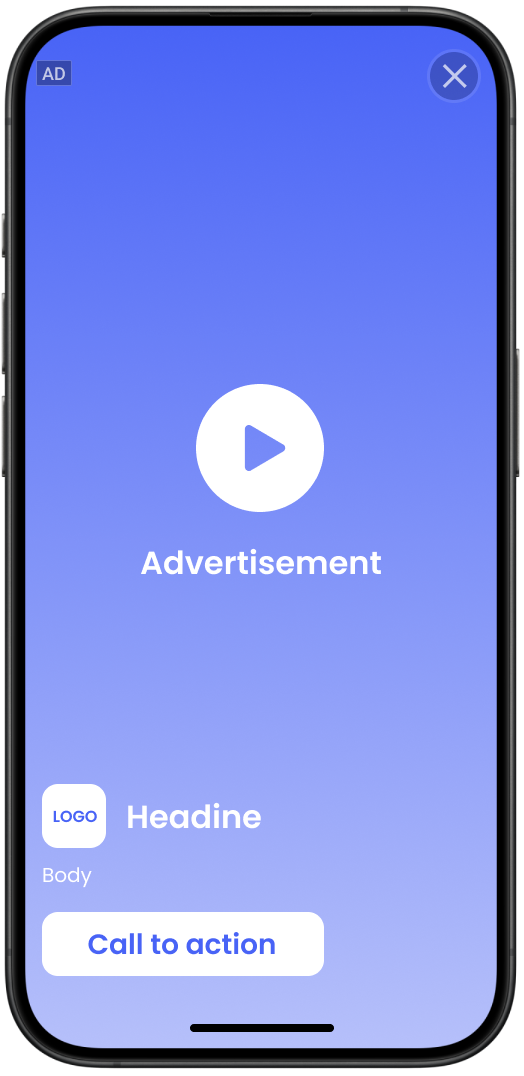
2. Full-Screen Video Ads
Objectives & Growth Stage
• Primary goal: App installs, website conversions, user re-engagement
• Best stage: From model validation to scalable growth
• High-potential categories: Emotion-driven (social, dating, mental health), visually driven (beauty, fashion, 3C)
Audience Relevance & Psychology
Users are already consuming content and are in an active browsing mindset. Full-screen autoplay with sound creates immersion. If the first 3 seconds resonate emotionally, users are likely to continue watching.
Cost & ROI Profile
• Stable CPC / CPA, short learning phase (typically 3–5 days)
• Moderate production costs with strong conversion efficiency
• Particularly competitive CPA in SEA, MENA, and LATAM
Best-Fit Advertisers
• Games (story-driven, simulation)
• Social and dating apps
• DTC e-commerce brands
• Education and health services requiring trust-building
Creative Tips & Pitfalls
Best Practices
• Vertical format (9:16)
• 0–3s: pain point or question hook
• 4–10s: product usage demonstration (visual > narration)
• Strong CTA with urgency (“Free for the first 1,000 users”)
Avoid
Black screens or loading intros
Long voiceovers
Small or low-contrast CTA text
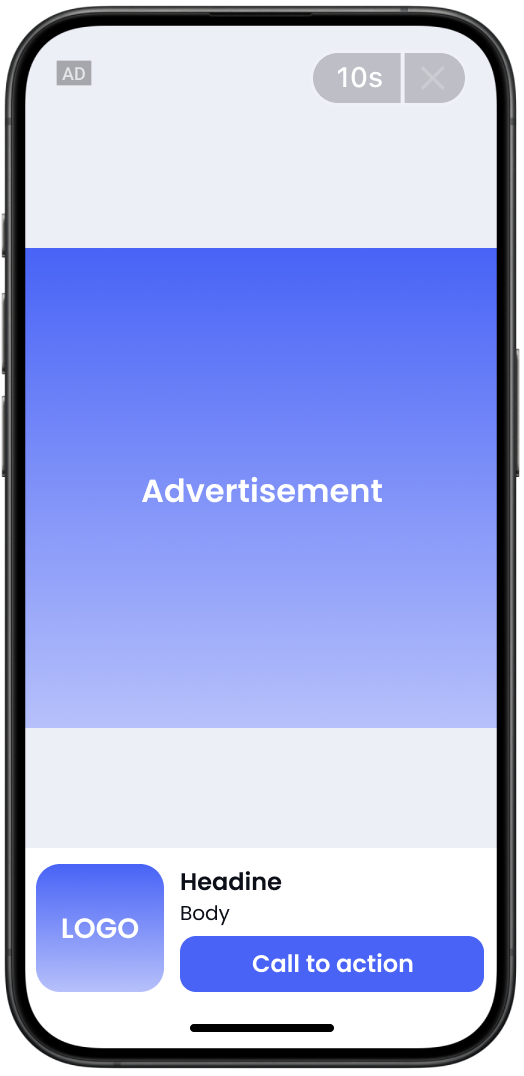
3. Interstitial Ads
Objectives & Growth Stage
• Primary goal: Efficient conversions (installs, sign-ups, purchases)
• Best stage: Scaling phase and remarketing
• Prime moments: Level completion, page transitions, task completion
Audience Relevance & Psychology
Users are in a short cognitive gap after completing an action, with attention still inside the app. Contextually relevant ads perform exceptionally well in this moment.
Cost & ROI Profile
• Mid-range CPM, strong CPC/CPA efficiency
• Stable scalability, suitable for long-term budget allocation
Best-Fit Advertisers
• Casual and light games
• Utility apps (cleaners, translators, PDF tools)
• E-commerce (single-product or limited-time offers)
• Finance and education with low-entry products
Creative Tips & Pitfalls
Best Practices
• Key benefit visible within 2 seconds (bold text + icon)
• Animated CTA buttons (pulse or micro-motion)
• Optional soft exits (“Remind me later”)
Avoid
• Triggering too fast (<1s)
• Blocking navigation
• Missing or hidden close buttons
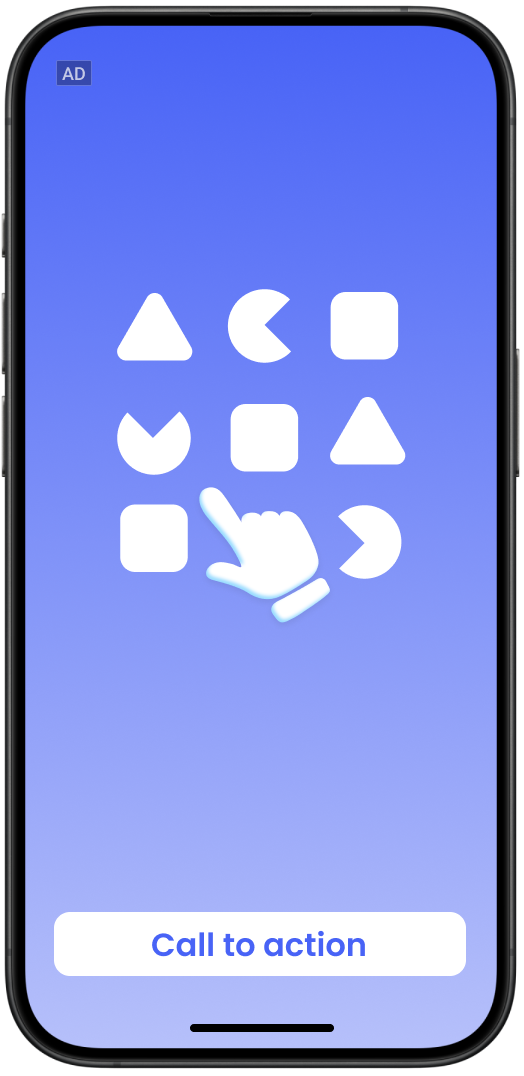
4. Playable Ads
Objectives & Growth Stage
• Primary goal: Filter high-intent users and improve LTV
• Best stage: Post-PMF validation, pre-scale optimization
• Core value: Reduce low-quality installs
Audience Relevance & Psychology
Users actively choose to interact, signaling strong intent. A 15–30 second micro-experience validates real interest before installation.
Cost & ROI Profile
• CPI typically 20–40% higher than standard ads
• Significantly better LTV/CAC for experience-driven products
• ROI driven by user quality, not volume
Best-Fit Advertisers
• Mid-core and hybrid games
• Highly interactive tools (AI, fitness, creative apps)
• Innovative products that require hands-on experience
Creative Tips & Pitfalls
Best Practices
• Instant interaction (no intro screens)
• Strong audiovisual feedback
• Clear exit CTA (“Install to continue Level 4”)
Avoid
• Overloading multiple mechanics
• Long loading times
• Unclear objectives
5. Native Ads
Objectives & Growth Stage
• Primary goal: Stable acquisition and long-term model optimization
• Best stage: Validation through maturity
• Unique value: High-quality engagement signals for algorithm learning
Audience Relevance & Psychology
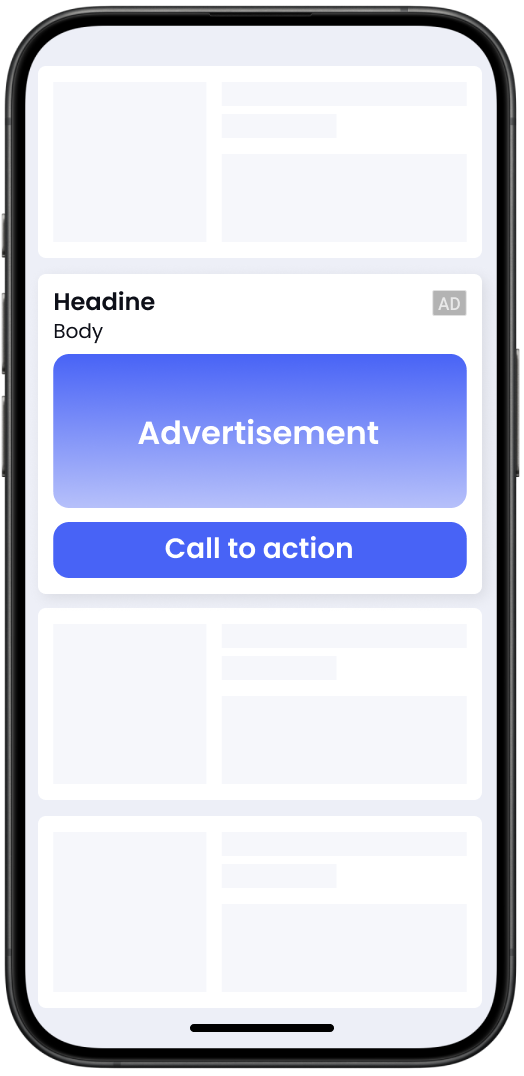
Native ads blend seamlessly into content feeds, mimicking UGC formats. When headlines and visuals match user interests, ad resistance is minimal.
Cost & ROI Profile
• Stable CPC / CPA, low volatility
• Short learning phase
• Supports gradual CPA improvement through sustained optimization
Best-Fit Advertisers
• Utility apps
• Social and community platforms
• Content-driven products (short dramas, novels, knowledge apps)
Creative Tips & Pitfalls
Best Practices
• Headline sounds like real user feedback
• Authentic visuals (screenshots, annotations)
Avoid
• Oversized logos
• Sensational or clickbait language
6. Banner Ads

Objectives & Growth Stage
• Primary goal: Low-cost incremental volume and brand support
• Best stage: Mature campaigns, retargeting tail traffic
• Use with caution: As a primary conversion driver
Audience Relevance & Psychology
Users tend to ignore banners unless the message is extremely clear and concise.
Cost & ROI Profile
• Lowest CPM among all formats
• Low CTR but strong absolute volume at scale
• ROI driven by reach efficiency
Best-Fit Advertisers
• Utility apps
• E-commerce clearance or replenishment
• Brands supporting upper-funnel exposure
Creative Tips & Pitfalls
Best Practices
• Single core message
• High-contrast colors with subtle animation
• Multi-size adaptability
Avoid
• Multiple CTAs
• Dense copy
• Low-resolution assets
7. Rewarded Video Ads
Objectives & Growth Stage
• Primary goal: High-quality conversions (installs, sign-ups, payments)
• Best stage: Growth to maturity
• Ideal scenarios: In-game rewards, feature unlocks
Audience Relevance
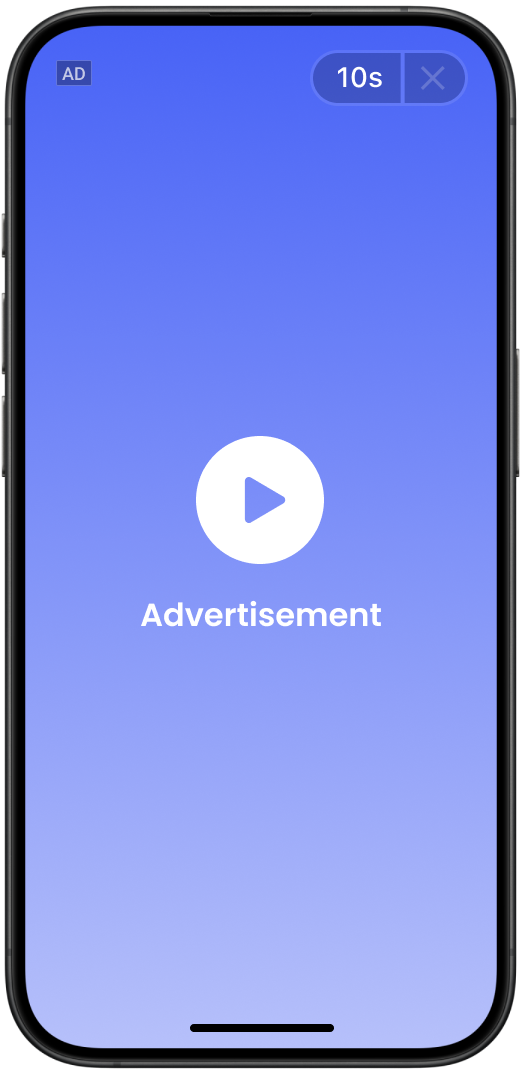
Users opt in voluntarily in exchange for rewards, leading to high completion rates and positive brand sentiment.
Cost & ROI Profile
• Slightly higher CPI than standard video
• Lower uninstall rates
• Strong LTV and CPA performance
Best-Fit Advertisers
• Games
• Utility tools (VIP trials, ad removal)
• Education and health services
• Finance tools (credit checks, simulations)
Creative Tips & Pitfalls
Best Practices
• Reward clearly stated upfront
• Value-driven storytelling
• Bonus incentive at install
Avoid
• Vague rewards
• Disconnect between ad content and incentive
8. Pop-up Ads

Objectives & Growth Stage
• Primary goal: Immediate conversion push
• Best stage: Exit intent or critical decision points
• Key principle: Use sparingly
Audience Relevance
Users are at a decision threshold. Strong, relevant incentives can dramatically boost conversion; poor timing causes frustration.
Cost & ROI Profile
• Higher CPM due to scarcity
• CVR often 2–3× higher than standard formats
• Recommended budget share: <10%
Best-Fit Advertisers
• E-commerce (cart abandonment)
• Finance (application recovery)
• SaaS (trial-to-paid prompts)
• Games (post-failure item offers)
Creative Tips & Pitfalls
Best Practices
• Precise trigger timing
• Real, limited-time value
• Clearly visible close button
Avoid
• Forced exposure
• Blocking core UI
• Fake countdowns
Conclusion: From “Choosing Formats” to “Designing Growth”
Effective growth on BIGO Ads is the result of:
Right objective × Right user × Right format × Iterative creatives
Instead of asking “Which format is cheapest?”, advertisers should ask:
• Which stage of the growth funnel am I in? (Exploration / Validation / Scaling)
• What mindset is my user in at this moment? (Browsing / Socializing / Deciding / Relaxing)
• Which format embeds my product value with the least friction?
In today’s precision-driven performance era, understanding ad formats is understanding users, and mastering formats is mastering growth. BIGO Ads is not just a media platform; it is a global growth operating system. Advertisers are its chief architects.
more posts
Moloco Ads Optimization: Surviving the Learning Phase and Scaling iROAS (2026)
October. 08 2026
LEARN MORE

Kwai Ads vs. SnackVideo Ads: 2026 Allocation Matrix for LATAM & Southeast Asia
September. 28 2026
LEARN MORE
Why NewsBreak is the Essential US UA Growth Engine in 2026: Platform Guide & Performance Analysis
September. 24 2026
LEARN MORE
Navigating Media Accessibility in Media Growth: Bottlenecks & Solutions
September. 23 2026
LEARN MORE