




UNIT 616 6/F KAM TEEM INDUSTRIAL BUILDING 135 CONNAUGHT ROAD WEST SAI WAN HONGKONG.
Copyright © 2026 NOVABEYOND LIMITED (company number 2833487). All rights reserved.
Introduction
A campaign can be ready to launch and still fail to get off the ground. Your offer is prepared, creatives are approved internally, and the landing page is built for conversions. Yet access permissions, billing arrangements, account configuration, or content review can delay the first impression and leave your acquisition budget idle.
These operational issues matter because launching a native advertising campaign involves more than uploading creatives and setting bids. Advertisers need a clear account structure, reliable conversion tracking, transparent funding arrangements, and landing pages that meet platform requirements.
Taboola's advertiser platform is Realize. Depending on the arrangement, agencies may help advertisers coordinate access, organize advertiser accounts, manage operational workflows, and prepare campaigns for review. Some agency setups use a Network structure with multiple advertiser sub-accounts. The appropriate configuration depends on the advertiser's requirements and the options available through Taboola. An agency ad account still operates under Taboola's review and policy rules.
This guide explains how a Taboola agency ad account works, what to confirm before funding, how to prepare for review, and which operational checks matter before increasing spend. If you are still evaluating native advertising as a growth channel, start with Novabeyond's overview of Taboola and native traffic.
Review your Taboola account setup with Novabeyond
Quick Answer
A Taboola agency ad account is an agency-supported advertising arrangement for managing Realize access, user permissions, funding workflows, and campaign operations. Depending on the setup, an agency may help organize advertiser accounts within a Network and coordinate onboarding with Taboola. Before launch, confirm the account structure, currency, billing terms, user rights, and conversion tracking. Agency support can improve operational readiness. Advertisers still need compliant destinations, relevant creatives, and reliable measurement before scaling campaigns.
Taboola Agency Ad Account Setup and Access
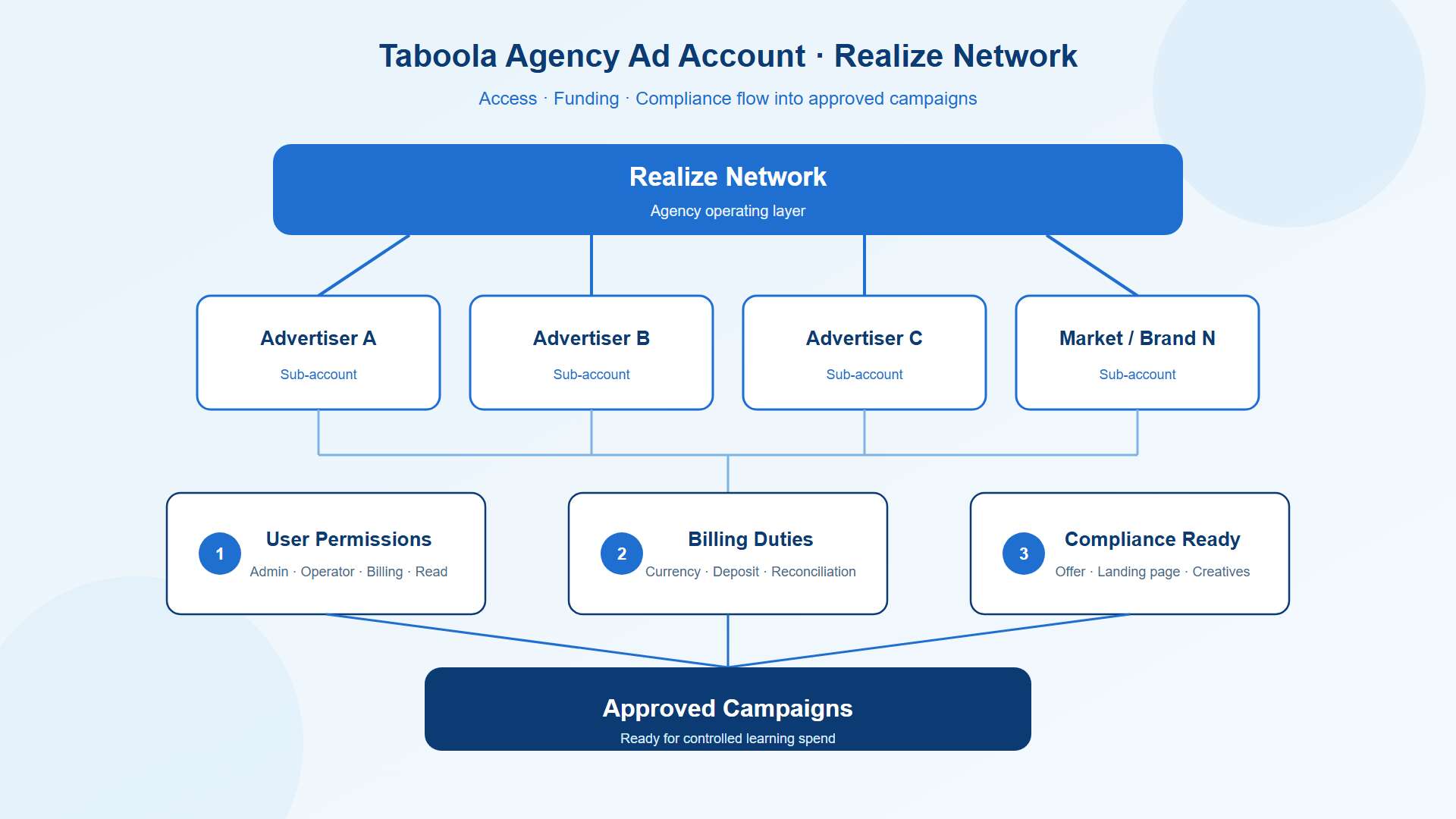
A Taboola agency ad account is best understood as an operating arrangement rather than a separate inventory tier. Advertisers still access Taboola's publisher inventory. The agency relationship changes how teams coordinate onboarding, permissions, funding, and campaign management.
Direct Advertiser Access vs. Agency-Assisted Access
A direct Realize advertiser account may be sufficient when a business has a suitable legal entity, a clear billing arrangement, and a team that can manage the platform independently.
Agency-assisted access may be useful when:
Multiple brands or markets need a structured account setup.
Finance teams require a clear process for payments, invoices, or prepayment.
Campaign operators need support preparing offers and landing pages for review.
Internal teams lack experience with account administration or native campaign operations.
Several stakeholders need defined responsibilities for access, tracking, and reporting.
The right approach depends on the advertiser's needs and the arrangements available through Taboola. An agency should explain what it manages, what the advertiser controls, and which decisions require platform support.
How Realize Networks and Advertiser Sub-Accounts Work
Taboola's Account Administration documentation provides guidance on account administration, including agency Network structures.
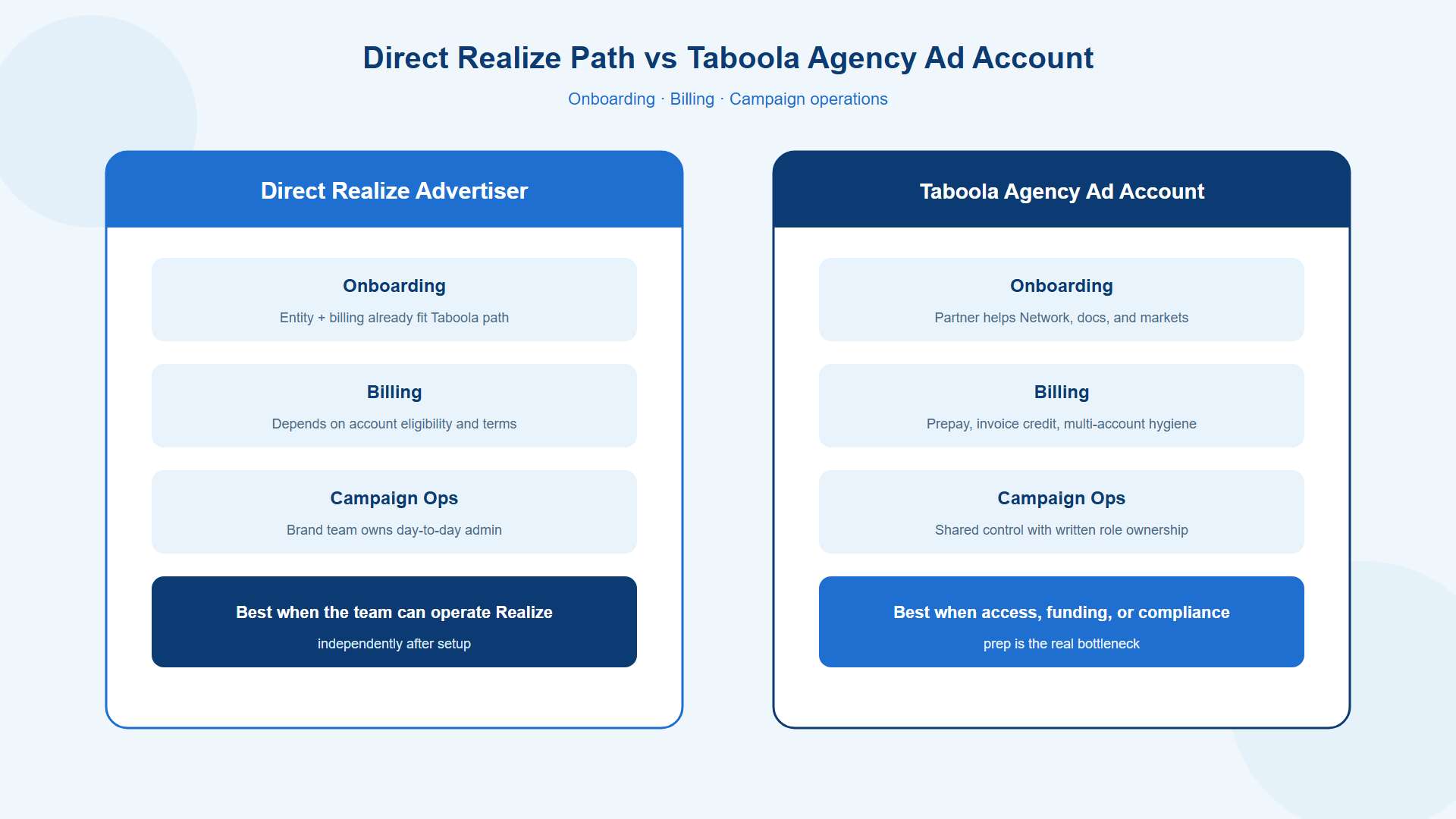
Before requesting access, confirm whether your arrangement involves a standalone advertiser account or a Network with advertiser sub-accounts. These structures serve different operational needs. A Network may help agencies coordinate multiple advertisers, while campaigns generally operate within the relevant advertiser account.
Consider a business that runs campaigns in two markets. Separate advertiser accounts may help organize budgets, reporting, and campaign responsibilities. Whether those accounts should sit under one Network depends on the actual account arrangement, billing requirements, and access rules.
Before setup, document:
The advertiser or legal entity associated with each account.
The markets and brands each account will support.
The currency required for each account.
The people responsible for administration, billing, and optimization.
The tracking and reporting requirements for each advertiser.
This planning reduces avoidable reconfiguration and helps prevent teams from mixing unrelated budgets, conversion events, or account responsibilities.
User Permissions and Access Control
Account access should follow clear responsibilities rather than convenience. Giving every team member broad administrative rights can increase the risk of billing changes, incorrect configurations, and accidental edits to campaigns or tracking.
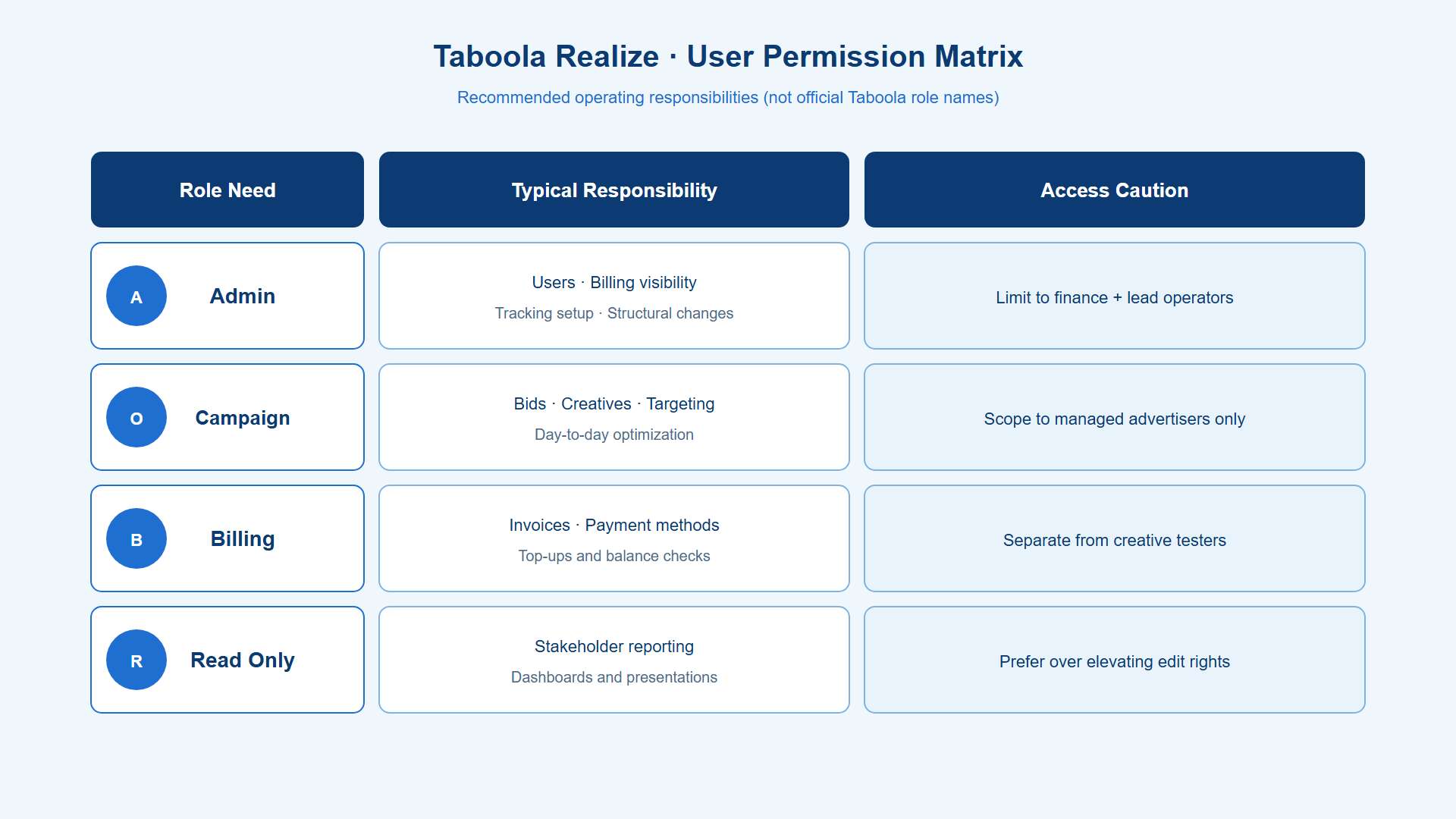
Use the following table as an internal responsibility framework. It describes recommended operating responsibilities, not a guaranteed list of Taboola's official role names or permissions.
| Role need | Typical responsibility | Access caution |
| Admin | Users, billing visibility, tracking setup, structural changes | Limit to finance and lead operators |
| Campaign operator | Bids, creatives, targeting, day-to-day optimization | Scope to the advertiser accounts they manage |
| Billing | Invoices, payment methods, top-ups | Separate from creative testers when possible |
| Read only | Reporting for stakeholders | Prefer this over giving every stakeholder edit rights |
When working with an external agency, agree on who can invite users, change billing settings, edit tracking, and approve budget increases. Document the process for removing access when a contract ends or a team member changes roles. The people responsible for performance should work efficiently without giving every user control over financial or structural decisions.
Tracking Ownership Before Launch
Account access alone does not produce accurate performance measurement. Tracking must be configured and tested across the complete customer journey.
Confirm which advertiser account owns the relevant tracking configuration, which conversion events the campaign uses, and who can modify those settings. If your implementation uses server-to-server tracking or redirects, verify that the required click identifiers and conversion parameters survive the full path.
Before launch, test the production landing page and conversion flow. Confirm that the intended event fires, that duplicate events do not inflate results, and that the event represents a meaningful business action.
For example, a purchase campaign should distinguish completed purchases from add-to-cart events. A lead-generation campaign should not treat every landing page visit as a qualified lead unless that is genuinely the optimization objective.
Also compare platform-reported conversions with your own analytics or backend records. Differences can arise from attribution windows, event definitions, consent settings, or reporting delays. Understand these differences before making budget decisions.
An agency-supported setup is valuable when it establishes clear ownership and a repeatable operating process.
Taboola Funding, Billing, and Account Control
Funding arrangements influence cash flow, budget control, and the amount of money exposed to an unproven campaign. Advertisers should resolve these questions before transferring funds, not after a creative rejection or billing dispute.
Taboola's available payment arrangements can depend on the account, market, eligibility, and agreed terms. Common billing structures include automatic billing, invoicing subject to an approved credit arrangement, and prepayment. Do not assume that every method is available to every advertiser.
Confirm Currency Before Account Creation
Currency deserves special attention during onboarding. Taboola's account administration guidance addresses currency selection and account setup. Confirm the current rule for your specific account before creation because a currency mismatch can complicate reporting, reconciliation, and cross-market budget management.
If your business reports in one currency but pays in another, document the conversion method, any applicable bank or payment-provider fees, and how the finance team will reconcile the final amount.
Do not rely on an informal promise that an existing account can be converted later. Obtain confirmation from the appropriate Taboola representative before committing to an account configuration.
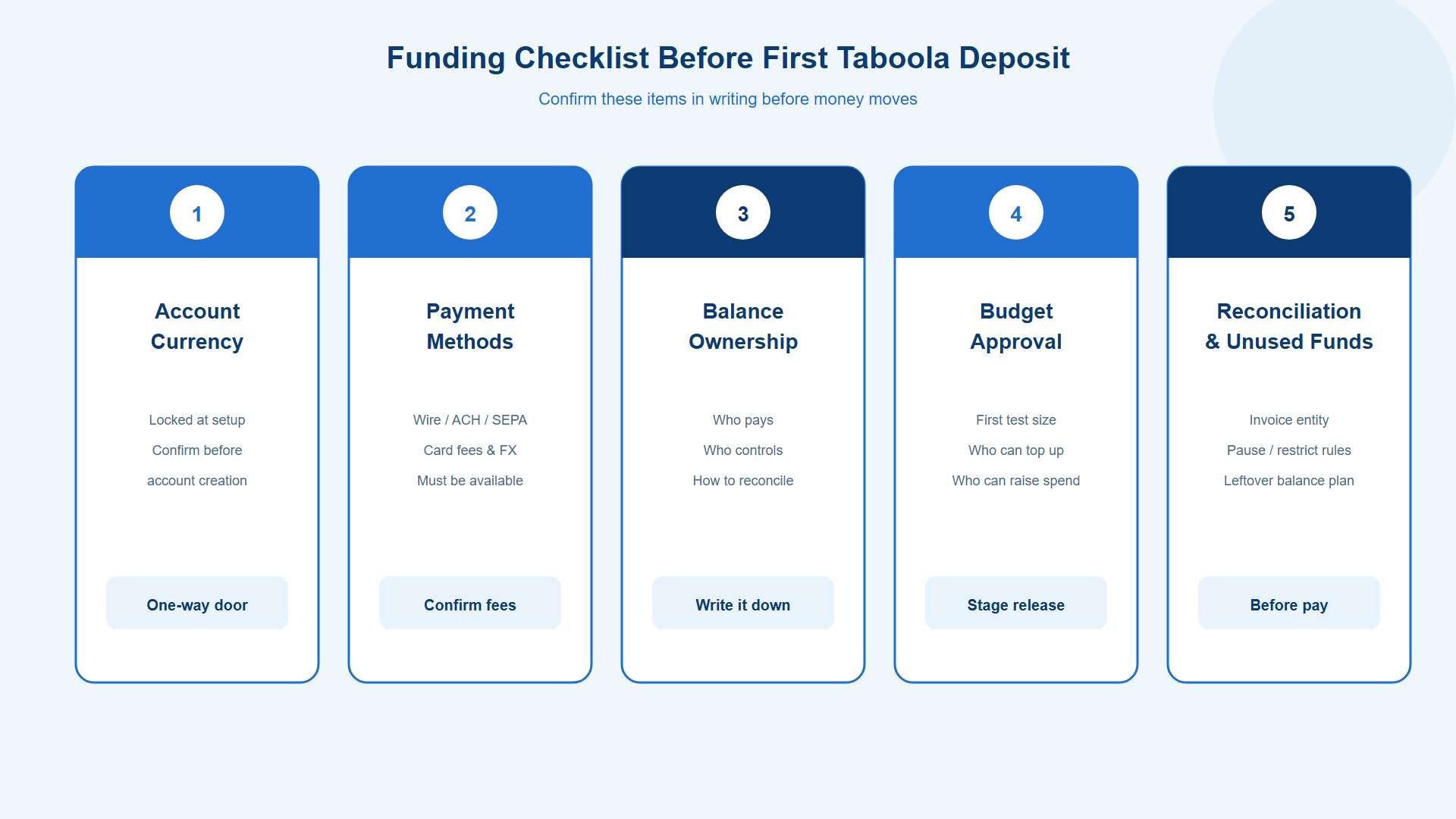
Questions to Resolve Before the First Deposit
Use this checklist with your agency, finance team, and relevant platform contact.
Account structure: Are you using a standalone advertiser account or a Network arrangement? Which accounts will hold the campaigns?
Balance ownership: Who pays for advertising, who controls the funds, and how will the parties reconcile the balance?
Payment method: Which payment methods are actually available for this account? Are there processing fees, bank charges, or foreign exchange costs?
Initial budget: How much is needed for the first controlled test? Avoid committing more capital than the campaign plan justifies.
Invoice details: Which legal entity will appear on the invoice? Confirm the billing address and any applicable tax documentation.
Unused funds: What happens to a remaining balance when campaigns stop, an account is restricted, or the commercial relationship ends?
Approval authority: Who can authorize deposits, change billing arrangements, and approve additional spending?
Get answers in writing. Where platform terms govern refunds, account restrictions, or the treatment of prepaid balances, those terms take precedence over informal assumptions. Confirm the actual options and any applicable conditions before paying.
Direct Funding vs. Agency-Assisted Funding
The comparison below describes typical operational trade-offs. Actual costs, available billing methods, and account privileges depend on the specific arrangement.
| Topic | Direct Realize path | Taboola agency ad account path |
| Setup speed | Fast when the entity and payment method already fit | Often faster when documents, markets, or Network structure need operator help |
| Billing flexibility | Depends on account eligibility and Taboola terms | Partner can help request prepay, invoice credit, or multi-account funding hygiene |
| Cost transparency | Platform fees appear in Realize help and invoices | Also confirm agency service fees, FX, and float terms in writing |
| Control | Brand owns day-to-day admin if the team is trained | Shared control; document who can invite users and edit billing |
| Cash exposure | Spend follows the selected billing schedule | Useful when it reduces idle cash; costly when large prepay lands before review |
Agency support is useful when it resolves real administrative bottlenecks: unclear fees, balances that are hard to reconcile, or advertisers who cannot see how funds are being used.
Establish a Simple Financial Control Process
A practical funding process does not need to be complicated.
First, record the approved budget, account currency, payment method, and responsible finance contact. Next, document the initial deposit and reconcile it against the relevant invoice or payment confirmation. During the campaign, review spend and remaining balances at an agreed frequency.
Define what happens if a campaign is paused, a payment fails, or spend differs from the approved plan. Also agree on how quickly the agency should notify the advertiser about unexpected charges or material account issues.
For new campaigns, release budget in stages according to the test plan and the quality of the available evidence. The objective is to generate useful performance data without unnecessarily exposing the business to unproven creatives, landing pages, or conversion tracking.
Review your Taboola funding and access plan with Novabeyond
Taboola Compliance and Landing Page Readiness
Access gets campaigns into the platform workflow. Compliance determines whether the creative and destination meet the applicable requirements.
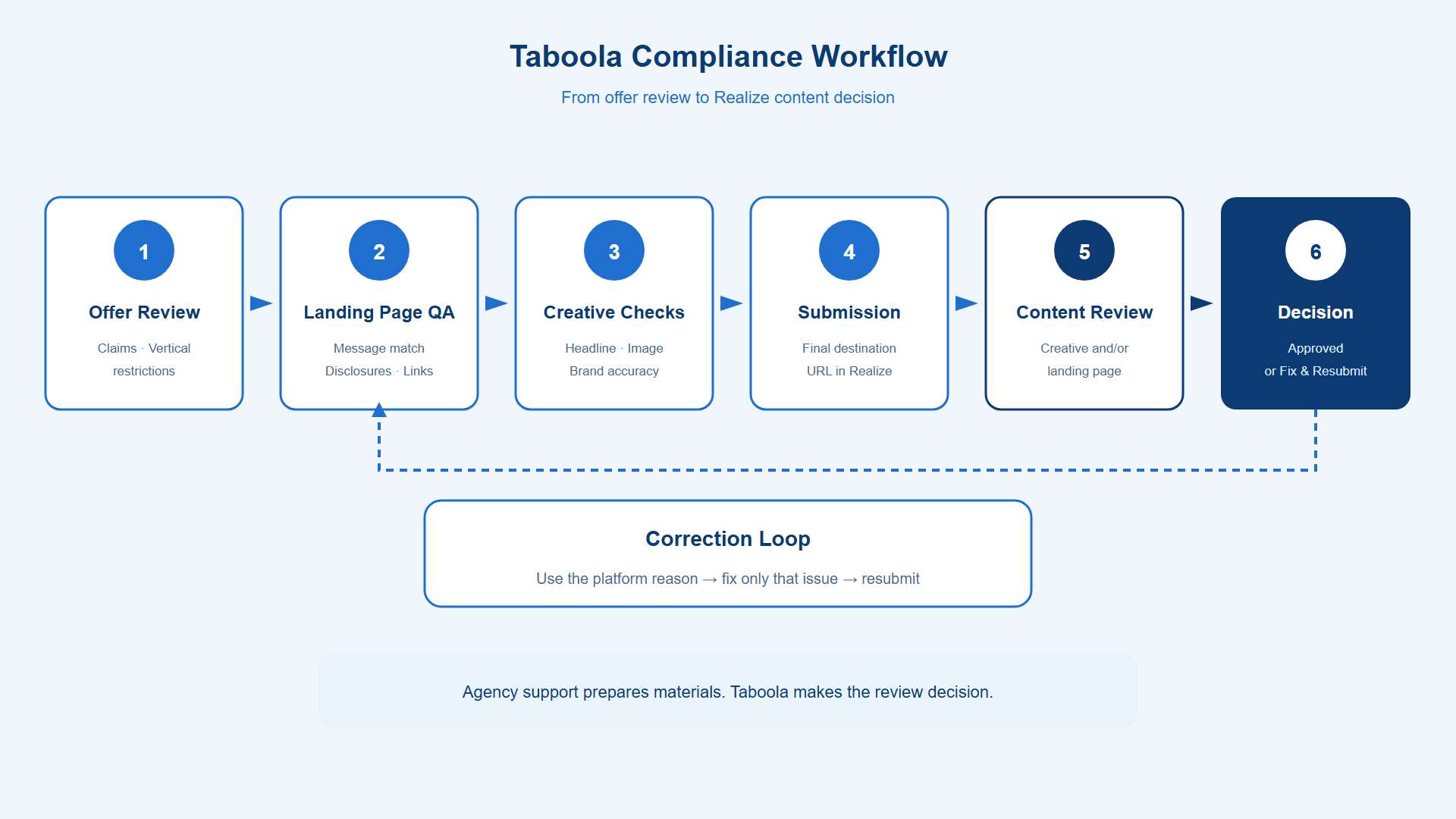
Taboola's Landing Page Policies should be part of the pre-launch review, not something the team checks only after an ad is rejected. Advertisers should consult the current policy and any additional requirements relevant to their offer or industry.
Check the Complete Destination
A landing page must deliver a coherent experience from the advertisement to the final destination. A headline should accurately represent the offer, and the page should provide the information users need to understand what is being promoted.
Review the following elements before submission:
Message consistency: Ensure the headline, image, and landing page describe the same offer.
Business transparency: Provide accurate business information and contact details where required.
Privacy and disclosures: Make relevant policies, commercial disclosures, and offer conditions accessible.
Page functionality: Test links, forms, page loading, and the experience on mobile devices.
Destination integrity: Check redirects and confirm that the submitted URL leads to the intended content.
Claims and urgency: Remove unsupported claims, misleading countdowns, and artificial scarcity.
Third-party elements: Review widgets, pop-ups, and scripts that could affect the user experience or the content presented for review.
If the funnel uses redirects, submit the final commercial destination for review. Cloaking and mismatched destinations create account and funding risk under Taboola's terms. Previous approval of one offer does not automatically clear a new offer, creative, or landing page.
Prepare Creatives for Native Inventory
Native advertising depends on the relationship between the recommendation unit and the destination. A strong creative attracts attention, but its promise must remain consistent with what the user finds after clicking.
Create several truthful creative variations when the campaign plan supports testing. Keep the brand name, offer details, and claims accurate across each version. If a creative is rejected, identify the reason before replacing it with another variation.
Avoid changing several unrelated elements at once. When the team changes a headline, image, landing page, and tracking setup simultaneously, it becomes difficult to determine what caused the outcome.
A documented review process helps the team identify recurring problems. Record the rejected asset, the stated reason, the correction made, and the result of resubmission. Over time, this record can inform internal quality checks and reduce repeated mistakes.
Allow Time for Review and Corrections
Do not build a launch plan around an assumed universal approval time. Review duration can vary, and a submission may require changes before it can run.
Prepare the final landing page, creative assets, and relevant disclosures before submitting the campaign. Leave time for review and corrections in the media schedule, especially when launch timing affects a broader marketing plan.
If a submission is rejected, start with the reason supplied by the platform. Check whether the issue relates to the creative, landing page, offer, destination, or another requirement. Make targeted corrections and follow the appropriate review process. An agency can help prepare submissions and organize corrections. Taboola still makes the review decision.
Tracking Validation, Performance Measurement, and Scaling
A campaign can be approved and spend money without generating reliable business results. Before increasing a budget, confirm that the tracking setup, conversion definitions, and reporting process provide a trustworthy view of performance.
Validate Measurement Before Scaling
Use a controlled test to verify the full path from the advertisement click to the intended conversion event.
Check that the landing page loads correctly, redirects preserve the required tracking parameters, and the expected event fires when the user completes the action. If you use a pixel or server-to-server integration, validate the implementation using the tools and documentation appropriate to that setup.
Then compare platform-reported results with analytics and backend data. Do not expect every reporting system to match exactly, but investigate material differences before using the data to justify additional spend.
Review these questions:
Does the campaign optimize for the intended conversion event?
Are duplicate or incorrectly triggered events inflating reported results?
Are click identifiers and campaign parameters retained through redirects?
Do platform reports and backend records show a plausible relationship?
Are attribution settings and reporting windows understood by the team?
Can the team distinguish reported conversions from incremental business outcomes?
For example, a campaign may report conversions while the backend shows fewer completed purchases. The discrepancy could reflect different attribution rules, event duplication, or reporting timing. Increasing spend before investigating can amplify a measurement problem rather than a successful campaign.
Use a Controlled Learning Budget
Start with a budget that supports the planned test without exposing more capital than necessary. Define the primary success metric before launch, whether that is qualified leads, completed purchases, customer acquisition cost, or another business outcome.
Give the campaign enough opportunity to produce interpretable evidence, but do not keep spending simply because a platform recommends further delivery. Evaluate the quality of the conversions, the consistency of tracking, and the commercial value of the results.
Before scaling, confirm that:
The landing page and creative meet the applicable requirements.
Conversion tracking works on the production path.
The results are consistent enough to inform a decision.
The campaign meets the business's agreed performance criteria.
The additional budget fits the approved financial plan.
Where possible, supplement attributed performance with an incrementality test or another suitable method of assessing whether the campaign generates outcomes that would not otherwise have occurred. Attribution and incremental impact answer different questions.
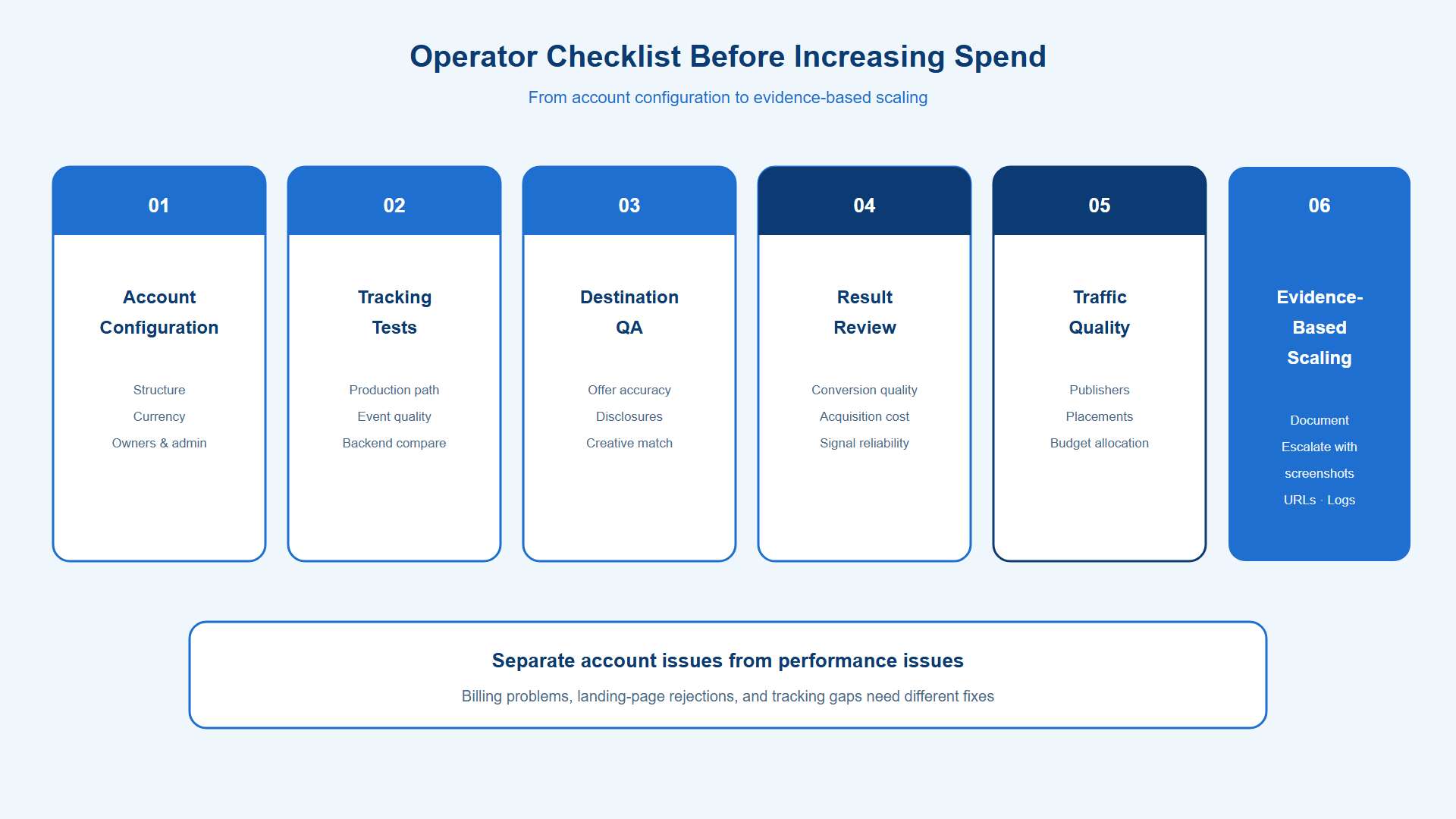
Operator Checklist Before Increasing Spend
Use this sequence when moving from launch to expansion.
Confirm account configuration. Record the account structure, currency, account owners, and administrative responsibilities.
Validate tracking. Test the production conversion path and investigate material discrepancies.
Recheck the destination. Confirm that the approved offer, disclosures, links, and creative claims remain accurate.
Review initial results. Evaluate conversion quality, acquisition costs, and the reliability of the measurement setup.
Assess traffic quality. Examine available publisher, placement, and campaign-level reporting before deciding where to allocate more budget.
Document decisions. Keep a record of budget changes, creative revisions, rejection fixes, and tracking adjustments.
Escalate with evidence. Provide relevant screenshots, URLs, configuration details, and event logs when requesting support.
These checks help separate account administration problems from campaign performance problems. A billing issue requires a different response from a landing page rejection or a tracking discrepancy.
Novabeyond's Emerging Media Solutions supports advertisers looking to organize emerging media operations, prepare campaigns, and manage execution. The objective is a repeatable process that helps teams make informed decisions.
For teams comparing native traffic options, the existing overview of MediaGo, Taboola, and Outbrain for e-commerce provides additional channel context. The account model should follow the advertiser's actual operational needs rather than determine the media strategy by itself.
A similar principle applies when reviewing other advertising platforms. Novabeyond's guide to a Kwai Ads agency ad account illustrates why access, platform-specific requirements, and operational responsibilities should be evaluated separately.
FAQ
1. What is a Taboola agency ad account?
A Taboola agency ad account is an agency-supported arrangement for managing advertiser access, account operations, funding coordination, and campaign execution in Realize. The exact structure depends on the arrangement with the agency and Taboola. It does not create a separate private auction or exempt campaigns from platform policies.
2. Is a Taboola Network the same as an agency ad account?
No. A Network is an account structure used to organize advertiser accounts, while an agency ad account describes a commercial and operational arrangement between an advertiser and an agency. Confirm the actual structure, permissions, and responsibilities before onboarding.
3. Can an agency change my Taboola account currency later?
Do not assume that currency can be changed after setup. Confirm the current rules for your specific account with Taboola before creating it. If a different currency is required, ask about the appropriate account setup rather than relying on a later conversion.
4. Does agency access bypass Taboola's content review?
No. Agency support does not waive advertising or landing page requirements. An agency may help prepare creatives, review destinations, and organize corrections, but Taboola retains control over its review and enforcement decisions.
5. Which funding model should I choose for a first Taboola test?
Choose based on the payment methods available to your account, cash-flow requirements, budget controls, and finance team's ability to manage reconciliation. Prepayment can help limit delivery to available funds, automatic billing may suit eligible advertisers, and invoicing depends on the applicable credit arrangement. Confirm all fees and unused-balance terms before paying.
6. What should I prepare before requesting Taboola access?
Prepare your legal entity details, brand and offer information, target markets, landing page URLs, relevant privacy and disclosure pages, creative drafts, intended budget, preferred currency, and list of users requiring access. Confirm any additional documentation required for your specific account and offer.
7. How does a Taboola agency ad account differ from accounts on other advertising platforms?
The general purpose of agency support is similar, but account structures, permissions, billing options, inventory, and review requirements differ by platform. Taboola's Realize environment and native advertising workflow require platform-specific preparation. Do not assume that another platform's account-management procedures apply unchanged.
8. When should I stay with direct self-service access?
Direct access may be sufficient when your business can complete onboarding, manage billing, maintain tracking, and operate campaigns independently. Agency support becomes more relevant when account administration, multiple advertisers, funding coordination, or compliance preparation creates a meaningful operational bottleneck.
Conclusion
A Taboola agency ad account can help advertisers manage the operational work behind native campaigns. Its value comes from clear access arrangements, well-defined financial responsibilities, compliant landing pages, reliable tracking, and disciplined campaign management.
Before launch, confirm the account structure and currency. Document who controls user permissions and billing. Understand the applicable funding terms, prepare the destination for review, and validate conversion tracking before increasing spend. These steps give the team a stronger foundation for identifying problems early, protecting budget, and making decisions based on credible evidence.
Novabeyond helps advertisers organize emerging media operations through Emerging Media Solutions, with support for account access, compliance readiness, tracking, and campaign execution.
more posts
Moloco Ads Optimization: Surviving the Learning Phase and Scaling iROAS (2026)
October. 08 2026
LEARN MORE

Kwai Ads vs. SnackVideo Ads: 2026 Allocation Matrix for LATAM & Southeast Asia
September. 28 2026
LEARN MORE
Why NewsBreak is the Essential US UA Growth Engine in 2026: Platform Guide & Performance Analysis
September. 24 2026
LEARN MORE
Navigating Media Accessibility in Media Growth: Bottlenecks & Solutions
September. 23 2026
LEARN MORE