





UNIT 616 6/F KAM TEEM INDUSTRIAL BUILDING 135 CONNAUGHT ROAD WEST SAI WAN HONGKONG.
Copyright © 2026 NOVABEYOND LIMITED (company number 2833487). All rights reserved.
Introduction
Low CPI can look like a growth win until retention drops, acquisition costs rise downstream, and finance questions the value of every new user. A campaign may generate thousands of installs while delivering little activation, weak retention, or limited revenue. The dashboard looks efficient, but the business results tell a different story.
Creative quality and audience targeting matter, but the supply path deserves equal attention. When advertisers rely heavily on open-exchange inventory, they may struggle to identify every seller, understand the context of placements, or separate efficient traffic from low-quality activity. A cheap impression or click does not automatically translate into a valuable customer.
Direct inventory advertising partnerships offer another way to approach acquisition. Advertisers build commercial relationships with apps, publishers, and media owners to access defined inventory, establish clearer buying terms, and gain more control over placement quality. The objective is not to abandon programmatic automation. It is to make supply selection more deliberate and performance easier to evaluate.
Novabeyond helps brands explore this approach through Direct Inventory Partnerships, connecting advertisers with local apps, publishers, and media owners. The focus is on relevant inventory access, transparent commercial relationships, and performance-led buying decisions.
Assess your current supply path
Quick Answer
Direct inventory advertising partnerships are negotiated relationships with publishers, apps, or media owners that give advertisers access to defined placements and clearer commercial terms. They can improve inventory visibility, reduce unnecessary intermediary layers, and help advertisers evaluate acquisition quality beyond headline CPI. Advertisers should verify seller relationships, track performance by supply path, compare quality-adjusted CPI, and measure downstream outcomes before scaling. Open exchanges, private marketplaces, and direct partnerships can work together when each serves a clear acquisition objective.
Why Cheap Exchange CPI Can Break at Scale
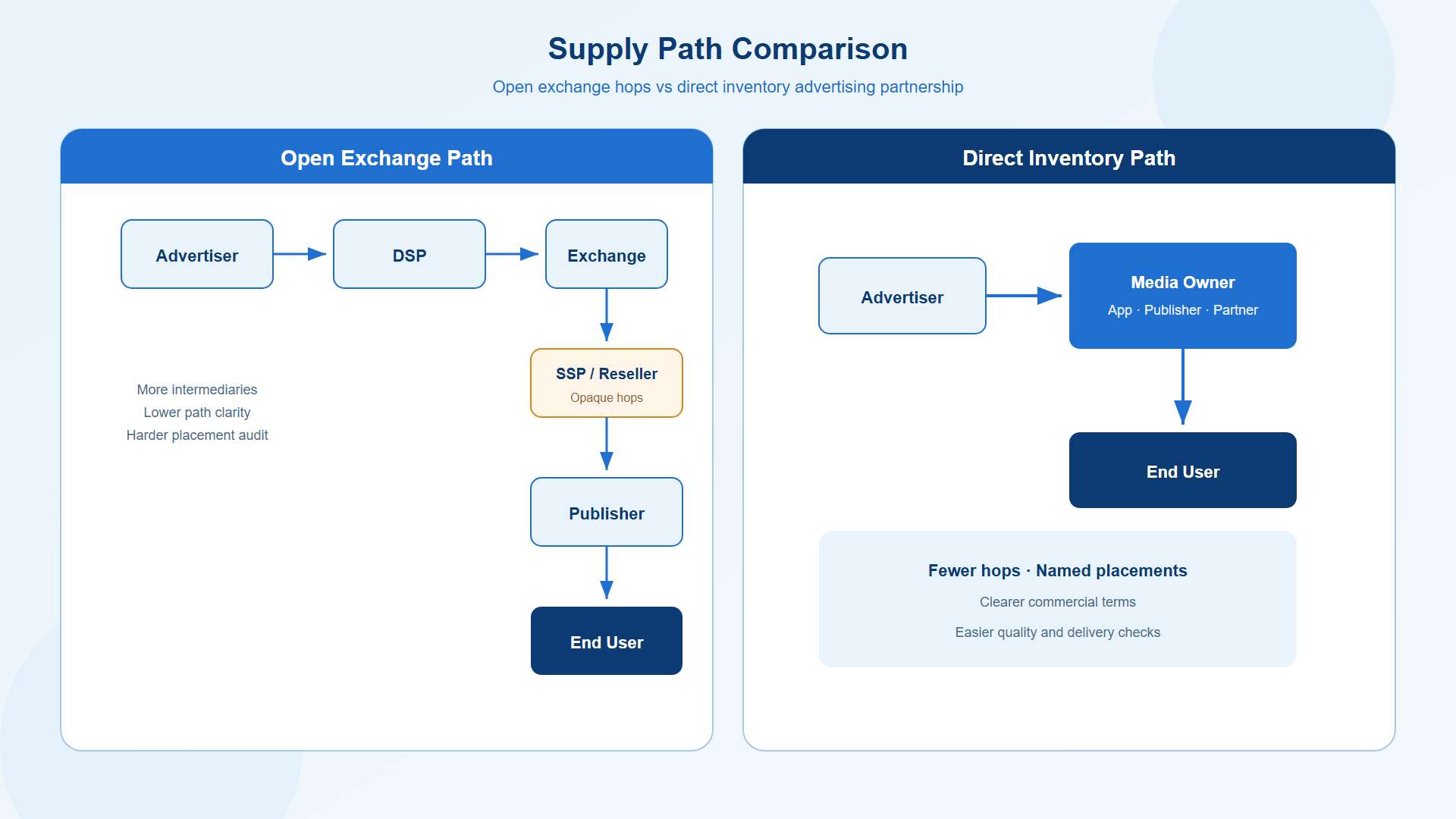
Open exchanges give advertisers broad access to digital inventory through automated auctions. They support rapid testing, flexible bidding, and efficient reach across multiple publishers and apps. For campaigns that need to discover new audiences, these capabilities remain valuable.
The challenge begins when teams treat the lowest reported CPI as proof of the best media efficiency. Different supply sources can produce very different levels of viewability, conversion quality, and downstream user value. Blended reporting can conceal those differences.
The ANA Q1 2026 Programmatic Transparency Benchmark illustrates why media quality deserves attention. The Association of National Advertisers reported that higher-performing advertisers converted 54.0% of programmatic spend into qualified impressions, compared with 32.1% for lower-performing advertisers. On a TrueCPM basis, the respective costs were $7.46 and $19.04 per thousand qualified impressions. The benchmark attributes the performance gap primarily to media productivity and quality management rather than transaction costs alone.
These findings show why quality controls belong in programmatic buying. Advertisers still need to validate individual placements and measure the results of their own campaigns.
Common warning signs include:
Cheap installs that rarely activate or return.
Unclear reseller relationships that make placement verification difficult.
Invalid traffic or low-quality inventory that inflates reported performance.
Creative tests that produce misleading conclusions because traffic quality varies.
Rising acquisition spend without corresponding improvements in retention, revenue, or contribution margin.
The practical question is not simply how to lower CPI. It is how to acquire more valuable users at a cost the business can sustain.
If your programmatic campaigns struggle to maintain returns, Novabeyond's guide to programmatic campaigns that stop delivering ROAS provides a related optimization resource. Supply path analysis becomes especially important when creative and bidding adjustments fail to explain deteriorating results.
How to verify supply chain transparency
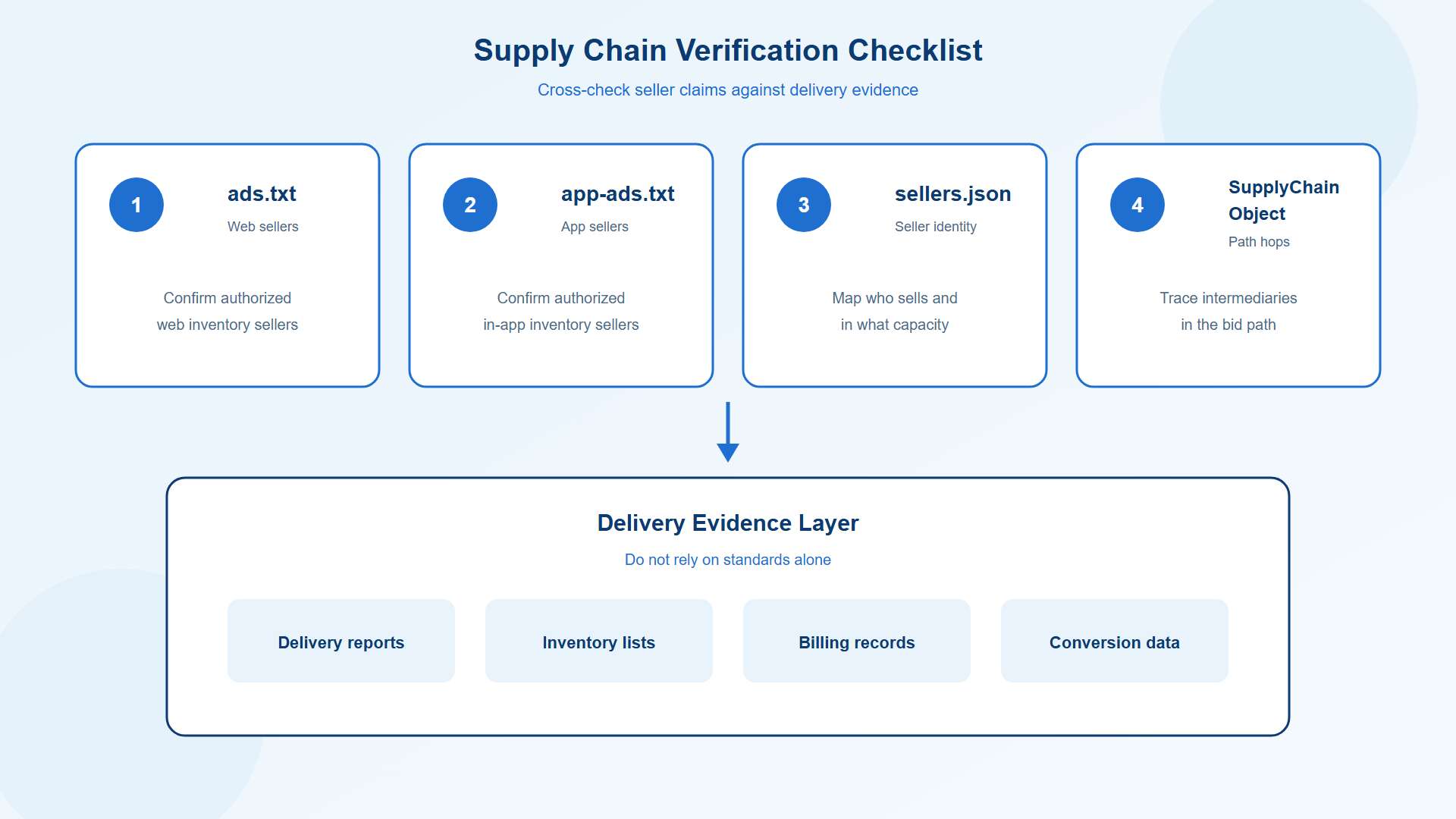
Before negotiating a direct package, establish what the seller can actually demonstrate. Several industry standards help advertisers inspect digital advertising supply relationships.
The IAB Tech Lab supply chain validation resources explain how these standards support authorized seller identification and greater transparency.
Use these records as part of a wider verification process. Compare the seller's claims with actual delivery reports, inventory lists, billing records, and conversion data. Where possible, ask for a clear explanation of every material intermediary and the role each party plays.
What Direct Inventory Partnerships Actually Buy
A direct inventory advertising partnership is a negotiated relationship with an app, publisher, or media owner that owns or controls the relevant advertising environment. Depending on the arrangement, the buyer may gain access to defined placements, exclusive packages, preferred delivery, or customized commercial terms.
The value typically comes from three areas.
Access: Advertisers can explore placements that may be unavailable through their usual buying routes or difficult to identify in open auctions.
Transparency: Buyers can establish which apps, sites, sections, and formats a package includes, then compare delivery with agreed expectations.
Operational flexibility: Commercial discussions can cover reporting, exclusions, creative requirements, test periods, and escalation procedures directly with the relevant media owner or authorized partner.
These benefits depend on the actual agreement. Advertisers should examine both the commercial arrangement and the delivery path.
Open Exchange vs. PMP vs. Direct Inventory
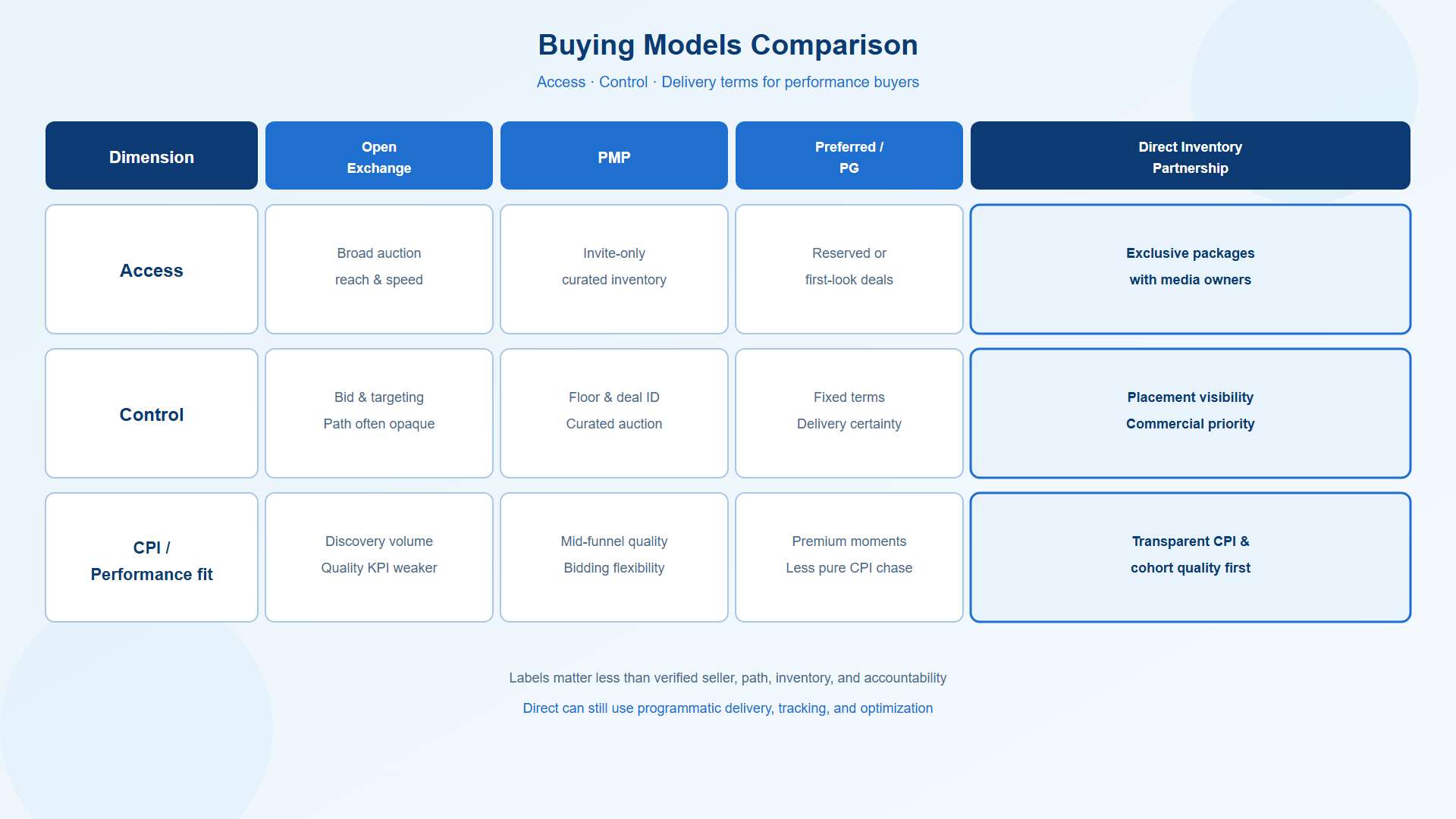
These buying approaches overlap, but they describe different aspects of media procurement.
A direct partnership can still use programmatic technology for delivery, tracking, or optimization. Similarly, a PMP or guaranteed deal can offer strong transparency when the inventory and commercial terms are well documented.
The key distinction is not whether a deal carries a particular label. It is whether the buyer can verify the seller, understand the actual supply path, identify the inventory being purchased, and hold the relevant parties accountable.
| Buying path | Who you negotiate with | Typical strength | CPI / performance fit |
| Open exchange | Many sellers via auction | Reach and speed | Strong for discovery; weaker when quality is the KPI |
| Private marketplace (PMP) | Publisher or SSP deal ID | Curated auction access | Mid-funnel quality with bidding flexibility |
| Preferred / programmatic guaranteed | Publisher via deal workflow | Fixed terms and delivery certainty | Better for reserved premium moments than pure CPI chasing |
| Direct inventory partnership | App, publisher, or media owner | Exclusive packages, placement visibility, commercial priority | Best when transparent CPI and cohort quality matter more than the cheapest click |
What bypassing ad exchanges really means
Bypassing ad exchanges means choosing a more direct or controlled route to inventory when that route offers a meaningful advantage. It does not mean rejecting all automated buying or assuming that every intermediary adds unnecessary cost.
A practical supply path review should answer five questions:
Who owns or controls the inventory?
Which entity is authorized to sell it?
Which intermediaries participate in the transaction?
What fees, pricing rules, and delivery obligations apply?
Can the advertiser verify the resulting placements and performance?
The answers help teams distinguish a genuine direct opportunity from a package that simply carries a premium label.
Novabeyond's Direct Inventory Partnerships service focuses on connecting advertisers with relevant local apps, publishers, and media owners. The commercial objective is to make inventory selection more deliberate while preserving the measurement and optimization practices that performance teams need.
How to Measure Quality-Adjusted CPI and Scale Direct Supply
A transparent CPI strategy begins by separating reported acquisition volume from verified acquisition value. A tracked install is useful, but it does not necessarily represent a valid, activated, or retained user.
Calculate the cost of a usable acquisition
Start with a consistent definition of a qualified acquisition. Depending on the business model, this could mean a verified install, an activated account, an approved lead, or a user who completes a meaningful purchase event.
A simple quality-adjusted CPI formula is:
Quality-adjusted CPI = Media spend ÷ Qualified acquisitions
For this calculation, qualified acquisitions must use a consistent and documented definition. The metric complements raw CPI rather than replacing every other performance measure.
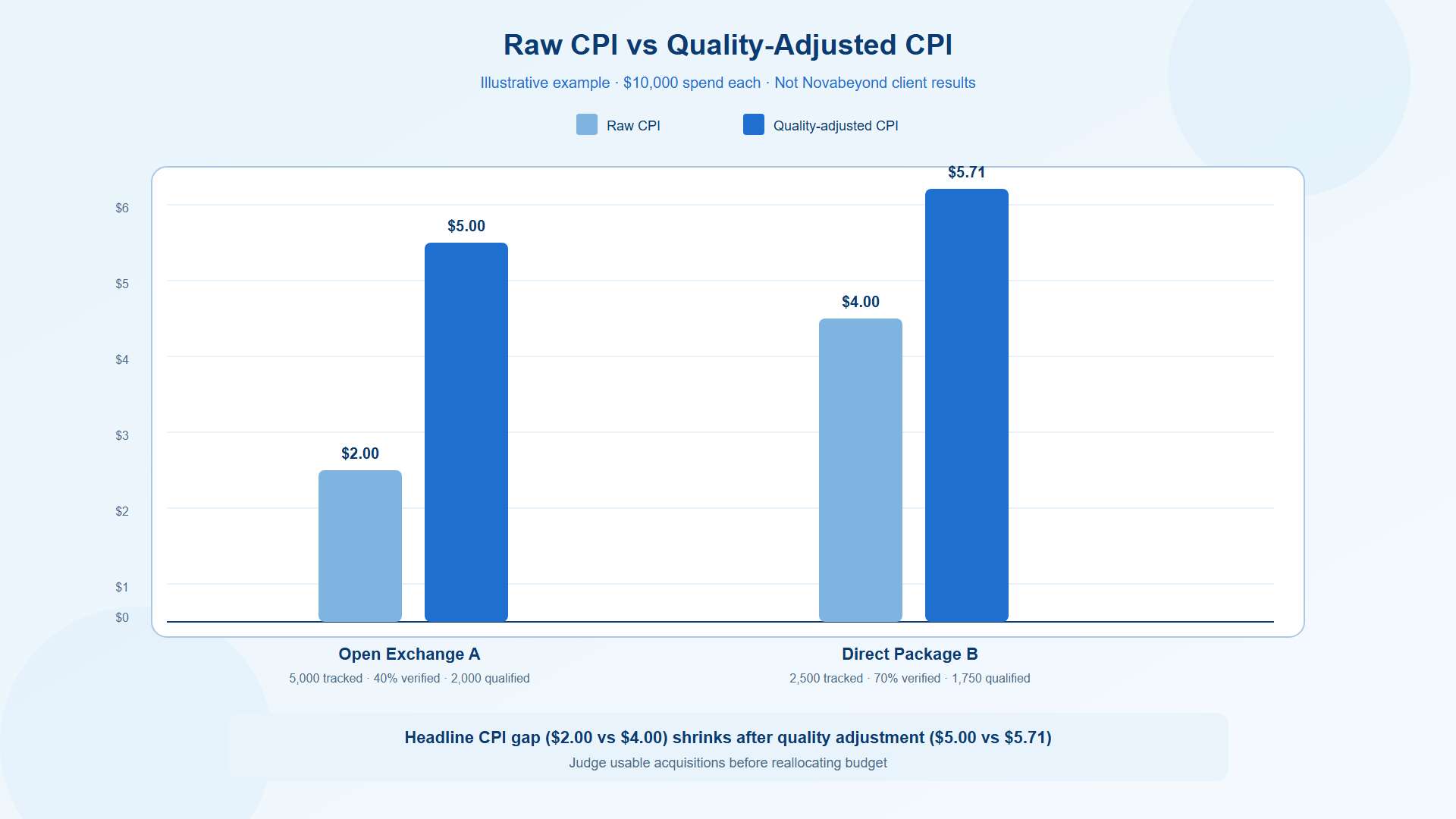
Consider the following illustrative example. Both channels spend $10,000, but their verified installation rates differ.
| Channel | Spend | Tracked installs | Raw CPI | Verified rate | Qualified installs | Quality-adjusted CPI |
| Open exchange A | $10,000 | 5,000 | $2.00 | 40% | 2,000 | $5.00 |
| Direct package B | $10,000 | 2,500 | $4.00 | 70% | 1,750 | $5.71 |
Channel A retains the lower cost per qualified install in this example, but the gap is much smaller than raw CPI suggests ($2.00 vs $4.00). Neither channel should automatically receive more budget without further analysis of activation, retention, revenue, and acquisition volume.
Illustrative example only. These figures are hypothetical and do not represent Novabeyond client results or industry benchmarks.
For businesses that optimize toward revenue, extend the analysis to downstream metrics such as day-7 retention, purchase rate, customer acquisition cost, contribution margin, and cohort ROAS. The most useful definition of quality depends on the value the campaign is designed to generate.
A practical framework for evaluating direct inventory
Use the following sequence to compare direct packages with existing acquisition channels.
Separate results by supply path. Report open exchange, PMP, and direct inventory separately. Include spend, impressions, clicks, conversions, and the relevant cost metric.
Validate tracking before judging performance. Confirm attribution settings, conversion events, click identifiers, postbacks, and reporting windows. Inconsistent tracking can distort comparisons between channels.
Inspect inventory and delivery. Review app or site lists, placements, formats, geographic distribution, and any contractual exclusions. Compare actual delivery with the inventory that the seller agreed to provide.
Evaluate downstream quality. Compare activation, retention, approval rates, refunds, purchases, and contribution margin where relevant. Use enough data to distinguish a meaningful performance difference from normal variation.
Test incrementality when appropriate. If the objective is net-new acquisition, use a suitable holdout or geographic test where practical. Attributed conversions alone do not establish that a channel created additional conversions.
Reallocate based on evidence. Increase investment in packages that meet the agreed quality and business thresholds. Retain or reduce other channels according to their actual contribution, not assumptions about buying models.
Evaluate direct inventory for your CPI goals
The direct inventory operator playbook
A direct deal should operate like a measurable acquisition channel, not an inflexible sponsorship. Build the following requirements into the buying process.
Define the inventory package before negotiating price. Request the names of participating apps or publishers, included sections or placements, formats, target geographies, delivery expectations, and applicable exclusions. Clarify whether the seller owns the inventory or represents another authorized party.
Choose a commercial model that fits the objective.
CPM: Useful when buyers want defined inventory and plan to optimize conversions independently.
CPI or CPA: Appropriate when both parties can agree on reliable conversion measurement and attribution rules.
Hybrid pricing: May combine minimum spend or delivery commitments with performance incentives or agreed quality conditions.
No pricing model eliminates risk. Review payment terms, attribution windows, invalid-traffic provisions, and the circumstances under which either party can pause or adjust delivery.
Separate the learning budget from the scale budget. Begin with a controlled test covering a defined package, audience, and creative approach. Agree on a maximum test spend, a review schedule, and the evidence required before expansion.
Set decision thresholds according to your economics. A business with a long conversion cycle may need more time and a different success measure than an app that records immediate purchases.
Include operational rights in the agreement. Define how the buyer can request placement exclusions, refresh creative, investigate suspicious activity, and pause delivery when agreed requirements are not met. Specify the reporting cadence and the process for resolving discrepancies.
Match creative to the placement context. A message that works in a social feed may not work in a utility app or editorial environment. Align the creative, landing page, and conversion objective with the context while maintaining consistent measurement.
When to use direct inventory and when to keep open exchange
This approach preserves the flexibility of programmatic media while giving advertisers greater control where inventory quality and transparency have the greatest impact.
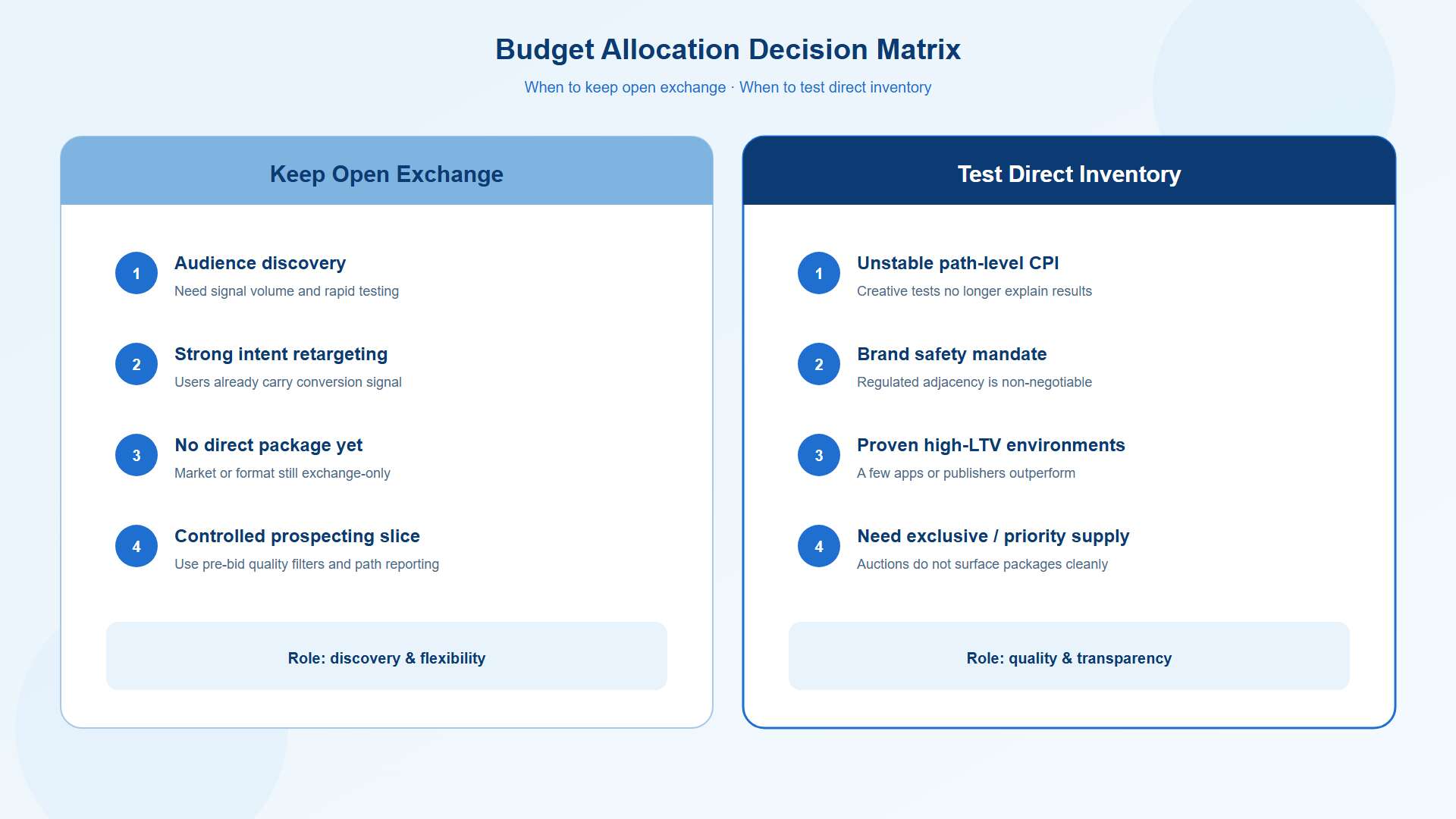
Novabeyond can support this process through inventory sourcing, controlled campaign testing, and performance evaluation. For advertisers exploring broader acquisition diversification, the guide to programmatic paths that drive incremental user acquisition versus Google App Campaigns offers a related perspective. The underlying principle is consistent: evaluate channels by the incremental value they deliver, not simply by the volume they report.
FAQ
1. What are direct inventory advertising partnerships?
They are negotiated relationships with apps, publishers, or media owners that control or represent specific advertising inventory. Advertisers establish clearer inventory definitions, commercial terms, and reporting expectations. The exact benefits depend on the agreement and the seller's role.
2. Does bypassing ad exchanges always lower CPI?
No. Direct inventory may carry a higher initial price but deliver better qualified traffic, or it may fail to outperform existing channels. Compare quality-adjusted CPI, downstream user value, and incremental results before increasing investment.
3. How is direct inventory different from a PMP deal?
A PMP provides curated access through a private programmatic auction. A direct inventory partnership emphasizes the commercial relationship and control over defined inventory. The two can overlap because a direct relationship may still use programmatic technology for execution.
4. How can advertisers verify a direct publisher's inventory claims?
Request an inventory list, seller identity, delivery terms, reporting examples, and clear information about any intermediaries. Where applicable, review ads.txt, app-ads.txt, sellers.json, and SupplyChain Object data. Cross-check these records against actual delivery and billing reports. None of these checks alone guarantees traffic quality.
5. Which metrics matter beyond raw CPI?
Track verified conversion rates, invalid-traffic indicators, activation, retention, purchase rates, refunds, contribution margin, and cohort ROAS where relevant. The appropriate metric depends on the business model. If incrementality matters, supplement attribution with a suitable experimental design.
6. Can advertisers use automation with direct inventory?
Yes. Direct commercial relationships can coexist with automated pacing, conversion tracking, creative testing, and other optimization tools. The important distinction is how inventory is sourced and governed, not whether every campaign operation is manual.
7. What should the first direct inventory brief include?
Specify campaign objectives, target markets, audience requirements, excluded categories, required inventory visibility, tracking methods, pricing preferences, test budget, success criteria, and pause or exclusion rights. A clear brief makes offers easier to compare and reduces ambiguity during execution.
8. How does Novabeyond support direct inventory buying?
Novabeyond's Direct Inventory Partnerships service helps advertisers explore relevant apps, publishers, and media-owner relationships. The objective is to improve access to suitable inventory, clarify buying arrangements, and support performance evaluation. Advertisers should agree on campaign scope, reporting, and success criteria before launching a test.
Conclusion
Direct inventory advertising partnerships give advertisers another way to manage acquisition costs, inventory visibility, and media quality. They can help reduce unnecessary supply chain complexity, but they are not a universal replacement for open exchanges or programmatic deals.
The strongest strategy starts with evidence. Verify seller relationships, define the inventory package, establish clear commercial terms, and measure qualified acquisitions rather than relying on headline CPI alone. Compare downstream outcomes and test incrementality where appropriate. Scale only when results support the decision.
For brand marketers, media buyers, and growth leaders, the goal is not simply to buy media more directly. It is to build a more transparent, measurable, and sustainable acquisition system.
Novabeyond's Direct Inventory Partnerships help advertisers explore relevant media-owner relationships and evaluate supply opportunities with a performance-led approach. If your current channels deliver volume without dependable quality, reviewing your supply mix is a practical place to start.
more posts
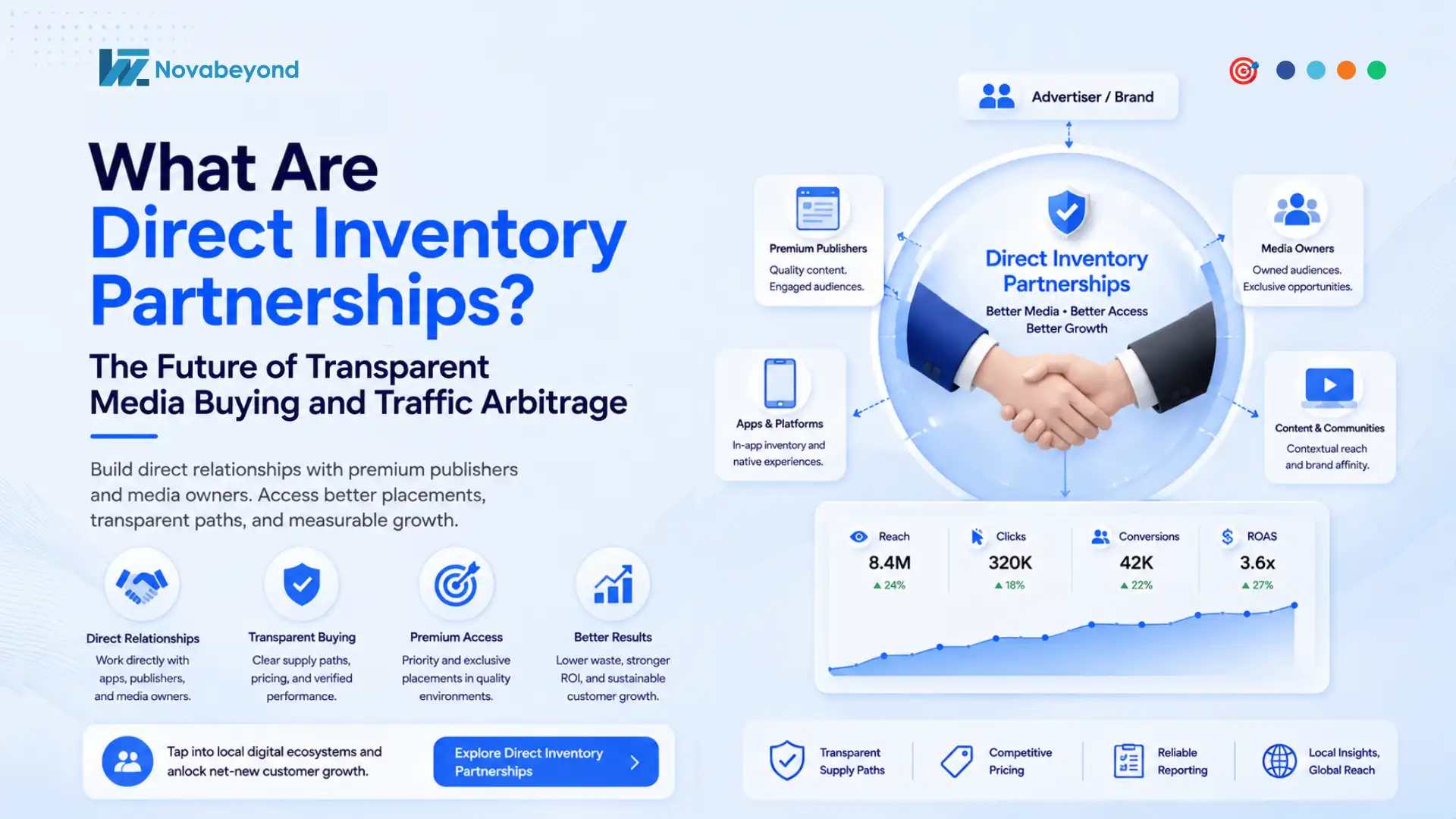
What Are Direct Inventory Partnerships? The Future of Transparent Media Buying and Traffic Arbitrage in 2027
November. 13 2026
LEARN MORE

Direct App and Web Inventory for Performance Growth
October. 12 2026
LEARN MORE
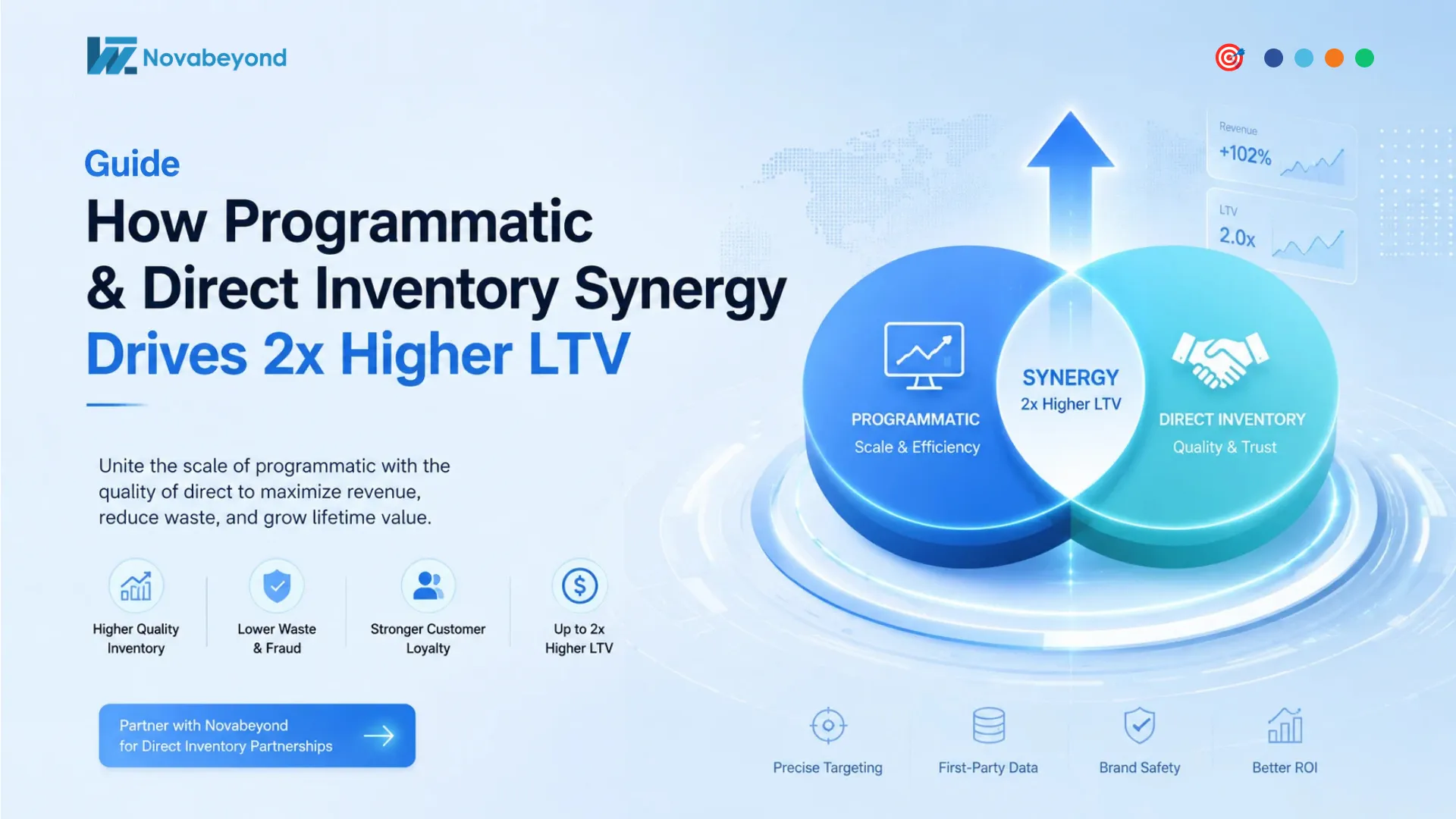
How Programmatic & Direct Inventory Synergy Drives 2x Higher LTV
September. 14 2026
LEARN MORE