





UNIT 616 6/F KAM TEEM INDUSTRIAL BUILDING 135 CONNAUGHT ROAD WEST SAI WAN HONGKONG.
Copyright © 2026 NOVABEYOND LIMITED (company number 2833487). All rights reserved.
Introduction
Your paid acquisition costs are rising. Creative fatigue sets in faster, audience overlap grows, and every major platform competes for a larger share of your budget. Even when reported ROAS looks healthy, incremental growth can become harder to find. For brands that depend heavily on Meta and Google, another policy change or tracking disruption can stall delivery quickly.
Adding more campaigns to the same platforms will not always solve the problem. Advertisers need access to new audiences, different discovery environments, and additional ways to acquire customers without sacrificing measurement or control.
That is where Emerging Media Solutions come in. Regional short-video, live-content, and native discovery platforms give advertisers more options beyond mainstream advertising ecosystems. With the right market selection, agency ad account access, localized creative, and reliable tracking, these channels can become a measurable part of a broader acquisition strategy.
Novabeyond helps brands explore emerging media opportunities, navigate platform requirements, and build structured campaigns around their growth objectives. Instead of spreading budgets across every available network, teams can identify promising markets, test selected platforms, and scale based on business outcomes.
Explore Emerging Media Opportunities for Your Target Markets
Quick Answer
Alternative traffic sources for advertisers in 2027 include regional short-video, live-content, native discovery, and other advertising environments beyond the Meta-Google core. For many cross-border brands, Emerging Media Solutions offer a practical starting point. Platforms such as BIGO Ads, Kwai, and MediaGo can help advertisers explore new audience segments and acquisition opportunities, depending on GEO, vertical, and campaign objectives. Success depends on clean tracking, localized creative, sufficient testing budgets, and consistent measurement. Keep established channels running while validating new ones. Evaluate incremental conversions, customer acquisition cost, retention, and operational reliability before increasing spend. OEM, CTV, programmatic, and direct inventory can complement the mix when specific reach or supply requirements justify expansion.
Why Advertisers Need Alternative Traffic Sources in 2027
Digital advertising continues to grow, but growth does not eliminate the challenges of channel concentration.
According to the IAB/PwC 2025 Internet Advertising Revenue Report, US internet advertising revenue reached $294.6 billion in 2025, an increase of 13.9% year over year. Digital video revenue grew 25.4% to $78 billion, while social advertising revenue reached $117.7 billion. That US scale shows why concentration risk matters for teams still buying mostly inside Meta and Google.
For global advertisers, the strategic question is more specific: where can the next profitable customers come from, and how can teams test new sources without weakening their existing acquisition engine?
Three challenges make diversification worth evaluating.
Audience overlap. Users may encounter similar offers across several large platforms. Reported conversions can remain strong even when additional spending produces fewer genuinely new customers.
Competitive pressure. Auction costs vary by market, audience, season, and vertical. Adding another campaign to a crowded environment may increase spending without generating proportional growth.
Operational concentration. Heavy dependence on a small number of platforms leaves fewer alternatives when account restrictions, measurement changes, or policy updates disrupt delivery.
Emerging media can help address these challenges when advertisers select channels based on market fit. A regional platform may reach audiences that receive less advertising from a particular category. A native discovery network may introduce an offer in a content-led environment. A short-video platform may provide creative opportunities that differ from established social feeds. Each option deserves a structured test with a clear success bar.
Novabeyond's Emerging Media Solutions help advertisers approach these opportunities through platform access, onboarding support, localized policy handling, and campaign execution. The objective is to build another measurable acquisition option, not simply add more logos to a media plan.
What Emerging Media Solutions Include
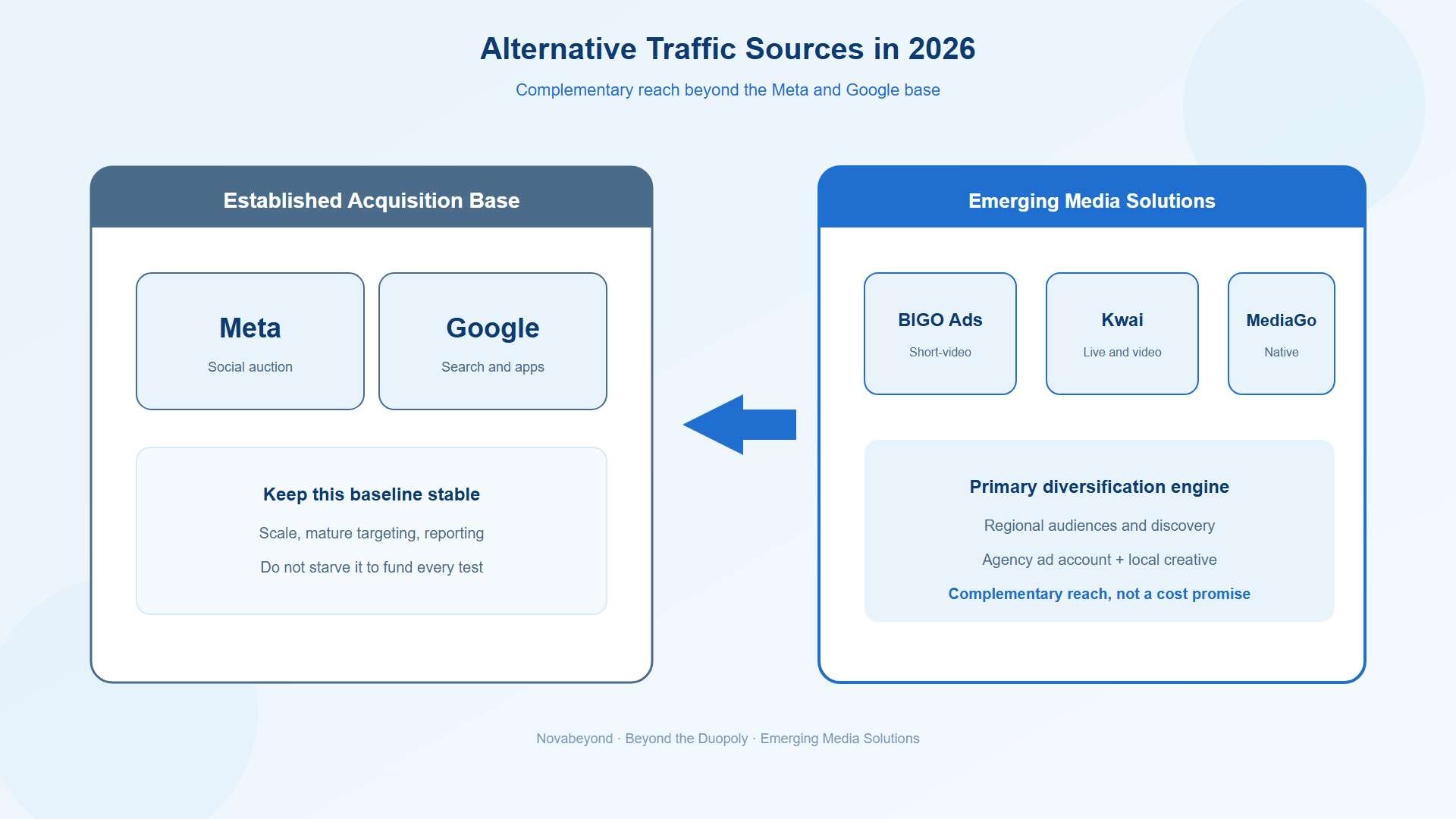
Emerging Media Solutions are not simply every advertising channel outside Meta. For Novabeyond, they represent a focused approach to regional and specialized media environments that global advertisers may not fully use.
The emerging media ecosystem for UA incremental growth provides a broader overview of the available landscape. This guide focuses on how advertisers can evaluate those channels and turn selected opportunities into structured acquisition tests.
Regional short-video, live, and native discovery
Different platforms support different user behaviors and campaign objectives. BIGO Ads and Kwai can be relevant to short-video or live-content acquisition strategies in suitable markets. MediaGo can be considered for native discovery and content-led advertising approaches.
These examples are starting points, not universal recommendations. Platform suitability depends on target GEO, audience characteristics, vertical eligibility, conversion goals, available inventory, and campaign economics.
Before selecting a platform, answer four questions:
Does the platform reach the audience and geography that matter to the business?
Does its content environment fit the offer and creative format?
Can the campaign optimize toward a meaningful business event?
Can the team support the platform's operational and compliance requirements?
For advertisers comparing short-video and native strategies, the BIGO Ads vs MediaGo ROI playbook offers additional platform-specific context. Teams exploring LATAM or other relevant markets can also use the Kwai Ads agency ad account guide to understand account setup and launch considerations.
The four capabilities behind an effective Emerging Media strategy
1. Regional market and platform selection
Start with business priorities, not a platform list. Match each potential channel to a target GEO, audience, vertical, and acquisition objective. Review historical performance, market coverage, creative requirements, and expected conversion volume before committing budget.
2. Agency ad account access and launch readiness
New-platform launches can involve business verification, payment arrangements, account setup, tracking integration, and creative review. Resolve these requirements before the campaign launch. The correct agency ad account setup can reduce operational friction, but access alone does not guarantee delivery or performance.
3. Localized policy and risk management
Advertising rules, content restrictions, and review processes differ across platforms and markets. Prepare localized creative, check landing pages, and confirm category eligibility before spending. Build a process for handling rejections, account issues, and policy changes.
4. Adaptive campaign execution
Do not copy an existing campaign structure into a new environment without adjustment. Test creative hooks, placements, bidding approaches, landing pages, and conversion events according to each platform's capabilities. Use early results to identify what deserves further investment.
Novabeyond brings these capabilities together so advertisers can move from platform discovery to campaign execution with a clearer plan. The value lies in coordinating access, tracking, localized operations, and optimization around the client's growth goals.
Push, pop, and arbitrage-oriented networks may suit certain performance offers. Advertisers prioritizing brand suitability, customer quality, and sustainable acquisition should evaluate inventory quality and risk controls before treating these networks as core growth channels.
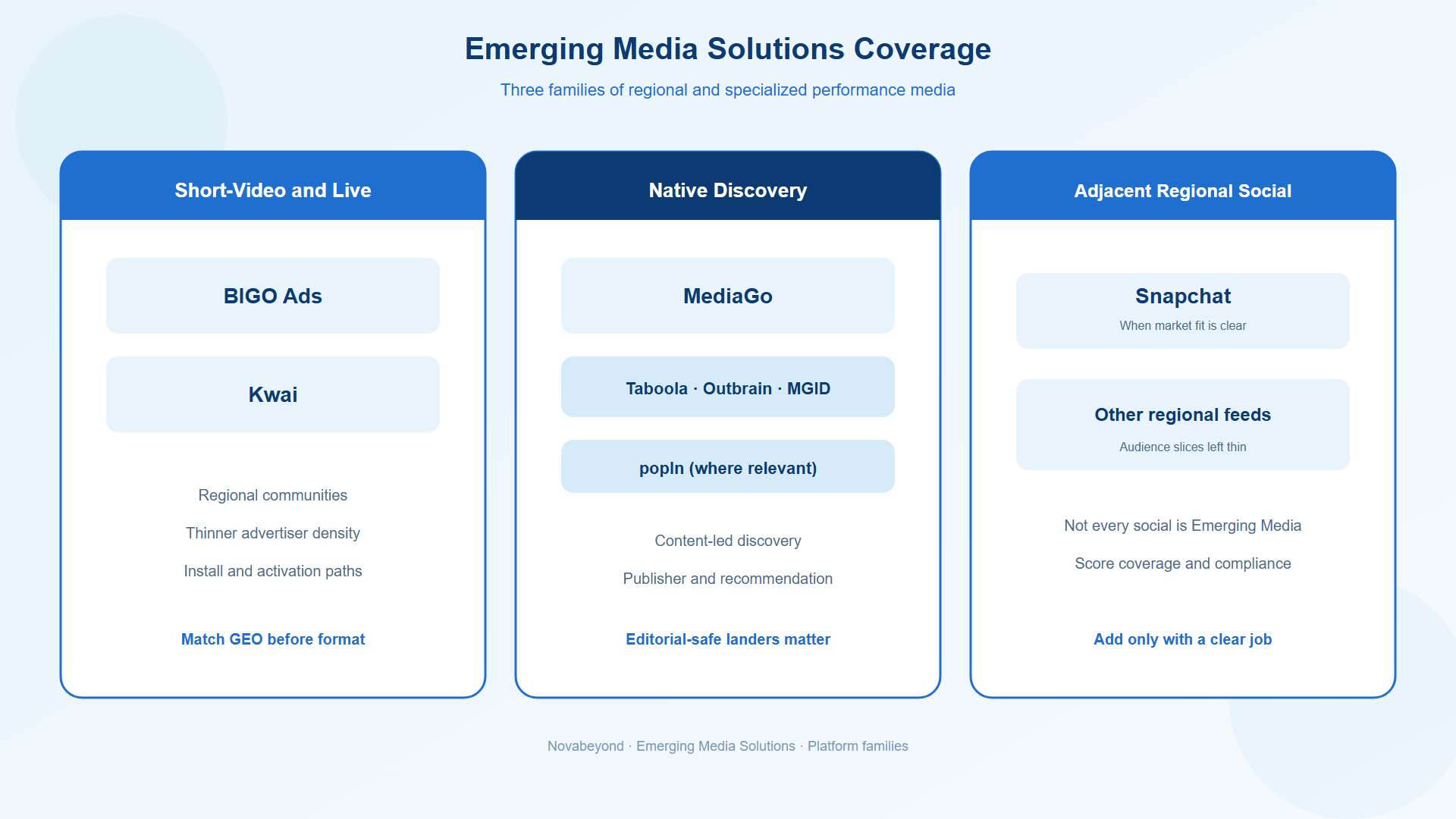
How to Test Emerging Media for Incremental Growth
Diversification works best when teams control the testing process. Launching across too many platforms at once can fragment budgets, weaken learning, and make performance difficult to interpret.
Step 1: Keep the baseline stable
Do not cut established channels simply to fund a new experiment. Maintain a baseline that reflects current business priorities, then allocate a defined test budget to one primary Emerging Media opportunity.
Select a market where the audience, offer, and platform appear well aligned. Choose a backup only when the team has sufficient budget and resources to evaluate it properly.
Step 2: Prepare tracking before launch
Confirm that the full conversion path works before increasing spend. Depending on the campaign, this may include MMP integration, SDK events, server-side events, postbacks, attribution settings, and landing-page consistency.
Check whether the platform receives the events needed for optimization. Compare platform reporting with the advertiser's analytics or measurement system, and document differences in attribution windows.
A campaign cannot produce reliable learning when the team cannot distinguish real conversions from missing or duplicated events.
Step 3: Localize the creative
Short-video campaigns need compelling opening hooks, clear value propositions, and formats suited to the platform. Native campaigns need content that matches the discovery context and landing pages that continue the same message.
Test local language, cultural references, price cues, product benefits, and creative styles. Do not assume that subtitles added to an English-language ad will perform as well as a properly localized concept.
Run controlled creative tests where practical. Change one major variable at a time when the budget allows, and use results to guide the next iteration.
Step 4: Fund learning instead of scattering spend
There is no universal minimum test budget or fixed learning period for every emerging platform. The appropriate investment depends on historical conversion rates, target CPA, expected event volume, market size, and the time available to make a decision.
Before launch, define:
The business outcome the campaign must achieve.
The budget and evaluation window.
The minimum evidence needed to judge performance.
The conditions for continuing, adjusting, or stopping.
The user-quality metrics that matter after conversion.
A few days of weak CPA may not provide enough evidence to reject a new channel. Equally, a short period of cheap conversions does not justify scaling before quality and tracking checks.
Step 5: Evaluate performance beyond platform ROAS
Use a consistent scorecard to assess whether a channel deserves more investment.
Choose metrics that match the business model. App advertisers may focus on installs, activation, retention, and lifetime value. Ecommerce teams may prioritize purchases, contribution margin, and repeat orders.
Where feasible, use geographic holdouts or other controlled experiments to estimate incremental impact. When a formal holdout is not practical, compare blended acquisition costs, user quality, and performance trends while accounting for seasonality and changes in the existing media mix.
Novabeyond's diversified acquisition evaluation framework provides further context for assessing channel opportunities. Scale when evidence supports the business case, not just because a platform dashboard reports attractive ROAS.
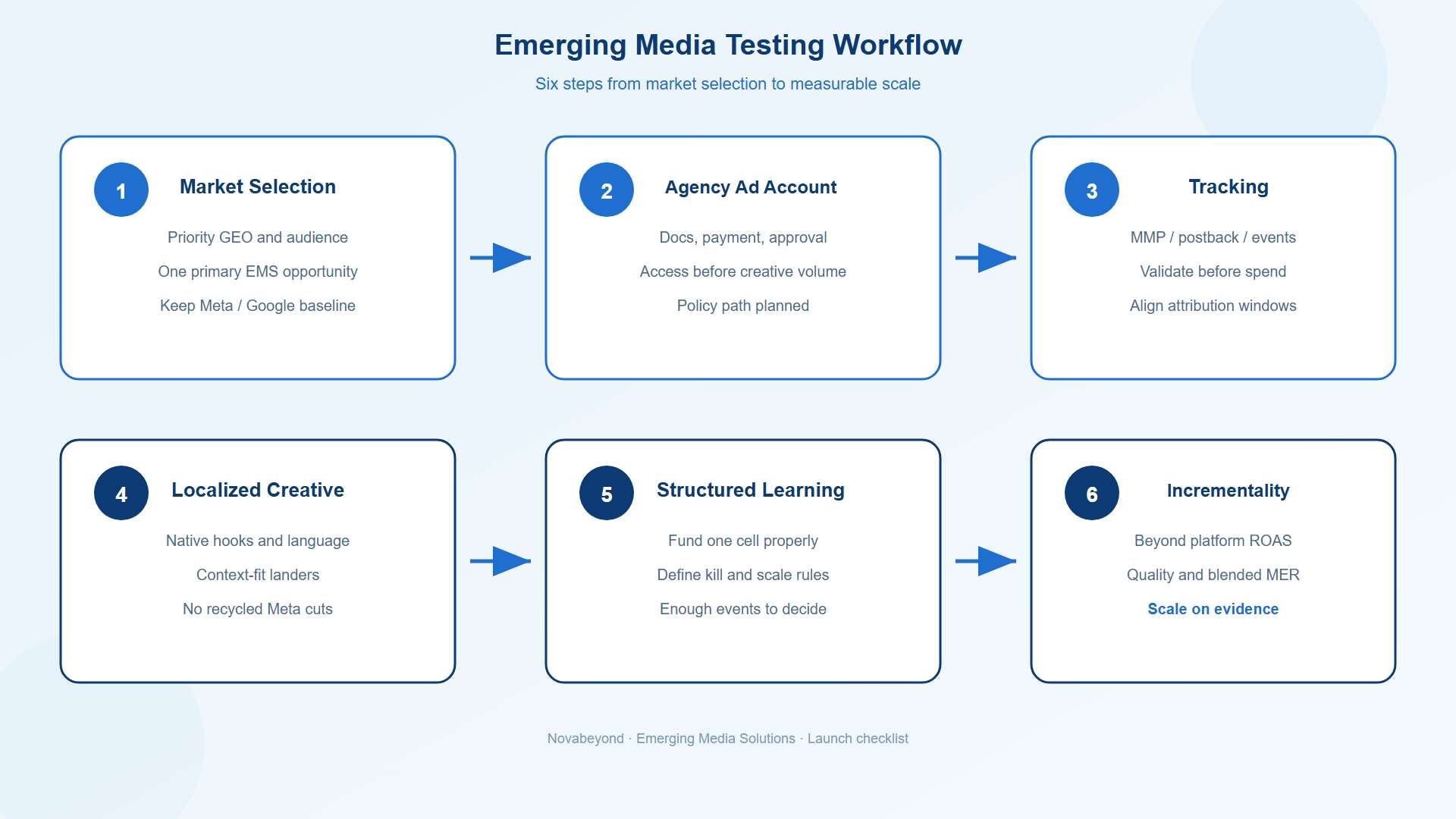
| Practice | Duopoly-default habit | Emerging Media habit in 2027 |
| Budget shape | Always-on Meta and Google, leftover for tests | Stable Meta and Google baseline, funded learning on 1 to 2 EMS engines |
| Access | Self-serve login assumed | Agency ad account, docs, and policy path planned first |
| Success metric | Platform ROAS in 7 days | Incremental CPA or LTV plus blended MER |
| Creative | One master cut resized everywhere | Local language and context-native assets per platform |
| Scale trigger | CPA looks good for a week | Passes scorecard, quality checks, and compliance review |
If you need help sequencing GEOs and platforms, Novabeyond can map a structured Emerging Media test plan against your current baseline.
Request an Emerging Media Test Plan for Your GEOs
When to Expand Beyond Emerging Media
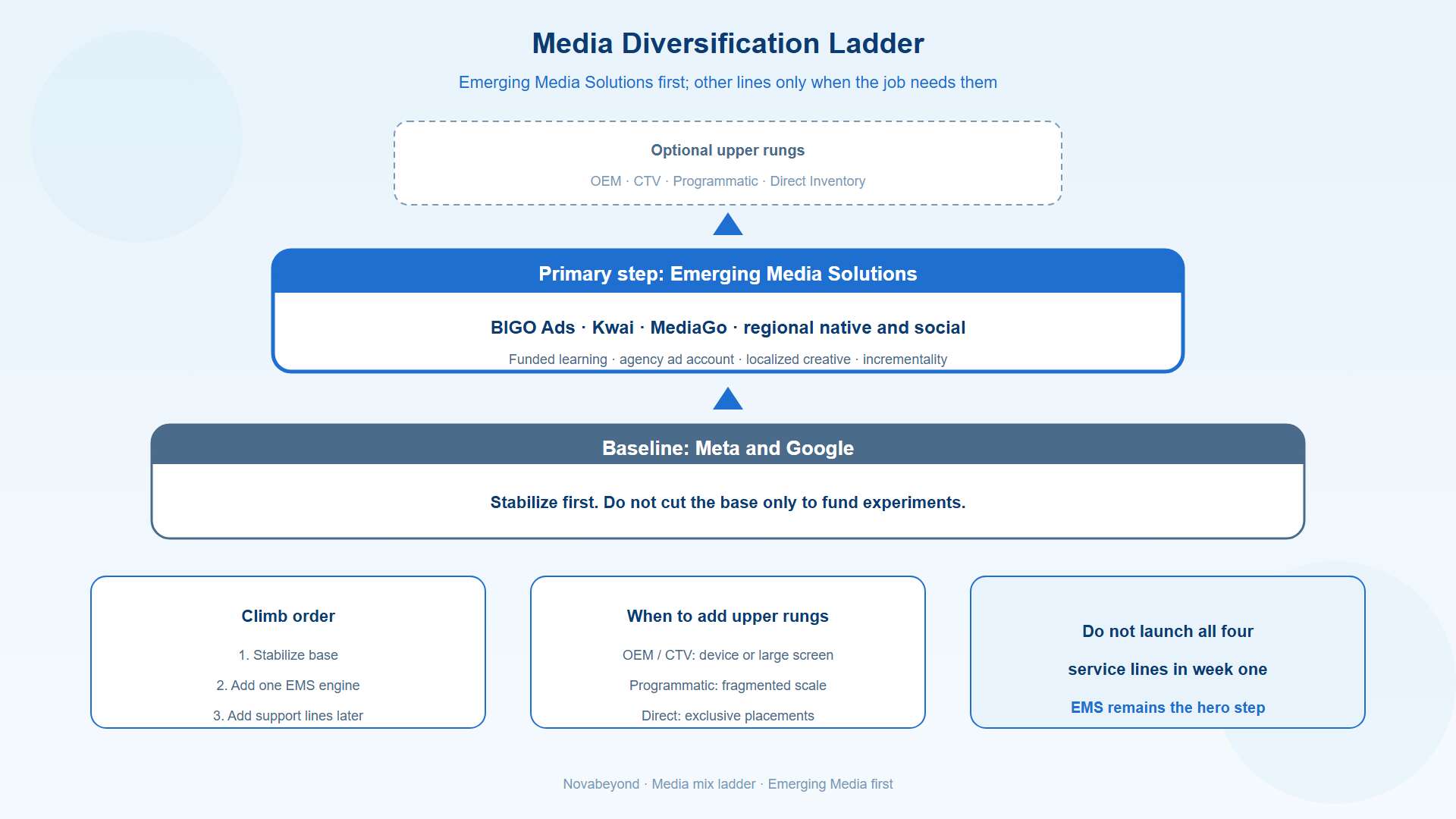
Emerging Media Solutions should lead the diversification strategy when regional audience discovery and alternative acquisition opportunities are the primary goals. Other channels become relevant when they solve a distinct business problem.
OEM and CTV for device-native and large-screen reach. OEM & CTV Growth Channels can complement Emerging Media when a campaign needs device-level discovery opportunities, connected-TV exposure, or a broader cross-screen approach. These channels should have a clear role in the media mix rather than compete for budget without a defined objective.
Programmatic for fragmented web and in-app inventory. Programmatic Growth Strategies can help advertisers access a wider range of digital inventory when they need additional scale, audience strategies, or more flexible supply options.
Direct inventory for specific placements and supply requirements. Direct Inventory Partnerships can be appropriate when advertisers need selected publisher relationships, defined placement environments, or greater control over particular supply sources.
Each channel requires its own measurement approach. Do not compare all channels using the same attribution assumptions when their roles and conversion paths differ.
A practical expansion sequence looks like this:
Stabilize the existing Meta and Google acquisition baseline.
Select one Emerging Media opportunity that matches a priority GEO and audience.
Validate tracking, creative, conversion economics, and user quality.
Add another emerging media category when the first test produces sufficient evidence.
Introduce OEM, CTV, programmatic, or direct inventory when a distinct reach, screen, or supply requirement justifies it.
This approach keeps Emerging Media Solutions at the center of the diversification plan while preserving room for a broader cross-channel strategy. It also prevents teams from splitting limited budgets across four different service lines before they have established what works.
FAQ
1. What are alternative traffic sources for advertisers in 2027?
Alternative traffic sources are paid or partnered acquisition channels beyond an advertiser's established core platforms. They can include regional short-video, live-content, native discovery, OEM, CTV, programmatic, and direct inventory. The right choice depends on audience fit, campaign objectives, measurement capabilities, and business economics.
2. Why start with Emerging Media Solutions instead of programmatic or OEM?
Emerging Media Solutions can provide a focused way to test regional platforms and discovery environments beyond the Meta-Google core. Programmatic and OEM solve different problems, including broader inventory access and device-native reach. Start with the channel that best matches the target audience and growth objective, then expand when the evidence supports it.
3. What are the best practices for media buying on emerging platforms?
Define one primary outcome per test, validate tracking, prepare localized creative, establish clear budget and evaluation rules, and measure customer quality alongside acquisition cost. Confirm agency ad account requirements and platform policies before launch. Scale only after the campaign demonstrates results that support the business case.
4. How is this guide different from an emerging media ecosystem overview?
An ecosystem overview explains which platforms and environments exist. This guide focuses on the buying process: how to select a market, prepare account access and tracking, fund a meaningful test, evaluate incremental growth, and decide when to scale.
5. Which Emerging Media platforms fit mobile app user acquisition best?
BIGO Ads, Kwai, and MediaGo may be relevant for different acquisition strategies, depending on market coverage, audience behavior, available inventory, and campaign objectives. Short-video environments may suit some app-install or activation campaigns, while native discovery may fit content-led acquisition paths. Validate performance and retention in the target GEO before selecting a primary platform.
6. How long should an Emerging Media test run?
Set the evaluation period according to expected conversion volume, creative iteration needs, attribution delays, and the business's decision timeline. The test should generate enough evidence to assess acquisition cost and user quality. Define continuation and stopping rules before launch instead of relying on a universal number of days.
7. Should brands cut Meta and Google spending to fund Emerging Media?
Not automatically. Maintain a stable baseline while allocating a defined budget to emerging media tests. Reallocate more aggressively when evidence shows that established channels have diminishing incremental returns or that a new channel delivers stronger incremental business value. Avoid making major budget decisions from platform ROAS alone.
8. When should a growth team work with an agency operator?
Consider external support when platform access, account setup, compliance, tracking, or multi-GEO execution slows testing. An experienced operator can help coordinate these tasks and establish a clearer launch process. Confirm the provider's actual platform access, scope of support, and measurement capabilities before committing.
Conclusion
Beyond the duopoly does not mean abandoning Meta and Google. It means building a more resilient acquisition portfolio, testing new audience environments, and investing in channels that can demonstrate incremental value.
For brands expanding across markets, Emerging Media Solutions offer a practical starting point. Regional short-video, live-content, and native discovery platforms create additional opportunities to explore, but results depend on market selection, agency ad account readiness, localized creative, reliable tracking, and disciplined measurement.
Novabeyond helps brand marketers, media buyers, and growth leaders turn these opportunities into structured acquisition plans through Emerging Media Solutions. With an execution-focused approach to platform access, localized operations, testing, and optimization, teams can evaluate new channels without losing sight of their existing performance targets.
Start with a clear market hypothesis, fund a meaningful test, and scale when the data supports the decision.
more posts
2027 Mobile Marketing Trends: 4-Pillar Strategy for Global App Growth
October. 22 2026
LEARN MORE

Diversified Acquisition Strategies for Global Advertisers: A Framework for Evaluating New Channels
September. 11 2026
LEARN MORE
The Hidden Cost of Platform Dependency: What One Policy Change Can Destroy
August. 27 2026
LEARN MORE
How Incremental Growth Is Changing Performance Marketing
August. 25 2026
LEARN MORE