





UNIT 616 6/F KAM TEEM INDUSTRIAL BUILDING 135 CONNAUGHT ROAD WEST SAI WAN HONGKONG.
Copyright © 2026 NOVABEYOND LIMITED (company number 2833487). All rights reserved.
Introduction
Your app can keep buying installs while profitable growth slows. Higher budgets bring more users, but retention, purchase revenue, and payback do not improve at the same pace. Expanding to another DSP only helps when the new inventory and optimization objective address that gap.
For teams planning 2027, the opportunity is to connect programmatic reach with a clearer definition of user value. MediaGo and Moloco DSP illustrate how deep learning, post-install signals, and acquisition-to-revenue feedback can support that shift. The operating challenge is choosing useful supply, feeding the right signals, and deciding when performance justifies expansion.
Novabeyond's Programmatic Growth Strategies bring those decisions into one framework: diversified media access, traffic intelligence, campaign optimization, and ongoing quality monitoring.
Explore Programmatic Growth Strategies for your 2027 app acquisition plan
Quick Answer
The programmatic advertising trends that matter for app growth in 2027 are value-based optimization, connected acquisition and monetization, privacy-aware measurement, placement-specific creative, and more disciplined supply selection. MediaGo for App links acquisition and monetization through deep-learning models. Moloco Ads supports install, in-app event, and ROAS optimization, including combined purchase and advertising revenue in documented Dual ROAS deployments. Growth teams should select platforms around their revenue model, validate event and revenue signals, and compare mature cohorts before expanding. Novabeyond's Programmatic Growth Strategies provide the media access, traffic intelligence, monitoring, and optimization framework needed to turn these capabilities into a scalable acquisition strategy.
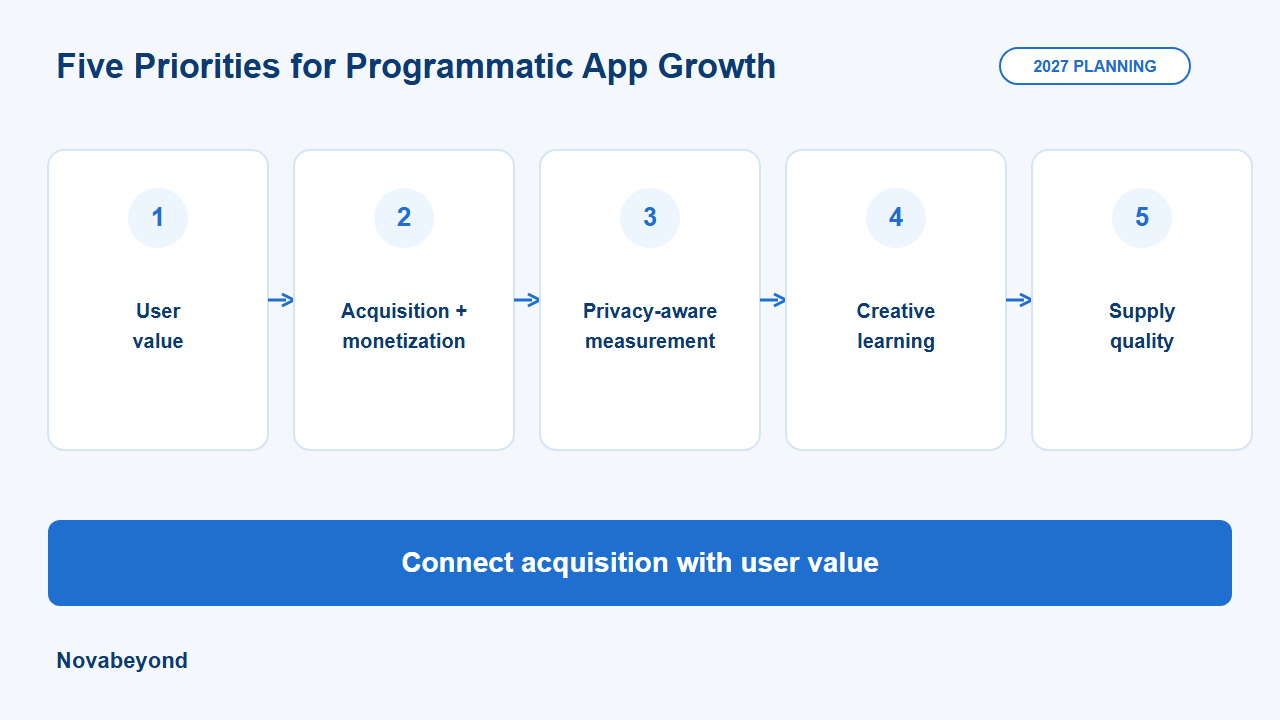
Five Programmatic Advertising Trends to Build Around in 2027
These priorities follow capabilities already available in 2026. Their significance for 2027 is how growth teams put them together, rather than whether another advertising feature appears.
1. Value-based bidding moves the conversation beyond CPI
Cost per install measures the price of acquisition, not what the acquired user contributes. A lower CPI can conceal weak activation, short retention, or low revenue. A higher CPI can be viable when users generate more contribution within the required payback window.
Moloco's campaign-goal documentation makes a useful distinction: purchase-event optimization seeks users likely to purchase, while purchase ROAS optimization considers the revenue those purchases generate. Those objectives solve different business problems.
For 2027 planning, define the outcome before selecting the bid strategy. A subscription app might prioritize paid activation; an IAP-led game might prioritize cohort purchase revenue. An ad-supported app needs advertising revenue in its evaluation. Keep CPI as a diagnostic, then judge acquisition against user quality and payback.
2. Acquisition and monetization become a connected feedback loop
Buying users and monetizing users become more effective when both teams work from the same value definition. Otherwise, acquisition can optimize toward an incomplete picture of the app's economics.
In its 2026 MediaGo for App announcement, MediaGo described a deep-learning Hybrid model that connects acquisition and monetization around ROAS. Moloco's ReelShort case study documents Dual ROAS evaluating in-app purchase (IAP) and in-app advertising (IAA) revenue together.
The strategic implication is specific: a user who never purchases may still generate valuable advertising revenue. For hybrid apps, separate the revenue streams in reporting, then combine them consistently when evaluating total cohort value. Check that revenue collection does not double-count purchases or advertising proceeds.
3. Privacy-aware measurement becomes part of campaign design
App acquisition spans environments with different signal availability and reporting delays. A common dashboard does not make those measurement conditions identical.
Moloco's current app advertising documentation describes support for MMP integrations, SKAdNetwork reporting, and incrementality testing. Build the campaign around the measurement route available to the target operating system and market. Establish event mappings, permissions, reporting windows, and expected delays before launch.
Compare cohorts at equivalent maturity. A recent cohort with incomplete revenue should not compete for budget against one that has already completed its evaluation window. Keep platform optimization reporting distinct from the business evidence used to allocate spend.
4. Creative quality means learning what produces valuable users
Creative testing needs to answer more than which asset attracts clicks. The stronger question is which message attracts users who activate, return, and generate revenue.
Native discovery may require an explanatory headline and a clear value proposition. In-app video may need to demonstrate the product experience quickly. Evaluate the connection between the promise in the ad and the experience after install.
Organize tests around distinct motivations, not cosmetic variations. Tag each concept so the team can connect creative performance to cohort quality. A high click-through rate paired with poor activation is a reason to revise the promise, not automatically increase delivery.
5. Supply quality becomes an allocation decision
Additional inventory creates growth opportunities only when its users and economics fit the app. Evaluate publisher or placement groups using retention, qualified actions, revenue, and suspicious-activity indicators alongside delivery metrics.
IAB Tech Lab's supply-chain transparency framework helps buyers identify unauthorized supply paths through ads.txt, app-ads.txt, and sellers.json validation. Combine that authorization layer with traffic-quality monitoring and business outcomes. Seller authorization and conversion quality answer different questions.
The broader 2027 mobile marketing strategy covers the channel portfolio. This programmatic layer focuses on the signals, supply decisions, and operating discipline that make a selected channel worth scaling.
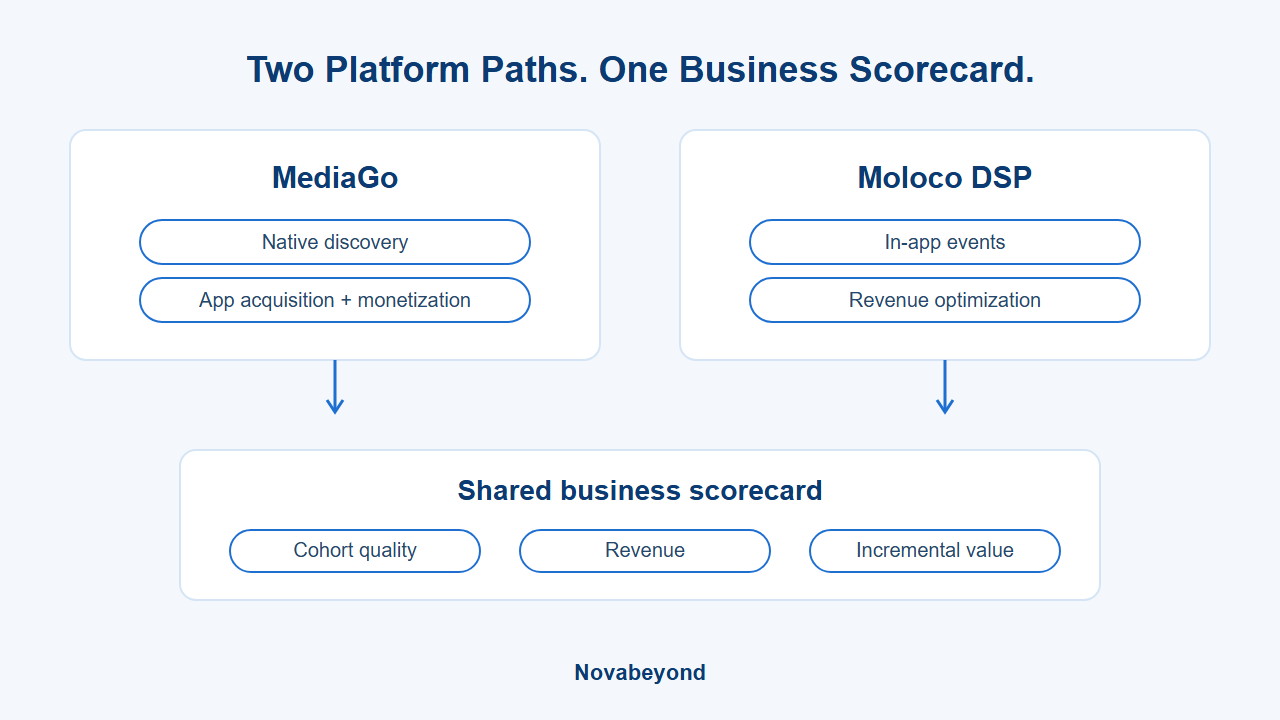
Give MediaGo and Moloco DSP Clear Growth Roles
Platform selection should start with the acquisition problem and revenue model. MediaGo and Moloco both use AI-driven optimization, but their available products and campaign configurations need separate evaluation.
MediaGo: separate native discovery from App growth
MediaGo's established publisher offering uses native and display formats, with deep learning evaluating signals and optimizing bids. Novabeyond's MediaGo native advertising support covers audience planning, native creative, landing-page review, and conversion-focused campaign management.
MediaGo for App adds an acquisition-and-monetization proposition. For an app-growth brief, identify which product and conversion path you are testing. A publisher-native campaign leading to an explanatory page has different creative, tracking, and funnel requirements from a dedicated App campaign.
For ad-supported or hybrid apps, assess how the App solution can use the relevant revenue signals. For content-led acquisition, examine the path from native discovery to store visit, activation, and monetization. That distinction makes the test interpretable.
Moloco DSP: align optimization with post-install value
Moloco Ads offers user acquisition and re-engagement campaigns with objectives tied to installs, in-app events, or ROAS. Its current product page describes AI evaluating impression opportunities and relevant creative against the advertiser's business outcomes.
The key decision is how deeply the campaign can optimize with the available signals. Registration, purchase probability, and purchase revenue are not interchangeable. Hybrid apps should evaluate combined-revenue optimization against their actual IAP and IAA data setup.
Planning question | MediaGo | Moloco DSP |
Which growth path are we testing? | Publisher-native or display discovery, or the dedicated MediaGo for App solution | App user acquisition or re-engagement through Moloco Ads |
What value should the test recognize? | Funnel conversions for the selected product; acquisition and monetization value for App growth | The selected in-app action or revenue objective; combined IAP and IAA where the configuration supports it |
What should creative demonstrate? | A relevant native promise or an App message suited to the chosen placements | The app experience and motivation for the desired post-install action |
What determines expansion? | Mature cohort quality, revenue, and incremental contribution | Mature cohort quality, revenue, and incremental contribution |
Use a shared business scorecard while preserving each campaign's product-specific setup. The goal is to establish complementary growth roles, not force both platforms into identical configurations.
Build the Signal and Creative Foundation Before Buying Scale
A campaign needs a reliable connection between delivery and the outcome it is supposed to improve. Create a readiness brief covering the target market, operating system, revenue model, optimization event, and evaluation window.
Define events that represent business value
Distinguish activation from registration, a purchase from a trial, and revenue from transaction value. Specify event names, revenue values, currencies, timestamps, and treatment of refunds. Reconcile incoming events against app analytics and financial reporting.
For Moloco purchase ROAS, the official requirements include purchase revenue through MMP postbacks. Confirm the data required by the chosen MediaGo product separately. Permissions and platform requirements should shape the integration, rather than assuming every available event can be transmitted.
If a high-value outcome occurs infrequently or much later, choose an earlier signal only when historical cohorts demonstrate a useful relationship with revenue. Continue checking that relationship as the audience mix changes.
Keep creative tests interpretable
Build a small set of distinct concepts: product demonstration, problem solved, or a specific use case. Localize the offer, language, and store experience for the target market. Evaluate each concept beyond its initial engagement metrics.
Separate changes to creative from changes to optimization goals when possible. If the team alters both together, it becomes harder to understand which decision changed user quality. Novabeyond's Moloco learning and iROAS guide provides the deeper platform-specific operating detail.
![App event and revenue validation workflow before programmatic campaign launch]](https://novabeyond.com/ueditor/php/upload/image/20261110/1794306265801656.jpg "App event and revenue validation workflow before programmatic campaign launch]")
See how Novabeyond connects traffic intelligence, measurement, and campaign optimization
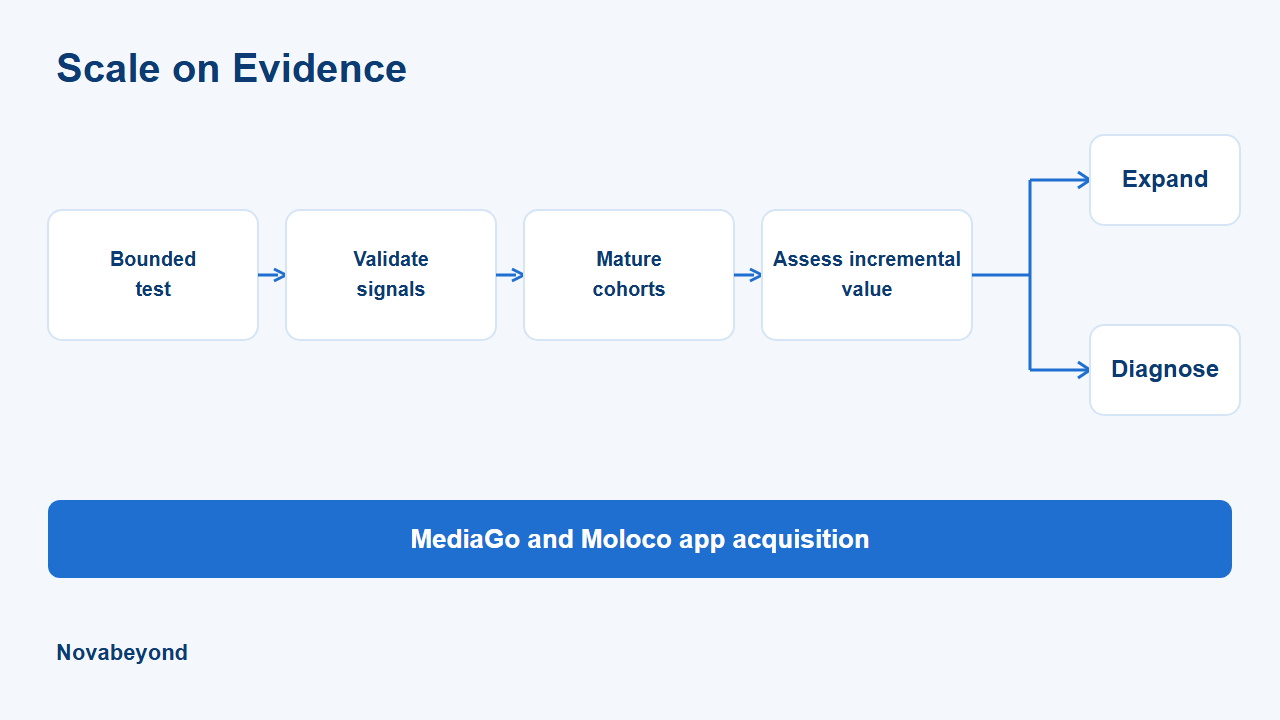
Scale with Cohort Evidence, Not a Short-Term Dashboard Win
Adding a platform should answer a testable question: can this acquisition path generate additional valuable users at acceptable economics?
Start with a bounded test
Select a defined market, operating system, and growth objective. Keep the established acquisition baseline reasonably stable. Allocate enough budget and time to observe the chosen event and its revenue window, without fragmenting the test across many small campaigns.
Set decision criteria before delivery starts: qualified-user cost, retention, mature cohort ROAS, payback, and traffic-quality checks. Separate new-user acquisition from re-engagement so returning customers do not inflate the apparent acquisition result.
Compare at the same cohort age
Review users acquired during comparable periods and allow the selected revenue window to mature. Track purchase and advertising revenue consistently across channels. Investigate differences between the MMP, platform reporting, and app analytics before treating a result as an allocation signal.
Platform attribution shows credited outcomes. Where feasible, a holdout or comparable-market experiment can help estimate outcomes caused by the additional spend. The programmatic versus Google App Campaigns guide develops that testing distinction.
Expand the validated dimension
If a campaign produces acceptable cohort quality in one market, increase investment while monitoring the same scorecard. Treat a new geography, different optimization event, or new creative promise as a separate hypothesis.
Watch marginal performance after each expansion. Stable average ROAS can conceal weaker returns from the latest budget increase. Pause expansion when revenue quality or payback deteriorates, then diagnose whether supply, creative, signals, or audience overlap changed.
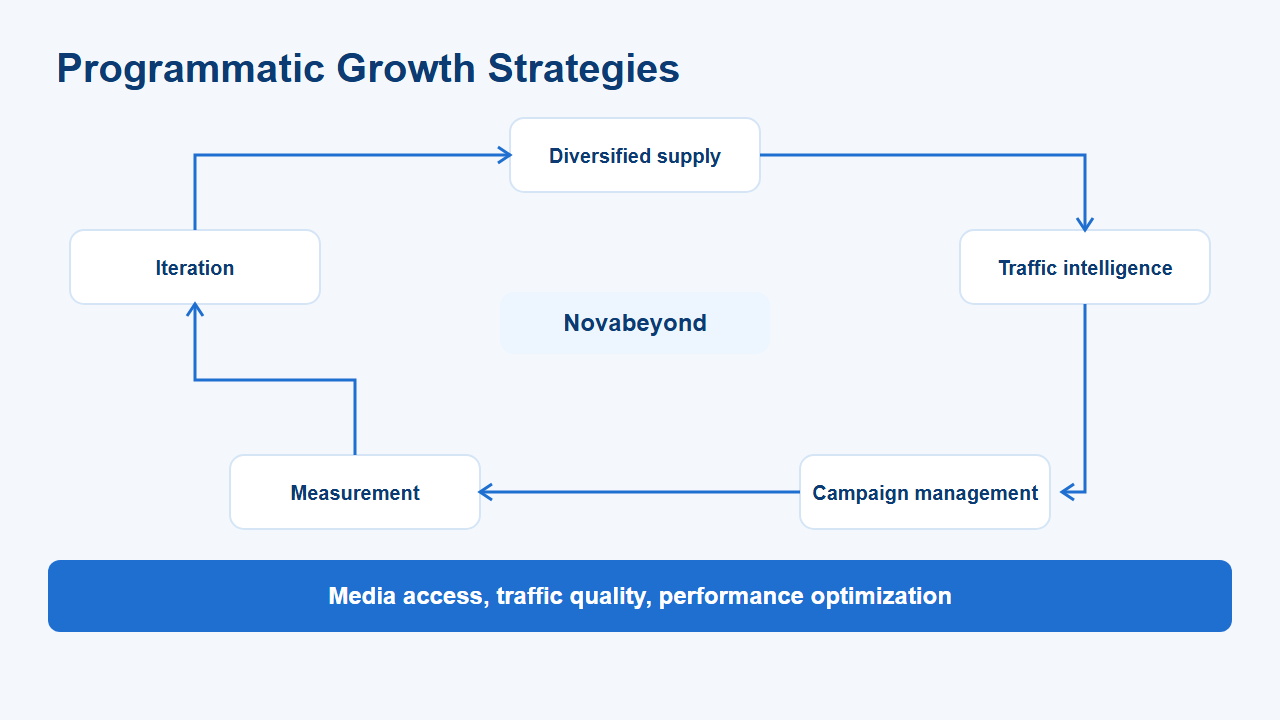
How Novabeyond Turns These Trends into Programmatic Growth Strategies
The value of a programmatic partner is the connection between media access and operating decisions. Novabeyond's Programmatic Growth Strategies address that connection through four practical capabilities.
Diversified global and local supply. Access through SSPs, ad exchanges, and publisher partnerships gives teams more acquisition environments to evaluate. Select supply around the app's market and audience requirements.
AI-driven traffic intelligence. User-value modeling, suspicious-traffic filtering, and real-time performance monitoring support decisions about which traffic deserves further investment.
Campaign and allocation management. Audience, channel, creative, and delivery strategies can be adjusted around product and market performance. Novabeyond's service framework supports CPI, CPA, CPS, and CPM buying models; the commercial model and the optimization objective should be specified separately in the campaign brief.
Measurement and iteration. Conversion-path tracking, user-behavior analysis, dashboards, and third-party checks support a recurring review of cost, quality, and outcomes.
For a MediaGo and Moloco growth plan, begin with the app's revenue model, data readiness, and priority market. Then define the platform roles, test structure, and expansion criteria. This keeps Programmatic Growth Strategies focused on the growth system rather than simply adding another source of traffic.
FAQ
1. What are the most relevant programmatic advertising trends for app growth in 2027?
Value-based optimization, connected acquisition and monetization, privacy-aware measurement, creative learning, and supply-quality decisions. Their practical value comes from linking campaign delivery to retention, revenue, payback, and incremental contribution.
2. Can MediaGo support app growth as well as native advertising?
Yes. MediaGo announced MediaGo for App in 2026, connecting acquisition and monetization through deep learning. Define whether the brief concerns that App solution or publisher-native discovery, because the conversion path and data requirements differ.
3. How is Moloco purchase-event optimization different from ROAS optimization?
Purchase-event optimization targets users likely to purchase. Purchase ROAS optimization also considers the revenue value of purchases. Moloco requires revenue-bearing purchase postbacks for the latter, so the integration must support the chosen objective.
4. How should an app that earns both purchase and advertising revenue evaluate users?
Track IAP and IAA separately, then evaluate total cohort revenue over a consistent window. Consider combined-revenue optimization where supported, and reconcile both streams to prevent omissions or double-counting.
5. Should MediaGo and Moloco replace existing acquisition channels?
Start by testing them alongside the established baseline. Shift allocation when comparable cohorts and, where feasible, incrementality tests show acceptable additional value. Channel expansion should follow evidence about the app's economics.
6. What does Novabeyond add beyond DSP access?
Programmatic Growth Strategies connect diversified supply with traffic intelligence, campaign management, performance monitoring, and measurement. That operating framework helps teams select useful traffic, investigate performance changes, and plan expansion around business outcomes.
Conclusion
For 2027, scalable programmatic app growth depends on buying toward the value users create after install. MediaGo's acquisition-and-monetization proposition and Moloco's event and revenue optimization capabilities make that approach actionable.
Execution determines whether those capabilities produce a useful growth channel. Define the outcome, validate signals, match creative to placements, evaluate mature cohorts, and expand against a consistent scorecard. Novabeyond's Programmatic Growth Strategies connect media access, traffic intelligence, optimization, and quality monitoring to support that process.
Build your 2027 app growth framework with Novabeyond's Programmatic Growth Strategies
more posts
Driving Scale in SEA: Why Indonesia and Vietnam Are App UA Growth Hotspots (And How to Win via Programmatic Ads)
October. 15 2026
LEARN MORE

Mastering Mobile User Acquisition for Fintech Apps in 2026: What Actually Works
October. 08 2026
LEARN MORE
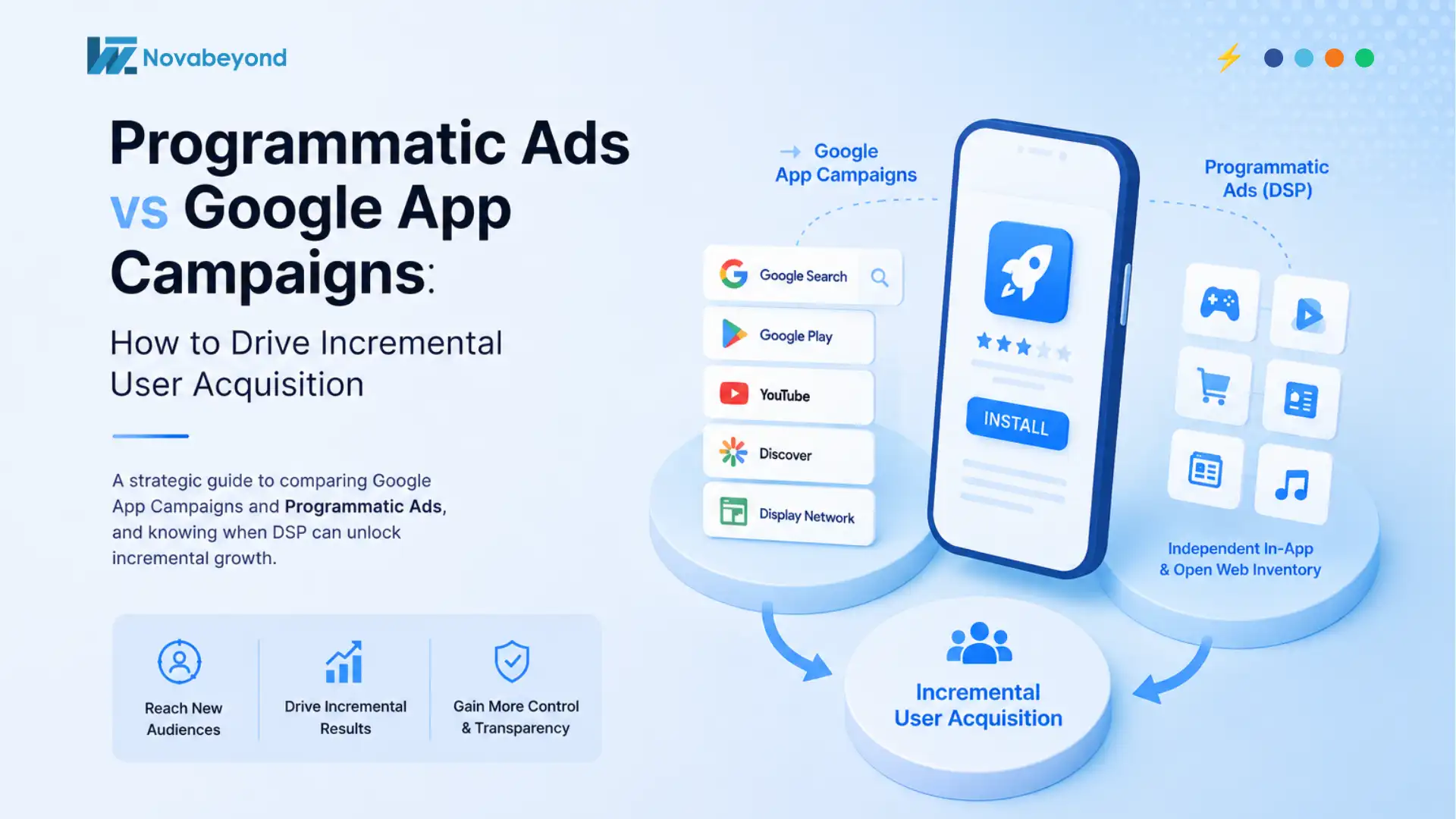
Programmatic Advertising vs. Google App Campaigns: How to Drive Incremental UA in 2026
September. 23 2026
LEARN MORE
The Complete Practical Guide to Mobile App User Acquisition in 2026: Bidding, Creatives, and Scaling
September. 22 2026
LEARN MORE