





UNIT 616 6/F KAM TEEM INDUSTRIAL BUILDING 135 CONNAUGHT ROAD WEST SAI WAN HONGKONG.
Copyright © 2026 NOVABEYOND LIMITED (company number 2833487). All rights reserved.
Introduction
Many advertisers struggle to scale emerging short-video campaigns for a simple reason: they treat Kwai Ads and SnackVideo Ads as interchangeable channels. A team adapts one Portuguese creative into Bahasa Indonesia, splits the budget across two markets, and evaluates both campaigns using a blended CPA. When results disappoint, the team cannot tell whether the problem comes from market selection, creative fit, or conversion readiness.
The first decision should not be which platform has the lowest CPM. It should be which market can generate valuable customers and which advertising channel can reach them effectively.
Kwai is a key short-video channel to evaluate for Brazil and other confirmed Latin American markets. SnackVideo deserves consideration when Indonesia is the commercial priority and advertising access, available formats, and the conversion journey are ready.
Both channels require a clear operating plan. Advertisers need to verify local access, prepare market-specific creative, establish reliable tracking, and allocate enough budget to learn from the results.
For a broader regional planning framework, see Novabeyond's Kwai Ads vs SnackVideo allocation matrix for LATAM and Southeast Asia.
Validate your Kwai and SnackVideo market strategy
Quick Answer
Use Kwai Ads when Brazil or another verified Kwai market matches your revenue goal and your business can convert local customers. Consider SnackVideo Ads when Indonesia or another confirmed SnackVideo market is commercially ready. Before launching, verify advertising access, available formats, local creative, and the conversion path. Start with one primary market, measure conversion quality alongside CPA, and expand only when the second market has its own budget, tracking, and localization plan. Never choose a channel based on low CPM alone.
Rule Set 1: Geography First, Brand Name Second
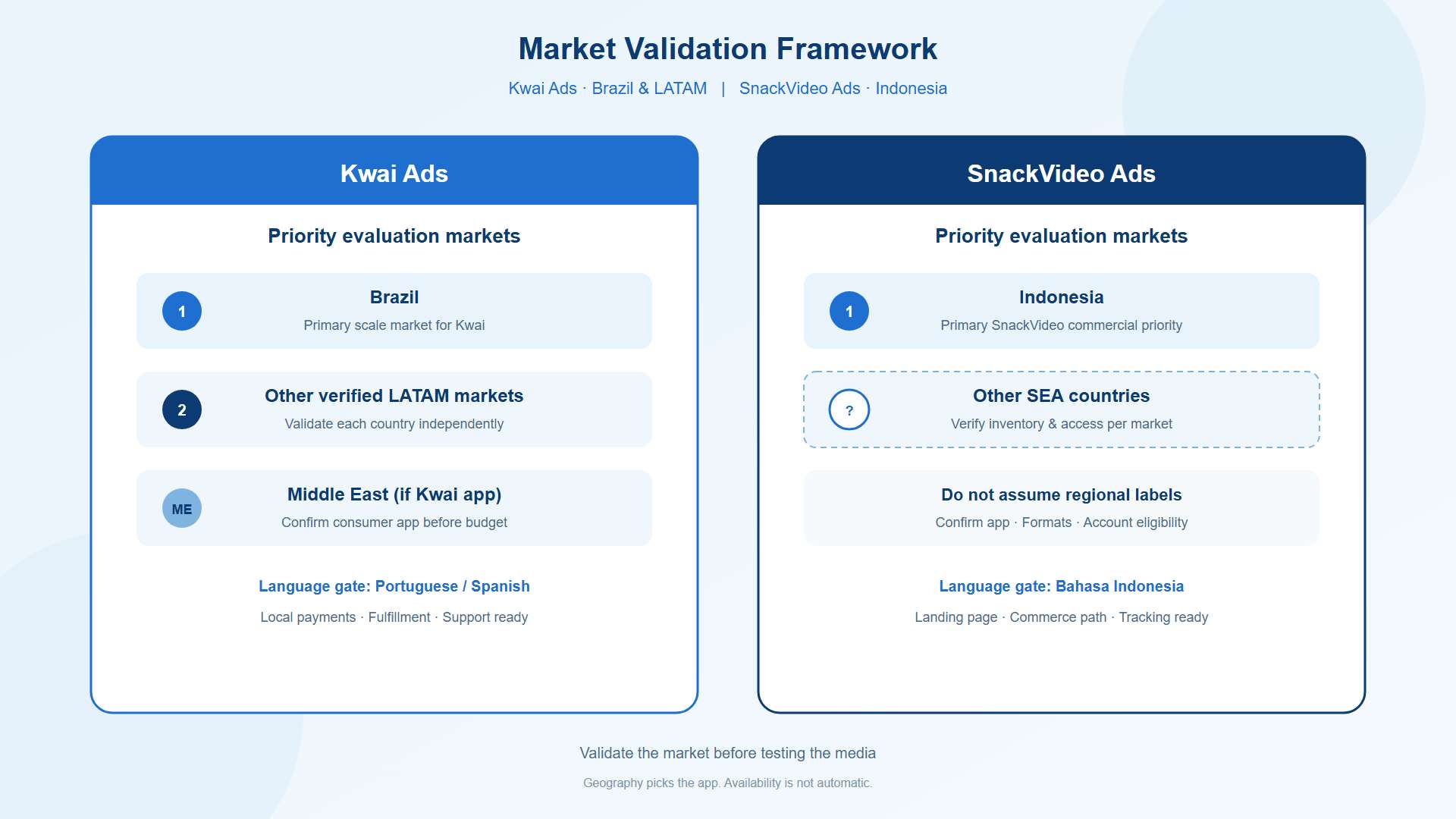
The consumer app and advertising products available in a country should guide channel selection. Regional labels such as LATAM, Southeast Asia, and the Middle East are useful for planning, but they do not confirm inventory availability or advertising access.
Before allocating budget, establish where the business needs to generate revenue, which audience it needs to reach, and whether the selected channel can support the campaign.
| Decision | Use Kwai Ads | Use SnackVideo Ads | Do not launch yet |
| Geography | Brazil first, then other verified Latin American Kwai markets | Indonesia first, then other countries with confirmed SnackVideo access | A region label with no primary country |
| Language and creative | Brazilian Portuguese or country-specific Spanish | Bahasa Indonesia as the default Indonesia test language | English-only global cuts |
| Conversion path | Local payments, fulfillment, and support in the target country | Local landing page, app path, or commerce destination that works in Indonesia | No working purchase or registration journey |
| Budget role | Primary test when LATAM is the revenue goal | Primary test when Indonesia is the revenue goal | A 50/50 split that underfunds both markets |
When to Use Kwai Ads
Kwai Ads deserves consideration when Brazil or another verified Kwai market aligns with the campaign objective.
1. Brazil as a priority market. If Brazil represents a meaningful revenue opportunity, evaluate Kwai alongside your other eligible acquisition channels. Confirm the available advertising products, account access, and campaign requirements before committing spend.
2. Other Latin American markets. Do not treat Latin America as one homogeneous audience. Spanish-speaking markets differ in purchasing power, payment preferences, fulfillment requirements, and customer behavior. Validate each country independently.
3. Offers that require local relevance. Portuguese creative can support Brazilian campaigns, while Spanish-language campaigns need language and cultural adaptation for their intended country. A translated headline alone does not make an offer locally relevant.
4. Businesses with a working conversion journey. Confirm that the product can reach customers, accept local payments where applicable, and provide appropriate support. Advertising access means little if customers cannot complete the intended action.
When to Use SnackVideo Ads
Consider SnackVideo Ads when Indonesia is the primary market or when another market has confirmed SnackVideo availability and a viable commercial opportunity.
1. Indonesia-focused acquisition. Confirm that your intended audience is reachable through the available advertising inventory and that your account can access the required campaign products.
2. Localized conversion paths. Prepare Bahasa Indonesia creative where appropriate, along with a landing page, app experience, or commerce destination that supports local users. Check payment methods and fulfillment before interpreting weak conversion rates as a media problem.
3. Commerce and app campaigns. If the campaign depends on product pages, deep links, app installs, or in-app commerce, confirm which destinations and tracking options the current setup supports. Do not assume that every format or destination is available to every advertiser.
4. Expansion into other Southeast Asian countries. Verify each country's consumer app, inventory, account eligibility, and available formats. The presence of SnackVideo in one market does not establish that the same advertising options work in neighboring countries.
When Neither Channel Is Ready
Delay the launch if the campaign lacks a primary country, local creative, reliable conversion tracking, or a functioning purchase or registration journey.
The same applies when product restrictions, local compliance, payments, or customer support remain unresolved. These are business-readiness issues. Extra impressions will not fix them.
Validate the market before testing the media. That keeps spend on a channel that can support the commercial objective.
Rule Set 2: Creative Rules That Decide Fit
Market selection determines where to test. Creative determines whether the offer makes sense to the audience.
Both channels use short-video advertising, but advertisers should not assume that a creative concept will perform equally well across countries. Language, cultural references, price presentation, product relevance, and the conversion journey all influence campaign outcomes.
Creative Rules for Kwai Ads
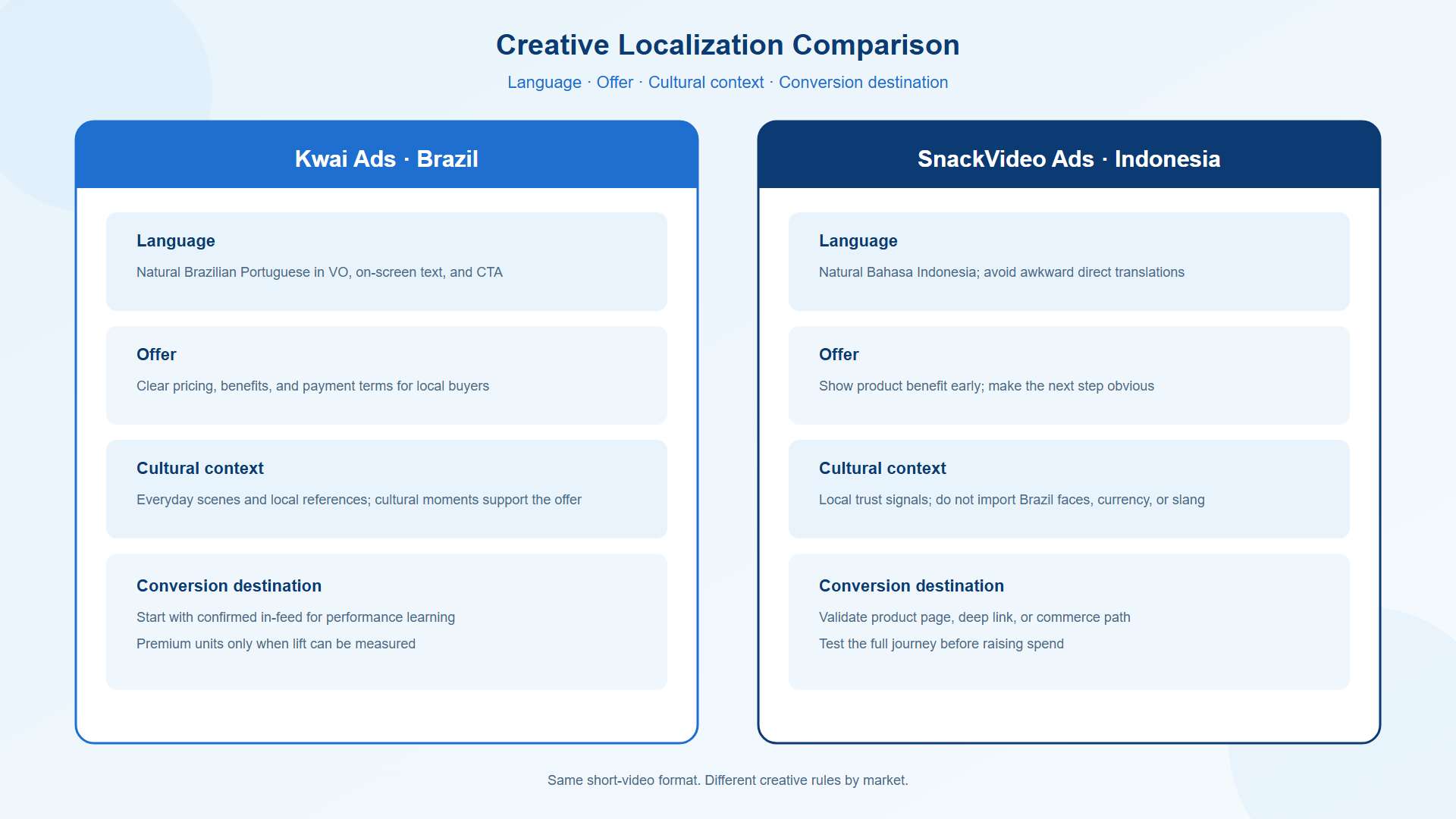
1. Lead with local language and context. For Brazil, use natural Brazilian Portuguese in voiceovers, on-screen text, and calls to action. For other markets, adapt the message to the language and expectations of the intended audience.
2. Show the product in a recognizable setting. Everyday situations, clear product demonstrations, and relevant local references can help audiences understand the offer quickly. The job is to make the value proposition easy to recognize.
3. Make the commercial offer clear. Ecommerce campaigns should communicate relevant pricing, benefits, payment conditions, or promotional terms accurately. Avoid vague claims that force users to search for basic information after clicking.
4. Plan around local demand. Seasonal events and retail periods can influence campaign timing. A cultural moment should support a relevant offer rather than replace one.
5. Start with formats that support the objective. When performance learning is the priority, begin with an in-feed format confirmed for your market. Consider premium placements when you have a defined awareness or reach objective and a measurement plan that can evaluate their contribution.
Check the current specifications, buying requirements, and availability of products such as Eyemax through your authorized partner before briefing the creative team.
For additional guidance on campaign objectives and formats, see Novabeyond's Kwai Ads 2027 strategy guide.
Creative Rules for SnackVideo Ads
1. Use natural Bahasa Indonesia where appropriate. Avoid direct translations that sound unnatural or overlook local expressions. Native review can help identify confusing wording and culturally unsuitable references.
2. Communicate the benefit early. Give viewers a clear reason to continue watching. Demonstrate the product, explain the offer, or establish the problem the product solves before introducing unnecessary background.
3. Make the next step obvious. If the goal is an app install, explain the benefit of installing the app. If the goal is a purchase, make the offer and destination clear. Match the call to action to the conversion event being measured.
4. Validate the destination. If your campaign depends on a product page, app deep link, or commerce experience, confirm that the destination works on the intended devices and supports the required tracking. Test the complete journey before increasing spend.
Build local trust. Product demonstrations, credible claims, clear terms, and relevant customer scenarios can support consideration. A recognizable creator or brand account does not compensate for a broken landing page or an unclear offer.
Shared Creative Diagnostics
Use campaign signals to identify the next action rather than replacing creative without a clear hypothesis.
Review watch time, clicks, and conversion quality alongside delivery data, audience settings, tracking quality, and the intended conversion event.
High watch, weak click: change the offer, end card, or CTA before reshooting the whole concept.
Strong click, weak purchase or install: audit the landing page, price, payment, and tracking before blaming the creator.
One English global asset across both apps: rebuild local cuts before launch.
A creative test should answer a question. Change one meaningful variable at a time when practical, document the hypothesis, and compare results under reasonably consistent conditions.
Build a market-specific short-video test plan
Rule Set 3: Budget Rules for Testing, Dual-Running, and Scaling
Budget decisions determine whether campaign results are useful. Splitting money equally across two markets may appear balanced, but it can leave both campaigns without enough data to support a decision.
Instead, assign each market a specific role, define its learning objective, and set a measurement framework before launch.
Budget Rule A: Start With One Primary Market
Choose the market with the strongest combination of commercial opportunity, operational readiness, and available audience access.
Then establish one clear campaign objective, a primary conversion event, and a budget designed around the expected cost of that event.
An advertiser using a shared Kwai Ads agency ad account may be able to coordinate campaign operations across markets, depending on account permissions and partner arrangements. Shared administration does not mean that markets should share the same optimization assumptions or reporting benchmarks.
Keep country-level campaigns and performance data separate so that each market produces a useful learning signal.
Budget Rule B: Calculate a Defensible Test Budget
Do not rely on a universal dollar amount as the minimum required for a successful test. Actual requirements depend on the objective, expected conversion cost, delivery conditions, and the amount of evidence needed for a decision.
A practical planning method is:
Define the primary conversion event.
Estimate the expected cost per conversion using relevant historical data, partner guidance, or a clearly labeled planning assumption.
Set a target number of conversions for the test.
Multiply the estimated cost per conversion by the target conversion count.
Review whether the resulting budget and observation window are realistic.
For example, a planning CPA of $20 and a target of 30 conversions implies a $600 media budget [to verify against your vertical floor]. If actual costs differ from the estimate, reassess the budget and measurement plan.
For campaigns with low conversion volume, extend the observation period or change the diagnostic approach. Do not declare a winner because one campaign records a few inexpensive conversions.
Budget Rule C: Separate Reporting Even When Finance Is Unified
Finance teams may need one invoice or a consolidated view of total media spending. That is an administrative decision, not a reason to merge campaign performance.
Report each market separately using metrics that match the business objective. Choose the measures that connect the advertising objective to the business outcome.
A lead-generation campaign should not scale on form submissions alone if many leads fail qualification. An app campaign should not treat inexpensive installs as success if users do not remain active.
Budget Rule D: Dual-Run Only When Both Markets Are Ready
Running Kwai Ads and SnackVideo Ads in the same quarter can make sense when the business has a real commercial opportunity in both markets.
Before starting a dual-market program, confirm three conditions:
The first market has produced a useful signal. Delivery, tracking, and conversion quality are sufficiently reliable to inform the next decision. A short-lived cost improvement does not automatically establish sustainable performance.
The second market has its own operating plan. Prepare local creative, a suitable conversion journey, a market-specific budget, and a measurement framework before launch.
The business can support both markets. Product availability, customer service, fulfillment, payment readiness, and compliance must support the expansion.
Do not launch a second market simply because the first campaign is underperforming. Adding another channel without diagnosing the original problem multiplies uncertainty.
Budget Rule E: Scale Quality, Not the Cheapest CPM
Scale only when the campaign produces reliable evidence that the cost and quality of conversions meet the business objective.
Increase budgets in controlled steps, monitor changes in CPA and downstream quality, and check whether performance remains acceptable as delivery expands.
Pause or revise a campaign when tracking becomes unreliable, the conversion journey breaks, or customer quality falls below the required standard. A low CPM cannot compensate for poor commercial outcomes.
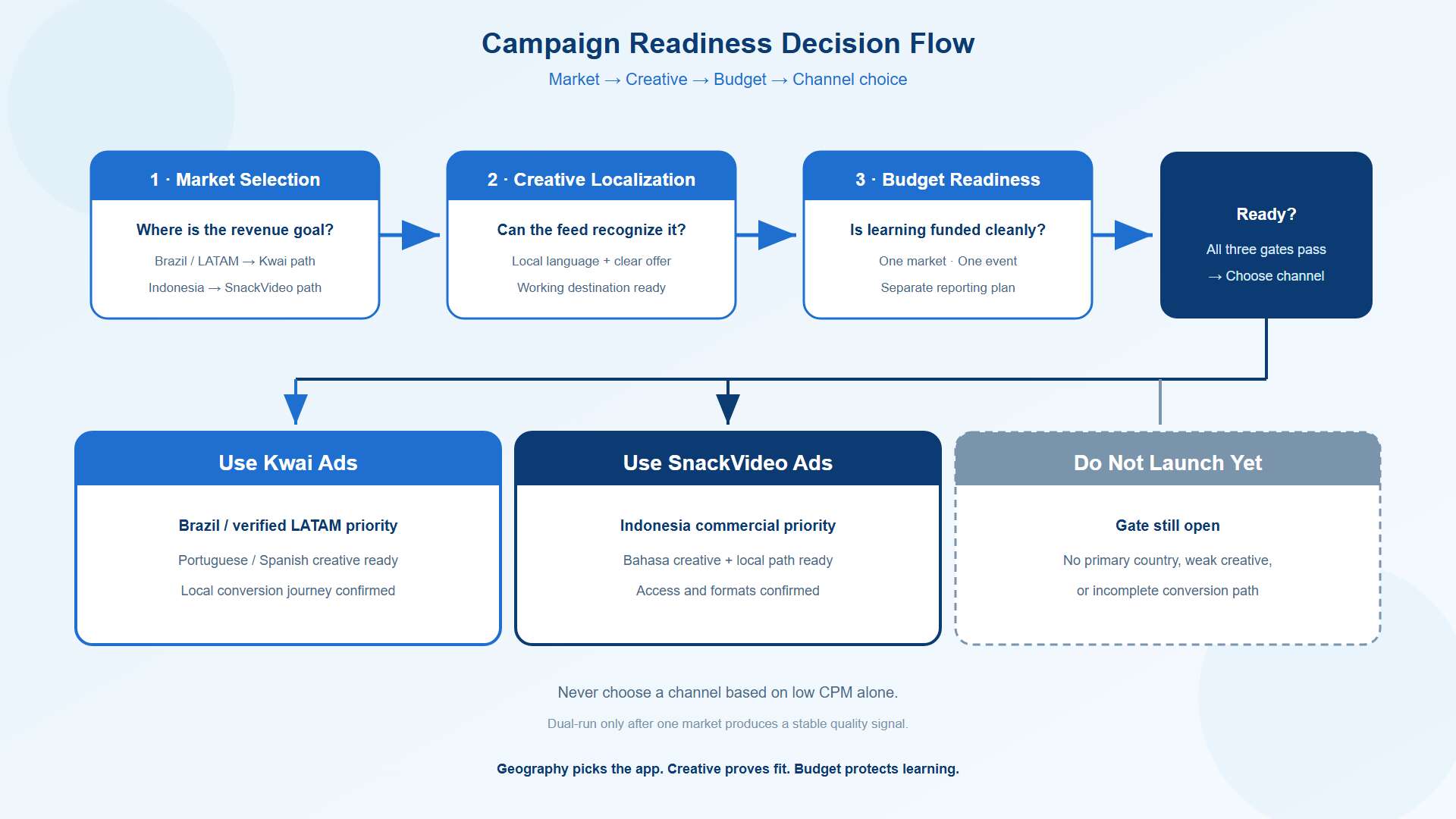
Use this operating sequence to guide decisions:
Select the market: Identify where the business can realistically convert customers.
Verify access: Confirm the consumer app, available inventory, and advertising permissions.
Prepare creative: Localize the message and conversion path.
Fund the test: Set a defensible budget based on the objective and expected conversion cost.
Evaluate quality: Review results separately for each market.
Expand selectively: Add the second market when its commercial readiness and measurement plan justify the investment.
FAQ
1. Are Kwai Ads and SnackVideo Ads the same platform?
They are commercially related channels, but their consumer apps, market coverage, advertising products, and campaign requirements should not be assumed to be identical. Advertisers should verify account access, available inventory, and buying arrangements for each target market before planning a combined campaign.
2. When should I use Kwai Ads instead of SnackVideo Ads?
Consider Kwai Ads when Brazil or another verified Kwai market matches your revenue objective and your business can serve local customers. Consider SnackVideo Ads when Indonesia or another confirmed SnackVideo market offers a viable commercial opportunity. The final decision should reflect actual availability, conversion readiness, and campaign economics.
3. When should I use SnackVideo Ads in Indonesia?
Consider SnackVideo Ads when Indonesia is your target market, localized creative is ready, and the conversion journey supports local users. Verify advertising access, available formats, destination compatibility, and tracking before launching. Do not assume that a successful campaign structure in Brazil will transfer unchanged to Indonesia.
4. Can I manage Kwai Ads and SnackVideo Ads under one budget line?
You may consolidate financial reporting where your account and billing arrangements support it. However, keep campaign budgets, conversion events, and performance reporting separated by market. This allows you to identify which channel produces valuable results instead of relying on a blended CPA that hides differences in cost and quality.
5. What creative format should I test first?
For performance campaigns, start with a vertical in-feed format confirmed as available in your target market. Lead with the benefit, use natural local language, and make the next step clear. Verify current creative specifications and premium placement requirements with your authorized partner before production or budget commitments.
6. How much budget do I need before judging a campaign?
Estimate the expected CPA, decide how many conversions you need to observe, and calculate a planning budget from those assumptions. Then account for the campaign objective, delivery conditions, and measurement limitations. No single budget guarantees a reliable result across every vertical. If conversion volume is insufficient, extend the observation period or revise the test design.
7. How should advertisers validate Kwai or SnackVideo availability in the Middle East or other new markets?
Start by identifying the consumer app serving the intended audience. Then confirm local advertising access, inventory, eligible formats, account permissions, and commercial requirements with an authorized partner. Do not assign a market to Kwai or SnackVideo simply because it belongs to an emerging-market region.
8. Do I need an agency ad account to run these channels?
Access requirements depend on the advertising product, market, and current partner arrangements. International advertisers should confirm whether an agency ad account or authorized partner onboarding is required, along with billing and account permissions. Novabeyond can help businesses assess channel access and plan market-specific campaign operations.
Conclusion
Choosing Kwai Ads vs SnackVideo Ads is a market and growth decision, not a branding preference. Geography identifies where the opportunity exists. Creative localization helps audiences understand the offer. Budget discipline determines whether campaign results provide enough evidence to support the next investment.
Start with one commercially ready market, verify the available advertising products, and build a test around a meaningful conversion event. Evaluate cost alongside customer quality, keep reporting separated by market, and expand only when the second market has its own creative, conversion path, and measurement plan.
Novabeyond supports advertisers through Emerging Media Solutions, helping teams assess emerging channels, navigate access requirements, localize campaigns, and build more disciplined growth strategies.
Before allocating your next budget across Latin America and Southeast Asia, make the market decision explicit. A well-designed first test gives your team a stronger foundation for sustainable acquisition and more confident expansion.
more posts
Category × Platform: Three Questions to Find Your First Emerging Media Test
November. 19 2026
LEARN MORE

The 7 Days After the Big Sale: Why December Is the Golden Window to Test Emerging Media
November. 16 2026
LEARN MORE
Same Offer, Two Playbooks: How News-Feed and Social-Story Platforms Differ
November. 13 2026
LEARN MORE
MediaGo URL Pre-Approval: Landing Page Checklist and Fixes
October. 30 2026
LEARN MORE