





UNIT 616 6/F KAM TEEM INDUSTRIAL BUILDING 135 CONNAUGHT ROAD WEST SAI WAN HONGKONG.
Copyright © 2026 NOVABEYOND LIMITED (company number 2833487). All rights reserved.
Introduction
Search campaigns can remain profitable while growth slows. You capture existing demand, but additional budget brings fewer new customers or a higher acquisition cost. Google Display Ads offer another route: reaching people while they browse, building consideration, and reconnecting with visitors before their next purchase decision.
The challenge is deciding whether that reach creates business value. More impressions, cheaper clicks, and a stronger reported ROAS can tell different stories. This guide explains how to evaluate Google Display Network performance, improve campaign inputs, and make budget decisions that support incremental growth beyond Search.
Discuss your search-to-discovery growth strategy with Novabeyond
Quick Answer
Evaluate Google Display Ads against a defined business outcome, such as qualified leads, profitable purchases, or retained app users. Separate prospecting from remarketing, inspect placement quality, and compare results after conversion delays have settled. Distinguish click-through, engaged-view, and view-through conversions before comparing campaigns. In 2026, Display campaigns are transitioning into Demand Gen, while GDN remains available as a channel. Performance Max also reaches GDN but includes Search and other channels. Scale through a controlled budget test: improve signals and creatives, set spending guardrails, and verify whether total business outcomes increase rather than simply shifting attribution.
1. Understand What Google Display Ads Mean in 2026
GDN is a channel, not a synonym for every Google campaign
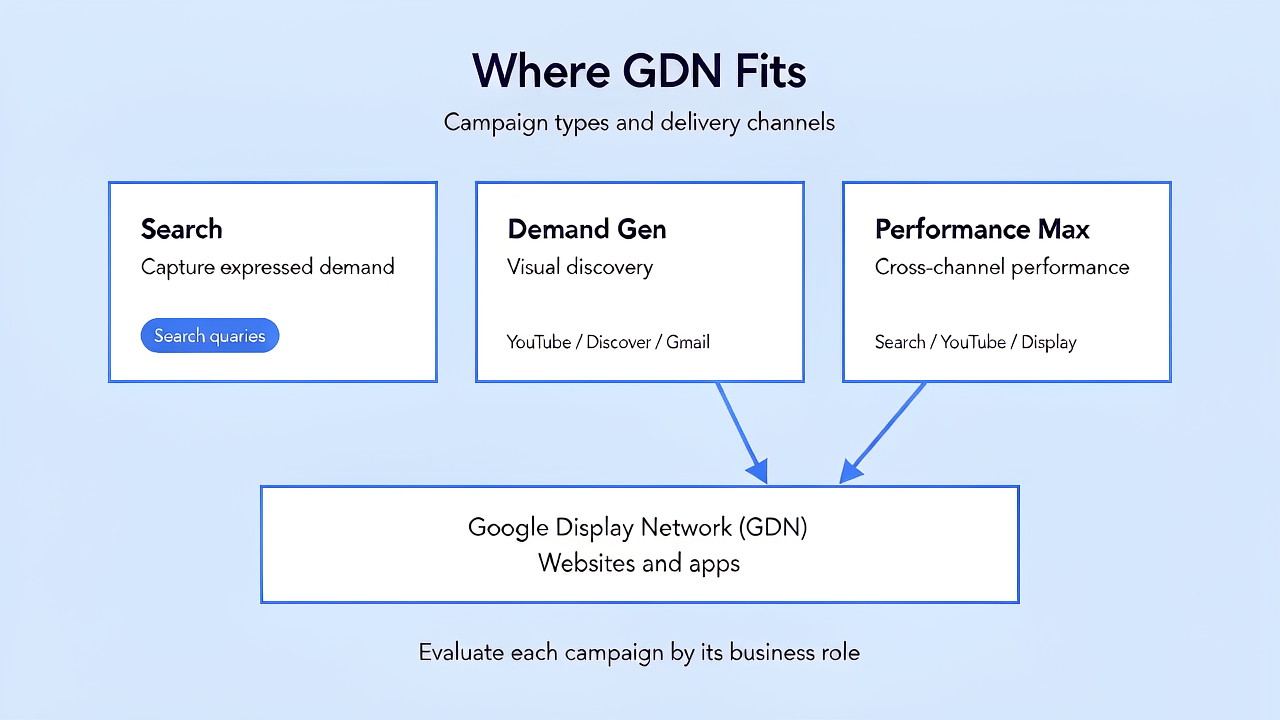
The Google Display Network reaches websites and apps where users consume content rather than actively entering a purchase query. Its value comes from audience relevance, context, creative attention, and the ability to support decisions over time.
Three distinctions matter when evaluating results:
Search campaigns capture expressed demand through search queries.
Demand Gen campaigns support visual discovery across surfaces including YouTube, Discover, Gmail, and GDN. YouTube Search placements are different from Google Search results.
Performance Max campaigns optimize across Google channels, including Search, Display, and YouTube. Their combined results cannot be treated as a standalone Display performance benchmark.
For the underlying formats and targeting concepts, Novabeyond's Google Display Ads fundamentals guide provides a starting point. The operational question here is what additional business outcome Display delivers alongside your existing campaigns.
GDN's advantages are broad discovery opportunities, contextual environments, and remarketing reach beyond search queries. Its trade-offs are uneven placement quality, dependence on strong visuals, and conversion paths that may finish elsewhere. Evaluate that combination against the job you need done: attracting new buyers, developing consideration, or recovering qualified visitors. Each requires a different audience and success criterion.
Prepare for the Display-to-Demand Gen transition
According to Google's Display migration guidance, a phased migration tool rollout began in June 2026 for eligible advertisers. Later stages move new campaign creation and remaining eligible campaigns into Demand Gen. Existing Display campaigns can still be accessed and edited until they migrate.
GDN is not disappearing. Advertisers can continue serving exclusively on GDN through Demand Gen channel controls.
Before migrating, record audiences, conversion goals, exclusions, creative assets, and budget settings. The migration tool can transfer up to 42 days of performance history, but migration cannot be reversed. The new campaign also does not account for spend already incurred by the original campaign that day, so plan the migration day's budget carefully. Avoid migrating during an active lift study because the new campaign will not automatically inherit the study association.
2. Build a Performance Scorecard That Connects Media to Business Results
Measure the outcome before judging the traffic
Start with the conversion action that reflects your commercial objective. For ecommerce, purchases and transaction value should drive the evaluation. For lead generation, connect form submissions to qualified leads and sales. For apps, evaluate activation, retention, or revenue beyond the install.
Page views and landing-page visits help diagnose delivery, but making them the primary optimization target can reward traffic that never becomes a customer.
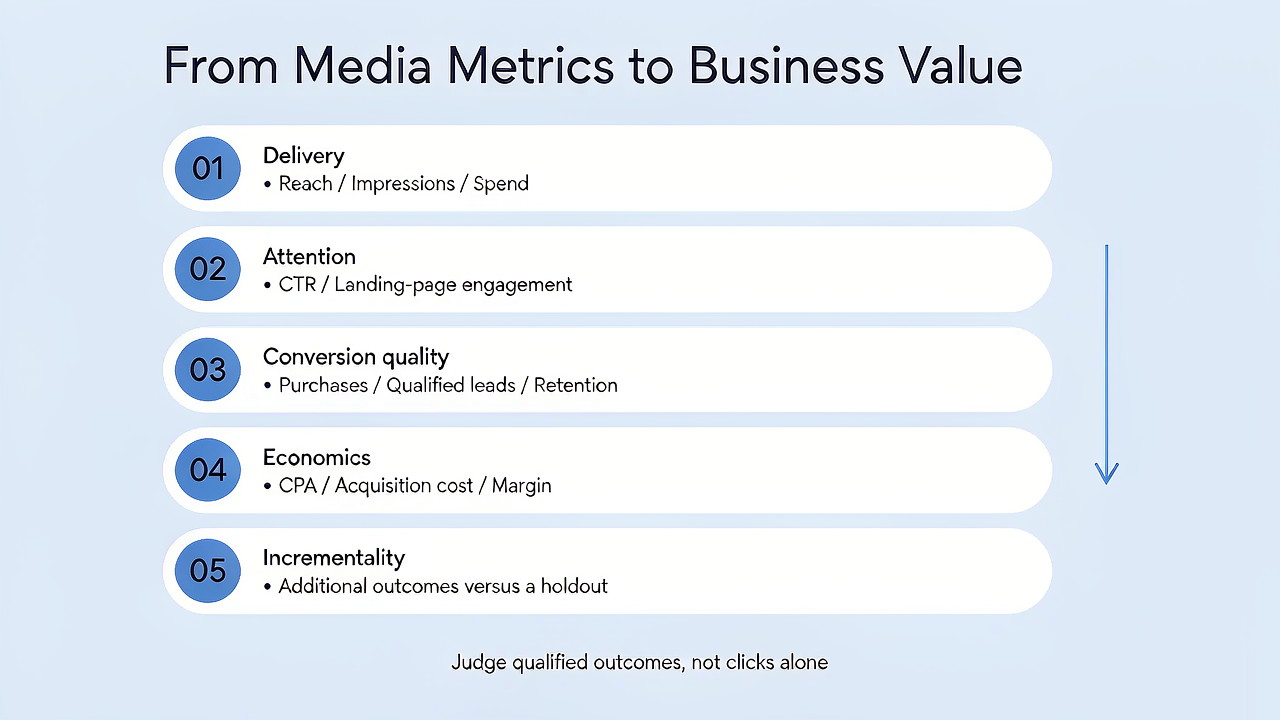
Evaluation layer | What to inspect | Decision it supports |
Delivery | Reach, impressions, eligible placements, spend | Is the campaign reaching the intended opportunity? |
Attention | CTR, landing-page engagement, creative response | Does the message attract relevant interest? |
Conversion quality | Purchases, qualified leads, activation, retention | Are interactions producing valuable outcomes? |
Economics | CPA, acquisition cost, conversion value, margin | Can the business afford these outcomes? |
Incrementality | Outcomes versus a comparable holdout | Would these results have happened without the advertising? |
A high CTR is useful only if the resulting visitors progress toward the business goal. Likewise, a low CTR does not settle the value of a discovery campaign. Review attention, conversion quality, and economics together.
Keep attribution events and time windows consistent
Display and video can receive credit after an impression or an engaged view, not just a click. Google's Demand Gen VTC optimization documentation explains that eligible view-through conversions can become biddable conversions. The feature applies to video assets on supported channels, and newly created Demand Gen campaigns have it enabled by default.
Check each campaign's actual setting. Segment conversions by ad event type to distinguish clicks, engaged views, and impressions. Align conversion actions and attribution windows before interpreting differences in CPA or ROAS. An increase caused by changing which events enter the main conversion column is different from an increase in sales.
Exclude the recent period where conversions are still arriving. Choose that interval from your own conversion-delay pattern, then compare mature periods rather than yesterday's incomplete results.
3. Improve Audience Signals, Placement Quality, and Creative Relevance
Separate prospecting from remarketing
Prospecting reaches potential customers who have not yet progressed through your funnel. Remarketing reconnects with people who have already visited, engaged, or purchased. Their conversion likelihood and role in growth differ.
Evaluate them separately so an efficient remarketing audience does not hide weak acquisition performance. Where the campaign supports the controls, exclude existing customers from new-customer prospecting and use distinct messages for recent visitors and past buyers.
First-party customer data is most useful when it represents the outcome you want to repeat. Qualified buyers or high-value customers provide a more purposeful input than an undifferentiated visitor list. Check eligibility, consent, and data accuracy before activating it. In Performance Max, audience signals guide learning rather than create a hard targeting boundary.
Diagnose placements instead of blaming the entire network
Review where ads served using the reporting available for the campaign type. Look for recurring combinations of spend, poor engagement, weak conversion quality, or unsuitable context. Where detailed placement economics are unavailable, combine placement visibility with channel-level performance and landing-page behavior.
Mobile app traffic deserves attention when engagement is unusually brief or conversions fail qualification. Those patterns justify investigation, not an automatic conclusion that every app placement is invalid.
Use supported placement exclusions and account-level content suitability controls to remove inappropriate environments. Distinguish brand safety from performance: a suitable placement can still be commercially inefficient, while poor conversion performance alone does not prove fraud.
Test creative concepts, not just resized banners
Build a small set of distinct concepts around the purchase decision: the problem, the product in use, a credible demonstration, or a specific offer. Match the landing page to the promise in the ad.
Change one main creative hypothesis at a time. Track downstream outcomes alongside clicks, and record whether the test changed audience mix or placement mix. A higher CTR followed by lower lead quality is a targeting and messaging problem to solve, not a creative win to scale.
Keep product feeds, prices, landing-page availability, and conversion tracking aligned. If creative performance deteriorates, check frequency and audience saturation before assuming the solution is more budget.
Build a traffic-quality and creative-testing plan with Novabeyond
4. Reallocate Search, PMax, and Display Budgets Through Controlled Tests
Find the marginal opportunity
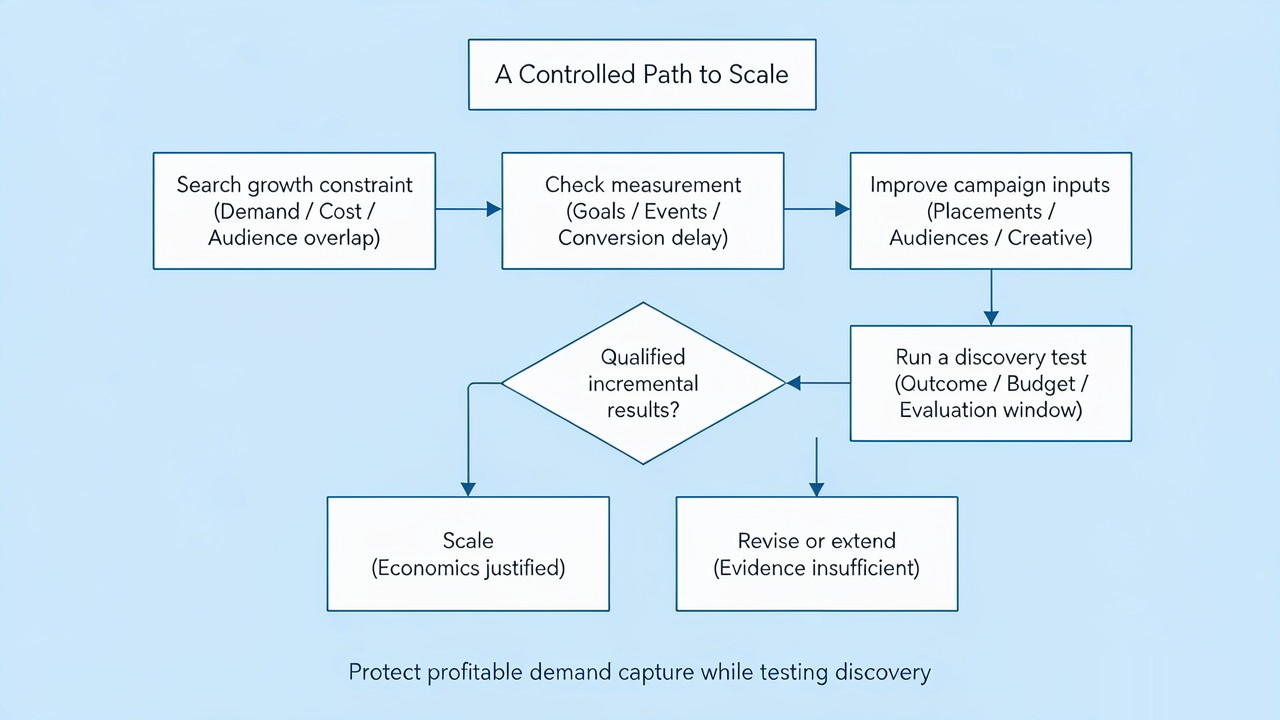
Do not fund Display simply because its CPC is lower. Identify the constraint in the existing mix: limited demand, rising marginal acquisition cost, creative fatigue, or an audience that repeatedly overlaps across campaigns.
Use Performance Max channel reporting to understand where delivery and conversions originate. Google's channel-report troubleshooting guidance explains why average channel ROAS can differ from marginal return. A channel with a weaker historical average may still offer a better return on the next dollar. Channel reports help diagnose allocation; they do not establish causal incrementality by themselves.
Protect efficient demand capture while creating a separately measurable discovery test. Define the outcome, spending limit, evaluation window, and expansion rule before launch.
Use the new budget controls accurately
Google's channel prioritization and budget allocation controls began rolling out progressively on October 15, 2026.
For eligible Search and PMax campaigns, low-priority channels can receive a budget allocation percentage. That percentage is calculated against average daily budget, not actual daily spend. It operates on a best-effort basis rather than as a guaranteed hard cap.
Channel prioritization has no effect when a campaign is not limited by budget, although supported allocation settings still apply. PMax also groups Google-owned surfaces together for prioritization, so these settings do not let you independently rank every surface.
Demand Gen supports channel prioritization, but this allocation feature does not currently support Demand Gen. Use its supported channel controls and campaign budget to structure the test instead.
Verify incremental results before expanding
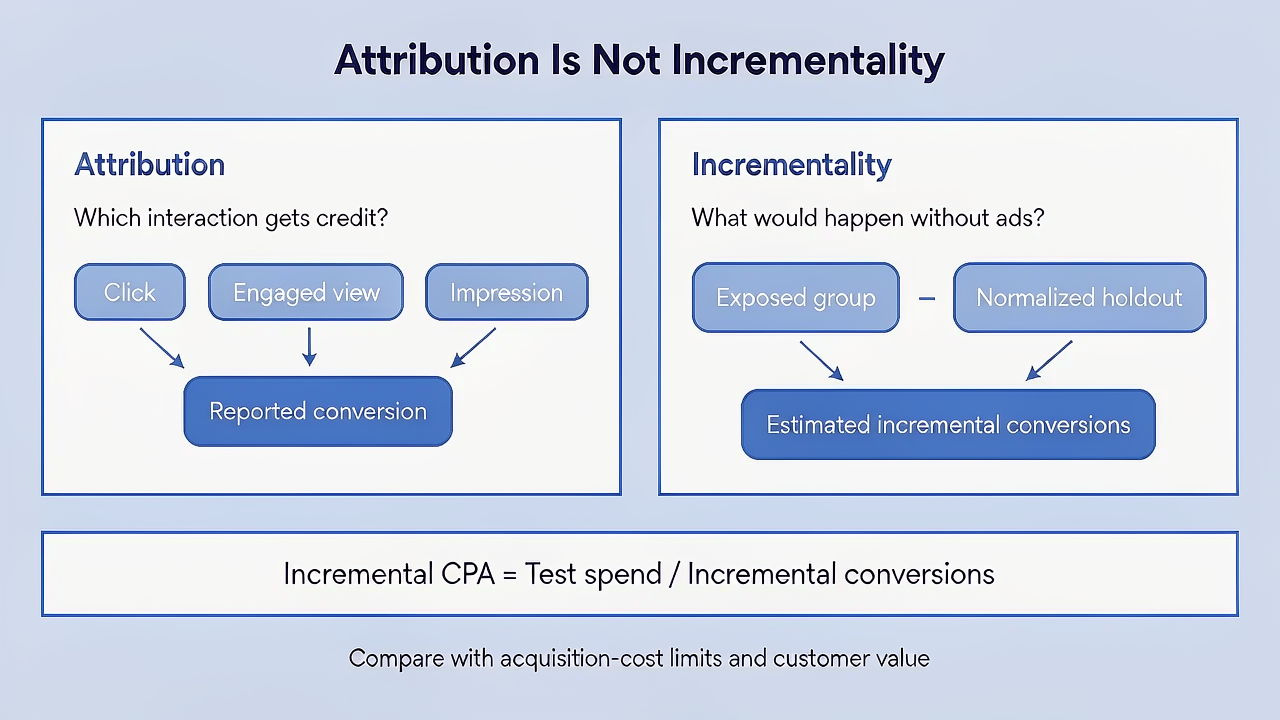
Attribution asks which interactions receive credit. Incrementality asks what would happen without the advertising.
Where available, use Conversion Lift based on users to compare outcomes with a holdout. Google's current setup guidance lists minimum requirements including 1,000 observed conversions and a $5,000 campaign budget for the study, plus compatible conversion tracking. Availability is not universal, so confirm account eligibility and study feasibility first.
A geographic holdout is another option when markets can be compared credibly. Keep other media activity, promotions, and operational changes controlled, then compare total business outcomes. A simple before-and-after comparison cannot isolate advertising from seasonal demand.
Calculate incremental CPA as test spend divided by estimated incremental conversions. For example, an illustrative $3,000 test generating 60 additional qualified customers implies a $50 incremental CPA. Compare that with your acquisition-cost ceiling and customer economics, not just platform-reported CPA.
Scale when the additional outcomes are valuable, evidence is sufficiently strong, and the next budget increase remains economically justified. If results are inconclusive, extend a feasible test or revise the hypothesis rather than declare a winner.
5. Extend the Growth Framework Beyond Google's Existing Audience Pool
Improving Display can uncover headroom inside Google. A broader acquisition strategy tests additional environments when existing audiences, formats, or supply paths constrain growth.
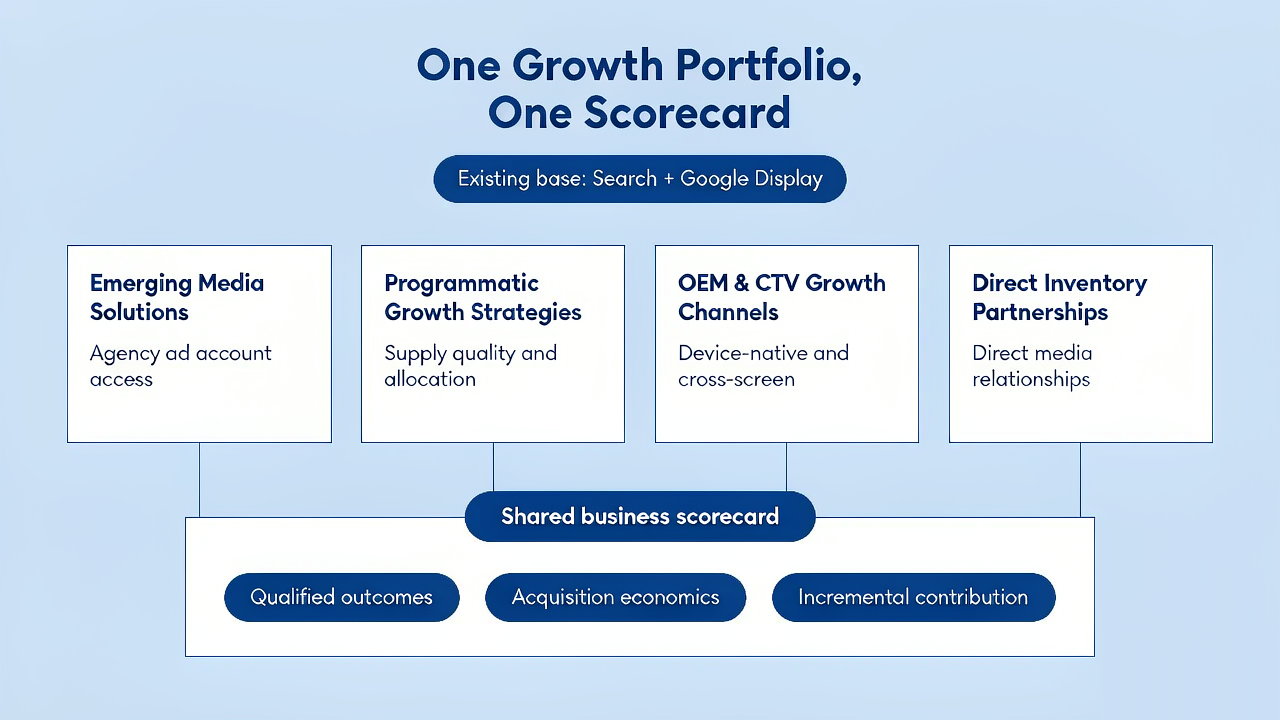
Novabeyond connects that work through four complementary business lines:
Emerging Media Solutions supports access to regional platforms including BIGO Ads, Kwai for Business, Mintegral, and MediaGo. Agency ad account onboarding, professional configuration, localized policy guidance, and optimization support help turn a channel hypothesis into an executable campaign while advertisers retain campaign-management control.
Programmatic Growth Strategies expands buying across global and local media supply through SSPs, exchanges, and publisher partnerships. Traffic intelligence, performance monitoring, and fraud-defense processes support decisions about supply quality and allocation beyond Google's ecosystem.
OEM & CTV Growth Channels adds device-native discovery and cross-screen reach. OEM opportunities include browser, app-store, and recommendation environments; CTV supports large-screen exposure and connected conversion journeys. Choose measurement appropriate to the format instead of forcing every exposure into a click-based comparison.
Direct Inventory Partnerships creates opportunities through direct relationships with apps, publishers, and media owners. Contextual placements, native experiences, and clearer supply paths help advertisers assess where they are buying and which audiences they may reach beyond existing channels.
Apply one commercial scorecard across the portfolio. Match each channel to a defined role, track qualified outcomes, and verify incremental contribution. More platforms only become diversification when they add meaningful reach or better acquisition economics.
Before activating another channel, assign owners for account access, funding, tracking, creative approvals, and reporting. Operational continuity matters because interrupted delivery and inconsistent measurement weaken both optimization and the next budget decision.
FAQ
1. Are Google Display Ads still worth using in 2026?
They are worth testing when relevant reach, qualified outcomes, and acquisition economics support the business objective. Separate prospecting from remarketing, inspect traffic quality, and measure additional outcomes. Cheap impressions alone are not a reason to continue investing.
2. Is Google Display Network being replaced by Demand Gen?
GDN remains available. Google is transitioning Display campaigns into Demand Gen, where advertisers can still choose GDN-only delivery. Migration changes campaign management and supported settings, so review the official migration checklist before transferring an existing campaign.
3. What is a good CTR for Google Display Ads?
Use comparable audience, placement, format, and objective data from your account rather than one universal target. CTR diagnoses creative response, but qualified conversion rate and acquisition economics determine whether the resulting traffic deserves more budget.
4. How should I compare Display with Search and Performance Max?
Compare consistent business outcomes after accounting for conversion delays and event types. PMax includes Search as well as Display, so review channel reporting before interpreting its combined ROAS. Use a controlled experiment to assess whether discovery activity adds business results.
5. Do view-through conversions prove incremental growth?
No. They record a conversion following an eligible impression, not the outcome that would have occurred without advertising. Review them separately from clicks and engaged views, then use lift measurement or a credible holdout to estimate causal contribution.
6. How much budget should move from Search to Display?
Base the decision on Search's remaining headroom and a measurable discovery hypothesis. Protect profitable demand capture, fund a test with clear spending and evaluation rules, and expand only when qualified incremental outcomes justify the additional cost.
Conclusion
Google Display Ads can help a profitable Search program reach beyond existing demand. Sustainable expansion depends on knowing what the campaign buys, which outcomes it measures, and whether those outcomes add customers rather than reassign credit.
Start with conversion quality, strengthen audiences and creative, inspect supply, and test the next budget decision. Novabeyond connects this process with emerging-media access, programmatic buying, OEM and CTV activation, and direct media partnerships, helping advertisers build a broader acquisition system around measurable growth.
more posts
TikTok Ads Rejected? 7 Common Policy Violations and How to Fix Them
November. 05 2026
LEARN MORE


Google Ads Suspended in 2026? How to Appeal and Unblock Your Manager Account
September. 20 2026
LEARN MORE
Swiftproxy Review 2026: Exploring Its Residential Proxy Features and Performance
July. 17 2026
LEARN MORE
Verified Agency Ad Account Provider | Stable Ad Accounts 2026
May. 25 2026
LEARN MORE