





UNIT 616 6/F KAM TEEM INDUSTRIAL BUILDING 135 CONNAUGHT ROAD WEST SAI WAN HONGKONG.
Copyright © 2026 NOVABEYOND LIMITED (company number 2833487). All rights reserved.
Introduction
When acquisition costs rise and established channels deliver fewer incremental users, adding more budget to the same media mix rarely solves the problem. Brands need access to new audiences, stronger inventory options, and a clear way to measure whether additional spending creates real growth.
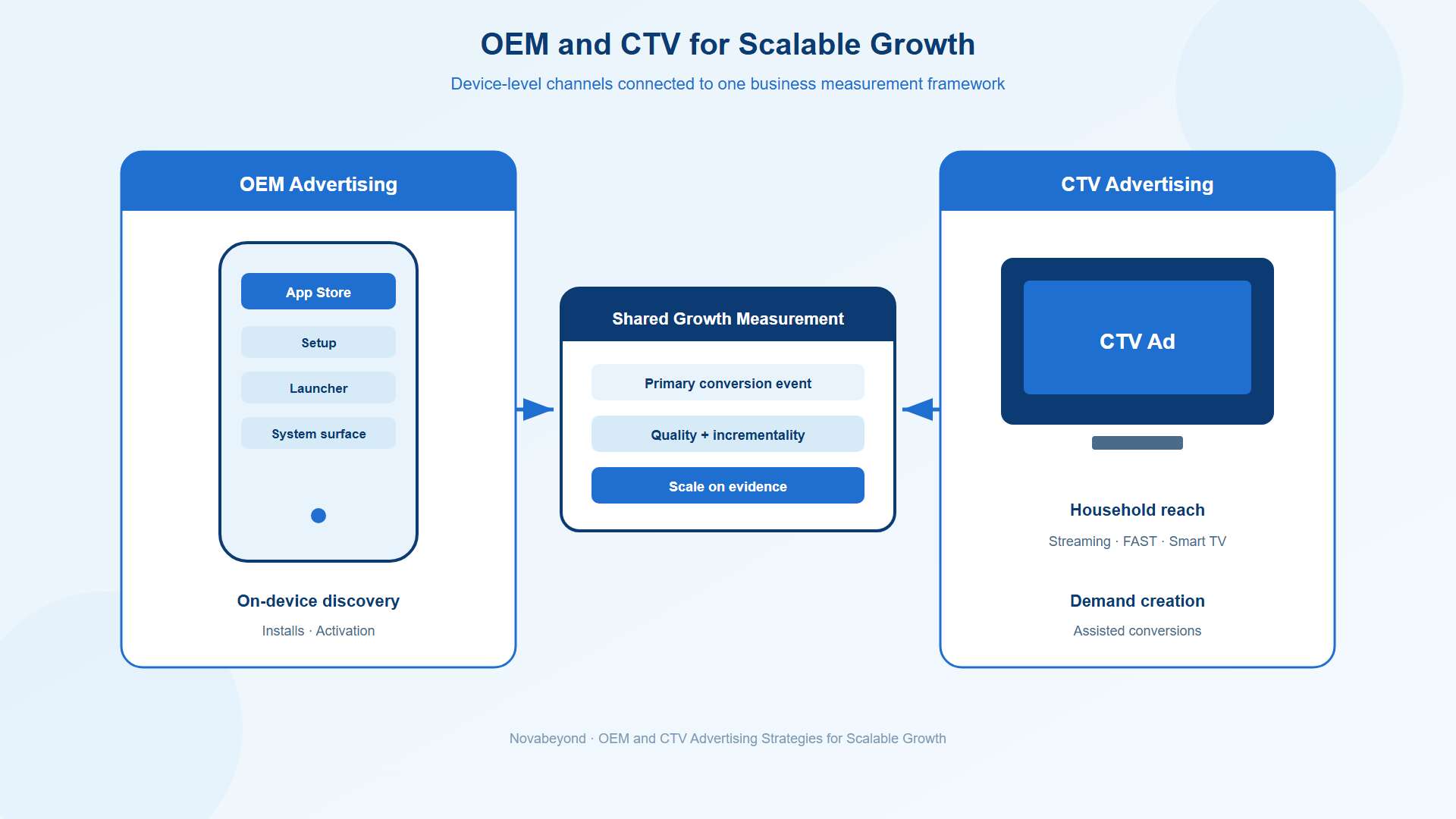
OEM and connected TV (CTV) advertising offer two ways to expand beyond familiar digital placements. OEM advertising connects brands with users through device-level environments, such as manufacturer app stores, setup recommendations, launchers, and other available system surfaces. CTV advertising reaches audiences through internet-connected televisions, streaming applications, and smart TV environments.
These channels serve different roles. OEM can support app discovery, installs, and post-install activation. CTV can build household-level reach, product consideration, and demand that may later convert through mobile or web channels. With the right planning, brands can use both to diversify media supply and develop a more complete acquisition strategy.
However, neither channel guarantees incremental growth. Results depend on inventory quality, market fit, creative execution, measurement design, and the ability to optimize toward meaningful business outcomes.
Novabeyond helps brands explore emerging media opportunities, activate OEM and CTV growth channels, and build performance-oriented media strategies across Emerging Media Solutions, OEM & CTV Growth Channels, Programmatic Growth Strategies, and Direct Inventory Partnerships. Through OEM and CTV, brands can evaluate how device-level inventory fits their acquisition goals instead of treating new channels as isolated experiments.
Explore OEM and CTV growth opportunities with Novabeyond
Quick Answer
OEM and CTV advertising help brands reach audiences through device ecosystems that extend beyond traditional search and social campaigns. OEM placements support on-device discovery and app acquisition through manufacturer-controlled environments. CTV delivers video advertising across connected televisions, streaming apps, and smart TV platforms. Brands can run either channel independently or combine them based on audience, market, and conversion goals. To protect ROI, evaluate OEM by placement-level acquisition quality and post-install value, and assess CTV through reach, assisted conversions, and incrementality testing. Novabeyond helps advertisers evaluate these opportunities and build a channel strategy around measurable growth rather than impressions or low acquisition costs alone.
Understanding OEM and CTV as Distinct Growth Channels
OEM and CTV both expand advertising opportunities through device ecosystems, but they reach audiences in different contexts. Understanding those differences helps marketers assign each channel a clear role in the media plan.
What OEM advertising brings to user acquisition
Mobile OEM advertising places promotional content within smartphone manufacturers' ecosystems. Depending on the manufacturer, market, and available inventory, placements may include:
Manufacturer app stores and app discovery recommendations
Device setup flows and onboarding recommendations
Home-screen launchers, folders, and other discovery surfaces
Manufacturer browsers, notifications, or lock-screen environments where supported
Preload or recommendation opportunities available through specific partnerships
These placements can introduce an app during device discovery or everyday device use. Users may move from a recommendation to an app store or install flow without navigating through multiple external platforms.
OEM can be particularly relevant for brands with mobile apps, subscription products, games, fintech services, or other offerings where installs and subsequent in-app actions contribute to growth. Its value depends on whether the device ecosystem reaches the right audience and whether that audience continues to deliver value after installation.
OEM advertising is not a single uniform inventory category. Placement types can differ in intent, visibility, scale, and post-install quality. An app-store recommendation may produce a different user profile from a notification or lock-screen placement. Marketers should evaluate those surfaces separately rather than treating all OEM traffic as interchangeable. Novabeyond's earlier guide on why brands miss the full potential of OEM advertising explains how device-level placements support smarter app growth when teams treat surfaces as distinct inventory families.
What CTV advertising brings to audience growth
CTV advertising reaches viewers through televisions connected to the internet. Available inventory can include streaming applications, free ad-supported streaming television (FAST) channels, and smart TV operating system environments.
Programmatic buying can give advertisers greater control over audience selection, delivery, pacing, and frequency across eligible inventory. Depending on the buying arrangement, marketers may access private marketplaces, programmatic guaranteed deals, or other curated supply paths.
CTV is useful when a brand needs broader household reach, video-led storytelling, or a way to introduce products to audiences that may not respond to direct-response formats alone. It can also support performance objectives when the campaign includes a defined conversion event and a credible measurement plan.
CTV rarely produces the same direct-click behavior as search or social advertising. Its impact may appear through later app opens, website visits, branded search activity, assisted conversions, or measurable changes in exposed markets.
The channel therefore needs a measurement approach that reflects how people respond to television advertising, rather than relying entirely on last-click attribution.
OEM vs. CTV: Which channel fits your growth objective?
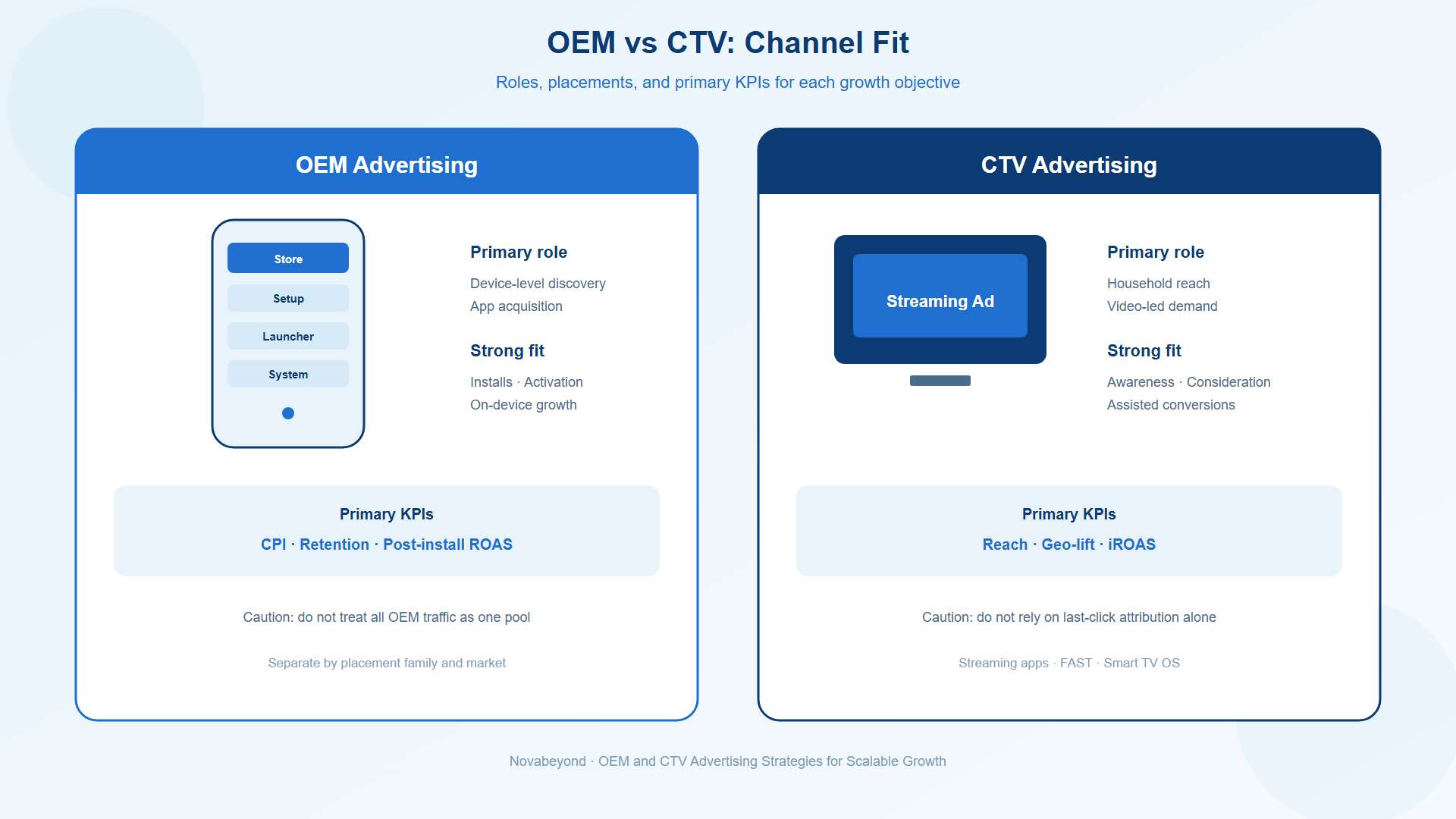
The right choice depends on the campaign objective. An app-first brand may prioritize OEM to build its acquisition base. A consumer brand launching a new product may use CTV to expand awareness and then evaluate downstream activity. Brands with suitable budgets and measurement capabilities can test both channels to understand their complementary value.
| Dimension | OEM advertising | CTV advertising |
| Primary role | Device-level discovery and app acquisition | Household reach and video-led demand |
| Typical placements | Manufacturer stores, setup, launchers, system surfaces | Streaming apps, FAST, smart TV OS environments |
| Strong fit | App installs, activation, on-device growth | Awareness, consideration, assisted conversions |
| Core delivery metrics | CPI, install volume, placement share | CPM, reach, frequency, completion |
| Business proof | Retention, activation, post-install ROAS | Assisted conversions, geo-lift, iROAS |
| Measurement caution | Do not treat all OEM traffic as one pool | Do not rely on last-click attribution alone |
Building an OEM and CTV Strategy Around Business Goals
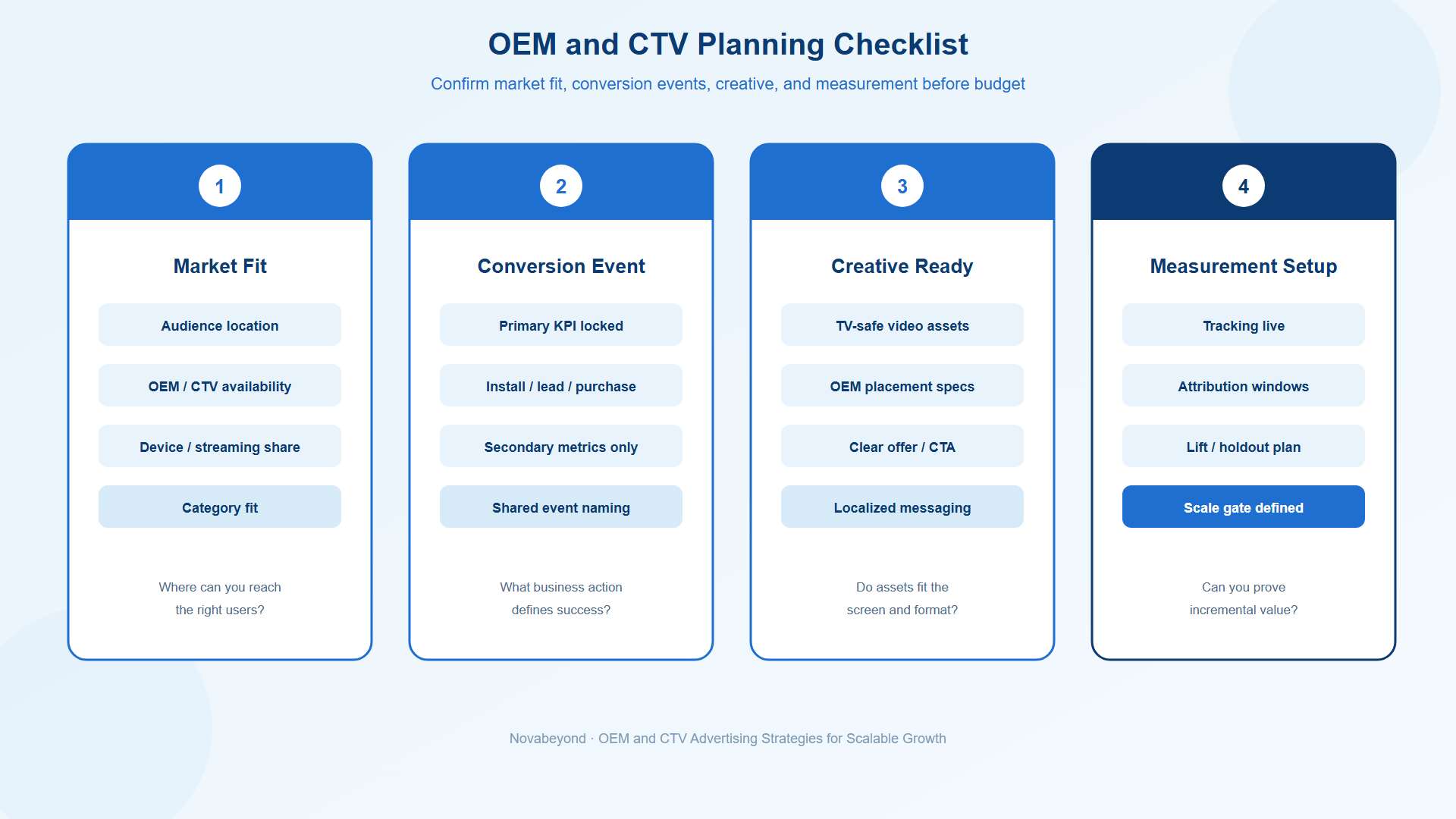
Choosing the channels is only the first step. Advertisers need to define what success means, select suitable inventory, and establish measurement before scaling investment.
Start with market fit and acquisition objectives
OEM and CTV availability varies by market, device ecosystem, audience, and buying arrangement. Before committing budget, assess where your target customers spend time and which environments can reach them effectively.
For OEM, review Android device penetration, manufacturer market share, available placement types, app category, and the potential value of new users. A market with substantial Android usage may present an attractive opportunity, but device share alone does not prove that a specific placement will perform.
For CTV, consider streaming adoption, audience reach, inventory availability, campaign objectives, and the expected path from exposure to conversion. Brands should also consider whether their creative assets suit a large screen and whether their analytics setup can capture meaningful downstream outcomes.
Define a primary conversion event before launch. This could be an app install, registration, subscription, qualified lead, purchase, or another action that reflects business value. Secondary metrics help explain performance, but they should not replace the primary objective.
Select inventory based on quality, not access alone
More inventory does not automatically create better results. OEM and CTV each require their own quality controls.
For OEM campaigns, separate reporting by placement family and manufacturer whenever the data allows. Compare install volume with downstream performance, including registration, retention, purchase behavior, or revenue. This helps identify placements that attract valuable users instead of merely generating inexpensive installs.
For CTV, assess supply transparency, publisher quality, frequency controls, and the buying model. Curated private marketplaces and programmatic guaranteed arrangements may offer useful controls for specific objectives. Open exchange inventory can also play a role, but advertisers should evaluate seller authorization, app transparency, fraud risk, and delivery quality before expanding spend.
Industry growth makes these controls more important. The IAB's 2024 CTV advertising report reported US CTV ad spending of $23.6 billion in 2024, up 16% year over year, and projected further growth in 2025. As investment increases, buyers need stronger processes for distinguishing quality reach from inefficient delivery.
CTV measurement also requires attention to inventory integrity. A 2026 report on detected CTV fraud schemes highlighted a substantial increase in detected schemes. Advertisers should use appropriate pre-bid protections, review supply-chain transparency, and consider independent verification for larger campaigns.
Measure performance beyond surface-level metrics
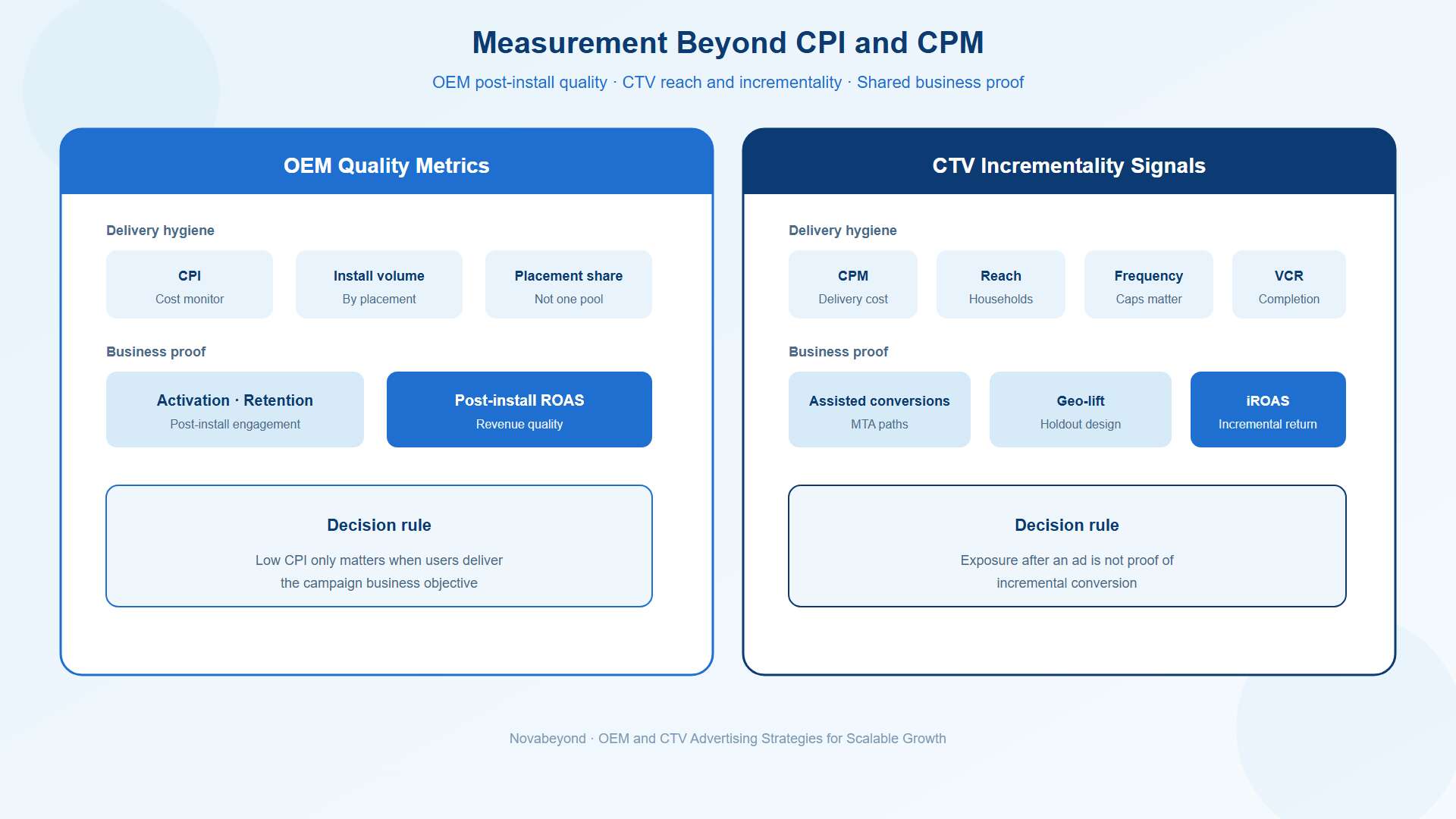
A channel can look efficient in a dashboard while contributing little incremental value. OEM and CTV therefore need different primary metrics, supported by a shared view of business outcomes.
For OEM, CPI is useful for monitoring acquisition costs, but it does not reveal whether users remain active or generate revenue. Track retention, activation, purchase behavior, and post-install ROAS where relevant. Review performance by placement and market to avoid letting high-volume, low-quality traffic distort campaign averages.
For CTV, CPM, reach, frequency, and video completion help assess delivery. They cannot establish whether the campaign created incremental business results. Combine exposure analysis with assisted conversions, appropriate attribution windows, and incrementality testing.
Depending on campaign scale and available data, measurement may include multi-touch attribution (MTA), geographic lift tests, or incremental return on ad spend (iROAS). Novabeyond's guide to measuring CTV ROI with MTA, geo-lift, and iROAS explains how these methods can support more informed budget decisions.
Use the measurement method that fits the campaign. Do not claim that a conversion was incremental simply because it occurred after an ad exposure.
Discuss an OEM and CTV test plan built around your growth goals
Activating and Scaling OEM and CTV with Novabeyond
A channel strategy becomes useful when it translates into a practical plan for inventory access, campaign setup, optimization, and scale. Novabeyond's OEM and CTV offering fits into a broader growth approach that connects emerging media opportunities with programmatic execution and inventory planning.
Step 1: Assess the opportunity before committing budget
Begin with the business objective, target markets, audience profile, and current acquisition mix. Identify where existing channels struggle to deliver incremental reach or acceptable acquisition economics.
For OEM, determine which manufacturer ecosystems and placement families may suit the product and target market. For CTV, assess audience reach, available supply, creative readiness, and the role video should play in the conversion journey.
This assessment should also identify practical constraints, including campaign access, tracking requirements, creative specifications, billing, and launch timelines.
Step 2: Match inventory and buying models to the objective
The most appropriate buying approach depends on the campaign's needs. Programmatic buying can help advertisers manage eligible inventory through audience controls, pacing, frequency management, and reporting. Direct inventory relationships may be useful when brands need specific placements, greater supply clarity, or a particular commercial arrangement.
These approaches should serve a defined objective rather than become goals in themselves. Advertisers should compare available options based on inventory quality, transparency, measurement, and expected business value.
Programmatic Growth Strategies and Direct Inventory Partnerships provide relevant service paths for brands evaluating programmatic execution and direct supply opportunities alongside OEM & CTV Growth Channels.
Step 3: Establish campaign controls and measurement
Before launch, align the campaign brief, creative, conversion events, reporting requirements, and optimization rules.
For OEM, make sure placement-level reporting and post-install event tracking are available wherever possible. For CTV, confirm the buying model, household frequency approach, supply-quality controls, and the method for assessing downstream impact.
If the campaign uses both channels, coordinate the geographic scope, core message, and conversion definitions. This creates a more consistent basis for evaluating performance, even when the two channels have different attribution limitations.
Account setup also matters. Depending on platform access, documentation, billing, and operational requirements, brands may need a brand-owned setup or support through an agency ad account. Agree on ownership, reporting access, and decision rights before the campaign begins.
Step 4: Test, learn, and scale with evidence
Launch with a clear learning objective. Avoid changing too many variables at once, or the team may struggle to identify what drives performance.
For OEM, compare available placement families, markets, and creative variants against acquisition quality and downstream outcomes. For CTV, monitor reach, frequency, delivery quality, and the conversion signals relevant to the campaign. Use a suitable holdout or lift methodology when the budget and design support it.
Scale only when the evidence supports expansion. Stable delivery is necessary, but it is not sufficient. The campaign should also meet its business-performance thresholds, and the team should understand how much confidence to place in the attribution results.
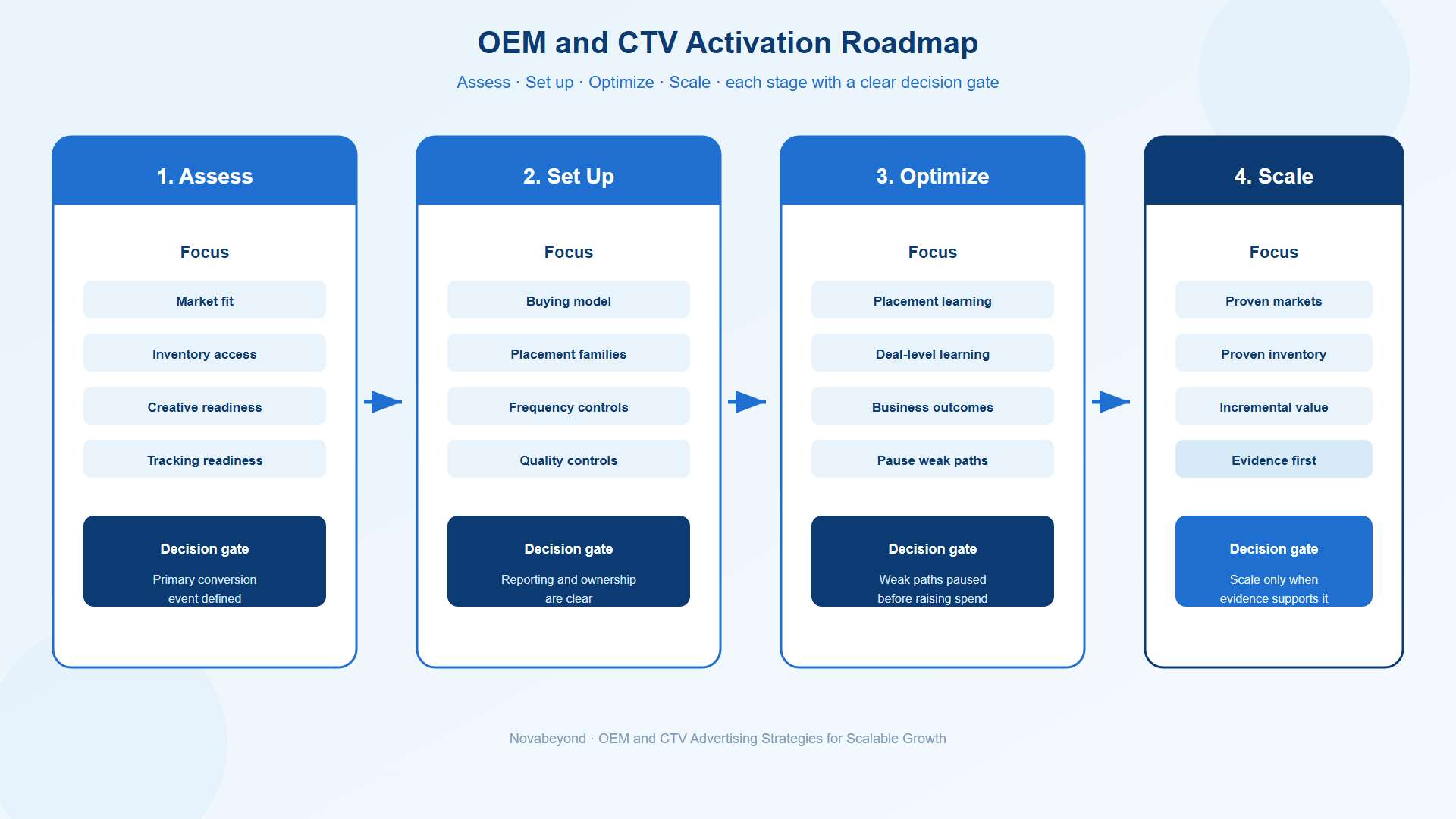
A practical operating framework looks like this:
| Stage | Focus | Decision gate |
| Assess | Market fit, inventory access, creative and tracking readiness | Proceed only when the primary conversion event is defined |
| Set up | Buying model, placement families, frequency and quality controls | Launch only when reporting and ownership are clear |
| Optimize | Placement or deal-level learning against business outcomes | Pause weak paths before raising spend |
| Scale | Expand markets or inventory with proven incremental value | Scale only when evidence supports further investment |
The purpose is not to make OEM and CTV use identical metrics. It is to make both accountable to the same business objective while respecting their different roles in the customer journey.
FAQ
1. What is OEM advertising?
OEM advertising uses advertising or recommendation placements within device manufacturers' ecosystems. Depending on availability, these may include manufacturer app stores, setup recommendations, launchers, browsers, and other supported smartphone surfaces. Brands often use OEM to support app discovery and user acquisition.
2. What is CTV advertising?
CTV advertising delivers ads through internet-connected televisions and their streaming environments. Common placements include streaming applications and FAST channels, with additional opportunities in eligible smart TV operating system environments. CTV supports video-led reach and can contribute to performance objectives when measurement is designed appropriately.
3. Should a brand invest in OEM or CTV first?
Start with the business objective. OEM may be a strong first test for app-focused brands seeking installs and activation in suitable device markets. CTV may fit brands prioritizing video reach, awareness, or consideration. The decision should reflect audience fit, available inventory, budget, creative, and measurement readiness.
4. Can OEM and CTV work together in one campaign?
Yes. CTV can introduce a brand or product to households, while OEM can provide mobile discovery and acquisition opportunities. However, shared exposure does not automatically prove that CTV caused an OEM install. Use consistent conversion definitions and appropriate measurement to evaluate whether the combination adds value.
5. Which KPIs should advertisers use for OEM campaigns?
Track CPI alongside activation, retention, purchase behavior, and post-install ROAS where relevant. Break down results by placement family and market when reporting allows. Low CPI is useful only when the acquired users contribute to the campaign's business objective.
6. How should brands measure CTV performance?
Use reach, frequency, completion, and delivery-quality metrics to monitor execution. For business impact, consider assisted conversions, attribution analysis, geographic lift, or other suitable incrementality methods. The right approach depends on campaign scale, data availability, and the conversion cycle.
7. What should brands prepare before launching OEM or CTV advertising?
Prepare a clear campaign objective, target markets, creative assets, conversion events, tracking requirements, budget, and optimization thresholds. Confirm inventory access and reporting capabilities before launch. For campaigns using both channels, align geographic targeting and the core message where practical.
8. How can Novabeyond support OEM and CTV growth?
Novabeyond offers OEM & CTV Growth Channels as part of its broader advertising services, alongside Emerging Media Solutions, Programmatic Growth Strategies, and Direct Inventory Partnerships. Brands can discuss their growth objectives, channel opportunities, and campaign requirements with the team to determine an appropriate approach to testing and scaling.
Conclusion
OEM and CTV advertising give brands additional ways to reach audiences beyond traditional digital media. OEM supports device-level discovery and mobile acquisition, while CTV expands video reach and can contribute to demand creation. Each channel needs its own inventory strategy, creative approach, and performance metrics.
The strongest strategy starts with a clear business goal, selects inventory based on quality, and measures results beyond surface-level delivery metrics. Brands should test carefully, evaluate incremental value, and scale only when the evidence supports further investment.
Novabeyond helps advertisers evaluate OEM and CTV opportunities within a broader growth strategy that includes Emerging Media Solutions, OEM & CTV Growth Channels, Programmatic Growth Strategies, and Direct Inventory Partnerships. For brands looking to diversify acquisition and build a more disciplined media plan, the next step is to assess which device-level channels fit their markets, audiences, and business goals.
more posts
How OEM Advertising Unlocks App Scale in Emerging Markets
October. 09 2026
LEARN MORE

How to Measure CTV ROI in 2026: From Multi-Touch Attribution to Geo-Lift & iROAS
September. 30 2026
LEARN MORE
Why Most Brands Miss the Full Potential of OEM Advertising — How to Drive Smarter App Growth
August. 24 2026
LEARN MORE
Five Misconceptions About CTV Advertising That Are Holding Growth Teams Back
July. 28 2026
LEARN MORE