





UNIT 616 6/F KAM TEEM INDUSTRIAL BUILDING 135 CONNAUGHT ROAD WEST SAI WAN HONGKONG.
Copyright © 2026 NOVABEYOND LIMITED (company number 2833487). All rights reserved.
Introduction
Facebook marketers entered 2026 with a familiar problem: familiar formats produced less predictable reach, while tactics that generated likes did not always create qualified attention. Blaming one "new Facebook algorithm" is too broad to guide a media plan.
Facebook uses different ranking and integrity systems across Feed, Reels, recommendations, and paid advertising. Meta changes them continuously without publishing universal signal weights. Marketers should focus on content that matches audience interest, earns meaningful interactions, avoids distribution penalties, and informs paid campaigns.
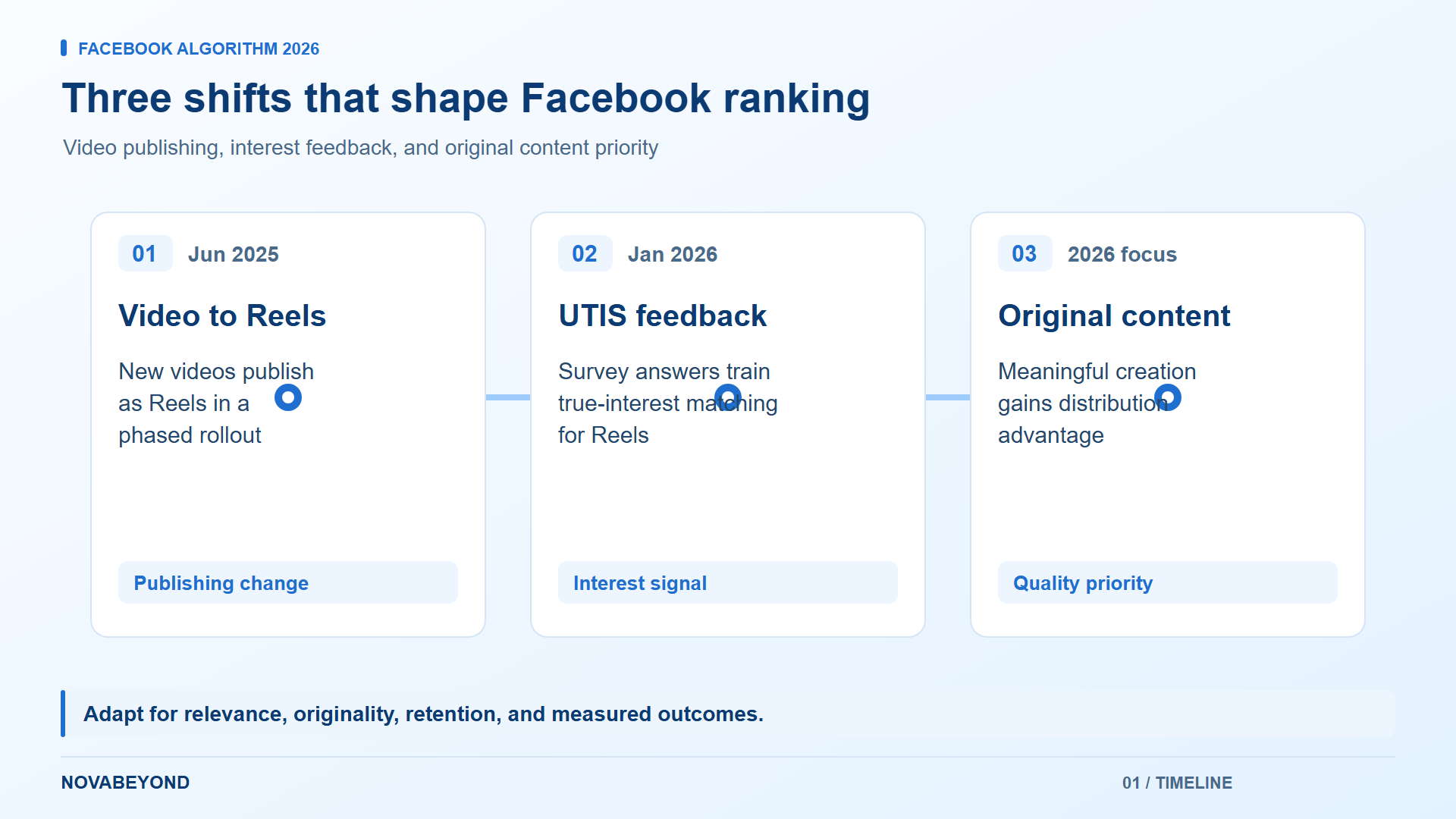
Confirmed Facebook algorithm changes and product updates in 2026 reinforce that direction. Reels now uses direct feedback about viewer interests, Facebook gives original content clearer distribution advantages, and Meta is unifying new video publishing under Reels through a phased rollout. The adaptation priorities are relevance, originality, retention, and disciplined measurement.
Review your Facebook growth plan with Novabeyond
Quick Answer
The Facebook algorithm in 2026 is not one formula. Feed gathers eligible posts, evaluates thousands of signals, predicts which content each person will value, and ranks posts by relevance score. Reels uses a separate recommendation system that considers viewing behavior and direct interest feedback. The most practical response is to publish original content for a defined audience, improve video retention, invite genuine conversation, avoid clickbait and engagement bait, and measure qualified actions rather than likes alone. Marketers should also keep organic ranking separate from paid ad delivery and account integrity, because strong content cannot replace reliable conversion data, policy compliance, or stable advertising operations.
What Changed in the Facebook Algorithm in 2026?
The core Feed ranking process did not suddenly disappear. What changed is the quality of the inputs Facebook can use to judge whether content is relevant, original, and worth a person's time.
Reels now uses direct interest feedback
In January 2026, Meta Engineering described its User True Interest Survey model, or UTIS. Survey responses about how well a video matches viewers' interests train a model that predicts satisfaction.
Interest matching goes beyond topic. Audio, production style, mood, and motivation can influence relevance. UTIS is one Reels ranking input, not a replacement for other engagement signals. Videos predicted to match genuine interests can receive a modest boost, while low-interest matches can be demoted. Passive watch time alone is therefore incomplete.
Build for a recognizable audience need. A niche tutorial, operator explanation, or culturally specific demonstration may align with true interest better than a broad trend clip.
Facebook is unifying new video publishing under Reels
Facebook announced in June 2025 a phased global rollout under which newly posted videos would be shared as Reels. Reels can be short or long and use different orientations. Meta said this publishing change did not, by itself, alter which videos it recommends.
Marketers should use one video system with distinct roles for short hooks, education, expert commentary, demonstrations, and longer explanations. Evaluate each format by retention, completion, qualified engagement, and downstream action.
Original content has a clearer advantage
Facebook's original content guidance prioritizes material created by the publishing Page or meaningfully transformed through new information, analysis, or storytelling. Simple reposts, watermarks, minor edits, or reaction clips without substantive additions may receive reduced distribution. What matters is meaningful added value.
Originality does not require expensive production. Product-in-use footage, operator answers to customer questions, market-specific comparisons, and first-party demonstrations can all qualify.
Low-quality distribution tactics remain a liability
Meta's distribution guidance identifies clickbait, engagement bait, fact-checked misinformation, limited-originality content, and some low-quality experiences as reasons to reduce reach. This is where credible sources and misinformation controls matter. Accuracy, source quality, and promise-to-content alignment protect both trust and distribution.
A strong hook is still useful. A misleading hook is not. The headline, thumbnail, opening seconds, and body should make the same promise. If the creative wins attention but creates immediate exits, hides, or reports, it produces the wrong feedback.
How the Facebook Algorithm Works Across Feed, Reels, and Ads
The phrase "Facebook algorithm" often combines three systems that solve different problems. Separating them prevents bad decisions.
Feed ranking uses four stages
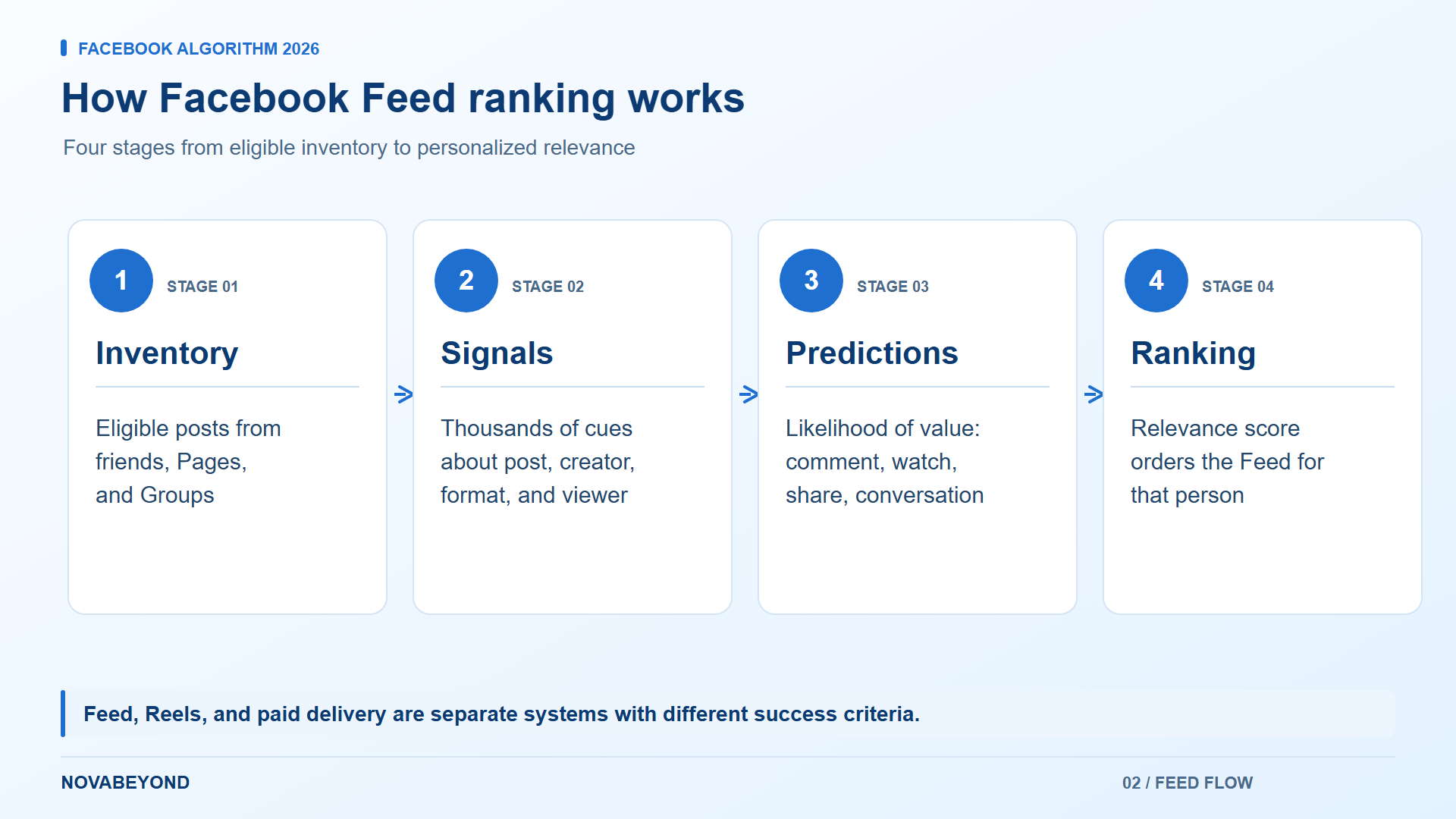
Meta describes connected Feed ranking through four stages:
Inventory: Facebook gathers eligible posts from friends, followed Pages, and joined Groups. Recommended content and ads can be inserted through related systems.
Signals: The system evaluates information about the post, its creator, its format, recency, and the viewer's previous behavior. Meta says it uses thousands of signals.
Predictions: Models estimate whether the viewer will find the post valuable. Examples include the likelihood of commenting, watching, sharing, or having a worthwhile conversation.
Ranking: Predictions are combined into a relevance score. Posts are ordered for that person, with additional rules used to create a balanced mix of content.
Facebook does not publish a fixed weighting table. A comment, view, or share does not have one universal value for every person and post. The system is personalized, and its models change over time.
Reels ranking focuses on video interest and behavior
Reels uses its own models and video-specific outcomes. Watch behavior, skips, completion, interactions, and predicted interest can influence what a viewer sees next. UTIS adds direct feedback about true interest alignment to that process.
This distinction matters for production. Feed posts should earn useful actions and conversation. Reels should also hold attention and feel right for the viewer's interests, preferred style, and viewing context. One asset can appear across surfaces, but the success criteria are not identical.
Paid ad delivery is not organic ranking
Paid campaigns enter an ad auction and use delivery systems, including retrieval systems such as Andromeda, built around the advertiser's objective, estimated action rates, ad quality, available conversion signals, and other auction inputs. Organic reach does not automatically improve because an advertiser uses a particular account type. Likewise, an engaging Page post does not repair poor event quality or a policy restriction.
The operating model should keep three questions separate:
System | Primary decision | Signals marketers can improve | Common mistake |
Feed ranking | Which connected or recommended post should appear higher? | Relevance, useful interaction, creator-viewer history, content quality | Chasing likes without measuring value |
Reels recommendations | Which video best matches this viewer's interests? | Originality, interest match, retention, completion, shares, feedback | Reposting generic trends without audience fit |
Paid ad delivery | Which eligible ad should win and serve against the objective? | Creative quality, conversion data, offer, campaign structure, policy compliance | Treating an account or budget change as an organic ranking tactic |
When paid operations are the bottleneck, use a dedicated Facebook agency ad account setup guide rather than turning an organic algorithm strategy into an account-opening exercise. For policy and integrity issues, the Meta policy and product updates guide addresses a different search job.
Which Engagement Patterns Matter for Reach and Virality?
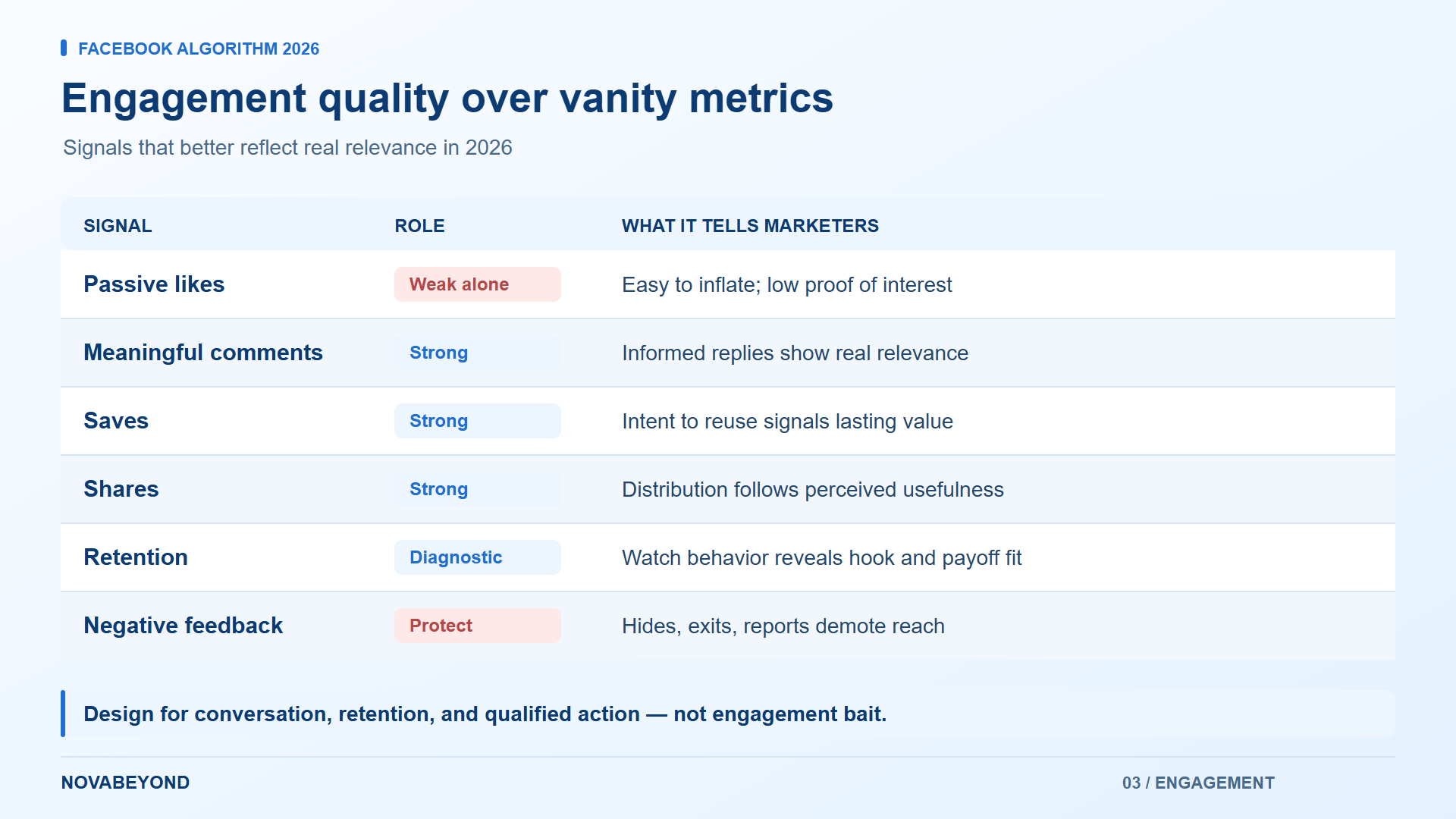
The strongest Facebook engagement patterns indicate real relevance. Meta's public material emphasizes predicted value, conversation, video interest, and negative feedback, not a fixed formula that assigns universal weights to actions.
Design for meaningful interactions
"Meaningful interactions" are not requests for comments. Give people a reason to respond, save, share, or keep watching. Useful formats include product demonstrations, buyer comparisons, actionable operator lessons, permission-based customer stories, market Q&As, and polls that produce useful insight.
Avoid prompts created only to inflate activity. "Comment yes" and "tag three friends" can resemble engagement bait. Specific questions that invite informed answers create better discussion and audience research.
Treat retention as a creative diagnostic
Short-form video needs a strong opening, concise message, legible visuals, and clear payoff. Early exits can indicate a weak or mismatched opening; retention without action may indicate a missing next step.
Track retention by format and audience segment. Compare tutorials with product stories, creator-led with brand-led clips, and localized with global edits. Use the shortest structure that fully delivers the promised value.
Virality is an outcome, not a planning model
Queries about Facebook algorithm trends 2026 for virality reflect marketer interest, but "going viral" is not a controllable campaign objective. Wider distribution usually follows a combination of relevance, original value, viewing behavior, sharing, conversation, and low negative feedback.
Plan for repeatable qualified reach instead. A niche video that attracts the right prospects and becomes a paid creative input can be more valuable than a broad clip that produces no commercial action. Novabeyond's Facebook content strategy best practices guide explains how to turn those content signals into a repeatable creative system.
Ask Novabeyond to connect content signals with a measurable media plan
How Marketers Should Adapt Their Facebook Strategy
A useful adaptation plan connects content, audience, paid media, localization, compliance, and measurement without relying on unconfirmed assumptions.
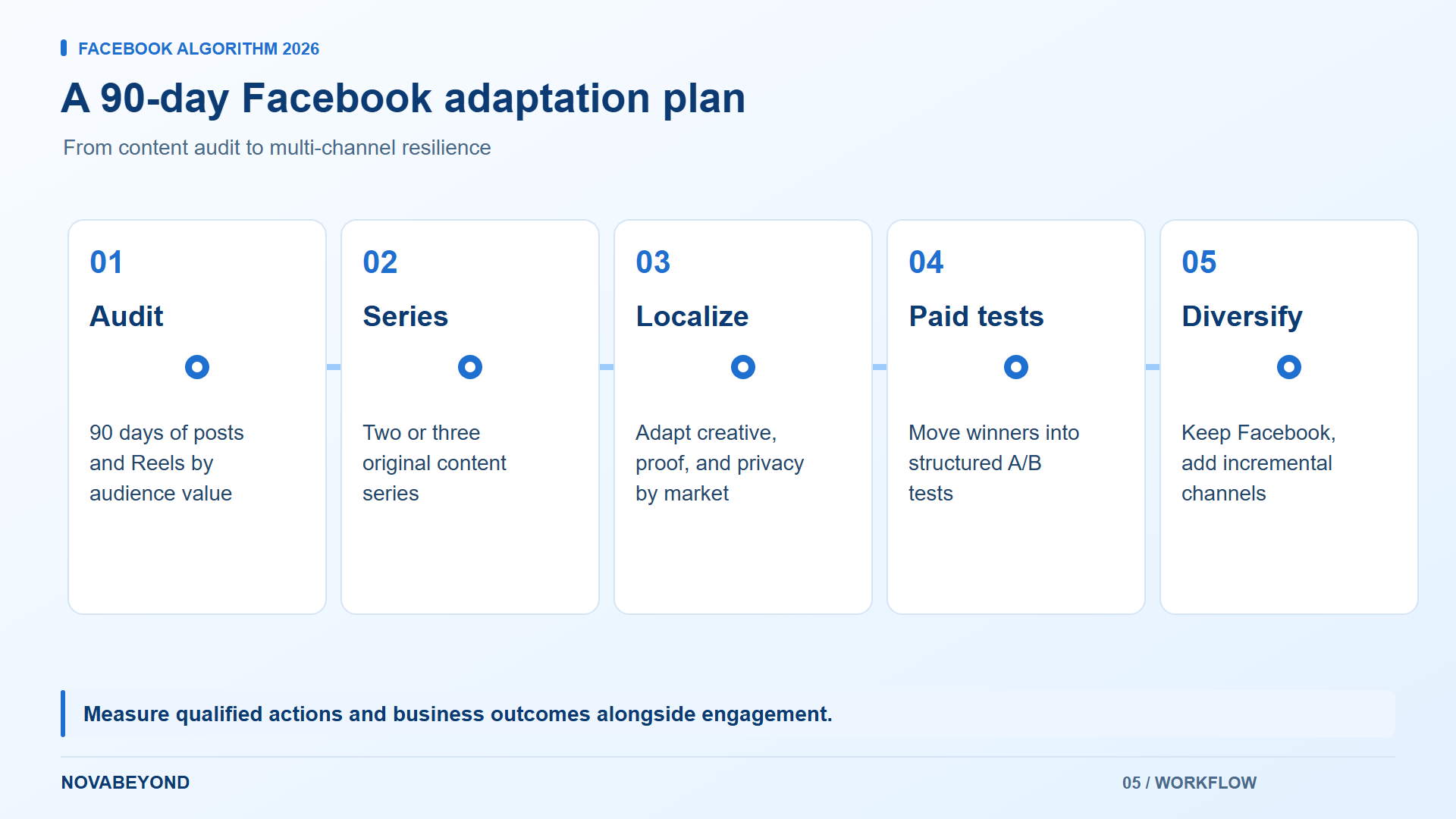
1. Audit content by audience value
Review at least 90 days of posts and Reels. Group assets by topic, format, audience, market, and funnel role. Compare follower and non-follower reach, watch time, completion, useful interactions, site actions, lead quality, and available negative signals. Keep formats that repeatedly create audience or business value.
2. Build original content series
Create two or three recurring series around audience problems. An e-commerce team might use product demonstrations, market-specific buying guides, and operator answers. A B2B team might explain benchmarks, implementation mistakes, and client-safe lessons.
Visual storytelling, augmented reality, product trials, polls, quizzes, and live formats can improve comprehension, but none guarantees an algorithm boost. Each still needs a clear audience, credible information, and a useful outcome.
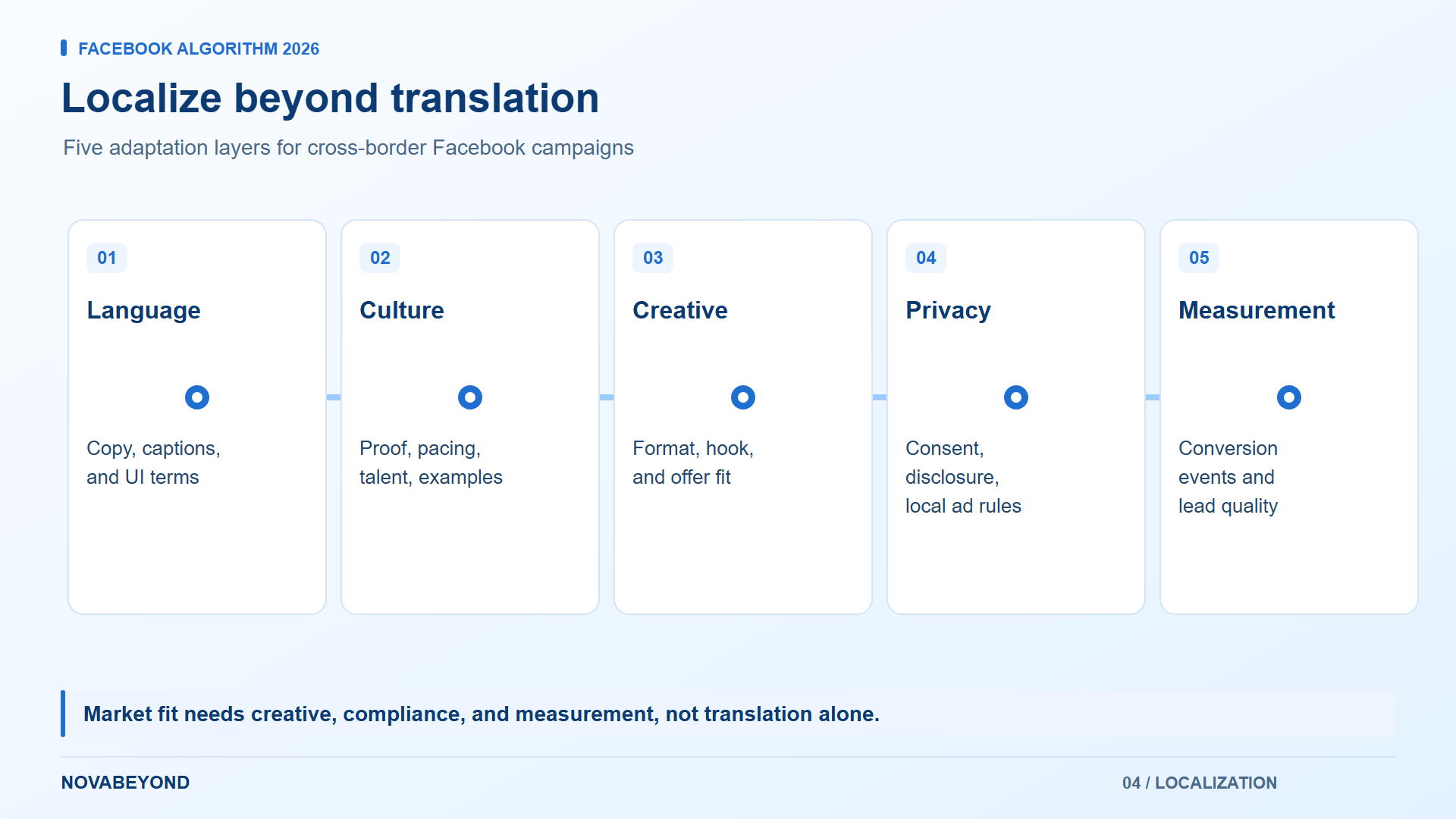
3. Localize cross-border campaigns beyond translation
International campaigns need more than translation. Local behavior, cultural nuance, platform habits, regulations, and offer expectations can change performance. Adapt examples, proof points, pacing, talent, calls to action, and landing pages by market.
Facebook commerce and advertising tools can support discovery or conversion when available, but they require a privacy-compliant plan. Obtain appropriate consent, explain data collection, maintain accurate disclosures, and review local advertising and privacy requirements.
4. Connect organic learning to paid testing
Move proven organic concepts into paid testing without assuming results will transfer. A discussion-led post may need a clearer offer, while a high-retention Reel may need a different opening for cold audiences.
Test one meaningful variable at a time: hook, proof point, format, audience, or offer. Evaluate engagement, conversion rate, return on ad spend, audience growth, and retention together. Each A/B test should produce a decision.
Novabeyond's analysis of Meta Ads campaign structure provides a useful companion when organic creative is ready for paid scaling.
5. Build resilience beyond a single platform
Facebook can remain a core acquisition channel, but algorithm changes, policy reviews, rising competition, and audience overlap create concentration risk. Novabeyond helps advertisers connect mainstream media learning with Emerging Media Solutions, OEM & CTV Growth Channels, Programmatic Growth Strategies, and Direct Inventory Partnerships.
The purpose is not to abandon Facebook. It is to use Facebook signals more intelligently while building additional sources of incremental reach and reducing platform dependency.
FAQ
1. What changed in the Facebook algorithm in 2026?
The most concrete 2026 change is Meta's deployment of the UTIS model for Facebook Reels, which uses survey feedback to estimate whether a video genuinely matches a viewer's interests. Facebook also clarified how original content receives priority while low-value reposts can lose distribution. The core Feed process of inventory, signals, predictions, and relevance scoring remains the useful official framework.
2. How does the Facebook algorithm work in 2026?
Facebook gathers eligible content, evaluates signals about the post and viewer, predicts which actions or experiences are likely to be valuable, and ranks content by a personalized relevance score. Reels and Feed use related but separate systems. Meta does not publish exact signal weights or a universal formula.
3. Does Facebook prioritize Reels over other content?
Facebook announced a phased rollout to unify new video publishing under Reels. That publishing change does not by itself prove that Reels receives automatic ranking priority. Video has major discovery potential, but the best format still depends on what a specific audience finds valuable.
4. Which Facebook engagement patterns matter most?
Useful comments, shares, saves, retention, completion, follows, and negative feedback are valuable performance indicators that may reflect genuine interest. Marketers should interpret them in context rather than assigning an invented universal weight to each metric.
5. How can a brand improve Facebook reach without engagement bait?
Publish original content that solves a defined audience problem, use a clear opening, deliver the promised value, and ask specific questions that invite substantive replies. Build recurring series, respond to useful comments, and use performance data to improve the next post.
6. How should cross-border marketers adapt Facebook content?
Localize the audience insight, creative format, cultural references, proof, offer, and landing experience. Review user consent, data protection, advertising law, intellectual property, and platform availability in each market. Translation alone does not create local relevance.
7. Does paid ad performance affect organic Facebook ranking?
No direct ranking relationship has been established. Organic Feed and Reels ranking are separate from paid ad delivery. Paid performance can still reveal useful audience and creative insights, but it does not create an automatic organic ranking advantage.
Conclusion
The Facebook 2026 algorithm rewards no single hack. Feed ranking still depends on personalized predictions and relevance. Reels now includes an explicit predicted-interest input based on survey feedback. Original content receives clearer priority, while clickbait, engagement bait, misinformation, and low-value reuse can restrict distribution.
The practical response is to define the audience, create original content series, improve retention and conversation, localize for each market, connect organic learning to paid tests, and measure business outcomes alongside engagement. That approach addresses the practical questions behind Facebook algorithm changes in 2026 and gives working marketers a plan they can execute.
Novabeyond helps brand marketers, media buyers, and growth teams connect platform strategy with measurable multi-channel growth.
Talk to Novabeyond about a more resilient global growth plan
more posts
TikTok Ads Rejected? 7 Common Policy Violations and How to Fix Them
November. 05 2026
LEARN MORE

Google Ads Suspended in 2026? How to Appeal and Unblock Your Manager Account
September. 20 2026
LEARN MORE
Swiftproxy Review 2026: Exploring Its Residential Proxy Features and Performance
July. 17 2026
LEARN MORE
Verified Agency Ad Account Provider | Stable Ad Accounts 2026
May. 25 2026
LEARN MORE